Preventing Telecom Failures Through AI Anomaly Detection in Smart PDUs

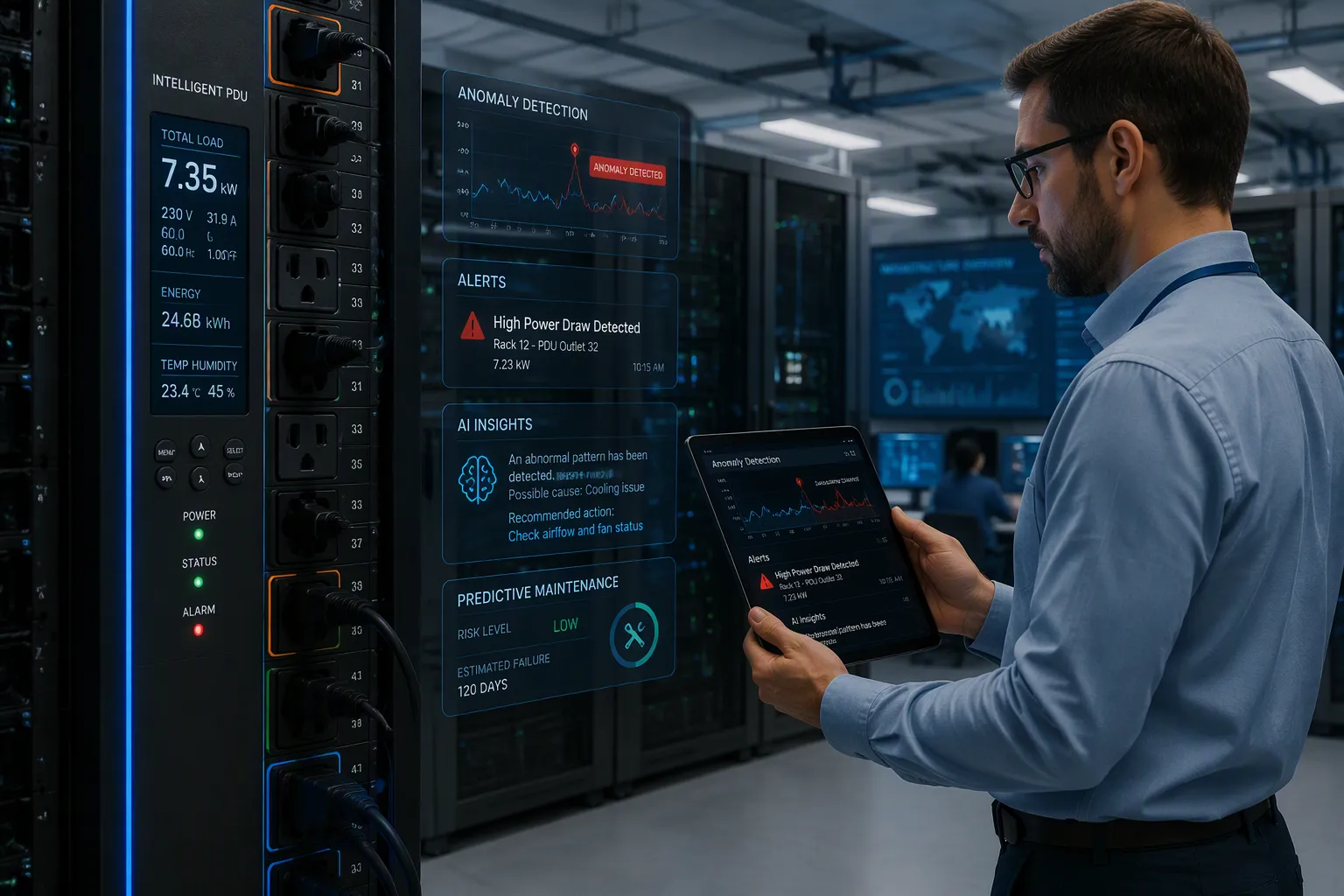
AI anomaly detection in a smart PDU catches minor power fluctuations early. This early warning stops small issues from escalating into cabinet-level outages. You face real stakes here. Telecom downtime can cost $2 million to over $6 million per hour, and service-level commitments leave little room for error. Fixed thresholds miss subtle power fluctuation drift. Minor fluctuations hide in normal operation. A slow voltage sag or a small current imbalance stays under the alarm limit until damage begins. Catching problems at this stage demands continuous telemetry from the unit and models tuned to normal behavior. The sections below explain how the technology works, where it fits, and how to roll it out.
Key Takeaways
AI anomaly detection catches small power problems early. This prevents big outages and saves money.
Smart PDUs provide detailed power data. This data helps AI models learn normal behavior and spot issues.
AI models find subtle changes that fixed thresholds miss. This gives you time to fix problems before they grow.
Integrate AI alerts into your existing workflows. This makes your team respond faster and trust the system.
Start with a pilot on key assets. Then scale up with a repeatable plan for all sites.
Smart PDU Telemetry in Telecom Cabinets
Core Monitoring Capabilities
A smart PDU turns a passive power strip into a sensor array. Take ESTEL's Smart Power Distribution Unit as a working example. It offers remote management, LCD real-time monitoring, surge protection, and a dehumidifying function. You can specify 8 to 19 outlets, a 16A maximum input current, and IEC60309-compliant plugs. Each feature produces a continuous stream of readings rather than a single on/off state.
That stream covers more than amps and volts. Modern power distribution units also report active power, apparent power, power factor, and breaker status. Environmental channels add temperature, humidity, airflow, water leaks, and vibration. Security and system-health channels track door access, battery health, and fuse status. The table below groups the main categories.
Category | Telemetry Parameters Measured |
|---|---|
Electrical | Current, voltage, power usage, active power, apparent power, power factor, breaker status |
Environmental | Temperature, humidity, airflow, water leaks, vibration |
Security / Access | Door access |
System Health | Battery health, fuse status |
Why Granular Power Data Matters
Anomaly models learn from data quality, not data volume. Clean, structured, standardized readings give a model a reliable baseline. Small data errors can produce wrong predictions, especially when the anomaly is subtle. Granular rack-level pdu telemetry solves this problem at the source. Outlet-level metering captures consumption at the individual device level, so the model sees which load moved, not just that the total shifted.
This granularity changes what power monitoring can prove. Metered PDUs log power events and irregularities at a fine level. You can run trend analysis, troubleshoot a fault, and compare pdu load trends across cabinets before a fault escalates. The same data feeds PUE calculation and stranded-capacity detection through SNMPv3, Modbus TCP, or RESTful APIs. For any data-center power-delivery equipment, that raw layer is what separates early warning from a post-mortem.
How Power Fluctuation Escalates into Failure
Blind Spots of Threshold Alarms
A fixed threshold only catches the exact condition it was written for. Failure modes that develop through a combination of readings never cross a single limit, so they stay invisible. A subtle mix of slightly elevated vibration, slightly lower flow, and slightly higher temperature can signal developing equipment failure long before any single reading crosses a threshold. The same logic applies to power distribution anomalies inside a cabinet.
Static limits also age poorly. Equipment wears, seasons change, and product mixes shift, yet a threshold set at commissioning is rarely revisited. A motor under varying load produces different current signatures at each operating point. A system that ignores this raises false alarms whenever the load shifts, and that erodes trust in every alert. Gradual degradation below the alarm level goes unnoticed until the fault is advanced. Small degradation trends therefore demand a model that learns normal behavior rather than a rule that waits for a limit.
The Cost of Late Detection
Power problems in telecom cabinets rarely begin as outright failures. They start as voltage fluctuations and intermittent module reboots, traced to messy wiring, loose terminals, and incomplete grounding. Left alone, the same root causes escalate into complete power outages, and in ESS cabinets into arcing and electric-shock hazards.
The financial toll of late detection dwarfs the hardware. Replacing a cabinet often costs less than the network interruption it causes. Service-level penalties, emergency repair work, customer complaints, traffic diversion, and loss of public-safety communications can dominate the final loss. Live telemetry lets maintenance supervisors schedule repairs before minor component issues become severe hardware breakdowns. That shift from reactive repair to planned intervention protects both uptime and field-team workload.
Inside AI-Driven Predictive Maintenance
Machine Learning Models for Pattern Recognition
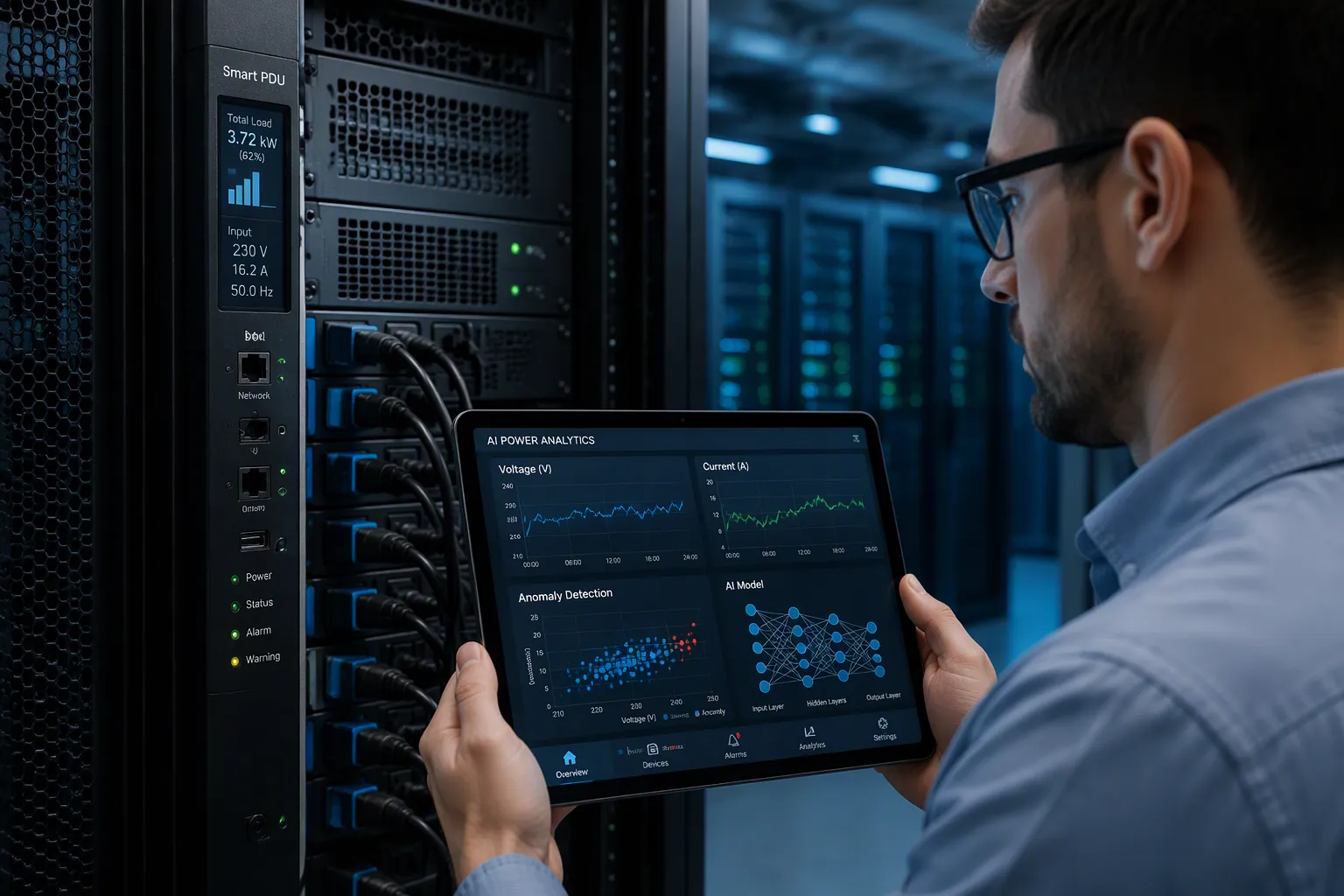
A model needs a definition of normal before it can spot trouble. You build that baseline from voltage, current draw, and phase balance readings collected over weeks of healthy operation. The model learns the shape of everyday load cycling, the daily rhythm of traffic, and the natural spread between phases. Once trained, it compares each new reading against that learned pattern and flags deviations.
Isolation Forest suits this job well. The method isolates outliers through recursive random partitioning. At each node it picks a feature and a split value at random. Anomalous points are few and different, so they get isolated after fewer splits and produce shorter path lengths than normal points. This makes the method efficient at separating outliers from the majority of data.
Autoencoders take a different route. They compress the input into a representation and decode it back. High reconstruction error after training on normal behavior signals an anomaly. The table below shows where each method fits.
Capability | Isolation Forest | Autoencoder-based Deep Learning |
|---|---|---|
Effective in high-dimensional spaces | Yes | — |
Handles non-linearity | Yes | — |
Tunable margin | — | Yes |
Robust to noisy data | — | Yes |
Scalability | Yes | — |
Ease of interpretation | Yes | — |
Feature learning | — | Yes |
Autoencoders capture complex, nonlinear dependencies and sometimes need fewer computing resources. An ensemble-of-autoencoders model for IoT botnet detection reached a 100% true positive rate with only a 7% false positive rate on a testbed of nine commercial IoT devices. Gradient boosting and Transformer-GAN models round out the toolkit. Self-learning mechanisms let the system update its baseline as equipment ages. PHM techniques add remaining-useful-life estimates by combining current health state with anticipated future loading.
PHM develops sensor hardware and algorithms to detect anomalies, diagnose the problems causing those anomalies, and compute a probability distribution of time to failure.
ESTEL Smart PDU data streams fit this input layer well, though field results depend on your site conditions.
Real-Time Analysis and Model Refinement
Real-time analysis acts on live data. Machine-learning anomaly detection algorithms process sensor readings as they occur, without extra preprocessing. Anomalies get flagged faster and more precisely. Monitoring electrical parameters in real time catches unexpected changes early, and direct extraction from measured data boosts detection accuracy while enabling quick alerts.
Refinement sustains that accuracy over time. Clean, structured, standardized data keeps models accurate, since even small data errors can cause wrong predictions when anomalies are subtle. Regular refinement as more data arrives lets the system adapt to new patterns. Your ai predictive maintenance stack should treat model updates as routine maintenance, not a one-time project. That discipline separates a working predictive maintenance system from a dashboard nobody trusts.
Predictive Failure Detection in Practice
Fit Across Cabinet Types and Sites
Predictive failure detection adapts to the cabinet you run, not the other way around. Telecom operators support edge data centers and distributed network nodes, and each site type produces its own load signature. A compact cabinet serving a remote node cycles differently from a dense rack in an edge facility. Failure prediction models learn each baseline separately, so a model trained on one site does not travel blindly to another.
Site conditions shape the tuning. Remote cabinets face wider temperature swings and less frequent inspection. Dense sites generate faster pdu load trends and tighter phase balance. You set sensitivity per site, then let the predictive maintenance system compare each cabinet against its own history. This approach keeps detection sharp across a mixed estate without drowning your team in alerts from sites that simply behave differently.
Integration with Existing Workflows
Integration succeeds when you build it into existing pipelines rather than bolt it on. Connect anomaly detection to maintenance platforms, dashboards, and ticketing systems so alerts land where your team already works. Give engineers a clear reason for every alert and the signals behind it. Keep human review for critical decisions, and review models whenever equipment or operating conditions change.
Expect friction at the seams. Legacy power and management systems each demand their own interoperability solution, and you must align communication protocols, management software, and physical interfaces at the same time. Plan for that engineering effort early.
To effectively integrate anomaly detection into existing data pipelines, organizations should consider a set of best practices — underscoring that deliberate integration into existing pipelines (rather than bolt-on deployment) is itself a key success factor.
Treat ai predictive maintenance as routine operations. Watch for power fluctuations that signal security problems as well as equipment wear, and manage false positives before they erode trust in the system.
Benefits and Rollout for Predictive Maintenance for Data Centers
Operational and Cost Advantages
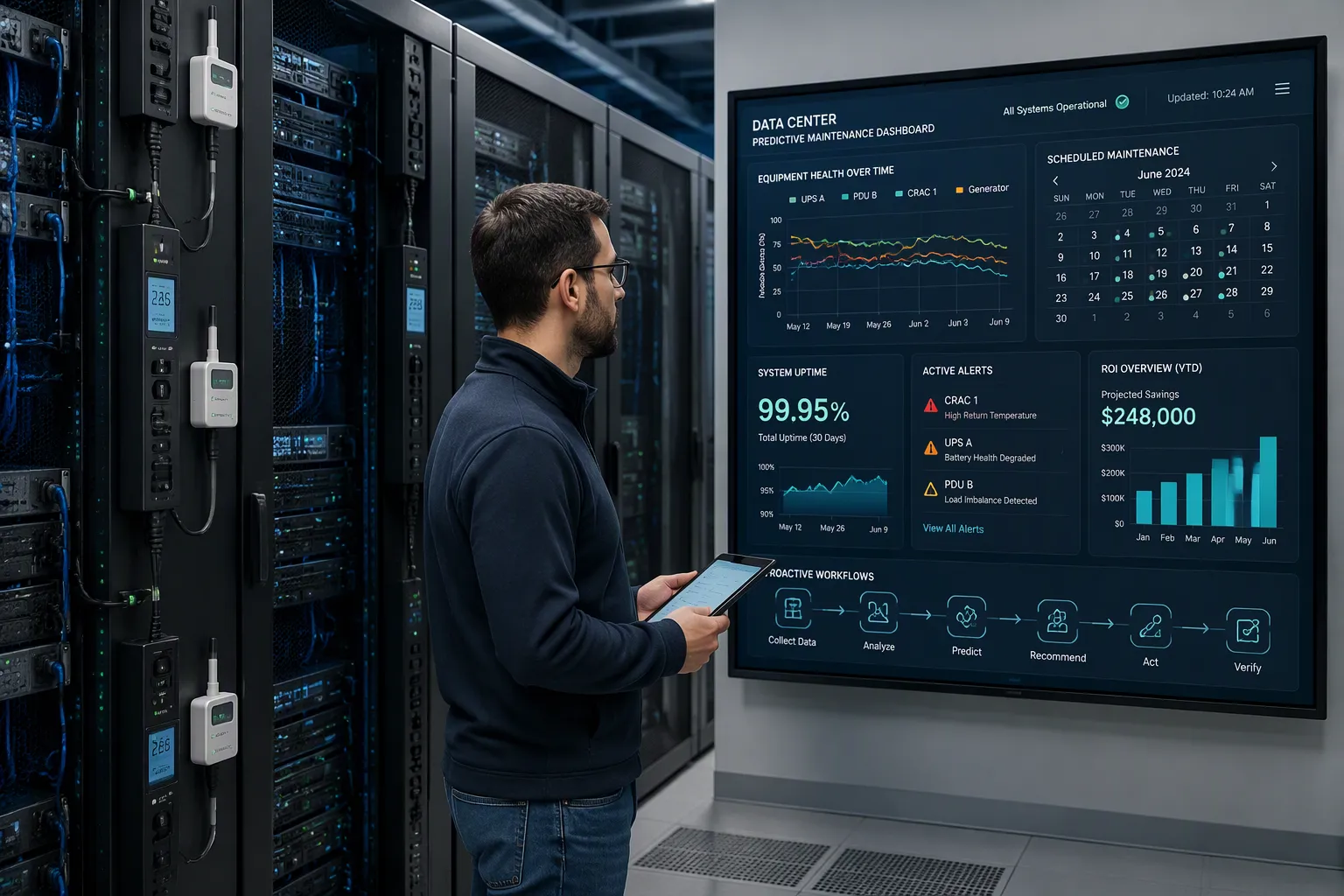
Predictive maintenance for data centers pays you back through fewer surprises. You take equipment offline right before an anticipated failure, so you avoid unnecessary maintenance and extend the asset lifecycle. Continuous monitoring also lowers power consumption and keeps you compliant with safety regulations. Budget planning gets easier too, because predicted maintenance models give you a schedule instead of a scramble.
The financial case is measurable. Organizations report up to 18–25% lower overall maintenance cost versus traditional approaches and 30–50% less unplanned downtime. ROI arrives within 12–18 months at a ratio of 10:1 to 30:1. About 95% of organizations report positive returns, and 27% achieve full payback within the first year. One caution: up to 30% of preventive maintenance tasks may be unnecessary, adding cost without reliability. A predictive maintenance system trims that waste by focusing effort where the data points.
Steps to Deploy AI-Enabled Smart PDUs
Start with a pilot. Pick one or two priority assets per facility, ideally those tied to costly downtime or known failure modes. Deploy IoT sensors for real-time data collection, then apply predictive analytics to learn patterns from historical maintenance logs. Integrate the output into your existing systems and establish proactive workflows. Automate alerts and remediation, such as automatic power redistribution when a UPS degrades, and test the models against new failure patterns.
Scale with discipline. Define enterprise-wide standards for tools, sensors, KPIs, and alert protocols, yet let each site control execution. Appoint a lead at every facility and track cross-site uptime on a centralized dashboard. Calibrated sensors and consistent placement matter, because noisy data causes false alarms. Pair historical records with live streams, validate models to prevent overfitting, and keep feedback loops running. This approach turns a smart pdu pilot into a repeatable playbook, and it keeps detection sharp as you add sites.
Early detection of minor fluctuations gives you the cheapest path to preventing major telecom failures. You catch drift while it is still small, and you act before a cabinet-level outage begins.
Start with granular PDU telemetry. Adopt AI models tuned to each site environment. Then integrate alerts into the operations your team already runs. That sequence turns raw readings into decisions.
You can scale this approach across sites with a repeatable playbook. ESTEL supports that rollout with smart PDUs and practical guidance at every stage.
AI-driven insight turns subtle signals into reliable uptime. Small warnings become planned repairs, and planned repairs keep your network running.
FAQ
What exactly does AI anomaly detection add to a smart PDU?
It adds a learned baseline of normal behavior. The model studies voltage, current draw, and phase balance over time. Each new reading then gets compared against that pattern. Fixed thresholds wait for a limit. A learned baseline notices drift while readings still look ordinary.
Does AI detection replace my existing threshold alarms?
No. Keep your threshold alarms as a safety net. They catch hard limits fast. AI models cover the subtle, multi-signal drift that limits miss. Run both layers together. The threshold handles the obvious fault, and the model handles the slow trend.
What data and protocols does the system need?
You need continuous telemetry from the PDU. ESTEL's Smart PDU provides LCD real-time monitoring, remote management, and 8 to 19 outlet configurations with a 16A maximum input current. Export that data through SNMPv3, Modbus TCP, or RESTful APIs into your monitoring stack.
Will the system flood my team with false alerts?
It can, if you skip tuning. Set sensitivity per site, because remote cabinets and dense racks behave differently. Review models whenever equipment or conditions change. Clean, standardized data also matters, since small data errors produce wrong predictions when anomalies are subtle.
How long before the investment pays back?
Evidence from predictive maintenance programs points to a 12–18 month ROI window, with reported maintenance cost reductions of 18–25% and 30–50% less unplanned downtime. Start with a pilot on one or two priority assets, then scale once the workflow proves itself.
See Also
Ensuring Consistent Power Delivery for Telecom Cabinet Operations
Key Features You Should Understand in Telecom Power Supplies
Achieving Best Monitoring Practices for Outdoor Telecom Cabinet Systems
ESTEL's Complete Guide to Analyzing Risks in Telecom Cabinet Batteries
Calculation Methods for Telecom Cabinet Power Systems and Batteries
CALL US DIRECTLY
86-13752765943
3A-8, SHUIWAN 1979 SQUARE (PHASE II), NO.111, TAIZI ROAD,SHUIWAN COMMUNITY, ZHAOSHANG STREET, NANSHAN DISTRICT, SHENZHEN, GUANGDONG, CHINA
