How Battery Packs Enable Black Start Support of Telecom Power Systems Without Mains Power

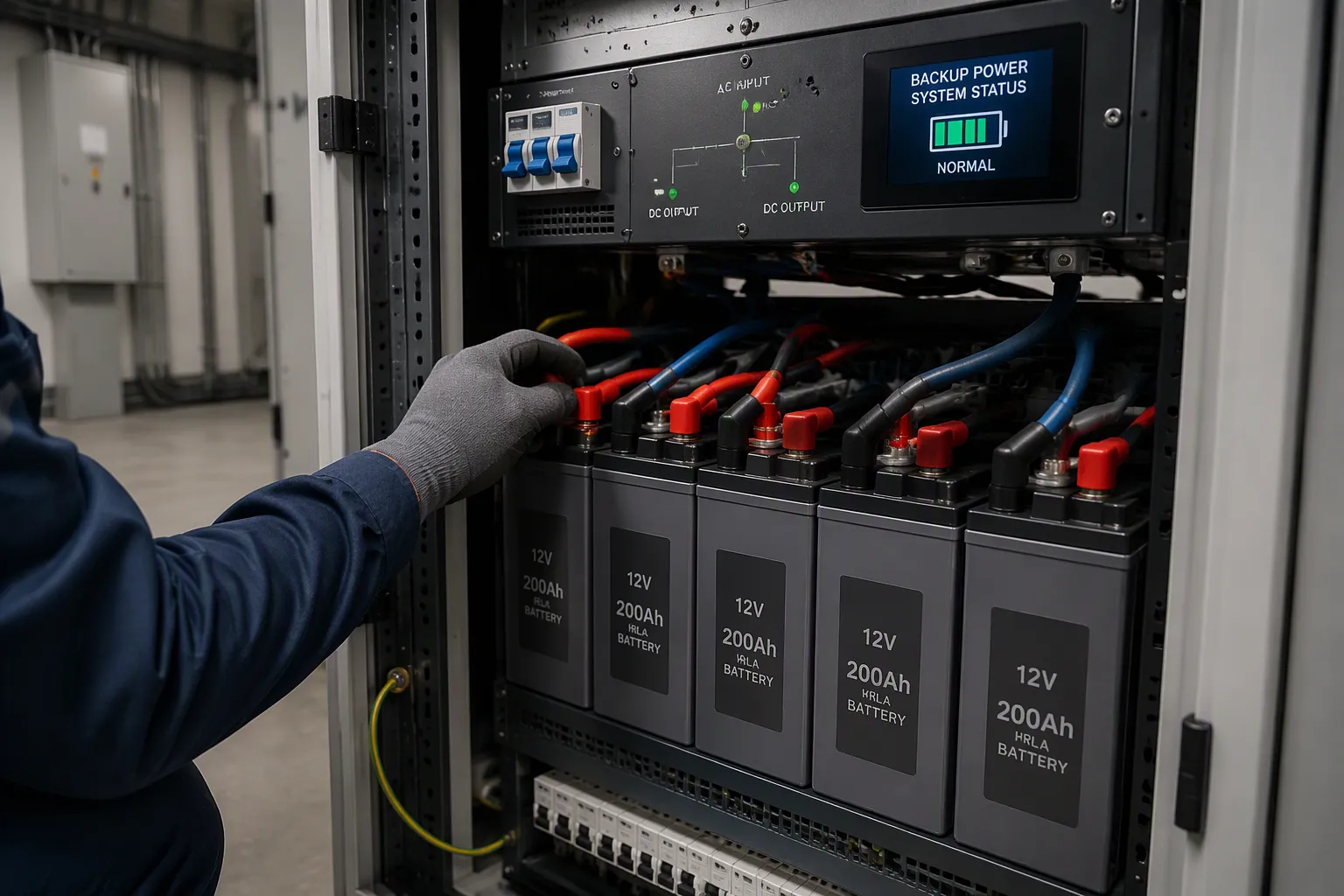
A battery pack makes black start possible by delivering immediate, grid-forming power. This power energizes telecom power systems when no external source is available. You get a restart path that depends on stored energy alone.
Self-sufficient restart matters because outages threaten service continuity. The data below shows how backup duration changes the risk of losing telephone service during an outage.
Backup Power Duration | Risk of Losing Telephone Service During an Outage |
|---|---|
4 hours | 6.8% |
8 hours | 3.9% |
15–20 hours | ~2.0% |
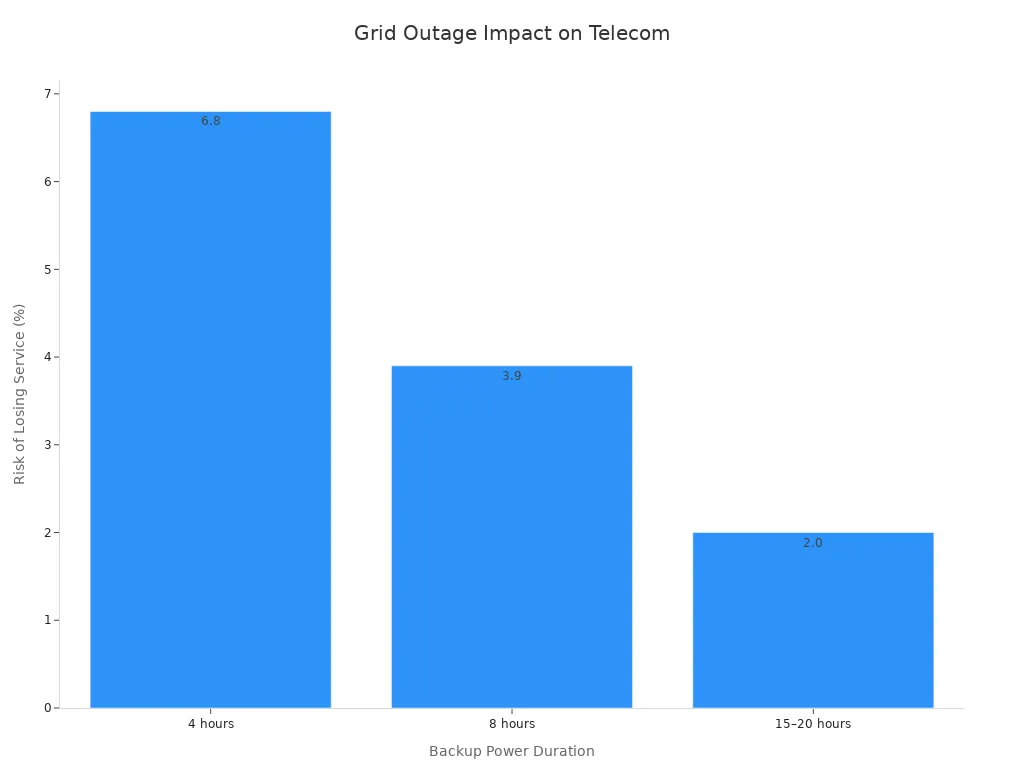
Longer backup windows reduce that risk. Well-designed batteries protect critical sites. This article explains the mechanism, the restart sequence, the challenges, and the design choices.
Key Takeaways
Battery packs provide instant power to restart telecom systems without the grid.
Grid-forming inverters create their own voltage and frequency for a stable restart.
A step-by-step restart process protects equipment and prevents failures.
Keep a locked battery reserve to ensure enough energy for a successful restart.
Batteries work best for remote sites with short outages and no fuel needs.
What Blackstart Means for Telecom Power Systems
Defining Blackstart in Telecom
Blackstart is the ability to restart and re-energize a system without relying on the external grid. In telecom, this means rectifiers, DC plants, and backup power must come back online without mains power. You restore service from stored energy alone, with no external source to lean on. The site acts as its own small power plant for a short window. This definition applies to any site that must recover on its own.
For telecom power systems, blackstart begins with a battery pack that can form voltage and frequency. The system then energizes rectifiers and loads in sequence. This process supports autonomous power restoration at a site that has lost its mains feed. A well-planned blackstart sequence also protects sensitive loads from voltage swings during the first moments of energization. Engineers call this staged approach a bottom-up restart. Each stage waits for stable voltage before the next load joins. The battery pack holds the reference for the whole island.
Why Blackstart Capability Matters
Blackstart capability matters for regulatory resilience and outage recovery. Remote sites often sit far from service crews. A site that can run independently of the grid recovers faster and keeps critical infrastructure online. Regulators increasingly ask operators to prove this ability during audits and storm reviews. A blackstart plan also covers fuel-free operation for days. A long outage at a mountain site can isolate a whole region from mobile service.
You also gain a stable supply after blackouts without a grid connection. Emergency backup systems with blackstart capability protect voice and data links during wide-area outages. The telecom industry increasingly treats autonomous restoration as a design requirement, not an extra. Blackstarting a site from batteries alone shortens restoration time and reduces truck rolls. Each backup cycle also proves the site can restart on its own. That proof builds confidence before the next storm season arrives. Field teams then spend less time on site and more time on preventive work.
How Battery Packs Enable Blackstart
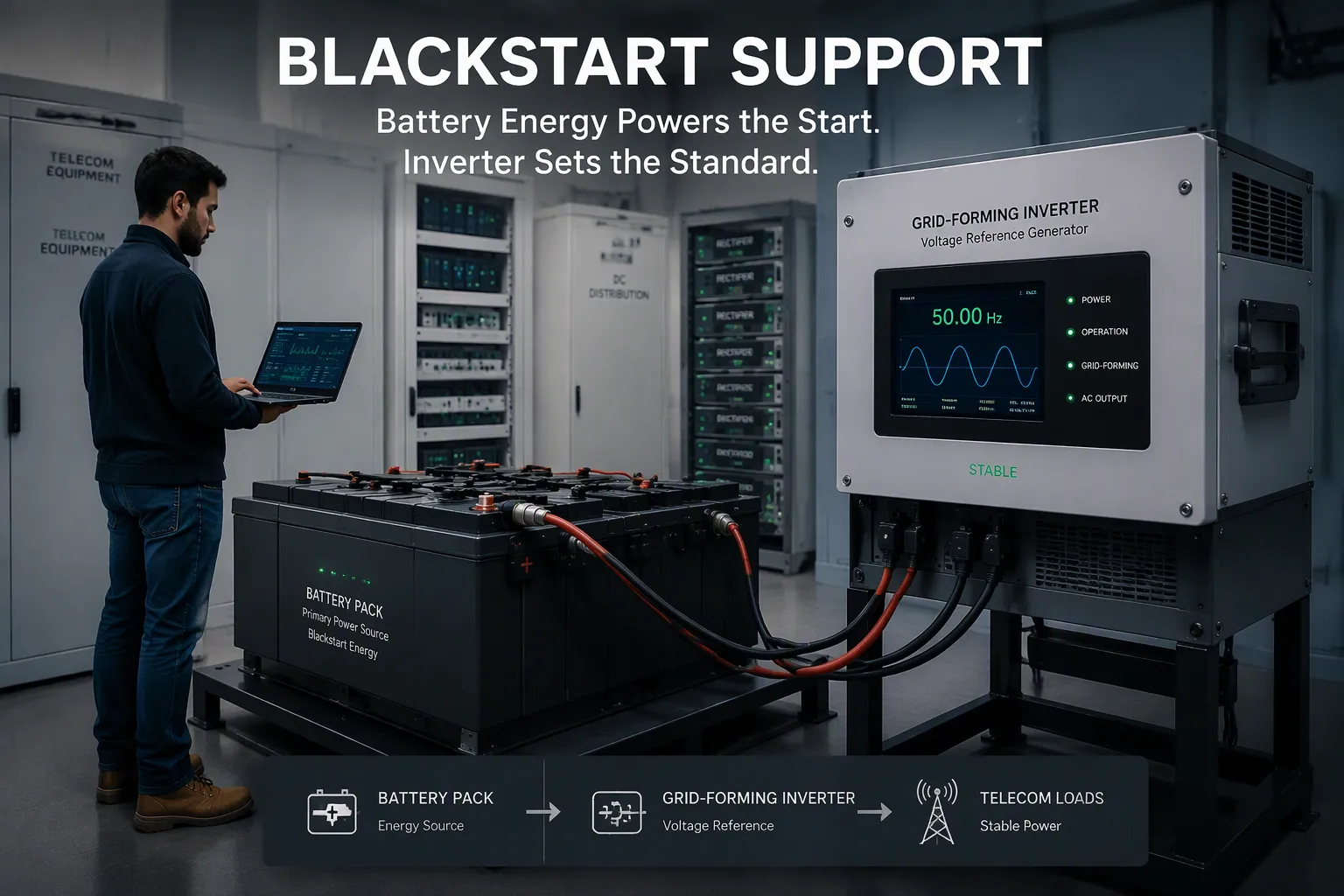
A battery pack delivers immediate DC power the moment you need it. That stored battery power energizes the system before any other source exists. You do not wait for a generator to spin up or a crew to arrive. The pack carries the first load alone.
The Role of Grid-Forming Inverters
Grid-forming inverters change the physics of a restart. A standard grid-following unit acts as a controlled current source. It uses a phase-locked loop to lock onto grid voltage and frequency. That approach works well on a healthy grid. It becomes ineffective when the voltage reference disappears during a blackout.
Grid-forming inverters work differently. They act as a controlled voltage source. They synthesize their own internal voltage and frequency with an internal oscillator. No external grid signal is needed. Every other element on the island synchronizes to the grid-forming unit. This reversal is what makes blackstart possible.
The table below shows the contrast.
Dimension | Grid-Following | Grid-Forming |
|---|---|---|
Inverter behavior | Controlled current source | Controlled voltage source |
Synchronization | PLL locks to grid | Internal oscillator |
Needs grid to operate | Yes | No |
Frequency response | 200–500 ms | < 20 ms |
Grid-forming behavior gives you native synthetic inertia and a fast response to rate of change of frequency. A grid-forming hybrid inverter also holds stability on weak grids. Testing shows stable operation at a short-circuit ratio below 1.5, including at 1.0. That matters at remote telecom power systems sites where the grid is thin or absent.
Battery storage systems can support black start capabilities through this architecture. The battery storage pack supplies the DC link. The grid-forming stage converts it into a clean AC reference. You get a stable power supply for rectifiers and loads.
Control Strategies for Reliable Restart
Three control strategies let grid-forming inverters to execute a blackstart reliably.
Droop control mimics a synchronous generator's governor. It is the simplest and most widely deployed approach.
Virtual Synchronous Generator control emulates inertial response. It reacts to both frequency deviation and rate of change of frequency.
Power Synchronisation Control uses active power as the sync signal. It stays most stable at very low short-circuit ratios below 1.5.
You also need state-of-charge management. The battery must hold enough reserve to ride through the restart. Coordination with rectifiers prevents a load surge from collapsing the reference. Voltage and frequency regulation keep the island within limits as each load joins.
Batteries with grid-forming capability turn a dead site into a live one. Battery systems built this way support grid stability and restoration across the network. Plan the control layer early, and the restart becomes predictable.
The Blackstart Process Step by Step
From Battery Activation to Energization
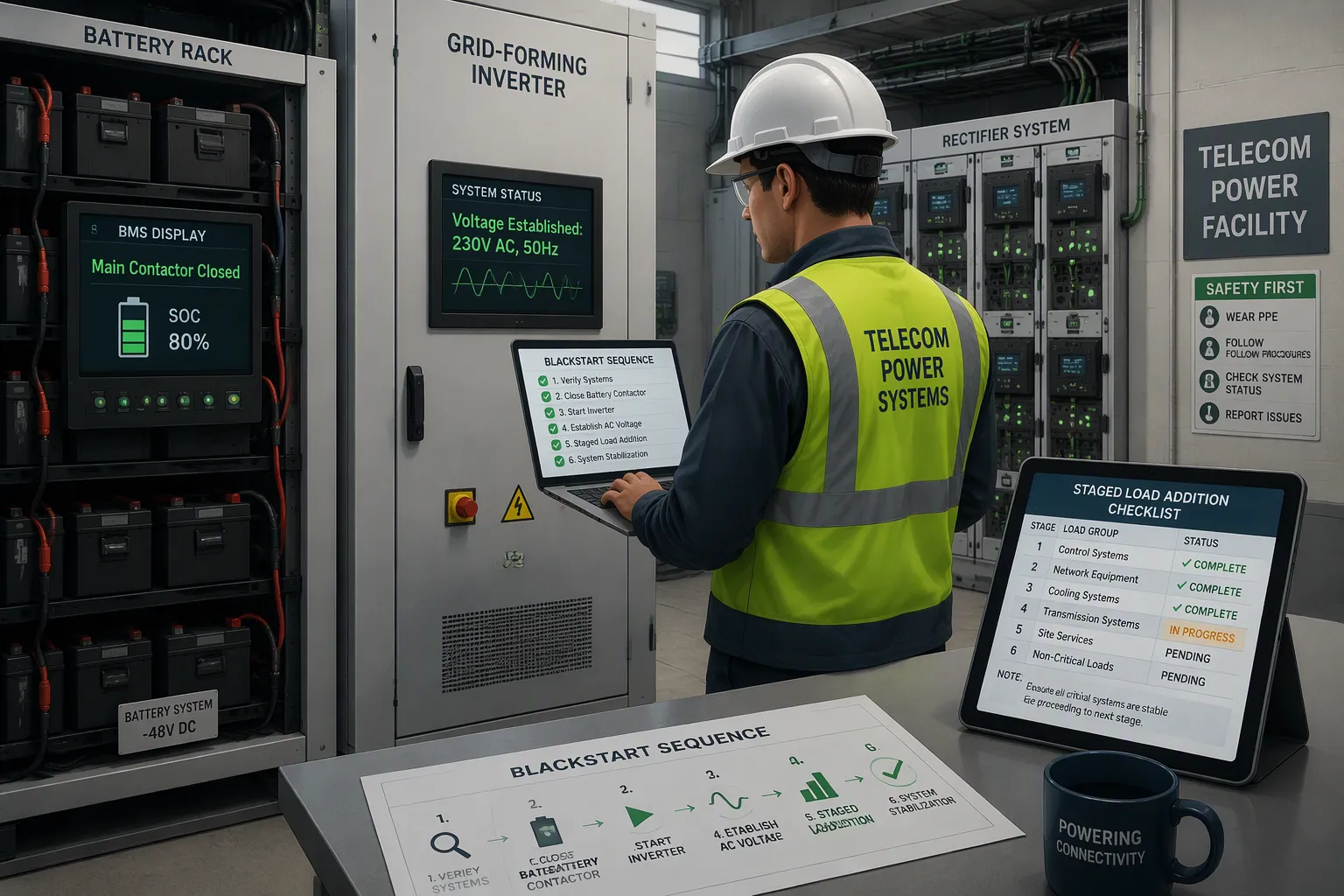
The restart follows a fixed sequence. Each stage waits for stable voltage before the next one begins.
Activate the battery pack. The battery management system closes the main contactor and confirms available energy.
Start the grid-forming inverter. It builds an internal voltage and frequency reference from the DC link.
Establish voltage. The inverter holds a steady AC waveform with no external grid signal.
Energize the rectifiers. They draw current from the island and begin charging the DC bus.
Add loads in stages. You connect critical circuits first and watch voltage and frequency before each step.
This order protects the island from collapse. A single large load added too early can pull the reference down.
Key Challenges and Solutions
The hardest scenario is a battery cabinet that reaches minimum state of charge. The inverter then loses its power supply, and the island dies. Design around this risk with a locked reserve. A fixed "bottom 20%" rule is not an engineering standard. Your energy management system should enforce a minimum available energy derived from the approved duty cycle. Update that figure for measured capacity, temperature, rack availability, and forecast auxiliary demand.
SoC Band | Allocation Purpose | Enforcement Mechanism |
|---|---|---|
Market participation (regulation, arbitrage, peak shaving) | Normal dispatch logic | |
Bottom 20–30% | Locked reserve for blackstart and critical auxiliaries | Hard limits via EMS/SCADA |
Enforce that reserve through EMS/SCADA hard limits, not operational habit alone. Size the reserve for the starting duty cycle, because failed attempts consume energy. Some chemistries degrade faster at sustained high SoC, so choose high-SoC-friendly chemistry such as LFP, oversize the pack, or cycle the SoC deliberately.
Other challenges need equal attention.
Challenge | Main Risk | Solution |
|---|---|---|
Protection trips, voltage dips | Controlled switching, staged energization | |
Step load addition | Frequency fall, voltage collapse | Measured stages, under-frequency load shedding |
Load prioritization | Overloading the island | Restore telecom sites and emergency services first |
Breaker trips, contact welding | Active pre-charge circuits, NTC thermistors |
Battery storage with grid-forming inverters responds in milliseconds and smooths short load changes during early restoration. Plan the power restoration process around measured steps. Keep each step within spinning reserve, and monitor frequency and voltage before every connection. Prioritize communications and emergency services, and defer non-essential feeders until the island is stable. Inrush limiting techniques such as NTC thermistors and series resistors with bypass protect large rectifiers. A disciplined sequence turns a fragile restart into a repeatable one, and your backup design gains real blackstart capability.
Comparing Black Start Capabilities and Deployment
Battery Packs Versus Traditional Methods
Generators and battery storage each fit different site profiles. A diesel generator delivers long-duration output from stored fuel. It suits sites with large loads and frequent crew access. A battery pack responds in milliseconds and needs no fuel delivery. It suits remote sites, short restart windows, and unmanned locations. Many operators combine both: battery storage handles the first minutes, and a generator takes over for extended runtime.
Consider a mountain repeater site that loses its feeder line in a storm. A battery storage system restarts the rectifiers within seconds and keeps voice service alive. A roadside cabinet on a highway follows the same pattern. The battery carries the island until crews arrive. These examples show where battery-based blackstart fits best: small loads, fast recovery, and no fuel logistics.
Design Considerations with ESTEL
Start with battery sizing. Match usable energy to the restart duty cycle plus a locked reserve. Keep a state-of-charge floor that covers failed attempts. Choose IP-rated outdoor battery cabinets for wet or dusty sites. Plan thermal management, because heat shortens battery life. Confirm the rectifier interface before you commit to a layout.
ESTEL's Telecom Power System supports this work. It accepts 90–300 Vac input, uses natural cooling, and installs on a 19-inch rack or inside a cabinet. Output reaches 150A. Pair it with ESTEL's lithium iron phosphate batteries and outdoor battery cabinets for a complete island. ESTEL builds to ISO9001 quality standards, and the equipment suits remote, harsh environments. Evaluate the design against your own duty cycle before deployment.
Battery packs make blackstart support possible for telecom power systems without mains power. Grid-forming inverters establish their own voltage and frequency reference, and control strategies such as droop control keep the island stable. Together they turn stored energy into a repeatable restart and faster service restoration.
Expect smarter control, higher energy density, and broader adoption across telecom infrastructure. Blackstart capability will become a standard design goal rather than an extra. Batteries will carry more of the first-minute load at remote sites.
Evaluate a battery-based restart design against your own duty cycle. ESTEL's Telecom Power System offers a practical starting point for that evaluation.
FAQ
Can a battery pack restart a telecom site with no mains power at all?
Yes. The pack supplies immediate DC power, and a grid-forming inverter builds its own voltage and frequency reference. Rectifiers and loads then energize in stages. No external grid signal is needed at any point in the sequence.
Do I need a grid-forming inverter for blackstart?
You do. A grid-following unit locks onto grid voltage with a phase-locked loop, so it has nothing to follow during an outage. A grid-forming unit synthesizes its own reference. Every other element on the island then synchronizes to that unit.
How much battery reserve should I lock for a restart?
Set a hard floor through your energy management system and size it for the starting duty cycle, including failed attempts. A fixed percentage is not an engineering standard. Derive the figure from measured capacity, temperature, and forecast auxiliary demand.
Where do batteries fit best compared with generators?
Batteries respond in milliseconds and need no fuel delivery, so they suit remote and unmanned sites with short restart windows. Generators deliver long-duration output from stored fuel. Many operators pair both: the battery carries the first minutes, and the generator takes over for extended runtime.
What should I check before deploying a battery-based restart design?
Confirm battery sizing against your duty cycle, keep a locked state-of-charge reserve, and verify the rectifier interface. Choose IP-rated outdoor cabinets for harsh sites and plan thermal management. ESTEL's Telecom Power System accepts 90–300 Vac input, installs on a 19-inch rack, and delivers up to 150A.
See Also
Methods For Calculating Telecom Cabinet Power Systems And Telecom Batteries
Grid-Connected Photovoltaic Inverter And Battery System For Telecom Cabinets
Photovoltaic Energy Storage Power System Designed For Telecom Cabinets
CALL US DIRECTLY
86-13752765943
3A-8, SHUIWAN 1979 SQUARE (PHASE II), NO.111, TAIZI ROAD,SHUIWAN COMMUNITY, ZHAOSHANG STREET, NANSHAN DISTRICT, SHENZHEN, GUANGDONG, CHINA
