Multi-Energy Input (Grid + PV) Hybrid Power Supply Telecom Power System for Green Base Station Application

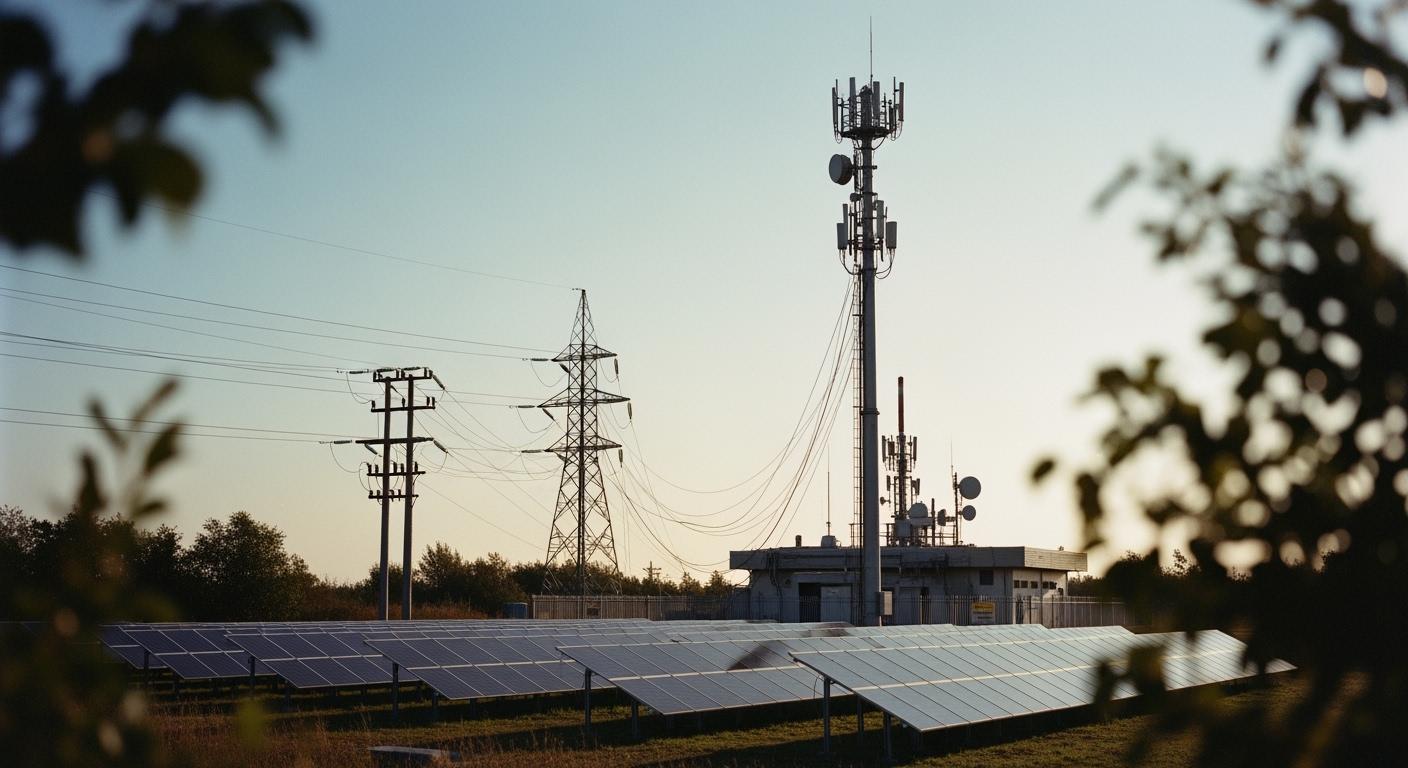
You can make your telecom base station greener and more reliable by combining grid power with solar PV in a hybrid system. When you use advanced solutions like the Telecom Power System, you lower your operational costs and help the environment. You reduce your diesel use by up to 70% and cut grid electricity expenses by 30%. The table below shows how hybrid systems optimize energy use and save money:
Benefit | Description |
|---|---|
Reduced Operational Costs | Lower energy bills and less fuel use |
Diesel Usage Reduction | |
Grid Electricity Expense Reduction | Up to 30% savings on electricity |
Key Takeaways
Combine grid power and solar PV to create a hybrid system for your telecom base station. This approach reduces diesel use by up to 70% and lowers electricity costs by 30%.
Invest in advanced battery technology like lithium iron phosphate (LiFePO₄) for longer lifespans and lower maintenance costs. These batteries enhance reliability and efficiency.
Utilize smart control systems to automate energy management. This technology ensures seamless switching between power sources, minimizing downtime and operational costs.
Prioritize renewable energy sources in your power management strategy. This not only helps the environment but also meets regulatory demands for sustainability.
Regularly monitor your hybrid system's performance to maintain efficiency. Early detection of issues can prevent costly repairs and ensure continuous service.
Power Challenges for Telecom Base Stations
Energy Costs and Reliability
You face significant challenges when powering telecom base stations, especially in areas with unreliable grid access. High energy costs can quickly add up, making it difficult to maintain profitable operations. When the grid fails, you must rely on backup systems, which often use diesel generators. These generators increase your fuel expenses and require regular maintenance.
Extreme weather events, such as typhoons, heavy rain, blizzards, heatwaves, sandstorms, and lightning, are becoming more common. These conditions put extra pressure on your telecom infrastructure. You may experience service interruptions and safety risks during these events. Reliable power is essential to keep your network running and your customers connected.
You also encounter several technical and financial barriers. The table below highlights some of the main challenges you might face:
Challenge | Description |
|---|---|
Infrastructure Costs | High costs of deploying and maintaining advanced power supply systems can be a barrier for operators. |
Technological Complexity | Rapid technological advancements require continuous upgrades, which can be complex and resource-intensive. |
Regulatory Compliance | Navigating complex regulations adds to the cost and complexity of deploying power supply systems. |
Energy Efficiency | Operators must enhance energy efficiency while minimizing environmental impact due to sustainability demands. |
Sustainability and Environmental Demands
You must also consider the growing demand for sustainable and environmentally friendly operations. Many governments and organizations now require you to reduce your carbon footprint. Traditional diesel generators produce greenhouse gases and contribute to air pollution.
Customers and regulators expect you to adopt cleaner energy sources. Solar PV and hybrid systems help you meet these expectations. By integrating renewable energy, you can lower emissions and support global sustainability goals.
You need to balance reliability, cost, and environmental responsibility. This balance is not always easy, but it is essential for the future of telecom infrastructure.
Tip: Investing in hybrid power solutions can help you overcome these challenges and position your network as a leader in green technology.
Hybrid Power System Overview
Multi-Energy Input: Grid and PV Integration
You can achieve reliable and sustainable power for your telecom base station by integrating both grid electricity and solar photovoltaic (PV) energy. This hybrid approach allows you to use solar energy during the day and switch to grid power when sunlight is not available. The system automatically manages the energy flow, ensuring your equipment always receives stable power.
Hybrid power systems must meet specific technical requirements to operate efficiently and safely. The table below summarizes the key parameters you should consider:
Technical Parameter | Description |
|---|---|
Voltage and Frequency Control | Systems must operate within defined voltage and frequency ranges and provide support to maintain these levels. |
Reactive Power Capability | The ability to inject or absorb reactive power helps manage grid voltage. |
Fault Ride-Through | Systems should remain connected during minor grid disturbances to prevent cascading failures. |
Harmonic Distortion | The electricity produced must have a clean waveform to avoid interfering with other grid equipment. |
When you use a hybrid system, you reduce your dependence on diesel generators and lower your operating costs. The chart below compares a diesel-only setup with a hybrid system that uses solar, batteries, and diesel backup:
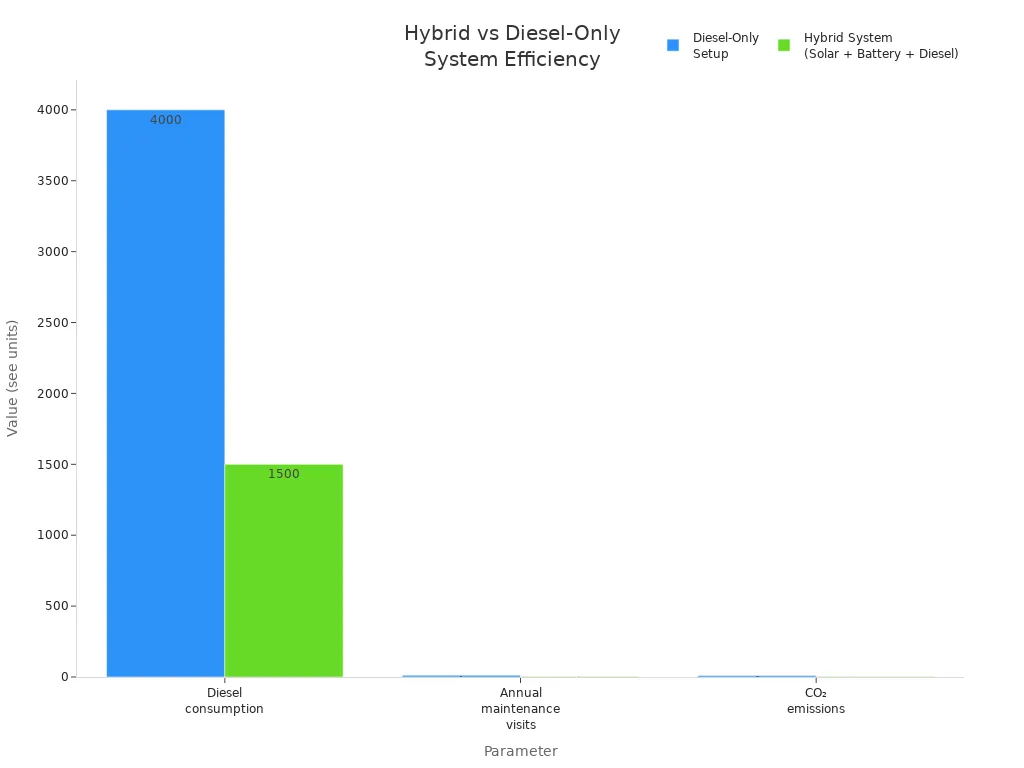
You can see that hybrid systems use less diesel, require fewer maintenance visits, and produce fewer CO₂ emissions. This approach supports your goal of building a green and cost-effective telecom network.
Key Components: Telecom Power System, Rectifier System, Batteries
A hybrid telecom power system relies on several key components to ensure reliable operation. Each part plays a unique role in keeping your base station running smoothly:
Component | Role in Hybrid Telecom Power System |
|---|---|
Solar panels | Generate clean energy during the day. |
Battery storage | Stores excess energy for nighttime or cloudy periods. |
Diesel generator | Serves as a fallback power source when renewable energy is insufficient. |
Hybrid controller | Manages energy flow, charging/discharging cycles, and remote monitoring. |
You will find that the Telecom Power System and Rectifier System are central to this setup. The Telecom Power System manages the distribution and conversion of power from both grid and PV sources. The Rectifier System converts AC power from the grid or generator into DC power, which your telecom equipment needs.
Batteries act as the energy heart of your hybrid system. They absorb renewable energy, balance fluctuating loads, and maintain voltage stability. Modern batteries offer higher energy density, longer runtimes, and faster charge rates. You can rely on them to provide uninterrupted power, especially in remote areas with unstable grid connections.
Note: Batteries with longer lifespans and higher efficiency help you reduce maintenance and replacement costs over time.
ESTEL Solutions for Telecom Infrastructure
You can trust ESTEL to deliver advanced solutions for your hybrid telecom power needs. ESTEL’s Telecom Power System and Rectifier System offer features that make them ideal for multi-energy input setups:
Feature | Description |
|---|---|
Maximum Power Point Tracking | Accuracy over 99.5% for solar module. |
Power Factor | Active power factor compensation technology with a value up to 0.99. |
Efficiency | Rectifier module efficiency over 93%, solar module efficiency over 95%. |
Hot Swap Technology | Non-destructive hot swap technology for easy replacement of modules in under one minute. |
Over-voltage Protection | Hardware and software protection with multiple lockout modes. |
Battery Management | Includes automatic voltage regulation, current limiting, and online battery testing. |
Light/Electricity Management | Prioritizes solar power supply to maximize solar energy use. |
Data Recording | 90 days of historical data and 200 alarm records. |
Alarm Function | Comprehensive fault protection and alarm features. |
Network Design | Flexible communication ports and remote monitoring capabilities. |
User Interface | LCD designed for intuitive operation and parameter querying. |
Lightning Protection | Robust design for both AC and DC sides. |
Energy-saving Design | Prioritizes solar energy use and includes sleep energy-saving functions. |
Outdoor Capability | IP55 protection level for outdoor use, compact design for easy installation. |
Remote Monitoring | GPRS function for remote monitoring and data transmission. |
ESTEL’s brand values focus on quality, innovation, and customer satisfaction. You benefit from products that promote renewable energy, enhance operational efficiency, and support sustainability goals. By choosing ESTEL, you help reduce your carbon footprint and align your network with global green initiatives.
Tip: ESTEL’s Telecom Power System and Rectifier System provide reliable, efficient, and easy-to-manage solutions for your hybrid telecom infrastructure.
System Operation and Management
Energy Flow and Source Prioritization
You can optimize your telecom base station’s energy use by prioritizing renewable sources. The energy management system always uses solar power first to supply your equipment. If solar generation exceeds your needs, the system stores the extra energy in batteries. When sunlight is low or unavailable, the batteries discharge to keep your station running. Only when both solar and battery power are insufficient does the system draw from the grid or activate a diesel generator. This approach ensures you maximize renewable energy and minimize reliance on traditional sources.
Solar energy supplies the load first.
Excess energy charges the batteries.
Batteries discharge when solar is not enough.
Grid or generator power is used as a last resort.
The intelligent energy management system continuously monitors energy generation, consumption, and storage. You benefit from dynamic balancing of power sources, which keeps your operations efficient and reliable.
Smart Control and Automatic Switching
You gain greater efficiency and reliability through smart control technology. The Telecom Power System uses advanced microprocessor logic and programmable controllers to automate energy management. These systems monitor voltage, current, and battery status in real time. They also provide remote control and integration with your network.
Component | Function |
|---|---|
Microprocessor Controlled Logic | Automates tasks, reducing manual labor |
Programmable Controller | Enables remote control and system integration |
Display and Controls | Provides real-time data monitoring |
Alarm Indicators | Alerts you to issues for quick resolution |
Protective Controls | Safeguards against surges and overloads |
Automatic switching between energy sources ensures seamless transitions. When solar power drops, the system instantly switches to batteries or grid power. This reduces downtime and keeps your network running without interruption. In advanced networks, dynamic energy management can improve efficiency by nearly 20%.
Tip: Automatic switching not only lowers your operating costs but also enhances reliability, especially in 5G networks.
Backup and Redundancy
You need robust backup and redundancy to maintain continuous service. Battery backup and uninterruptible power supply (UPS) systems provide immediate power during outages. Modern batteries, such as lithium iron phosphate (LiFePO4), offer long lifespans and perform well in harsh environments. Regular maintenance and testing of these systems prevent failures and ensure rapid power restoration, often within 30 minutes.
Batteries provide instant backup during grid failures.
Switched power distribution units (PDUs) control individual outlets, minimizing downtime.
ESTEL’s hybrid solutions include redundant power paths to maintain operations during emergencies.
You can trust that these measures protect your telecom base station from unexpected outages and regulatory risks.
Benefits for Green Base Stations

Energy Savings and Cost Reduction
You can achieve significant energy savings and lower your operating costs by using a hybrid power system at your telecom base station. When you combine solar PV with grid power, you reduce your reliance on diesel generators. This shift leads to less fuel consumption and fewer maintenance visits. You also benefit from advanced battery technology, which offers a longer lifespan and lower replacement costs.
Hybrid power systems can cut diesel use by up to 70%. This reduction means you spend less on fuel and logistics.
Lithium-ion batteries, though more expensive at first, cost 30-40% less over their lifetime compared to traditional VRLA batteries.
Operators who optimize their power systems often save 2-3% of their service revenue each year.
You can expect a 99.99% uptime, which helps you avoid revenue loss from network downtime.
Annual carbon emissions drop by nearly 78% per site, which can lower regulatory costs.
The Telecom Power System from ESTEL supports these savings by managing energy flow efficiently. Its advanced control features help you use more solar energy and less grid or diesel power. You also get real-time monitoring, which allows you to spot issues early and avoid costly repairs.
Note: Lower operational costs and higher uptime make your network more competitive and sustainable.
Emission Reduction and Sustainability
You help protect the environment when you switch to a hybrid power system. Solar PV and battery storage work together to reduce greenhouse gas emissions. This change supports your company’s sustainability goals and helps you meet government regulations.
Hybrid solar PV systems can lower CO2 emissions by 55%. As you expand your network with 5G, this reduction can reach 58%.
Integrated photovoltaic and energy storage systems can cut emissions by up to 84%.
Lower emissions mean you contribute less to air pollution and climate change.
ESTEL’s solutions use energy-saving designs and prioritize solar power. The system’s high efficiency and smart controls ensure you get the most out of every kilowatt-hour. You also benefit from features like automatic voltage regulation and online battery testing, which keep your system running cleanly and efficiently.
Tip: By reducing emissions, you not only help the planet but also improve your company’s public image and meet stricter environmental standards.
Reliability and Service Continuity
You need reliable power to keep your telecom base station running without interruption. Hybrid power systems give you this reliability by combining multiple energy sources and using smart controls. You get instant failover and automatic switching, which means your network stays online even during power outages.
Feature | Hybrid Power Systems | Traditional Systems |
|---|---|---|
Source Management | Integrates multiple energy sources seamlessly | Limited to one or two sources |
Automatic Switching | Transfers load within milliseconds | Manual intervention required |
Real-time Power Logic | Offers instant failover capacity | Lacks instant failover |
Network Stability | Powers critical devices continuously | Often struggles during outages |
Efficiency | High efficiency, reduces energy wastage | Generally less efficient |
ESTEL’s Telecom Power System and Rectifier System provide robust backup and redundancy. You get continuous power, even in harsh weather or remote locations. The system’s modular design and remote monitoring features make it easy to maintain and scale as your network grows.
Callout: Reliable power means fewer dropped calls, better customer satisfaction, and a stronger reputation for your network.
Real-World Application
ESTEL Case Studies and Performance
You can see the impact of ESTEL hybrid power systems in real telecom networks. Many operators have reported significant improvements after deploying these solutions. For example, GreenConnect reduced its energy use by 30%, saving millions of dollars each year. Hybrid systems also help telecom companies save up to $14 billion annually and cut 100–500 million metric tons of CO₂ emissions. These results support your sustainability goals and help you meet global climate targets.
Metric | Details |
|---|---|
Cost Savings | Hybrid systems could save telecom companies $13-14 billion yearly. |
CO₂ Reduction | These systems can cut 100-500 million metric tons of CO₂ each year. |
Energy Efficiency | Energy use dropped by 30% for GreenConnect, saving millions. |
You also benefit from improved reliability. Hybrid power systems ensure uninterrupted service, even in remote or challenging environments. Customer satisfaction rises as you deliver better network uptime and fewer outages. Operators have seen a 30% reduction in energy use in data centers and fewer system failures.
Metric | Improvement |
|---|---|
Customer Satisfaction | Enhanced through better experiences |
Operational Efficiency | |
Reliability | Reduced system failures and downtime |
Cost-Effectiveness | Sustainable and cost-effective |
Note: Integrating solar power with your existing infrastructure may seem challenging, but advanced controllers from ESTEL make the process easier and more rewarding.
Measured Improvements and Best Practices
You can maximize the benefits of hybrid power systems by following proven best practices:
Use hybrid systems for technical, economic, and ecological advantages over traditional diesel setups.
Combine solar power with advanced Lithium Iron Phosphate (LiFePO₄) battery storage to ensure consistent power for remote towers.
Monitor your system’s performance regularly to maintain high efficiency and reliability.
Projects like Smart Car Park and N470 Highway show measurable improvements:
Project Name | Improvement Type | Measurable Improvement |
|---|---|---|
Smart Car Park | Energy Efficiency | Over 15% improvement in energy efficiency |
N470 Highway | Energy Consumption | 10% less energy usage compared to AC grids |
N470 Highway | Infrastructure Reduction | 40-50% fewer converters and 50% less cabling |
Smart Homes | Overall Performance | 80% efficiency rate in energy management |
You can achieve similar results by adopting ESTEL’s hybrid solutions. Many users report satisfaction scores of 8.5 out of 10, showing high reliability and effectiveness. When you follow these best practices, you ensure your telecom base station operates efficiently and sustainably.
Future Trends and Innovations
Advances in Energy Storage and Controls
You will see rapid progress in energy storage technology for telecom base stations. Lithium iron phosphate (LiFePO₄) batteries now offer longer lifespans and higher energy density. These batteries charge faster and last through more cycles than older types. Smart battery management systems help you monitor health, predict failures, and optimize charging. You can expect new control systems that use artificial intelligence to balance energy sources. These systems learn your site’s patterns and adjust power flows for maximum efficiency. As a result, you get more reliable service and lower costs.
Tip: Upgrading to advanced batteries and smart controls can help you future-proof your telecom infrastructure.
IoT Integration and Remote Monitoring
You can now use the Internet of Things (IoT) to connect your power systems to the cloud. Sensors collect real-time data on temperature, voltage, and battery status. Remote monitoring platforms let you check performance from anywhere. You receive instant alerts if something goes wrong. This technology helps you reduce downtime and schedule maintenance before problems grow. IoT integration also supports predictive analytics, so you can plan upgrades and replacements with confidence.
Benefit | How It Helps You |
|---|---|
Real-time Monitoring | Detects issues early |
Predictive Maintenance | Prevents unexpected failures |
Remote Access | Saves time and travel costs |
Data Analytics | Improves decision-making |
Market Outlook
You will find strong growth in the telecom hybrid power market over the next decade. The diesel-solar segment is expected to grow at a compound annual growth rate (CAGR) of 14.3% through 2030. The overall telecom power systems market should expand at a CAGR of 10.3% from 2025 to 2035. From 2023 to 2030, the market is projected to grow at a CAGR of 12.2%.
The telecom power systems market could reach USD 16.1 billion by 2035, up from USD 6.1 billion in 2025.
In 2022, the global market size was USD 3.30 billion and may rise to USD 7.69 billion by 2030.
You can expect more investment in green energy and smarter power solutions. As demand for reliable and sustainable telecom networks grows, you will see more innovation and opportunity in this field.
You can transform your telecom base station by adopting hybrid power systems that combine grid and solar PV inputs. These solutions deliver reliable service, lower costs, and support environmental goals. ESTEL’s advanced systems help you maximize energy efficiency and reduce emissions. You gain a competitive edge and meet sustainability standards. Consider upgrading your network with smart hybrid technology for lasting benefits.
Tip: Embracing hybrid power solutions positions your telecom operation as a leader in green technology.
FAQ
What makes a hybrid power system better for telecom base stations?
You get higher reliability and lower costs. Hybrid systems use solar and grid power together. This setup reduces diesel use and maintenance. You also help the environment by cutting emissions.
How do ESTEL’s Telecom Power System and Rectifier System support green energy?
You benefit from high efficiency, smart controls, and remote monitoring. These systems prioritize solar energy and manage batteries well. You can track performance and reduce energy waste.
Can you install ESTEL’s power systems in harsh outdoor environments?
Yes. ESTEL designs its systems for tough conditions. You get IP55 protection, anti-corrosion coatings, and strong cooling. Your equipment stays safe in rain, dust, or heat.
Tip: Regular maintenance checks help your system last longer and work better.
What are the main advantages of using lithium iron phosphate (LiFePO₄) batteries?
Advantage | Description |
|---|---|
Long lifespan | You get more charge cycles |
Safety | Lower risk of overheating |
Fast charging | Shorter downtime for your network |
Stable voltage | Reliable power for your equipment |
See Also
Energy Storage Solutions for Telecom Cabinets Using Photovoltaics
Telecom Cabinets Featuring Grid-Connected Inverter and Battery Systems
Smart Energy Storage Systems for Telecom Cabinets with Microgrid Integration
Calculating Power Systems and Battery Needs for Telecom Cabinets
CALL US DIRECTLY
86-13752765943
3A-8, SHUIWAN 1979 SQUARE (PHASE II), NO.111, TAIZI ROAD,SHUIWAN COMMUNITY, ZHAOSHANG STREET, NANSHAN DISTRICT, SHENZHEN, GUANGDONG, CHINA
