Modular rectifier designs for low MTTR and scalability


You demand reliable power for your telecom infrastructure. Modular rectifier designs, such as the telecom rectifier system from ESTEL, help you reduce Mean Time to Repair by up to 35%. Automated alerts and remote monitoring cut repair time from 4.8 hours to 3.1 hours. You can add or replace modules in your telecom rectifier system without shutting down operations. Quick module replacement keeps your service running. ESTEL’s telecom rectifier system supports seamless growth and real-time monitoring. You benefit from a telecom rectifier system built on quality, innovation, and customer satisfaction.
Key Takeaways
Modular rectifier systems can reduce Mean Time to Repair (MTTR) by up to 40%, keeping your telecom services running smoothly.
Hot-swappable modules allow for quick replacements without system shutdowns, ensuring continuous service for customers.
Advanced monitoring features enable real-time tracking of system performance, helping to prevent outages before they occur.
The plug-and-play design of modular systems supports easy scalability, allowing you to expand your network as needed without major overhauls.
Implementing modular rectifier solutions can lead to significant cost savings, reducing maintenance time and energy consumption.
Challenges in traditional power systems
High MTTR and downtime
You face significant risks when relying on traditional telecom power systems. These systems often lead to high mean time to repair (MTTR) and frequent downtime. The main causes include power outages, aging components, environmental risks, and maintenance coordination challenges. The table below shows how these factors impact your network:
Cause of High MTTR and Downtime | Description |
|---|---|
Power Outages | 33% of downtime comes from power outages. Reliable systems are essential. |
Aging Components | Old batteries and parts fail more often, especially with temperature swings. |
Environmental Risks | Humidity and contamination damage sensitive equipment inside cabinets. |
Maintenance Coordination Challenges | Shared sites need clear schedules and communication for repairs. |
When you experience downtime and maintenance issues, your operational efficiency drops. Customer satisfaction also suffers. Studies show that reducing downtime can improve operational efficiency by 30% and increase customer satisfaction by 20%.
Scalability limitations
Traditional systems make it hard for you to expand your network. You often need to invest a lot of money upfront, sometimes over $1.5 million per site, especially if you want to add renewable energy or meet new regulations. You also face complex compliance requirements, which can add over $250,000 per site. These barriers slow down your ability to scale and adapt to new demands. Without n+x redundancy, you cannot easily add capacity or ensure backup during failures. Advanced power solutions with modular designs help you overcome these challenges by allowing you to expand as needed.
High initial investment costs limit your ability to grow.
Regulatory compliance adds complexity and expense.
Lack of n+x redundancy makes scaling risky and less reliable.
Advanced power solutions offer flexibility and cost savings.
Maintenance complexity
You spend more time and money maintaining traditional systems. Over 70% of transmission infrastructure is now past its 40-year design life. This leads to more frequent repairs and higher costs. Traditional maintenance methods do not work well with new technologies like renewable energy and smart grids. You also face unpredictable restoration times, with costs ranging from $700 to $1,300 per incident. Without n+x redundancy, you must shut down the whole system for repairs, increasing downtime. Modular systems with n+x redundancy let you swap out faulty modules quickly, keeping your network running. Advanced power solutions simplify maintenance and reduce costs by up to 35%.
Old infrastructure increases maintenance needs.
Integration of new energy sources raises operational costs.
Lack of n+x redundancy means longer outages during repairs.
Modular, advanced power solutions reduce complexity and costs.
Modular design advantages in telecom rectifier systems
Hot-swappable modules for low MTTR
You can reduce downtime and maintenance costs with modular rectifier systems that feature hot-swappable modules. This modular design allows you to replace faulty modules without shutting down the entire system. You keep your network running while you perform repairs. Industry studies show that modular designs with hot-swappable modules can cut mean time to repair (MTTR) by up to 40%. You do not need to wait for scheduled outages or disrupt service for maintenance. You simply remove the affected module and insert a new one. This approach keeps your operations efficient and reliable.
Modular rectifier systems with hot-swappable modules lower MTTR.
You avoid system shutdowns during maintenance.
You maintain continuous service for your customers.
Plug-and-play scalability and service continuity
You can expand your power system as your network grows. Modular rectifier systems use a plug-and-play approach, so you add new modules when you need more capacity. You do not need to overhaul your entire setup. This modular design supports scalability and service continuity. You can upgrade or replace components without interrupting service. This is especially important in high-availability environments, where even a short outage can impact thousands of users. You stay ahead of demand and keep your network resilient.
Tip: Use modular rectifier systems to scale your network quickly and maintain service continuity during upgrades.
Advanced monitoring and proactive maintenance
You gain full visibility into your power system with advanced monitoring features built into modular rectifier systems. These systems let you track voltage, current, and temperature in real time. You can monitor performance remotely and receive alerts before issues become critical. This modular design supports proactive maintenance, so you can address problems before they cause outages. Integration with smart systems enables predictive maintenance, which helps you plan interventions and avoid unexpected failures.
Remote tracking of power system performance reduces downtime.
Real-time monitoring of key metrics improves reliability.
Predictive maintenance lowers the risk of unplanned outages.
Evidence Description | Impact |
|---|---|
Up to 30% | |
Troubleshooting time reduction | 30% |
Decrease in battery failure rates | 98% (2018-2024) |
ESTEL’s modular ups architecture
You benefit from ESTEL’s modular ups architecture, which combines high efficiency rectifiers with a flexible modular design. ESTEL’s Telecom Rectifier System and Telecom Power System both use modular architecture to deliver reliable power and easy expansion. You can install these systems in standard 19-inch racks or cabinets, making integration simple. The modular ups systems from ESTEL support a wide range of input voltages and offer natural cooling, which reduces operational costs. You get a solution that adapts to your needs and supports future growth.
Modular rectifier systems from ESTEL provide high efficiency and adaptability.
You can expand or maintain your system with minimal effort.
You ensure scalability and service continuity for your telecom network.
Implementation and maintenance workflow
Installation steps for modular rectifiers
You can install ESTEL’s modular rectifier systems quickly and efficiently. The modular design streamlines each step, reducing installation time compared to traditional systems. You do not need specialized tools or complex procedures. The table below outlines the recommended steps:
Step | Description |
|---|---|
Positioning the Telecom Rectifier Module | Place the module in a clean, dry location away from dust, moisture, and heat sources. |
Connecting the Input Power Supply | Connect the power supply with proper grounding and insulation for safe operation. |
Wiring the Output Connections | Attach DC power lines to telecom equipment and battery backup, ensuring secure connections. |
This approach ensures you achieve optimal performance and longevity from your system. You benefit from easy maintenance and seamless integration with standard 19-inch racks, making the process suitable for diverse telecom environments.
Maintenance procedures for minimal downtime
You can keep your network running smoothly with easy maintenance routines. Modular design supports predictive maintenance tools, routine inspections, and comprehensive training. These procedures help you anticipate failures and address issues before they disrupt service. The following table summarizes the most effective maintenance practices:
Maintenance Procedure | Benefit |
|---|---|
Predictive maintenance tools | Anticipate failures before they occur |
Routine inspections | Identify issues early and ensure ongoing reliability |
Training protocols | Equip staff to minimize downtime |
Track key metrics and spot anomalies quickly | |
Technical training | Speed up issue identification and repair |
You gain maintenance and scalability advantages by using real-time monitoring and predictive maintenance. These strategies reduce downtime and improve equipment reliability.
Expansion process for growing networks
You can expand your power system easily as your network grows. Modular design enables incremental capacity expansion without major overhauls. You add or replace modules as needed, which reduces downtime and supports continuous operation. The table below highlights the benefits of this approach:
Evidence Description | Key Points |
|---|---|
Reliable rectifier systems protect against power loss | Ensure continuous operation and customer satisfaction |
Modules support stable power and scalability | Essential for evolving telecom infrastructure |
Modular approach achieves high efficiency and reliability | Supports scalability, redundancy, and easy maintenance |
Add or replace modules easily | Reduces downtime and improves power reliability |
High efficiency reduces energy bills | Supports environmental goals |
Remote monitoring enables oversight | Essential for modern telecom systems |
Redundancy and hot-swap capabilities | Ensure continuous operation during maintenance or failures |
You achieve seamless integration and minimal disruption during upgrades. Predictive maintenance saves up to 12% over preventive methods and up to 40% over reactive approaches. You ensure your telecom infrastructure remains reliable and future-ready.
Real-world benefits and ESTEL case studies
Reduced downtime and operational costs
You can see clear cost and energy savings when you use ESTEL’s modular rectifier systems. Many telecom operators have reported measurable improvements after switching to these solutions. The table below shows how different providers have benefited:
Operator Description | Improvement | Source |
|---|---|---|
Telecom provider in MENA region | ||
Another operator | Brought costs in line with benchmarks after renegotiating contracts | |
Large telecom | Reduced project costs by approximately 12% by consolidating services | |
City provider | 20% reduction in energy consumption after installing ESTEL rectifiers | |
Operators using ESTEL | Reduced energy use by 15% | |
High-efficiency rectifiers | Cut power loss by up to 75% | |
Modern rectifier systems | Achieve energy conversion efficiency above 96% |
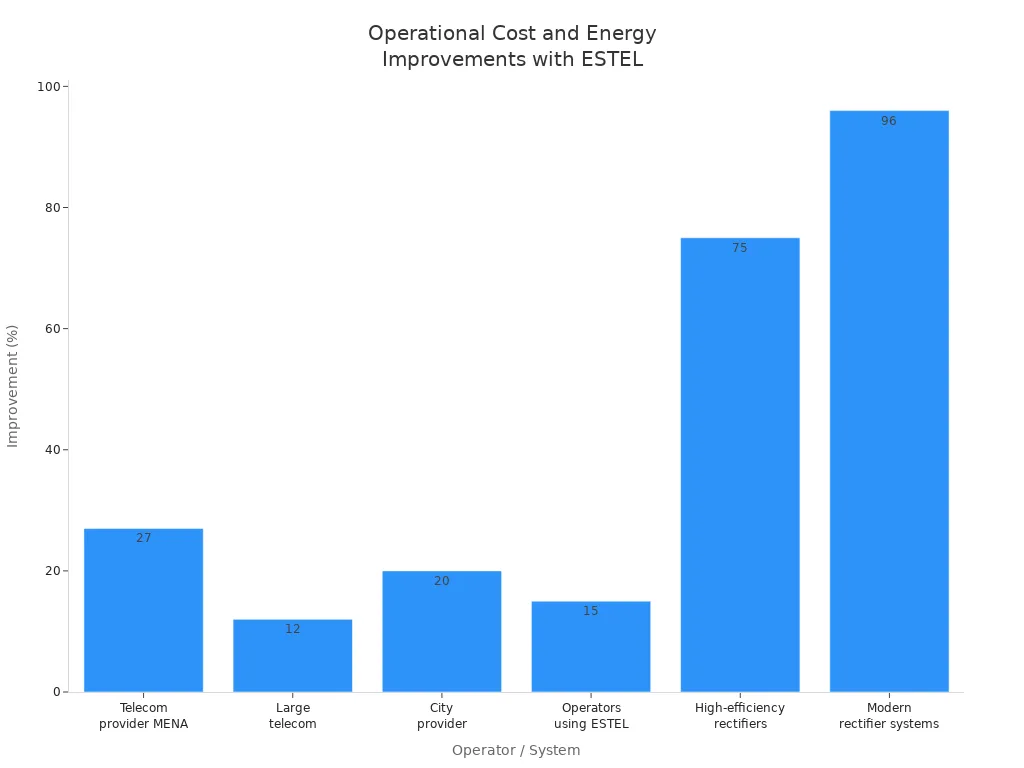
You benefit from reduced downtime and fast deployment, which means you spend less on maintenance and energy each year.
Adaptability for changing telecom demands
You need power systems that can grow with your network. ESTEL’s modular rectifier systems give you flexibility and reliability. You can add or swap modules as your power needs change. This approach supports plug-and-play upgrades and ensures your network stays online during maintenance. You also get redundancy features like N+1 configurations, which keep your system running even if one module fails.
You upgrade your system easily as your network expands.
You keep your network running with hot-swappable modules.
You enjoy cost-effective scalability and continuous operation.
A rural telecom operator in Southeast Asia used hybrid power systems and saw a 35% drop in operational costs. A European provider upgraded for 5G and improved network uptime by 20%.
ESTEL customer success stories
You can learn from other telecom operators who have chosen ESTEL. The table below highlights key outcomes:
Application | Key Outcomes |
|---|---|
5G Networks | |
Improved network performance | |
Data Center in Europe | Stable power delivery |
Minimized downtime |
You also see strong results in maintenance and reliability. For example, a leading mobile operator in Southeast Asia managed over 2,000 remote sites. After installing ESTEL’s smart monitoring, the operator reduced site visits by 38%. Mean time to repair dropped from 12 hours to just 4 hours. Annual O&M costs fell by $500,000. You can expect up to 35% lower O&M costs, 40% fewer maintenance visits, and a 25% increase in system uptime when you choose ESTEL’s modular rectifier solutions.
You solve MTTR and scalability challenges with ESTEL’s modular rectifier designs. You gain reliable power, easy expansion, and reduced downtime. To maximize benefits, follow industry best practices:
Use manufacturer-approved tools and parts.
Regularly check cooling systems.
Monitor voltage stability.
Utilize diagnostic tools.
Keep firmware updated.
Seek professional help when necessary.
Feature | Benefit |
|---|---|
Adapt to network growth and new demands | |
Independent modules | Minimize downtime and improve reliability |
Support seamless expansion for 5G and IoT |
You future-proof your telecom power system with modular solutions.
FAQ
What makes ESTEL’s modular rectifier systems different from traditional systems?
You get hot-swappable modules, real-time monitoring, and plug-and-play scalability. These features help you reduce downtime, simplify maintenance, and expand your network easily. You do not need to shut down your system for repairs or upgrades.
How do you maintain ESTEL’s modular rectifier systems?
You perform routine inspections, monitor key metrics, and use predictive maintenance tools. You can swap out faulty modules quickly. This approach keeps your network running and reduces the risk of unexpected failures.
Can you expand your power system without interrupting service?
Yes. You add or replace modules while your system stays online. This modular approach supports seamless upgrades and ensures continuous operation, even during maintenance or expansion.
What input voltages do ESTEL’s rectifier systems support?
You can use a wide range of input voltages, including AC220VAC and 380VAC. This flexibility lets you install the system in different telecom environments without compatibility issues.
How does modular design help reduce operational costs?
You save money by lowering energy use, cutting maintenance time, and reducing site visits. The high efficiency and easy scalability of modular systems help you control costs as your network grows.
See Also
Integrated Solar Inverter And Battery Solutions For Telecom Cabinets
Strategies For Maintaining Consistent Power Supply In Telecom Cabinets
Calculating Power Systems And Battery Needs For Telecom Cabinets
Advantages Of Lithium Batteries Over Other Options In Telecom Cabinets
Solar Energy Storage Solutions For Telecom Cabinet Power Needs
CALL US DIRECTLY
86-13752765943
3A-8, SHUIWAN 1979 SQUARE (PHASE II), NO.111, TAIZI ROAD,SHUIWAN COMMUNITY, ZHAOSHANG STREET, NANSHAN DISTRICT, SHENZHEN, GUANGDONG, CHINA
