N+1 Redundant Backup of Telecom Power Systems: Zero Interruption with Seamless Switch During Single-Module Failure

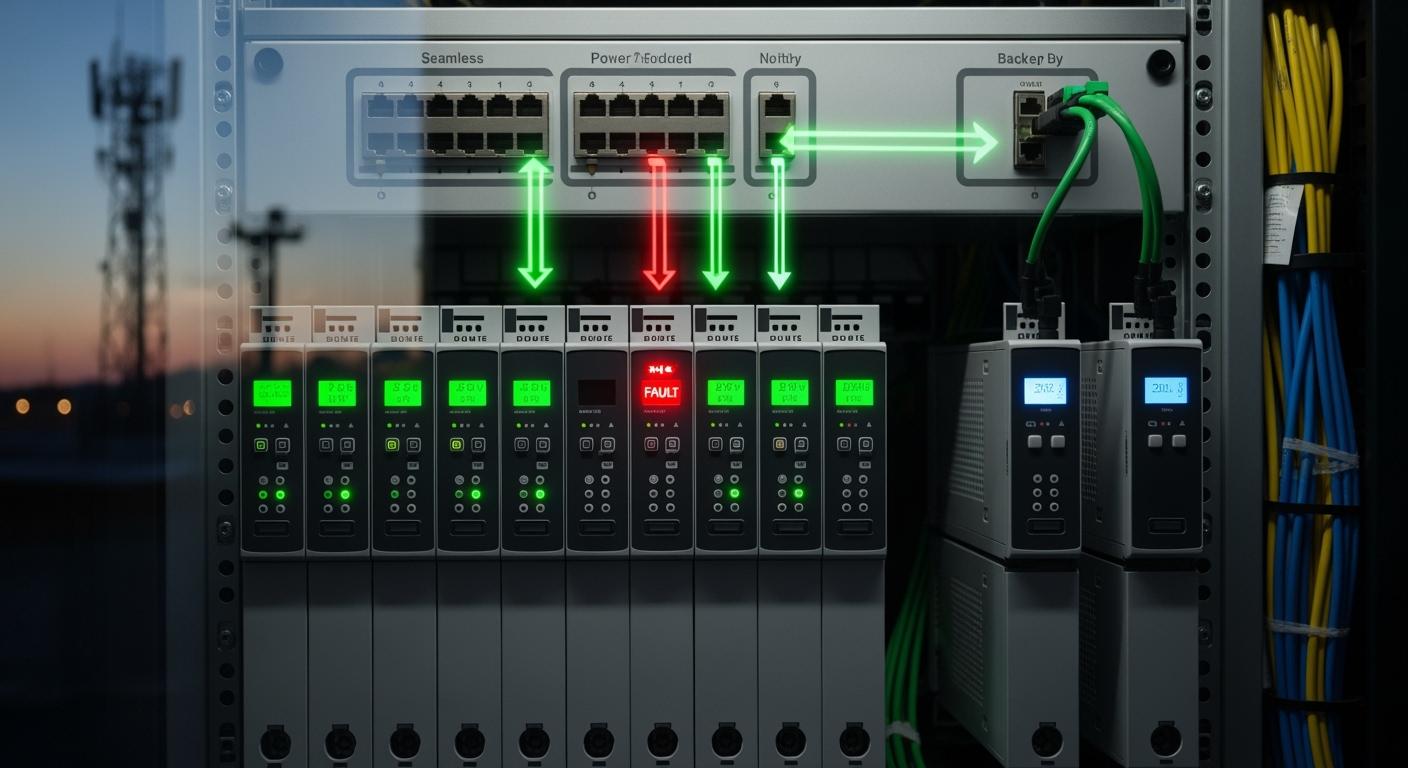
Imagine you manage a critical telecom site where even a brief power outage can disrupt thousands of connections. N+1 redundancy steps in to prevent these interruptions. In a Telecom Power System, you rely on N units to support your operation and one extra unit as backup. If a single module fails, the spare unit activates instantly, keeping your network running. You benefit from faster deployment, predictive maintenance, and smart control systems that isolate problems before they become outages. ESTEL delivers trusted N+1 solutions, ensuring your telecom infrastructure stays reliable.
Feature | Description |
|---|---|
Definition | The system has N units to handle the full load, plus 1 additional (spare) unit for redundancy. |
Operation during failure | If one component fails, the spare unit takes over, ensuring uninterrupted operation. |
Cost-effectiveness | Provides cost-effective redundancy for small-to-medium reliability needs. |
Handling of failures | Effectively manages single points of failure, making it suitable for critical applications. |
Key Takeaways
N+1 redundancy provides one extra power module to ensure continuous operation during a single module failure.
Automatic switching to the backup module prevents service interruptions, keeping your network online without manual intervention.
Regular maintenance and real-time monitoring enhance system reliability and extend equipment life.
Planning for capacity with N+1 redundancy supports future growth and minimizes the risk of downtime.
Choosing ESTEL’s N+1 solutions ensures compliance with industry standards and delivers reliable power for critical telecom applications.
N+1 Redundancy & Zero Interruption

Seamless Switch During Failure
You depend on your Telecom Power System to keep your network running. N+1 redundancy gives you confidence that your site will not experience downtime if a single module fails. The system includes one extra unit beyond what you need for normal operation. When a module stops working, the spare unit steps in immediately. You do not notice any interruption. The load shifts smoothly, and your equipment continues to receive power.
N+1 redundancy ensures that if one UPS module fails, the remaining modules manage the entire load without any interruption in service. This design protects your network from outages and keeps your operations stable.
You see this seamless switch in action when your Telecom Power System detects a fault. The backup module activates automatically. You avoid manual intervention and reduce the risk of human error. Your network stays online, and your customers remain connected.
Continuous Operation in Telecom Power System
Your Telecom Power System must deliver consistent power every day. N+1 redundancy supports this goal by providing an extra layer of protection. You benefit from a system that monitors each module and responds instantly to failures. The spare unit stands ready to take over, so you maintain continuous operation.
You experience fewer disruptions.
You simplify maintenance because you can replace failed modules without shutting down the system.
You improve reliability for critical telecom sites.
A table helps you understand how N+1 redundancy compares to basic setups:
System Type | Response to Module Failure | Impact on Operation |
|---|---|---|
Standard (No Redundancy) | Service interruption | Network downtime |
N+1 Redundancy | Seamless switch | Zero interruption |
You rely on this approach to keep your Telecom Power System running in harsh environments. The system adapts to changing conditions and maintains power delivery. You protect your infrastructure and support your business goals with uninterrupted service.
Telecom Power System Redundancy Explained
What Is N+1 in Telecom Power System
You see N+1 redundancy as a design principle that boosts reliability in your Telecom Power System. This approach means you have one extra module beyond what you need for normal operation. If a module fails, the spare unit takes over instantly. You avoid service interruptions and keep your network stable. N+1 redundancy plays a vital role in telecom infrastructure. It helps you minimize downtime and maintain high availability for your equipment.
N+1 vs. Other Redundancy Models
You can choose from several redundancy models for your Telecom Power System. Each model offers a different level of reliability and risk reduction. The table below helps you compare N+1 with N+2 and 2N models:
Redundancy Model | Description | Reliability Level | Risk Reduction |
|---|---|---|---|
N+1 | One backup for every N component. | Least reliable; downtime possible with multiple failures. | Minimal risk reduction. |
N+2 | Two backups for every N component. | Higher reliability; can handle two simultaneous failures. | Moderate risk reduction. |
2N | Two complete sets of components. | Highest reliability; operations continue even if one set fails. | Maximum risk reduction. |
You notice that N+1 redundancy improves fault tolerance and simplifies maintenance. It works well for many telecom applications. You also see that N+1 is cost-effective, but it may not protect against multiple failures. The table below highlights the advantages and disadvantages:
Advantages of N+1 Redundancy | Disadvantages of N+1 Redundancy |
|---|---|
Fault tolerance improvement | Semi-fault tolerance |
Extensive application | Additional investment required |
Simplified maintenance | Potential single points of failure |
Cost-effectiveness |
ESTEL’s Approach to Redundant Power
You benefit from ESTEL’s expertise in providing N+1 redundant solutions for telecom applications. ESTEL designs its Telecom Power System to meet industry standards for moderate uptime requirements. You find that these systems support Tier III data centers and comply with ANSI/TIA-942 for basic redundancy. ESTEL’s solutions allow you to perform maintenance without service interruptions. You experience seamless failover and energy efficiency. ESTEL also offers the Telecom Rectifier System, which features modular design and flexible installation options. You trust ESTEL to deliver reliable power and protect your network from unexpected failures.
System Operation & Failure Response

Normal Operation in Telecom Power System
You rely on your Telecom Power System to deliver steady power every day. Under normal conditions, the system includes one extra power unit beyond what you need. This setup means that if one unit fails, the others keep working. You avoid interruptions and maintain continuous operation. This redundancy is essential for sites where reliability matters most. You can trust your equipment to stay powered, even in demanding environments.
Automatic Module Switching
You benefit from automatic detection and switching processes built into N+1 redundant systems. The system monitors each power module and responds instantly to faults. When a module fails, the backup unit activates without delay. You do not need to intervene. The table below shows how these features work:
Feature | Description |
|---|---|
Output Redundancy | Each Redundant Power Package includes two identical power supplies connected through a diode switching arrangement that detects faults, isolates them, and ensures uninterrupted power output from the other supply. |
Theory of Operation | The primary supply's output voltage is set slightly higher than the backup supply. If the primary supply's voltage drops, the backup supply takes over without any interruption in power delivery. |
You see seamless switching in action. The system isolates the faulty module and keeps your network running. You avoid downtime and protect your operations.
ESTEL Real-World Application
You find ESTEL’s N+1 redundant solutions in many real-world settings:
Data centers use advanced redundancy to protect sensitive data and allow maintenance without downtime.
Industrial automation sites depend on immediate backup to maintain production.
Telecom networks benefit from modular designs that enable maintenance without service disruption.
You choose ESTEL products because they deliver reliability and resilience. You keep your infrastructure safe and your services online.
Benefits & Implementation
Reliability and Risk Reduction
You want your telecom site to stay online, no matter what happens. N+1 redundancy gives you peace of mind by making sure your power system keeps working, even if one module fails. This setup increases reliability and reduces the risk of downtime. You can see the main operational benefits in the table below:
Benefit | Description |
|---|---|
High Availability | Ensures continuous operation and minimizes downtime, critical for telecom systems. |
Fault Tolerance | Allows seamless failover during a single failure without service interruption. |
Enhanced Maintenance | Supports hot-swappable components, enabling upgrades without system downtime, crucial for 24/7 operations. |
You protect your network and your reputation by choosing a system that handles failures smoothly. ESTEL’s modular designs and advanced control features help you achieve these goals.
Maintenance and Monitoring
You need to keep your power system in top condition. Good maintenance practices help you avoid unexpected problems and extend the life of your equipment. Here are some steps you should follow:
Set up an N+1 configuration to ensure backup power is always available.
Use real-time monitoring to track the health and performance of each module.
Install automatic transfer switches for quick power source changes.
Schedule regular checks and load tests to confirm reliability.
Assess and manage your power loads to prevent overloads.
Choose equipment that can handle harsh environments.
Integrate uninterruptible power supplies for instant backup.
Service emergency power systems on a routine basis.
Design for future growth with scalable solutions.
Keep clear records and train your team on procedures.
Follow industry safety and performance standards.
Select high-quality components to reduce failure rates.
ESTEL’s systems support these practices with features like natural cooling, flexible installation, and advanced monitoring ports.
Planning for Capacity
You must plan for today’s needs and tomorrow’s growth. Start by identifying your critical power loads and calculating your total requirements. Always include a safety margin for future expansion. Follow these steps for effective capacity planning:
Identify and calculate all critical power loads.
Plan for growth and unexpected surges by adding a safety margin.
Check that your infrastructure can handle the total load.
Use N+1 redundancy for reliability and load balancing.
Monitor environmental factors like temperature.
Choose energy-efficient components to save costs.
Test your system under full load to verify performance.
Use real-time monitoring to track power quality.
Prepare for emergencies with a solid failover plan.
Meet all industry standards for safety and efficiency.
With ESTEL’s scalable and efficient solutions, you can meet your current needs and prepare for the future with confidence.
You ensure zero interruption in your telecom power system with N+1 redundancy. The backup module activates instantly if a failure occurs, so your network stays online. The table below shows how N+1 redundancy eliminates outages and reduces user complaints:
Configuration Type | Outages per Year | User Complaints Reduction |
|---|---|---|
Non-redundant 5G Stations | >12 | N/A |
N+1 Redundant Stations | 0 | 92% |
You gain reliable service, simplified maintenance, and peace of mind. When you review your backup strategy, consider these factors:
Scalability for future growth
Compliance with standards
Use of innovative technology
Long-term return on investment
Explore ESTEL’s N+1 solutions to strengthen your telecom infrastructure.
FAQ
What does N+1 redundancy mean for my telecom site?
N+1 redundancy means you have one extra power module ready to take over if any main module fails. You keep your network running without interruption.
How does the backup module activate during a failure?
Your system detects a fault instantly. The backup module switches on automatically. You do not need to do anything. Power delivery continues without any delay.
Can I perform maintenance without shutting down my system?
Yes. You can replace or service a failed module while the backup keeps your system running. You avoid downtime and keep your network stable.
Why should I choose ESTEL for N+1 redundant power solutions?
You get reliable, efficient, and scalable systems. ESTEL designs products for harsh environments and supports international standards. You ensure continuous operation for your telecom infrastructure.
See Also
Ensuring Consistent Power Supply For Telecom Cabinet Systems
Energy Storage Solutions Using Photovoltaics For Telecom Cabinets
Connecting Grid Photovoltaic Inverters With Telecom Cabinet Batteries
Calculating Power Systems And Battery Needs For Telecom Cabinets
Advantages Of Lithium Batteries Over Other Options In Telecom Cabinets
CALL US DIRECTLY
86-13752765943
3A-8, SHUIWAN 1979 SQUARE (PHASE II), NO.111, TAIZI ROAD,SHUIWAN COMMUNITY, ZHAOSHANG STREET, NANSHAN DISTRICT, SHENZHEN, GUANGDONG, CHINA
