Recyclable Material Design of Smart PDUs in Telecom Cabinets: Green Choice to Reduce E-Waste

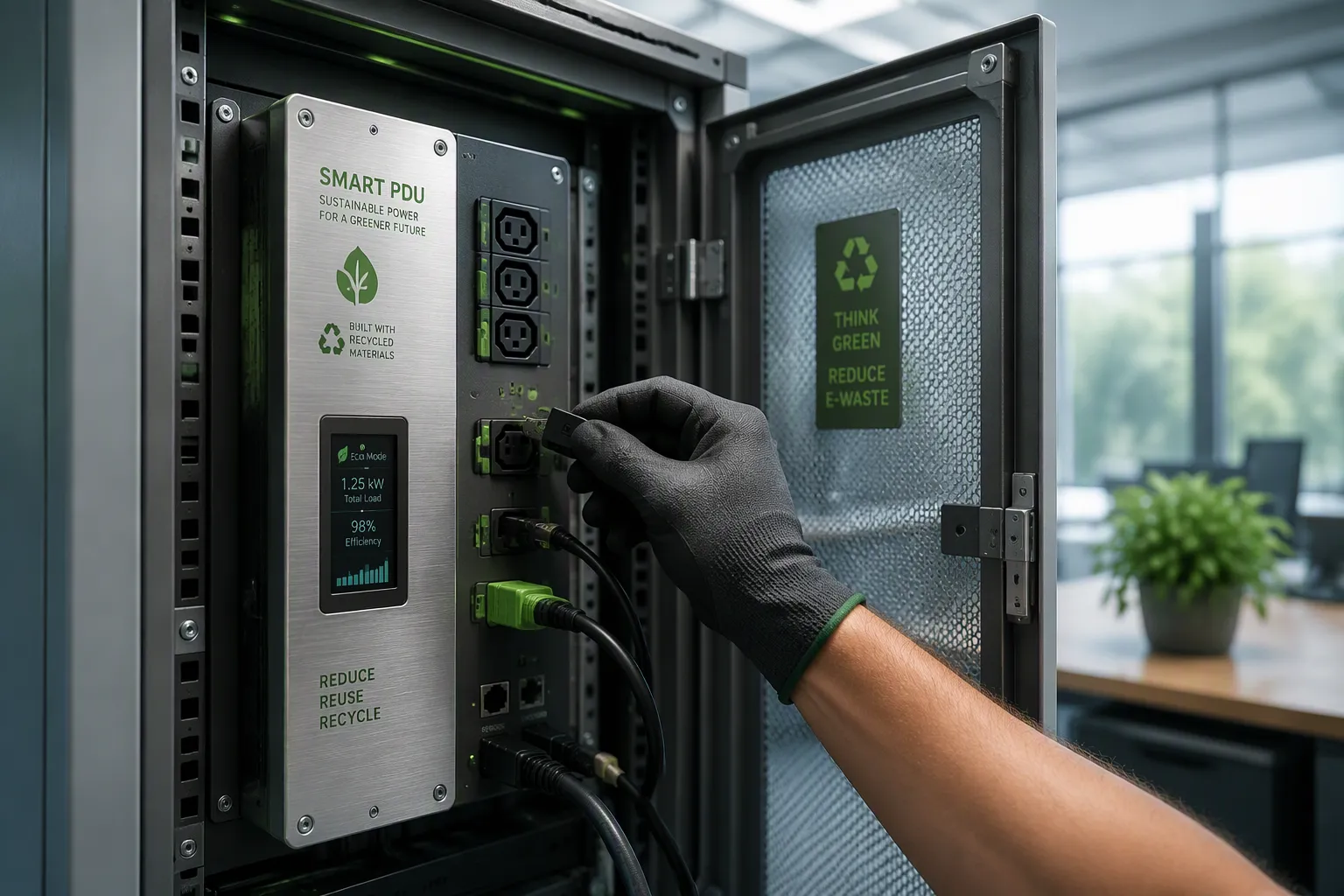
Recyclable material design in smart PDUs reduces e-waste in a direct way. It enables material recovery at end of life. Recoverable metals and plastics stay out of landfill and return to the supply chain instead.
You have a real stake in this choice. Telecom cabinets go into the field in large numbers. They also get replaced on predictable cycles. Each PDU material decision therefore compounds over time. Global e-waste generation reached about 62 million metric tons in 2022, nearly double the 2010 level. Better material choices at the cabinet level help shrink that stream.
ESTEL treats recyclable PDU design as an engineering and procurement decision, not a slogan.
Key Takeaways
Recyclable materials in smart PDUs keep metals and plastics out of landfills and return them to the supply chain.
Design features like modular parts and standard fasteners make it easy to separate components for recycling.
Recycled plastics and aluminum can meet the same performance needs as new materials when properly tested.
Recyclable designs often save energy and reduce costs over the product's life, despite some qualification effort.
Add recyclability criteria to your specifications and start with a pilot program to phase in recyclable PDUs.
Recyclable Materials for Smart PDU Performance
Metals, PCR Plastics, and Recyclable PCBs
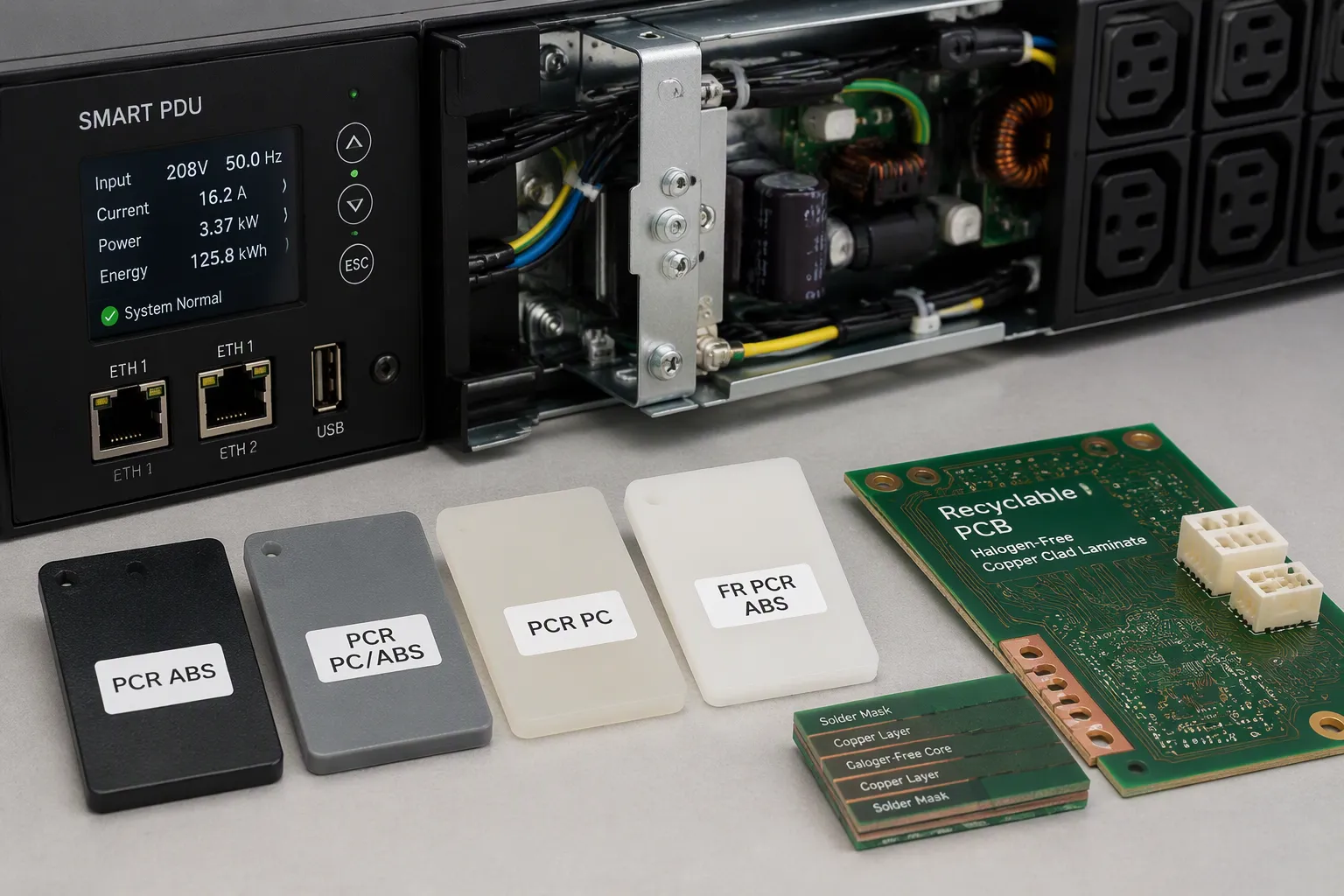
Post-consumer recycled (PCR) plastics offer a practical path away from virgin resin. You can specify PCR grades for housings, bezels, and internal brackets. The table below shows where each grade fits and how it compares with virgin material.
Material | Typical Electronics Applications | Key Performance Characteristics vs. Virgin |
|---|---|---|
PCR ABS | Router housings, monitor bezels, small appliance housings | Comparable impact and rigidity balance, surface appearance, and moldability; cosmetic parts need checks on color stability, black specks, odor, and batch consistency |
PCR PC/ABS | Laptop and monitor housings, charger housings, adapters | Higher impact resistance, heat resistance, and dimensional stability; improved processing and flexibility |
PCR PC | Electronic housings, lighting components, structural parts | Retains high impact resistance and heat resistance of virgin material |
FR PCR ABS / PC/ABS | Chargers, adapters, power-related enclosures | Recycled content with specified flame-retardant (UL94) performance; confirm the exact grade and thickness |
Qualify each grade against virgin on melt flow index, impact strength, tensile and flexural properties, heat resistance, surface appearance, and flame retardancy. One major OEM reported 18.6% PCR use in computers and monitors in 2024, with a 2025 target of 20–30%. PCR cannot replace virgin resin everywhere, though. High-spec parts still demand stable heat resistance and a premium finish, and post-consumer feedstock can carry contamination and variable composition.
Recyclable PCB design starts with material simplification. You reduce the number of resin systems and laminate types on one board. You also choose fasteners and connectors that separate cleanly. Halogen-free copper clad laminate cuts toxic gas emissions during manufacturing and at end-of-life disposal. EU RoHS and WEEE drive this shift, and REACH reinforces the restrictions.
Greener Interconnects and Duty-Cycle Fit
Interconnect material choices carry real environmental weight. Many brominated and chlorinated flame retardants are endocrine disruptors, and they tend to be persistent, bio-accumulative, and toxic. Improper recycling can let these compounds leak into the environment and enter the food chain. Uncontrolled burning releases toxic and corrosive gases. Lead-free and halogen-free interconnects keep these chemicals out of air and groundwater.
Recycled aluminum adds a further gain for housings and heat sinks. It needs over 90% less energy than primary production and prevents 97% of the emissions compared with new aluminum. Each recycled tonne saves 9 tonnes of CO2 and 4 tonnes of bauxite.
Match every material to the telecom duty cycle. Cabinet PDUs run continuously at moderate load, so heat resistance and dimensional stability matter more than peak surge capability. State your thermal and mechanical requirements in the specification. Then ask the supplier for test data at those conditions. This approach keeps performance claims grounded and avoids overstatement. A well-qualified Smart PDU material set meets the same electrical and monitoring duties as a conventional build.
Design Principles for Recovery
Modularity, Disassembly, and Labeling
Eco-design standards give you a factual basis for recovery requirements. EN 45552 covers durability assessment. EN 45554 addresses repair, reuse, and upgrade. EN 45555 covers recyclability, and EN 45557 assesses recycled content. EN IEC 62430 sets out environmentally conscious design principles. These standards assess material-efficiency aspects. They do not prescribe design details, so you translate them into your own specification.
Standard | Aspect addressed |
|---|---|
EN 45552 | Durability of products |
EN 45554 | Ability to be repaired, reused and upgraded |
EN 45555 | Recyclability |
EN 45557 | Recycled content |
EN IEC 62430 | Environmentally conscious design (ECD) |
Labeling and fastening choices decide whether separation is practical at end of life. Mark every polymer part with its resin identification code, moulded in rather than printed. Keep material diversity low and select mutually compatible materials. Avoid paints and metallized coatings on parts intended for recycling, because they contaminate the recycling stream. Design battery and electronics removal as the first teardown step.
Fastener selection matters just as much. Captive screws of a single driver type allow fast, clean separation with full part reuse. Reversible snap fits with access features separate quickly at low assembly cost. Adhesive bonding and ultrasonic welding are destructive and contaminate material streams. Reduce the number and variety of fasteners, standardize types across the design, and use connectors instead of permanent hard-wired connections.
Design features like non-permanent adhesives, standardized fasteners, and layered modular assemblies make it easier to separate components at the end of a product's life.
Durability, Reparability, and Compliance
Durability and reparability belong in the same specification as recyclability. EN IEC 62430 clause 6.2 covers assessment of reliability and durability. Clause 6.4 covers repair, reuse, and upgrade under EN 45554. Clause 6.5 covers recyclability and recoverability under EN 45555. You can cite these clauses directly when you write procurement criteria.
Compliance does not weaken application fit. A PDU built to these principles still meets its electrical, thermal, and monitoring duties. State the standards in your specification and ask suppliers for assessment evidence against each one. This keeps the discussion factual and standards-based.
How Recyclable Design Cuts E-Waste
Longer Life and Easier Repair
Durability and reparability directly shrink the replacement stream. A unit that stays in service longer needs fewer replacements. Each avoided replacement keeps a full assembly out of the waste pile.
Modular architecture makes this practical. You can swap monitoring modules without pulling the whole unit. The rack PDU's monitoring modules are interchangeable and hot-swappable, so upgrades can be performed without interrupting operation. Because the equipment is scalable, its service life is significantly extended. A Smart PDU built this way lets you add capacity in stages instead of replacing the cabinet. You keep spares strategies consistent and cut downtime during upgrades.
Cleaner End-of-Life Recovery
Recovery quality depends on how cleanly you can separate materials. Labeled polymers, single-driver fasteners, and snap fits all raise the yield of usable fractions. Upcycling then turns that sorted e-waste into functional, high-value materials rather than low-grade scrap.
The recovery chain follows a predictable sequence:
Disassemble the unit and remove hazardous components. Sort metal-bearing fractions such as printed circuit boards.
Reduce metal-containing parts with shredders, grinders, or pulverizers.
Separate fractions by shape, density, conductivity, and magnetism. Magnetic separation recovers ferrous metals most effectively before crushing.
Apply thermal or chemical routes for high-value metals. Microrecycling can recover rare earth elements from battery anodes at a 90–100% recovery rate.
These processes carry real limits. Precious metals can be lost, purity stays imperfect, and energy costs run high. Treat upcycling as one end-of-life path among several, not a guarantee. Design for clean separation first, and recovery performance follows.
Smart PDU Materials: Recyclable vs. Conventional
Performance, Fit, and Compliance
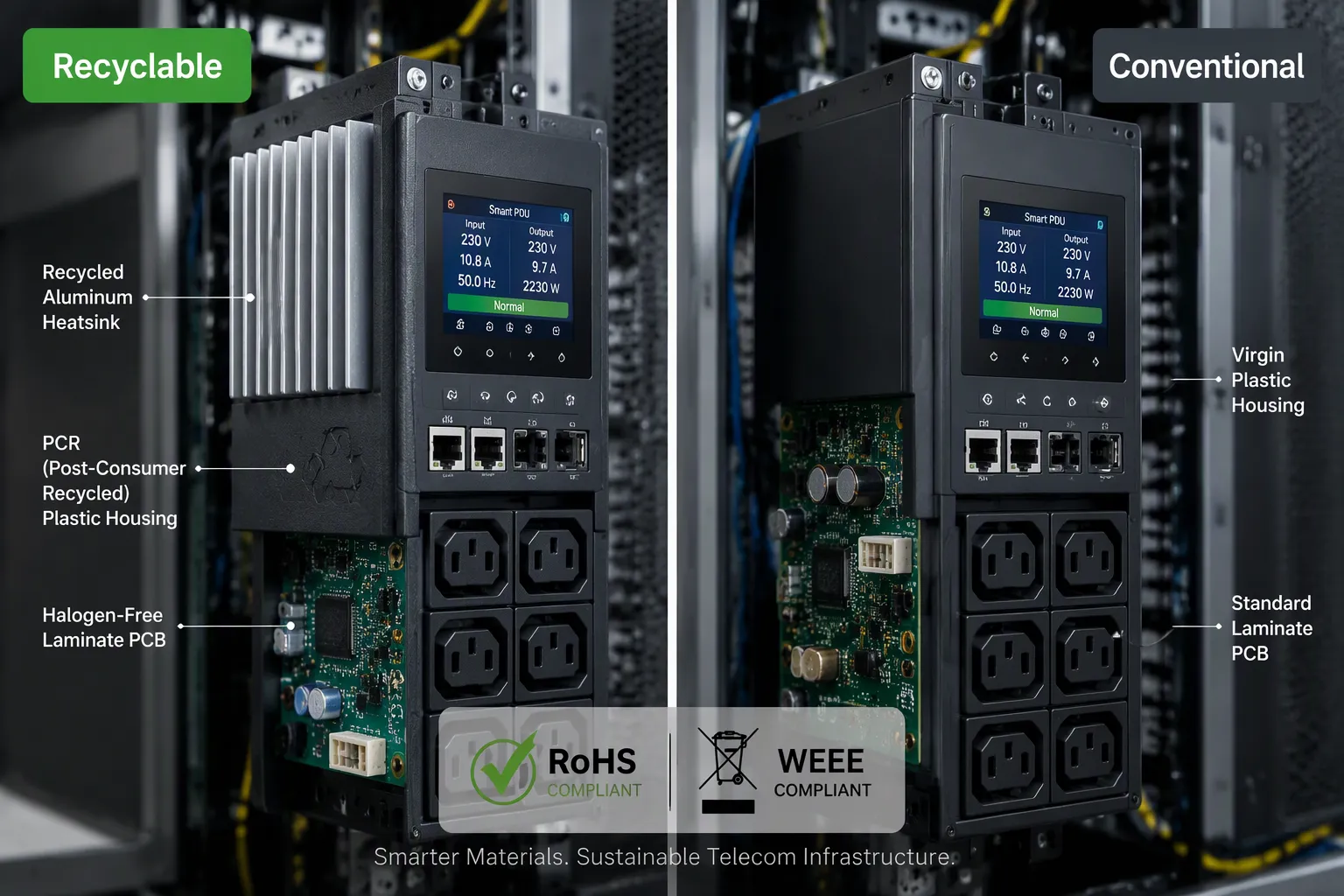
Both material paths can meet the electrical and monitoring duties of a cabinet PDU. The difference shows up in how each option handles heat, mechanical stress, and long service. Recyclable builds lean on PCR plastics, halogen-free laminates, and recycled aluminum. Conventional builds lean on virgin resins and established laminate systems. Virgin grades offer the most predictable batch-to-batch behavior. That predictability matters in high-heat or high-vibration positions. Recyclable grades close much of the gap once you qualify them against melt flow, impact, and heat resistance data.
Application fit decides more than raw material labels. A cabinet PDU runs continuously at moderate load. Recyclable materials suit this duty cycle well, because dimensional stability and heat resistance carry more weight than peak surge tolerance. Conventional materials remain the safer fit for legacy designs with fixed tooling, or for positions where a qualified recyclable grade is not yet available. Neither path is universally better. Each one fits a different point on the maturity curve.
Compliance is not a differentiator in principle. Eaton's PDUs, which incorporate recyclable materials, are designed to meet global environmental standards including RoHS and WEEE compliance, minimizing environmental impact across the product lifecycle. Conventional PDUs meet the same directives. Ask suppliers for declaration evidence either way, and confirm the exact grade and thickness behind any flame-retardancy claim.
Cost and Best-Fit Scenarios
Cost comparisons shift with volume, feedstock, and qualification effort. Recycled aluminum needs over 90% less energy than primary production, so the material cost case strengthens as energy prices rise. PCR resins can trade at a discount to virgin grades, yet contamination and variable composition add sorting and quality-control cost. Conventional materials carry lower qualification risk and simpler supply chains. Treat the comparison as total cost of ownership, not unit price alone.
Factor | Recyclable Build | Conventional Build |
|---|---|---|
Technical performance | Meets PDU duties after grade qualification | Most predictable batch behavior |
Application fit | Continuous moderate-load cabinets, new designs | Legacy designs, fixed tooling, unqualified positions |
Regulatory compliance | RoHS and WEEE achievable | RoHS and WEEE achievable |
Cost profile | Energy savings offset by qualification effort | Lower qualification risk, simpler supply |
Choose the recyclable path for new cabinet programs with room to qualify grades and specify labeling. Choose the conventional path where tooling is fixed or a qualified recyclable grade is not yet proven. Many programs run both, phasing recyclable materials into new builds while conventional units stay in service. ESTEL may sell every option compared here, so evaluate each on your own duty cycle, compliance evidence, and total cost.
Adopting Recyclable Smart PDUs
Specifying and Evaluating
Add recyclability, reparability, and material-labeling criteria to your procurement specifications. These criteria turn a vague green preference into a checkable requirement. Ask each supplier for evidence against every criterion, not a general statement of intent.
Green manufacturing and recycling programs belong in the same specification. Treat them as part of a sustainable power electronics practice, not a separate initiative. The table below maps each practice area to a concrete integration action.
Practice Area | Integration Action |
|---|---|
Design for reuse | Build durable products rated for multiple lifecycles; reuse packaging, trays, and fixtures across runs |
Design for repair and remanufacture | Use modular sub-assemblies and standard fasteners; add accessible diagnostic points; ensure spare-part availability |
Design for recycling and recovery | Add clear material labeling; avoid unnecessary coatings and mixed-material assemblies; engage recycling partners early |
Eco-friendly materials | Replace hazardous substances with safer alternatives; comply with RoHS; source from responsible suppliers |
Energy efficiency | Optimize architectures to cut power consumption; deploy real-time energy management |
Waste reduction | Apply lean manufacturing; run recycling programs for metals and plastics |
Score each bid against these rows. A supplier who cannot show a recovery fallback plan has not closed the loop.
Partnering with ESTEL
ESTEL works with you across evaluation, specification, and rollout. Start with a pilot cabinet program. Qualify recyclable grades against your duty cycle, then write the results into your standard specification. This sequence keeps risk low and builds evidence you can reuse.
Look for a partner with a working green program, not just a policy page. Versa Electronics offers a useful model. The firm prioritizes renewable energy across facilities and equips production lines with energy-saving machinery. It also runs a recycling and waste-management program that repurposes components wherever possible. Supplier partnerships complete the chain. Versa frames these measures as delivering cost savings, regulatory compliance, and stronger brand reputation.
Ask your Smart PDU supplier the same questions. Which materials carry labels? Which fasteners allow clean separation? Which parts ship as spares? ESTEL treats these answers as engineering deliverables, so your rollout rests on verified practice rather than claims.
Recyclable material design lets a Smart PDU deliver the same power distribution and monitoring value while improving end-of-life recovery. That is the green choice in one sentence.
You can balance performance, application fit, compliance, and cost through thoughtful material and design choices. Run a power audit, match input voltage and phase to your infrastructure, and select modular units that expand without an overhaul. Choose manufacturers that prioritize sustainability and hold certifications such as ISO9001, UL, and CE. Evaluate total cost of ownership rather than initial price.
Prioritize scalability and energy efficiency to future-proof the investment, and evaluate the data center's unique needs before selecting a PDU.
Add recyclability criteria to your specifications, then work with a partner such as ESTEL to put them into practice.
FAQ
What makes a smart PDU recyclable by design?
A recyclable PDU separates cleanly at end of life. You look for labeled polymer parts, single-driver captive screws, and snap fits instead of adhesives. Halogen-free laminates and recycled aluminum help too. These features let you recover metals and plastics as usable fractions rather than mixed scrap.
Do recycled materials weaken PDU performance?
Not when you qualify each grade. PCR plastics and recycled aluminum can meet the same electrical and monitoring duties as virgin materials. Ask for test data on melt flow, impact strength, and heat resistance at your cabinet's duty cycle. Continuous moderate load suits these materials well.
How do I check a supplier's recyclability claims?
Ask for evidence against named standards, not general statements. EN 45555 covers recyclability and EN 45557 covers recycled content. Request the exact grade and thickness behind any UL94 flame-retardancy claim. A supplier who cannot show a recovery plan has not closed the loop.
Where do conventional materials still fit best?
Conventional builds remain the safer choice for legacy designs with fixed tooling. They also fit positions where no qualified recyclable grade is proven yet. Virgin resins offer the most predictable batch-to-batch behavior in high-heat or high-vibration spots. Many programs run both paths side by side.
Can I phase recyclable PDUs into an existing cabinet fleet?
Yes. Start with a pilot cabinet program and qualify recyclable grades against your duty cycle. Write the results into your standard specification, then expand to new builds. Conventional units stay in service until their normal replacement cycle. This sequence keeps risk low and builds reusable evidence.
See Also
Eco-Friendly and Intelligent Outdoor Telecom Cabinets for the Year 2025
Solar Energy Storage Power Systems Designed for Telecom Cabinets
New and Upcoming Trends Shaping Outdoor Telecom Cabinets Today
Essential Material Requirements for Outdoor Telecom Cabinet Construction
CALL US DIRECTLY
86-13752765943
3A-8, SHUIWAN 1979 SQUARE (PHASE II), NO.111, TAIZI ROAD,SHUIWAN COMMUNITY, ZHAOSHANG STREET, NANSHAN DISTRICT, SHENZHEN, GUANGDONG, CHINA
