Smart PDU Corrosion Resistance for Offshore Communication Platforms in 2026

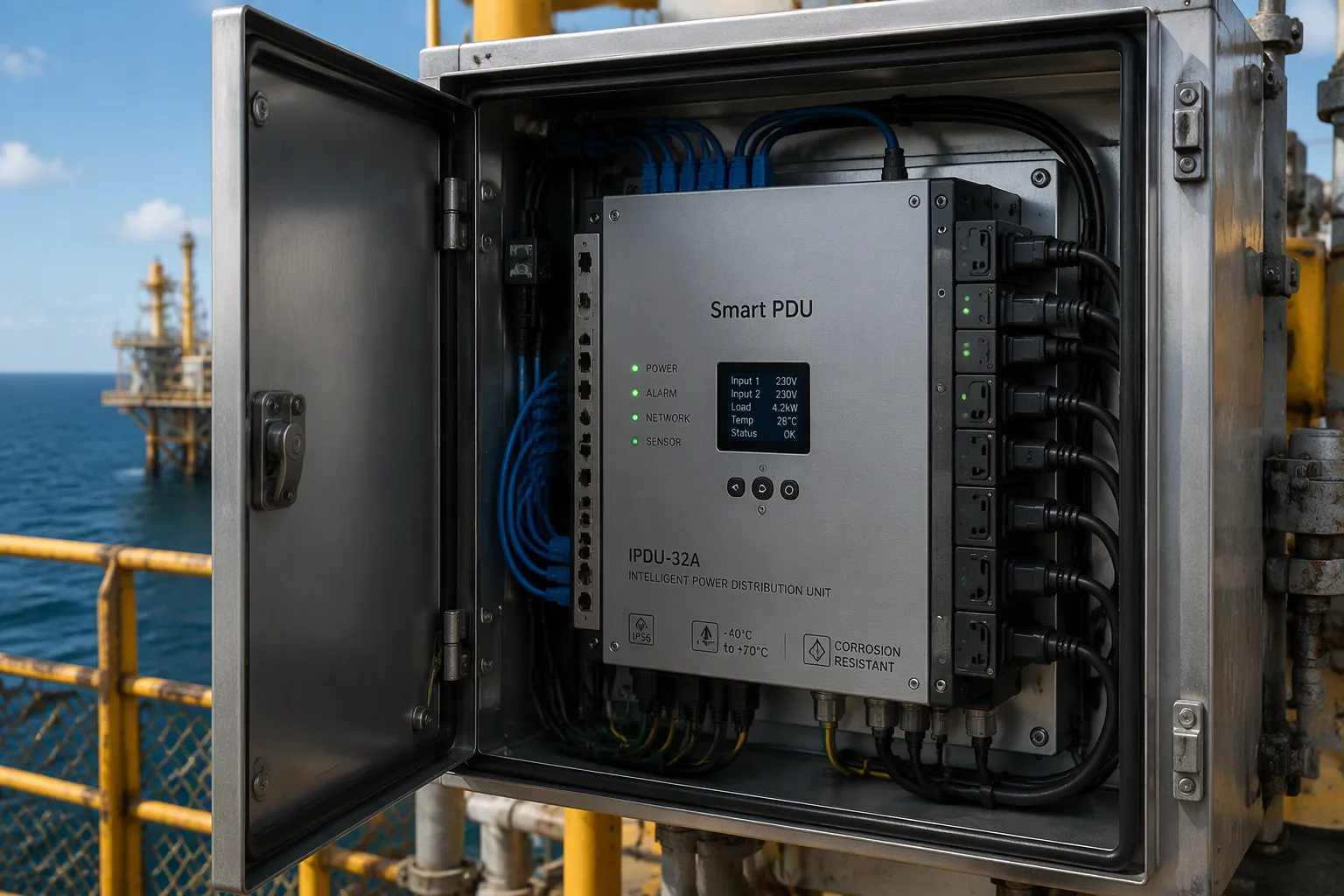
You protect a smart pdu in high-salinity offshore environments through four proven strategies: sealed enclosures, conformal-coated boards, marine-grade plating, and active dehumidification. Each layer blocks salt-laden moisture from reaching sensitive electronics. Corrosion resistance determines whether your communication platforms stay online or fail without warning.
The stakes run high. A corroded PDU can trigger unplanned downtime, and maintenance access on offshore platforms is slow, costly, and sometimes hazardous. Safety depends on reliable power distribution in these remote locations.
This guide gives you concrete technology, selection, maintenance, compliance, and cost guidance for 2026 deployments. You will learn how each protection layer works and how to specify equipment that survives salt air year after year.
Key Takeaways
Use four protection layers: sealed enclosures, conformal-coated boards, marine-grade plating, and active dehumidification.
Choose materials and coatings that resist salt spray, such as 316L stainless steel and polyurethane coatings.
Specify enclosures with both IP and NEMA 4X ratings to ensure salt-spray protection.
Schedule regular inspections and use thermal monitoring to catch corrosion early.
Compare total cost of ownership, not just purchase price, to save money over time.
How Salt Air Attacks Smart PDUs Offshore
Salt Fog, Humidity, and Galvanic Corrosion
Salt fog, humidity cycling, and galvanic corrosion act as distinct mechanisms. They compound each other in marine air. Salt fog deposits chloride-rich droplets on every surface. Humidity cycling drives moisture into seams and connectors during cool nights, then pulls it out during warm days. This breathing action concentrates salts and accelerates attack. Corrosion rates in marine environments accelerate with variations in water conditions, so a platform that sees alternating wet and dry cycles degrades faster than one kept at a steady state.
Saltwater acts as a highly efficient electrolyte. This is the key reason it aggressively accelerates galvanic corrosion on exposed enclosure surfaces. You create a galvanic cell whenever two dissimilar metals touch in the presence of that electrolyte.
Threading a 316L stainless bolt into an aluminum enclosure wall creates a galvanic cell, with saltwater serving as the electrolyte and the aluminum sacrificing itself.
Chloride ions also attack stainless steel directly. They penetrate and break down the passive chromium oxide layer. This initiates pitting corrosion that propagates downward into the metal. A pit forming under a gasket or behind a hinge becomes a crevice that is oxygen-starved, acidic, and self-accelerating.
Common Failure Modes on Platforms
Four failure modes dominate on offshore communication platforms. Connector pitting tops the list. Pits grow at plated pins and socket contacts, and resistance climbs until the link drops. PCB trace degradation follows. Moisture films bridge fine traces, and chloride residue eats copper until traces open. Enclosure seal failure ranks third. Gaskets harden, compress, and lose their seal, which lets salt fog reach interior electronics. Surge-related faults complete the pattern. Corroded grounding paths raise impedance, so a lightning strike or switching transient finds a weaker route through sensitive circuits.
These failures share one root cause. Moisture carries chloride ions to vulnerable interfaces. You cannot stop salt air from reaching the platform. You can stop it from reaching the electronics inside your PDUs. The next sections show how materials, coatings, and sealed enclosures break that path.
Corrosion-Resistant Materials and Coatings

Material selection is your first line of defense against salt spray corrosion. You choose the right substrate and finish before you worry about anything else. Advanced plating solutions used in offshore wind components show what long-term reliability looks like. High-performance epoxy and polyurethane systems, applied at 500–1000 microns under controlled factory conditions, ensure optimal adhesion and coverage. Thermal spray aluminum combined with sealer coatings achieves corrosion protection life exceeding 25 years on transition pieces and tower sections. You can apply the same thinking to PDU hardware.
Conformal Coatings and PCB Protection
A conformal coating seals the PCB surface from chloride-laden moisture. Different chemistries suit different threats. The table below summarizes the main options.
Coating Type | Protection Relevant to High-Salinity Offshore Use |
|---|---|
Silicone | Exceptional moisture protection for high-humidity and condensation exposure; performs well under thermal cycling and vibration |
Parylene | Exceptional moisture protection with uniform coverage for high-reliability electronics |
Polyurethane | Superior chemical resistance against fuels, solvents, and harsh cleaning chemicals; suited to harsh environments |
Epoxy | Superior chemical resistance and outstanding mechanical durability for harsh conditions |
Polyurethane and epoxy earn their place in harsh environments where abrasion and chemical attack matter. Silicone handles thermal cycling and condensation. Parylene delivers uniform coverage on high-reliability boards. Some high-performance conformal coatings provide additional salt-spray protection. Specify the coating to match the dominant threat at your site.
Marine-Grade Metals and Plating
Metal choice determines how long the enclosure body survives. The table below compares common options.
Metal / Plating Method | Marine Suitability | Notes |
|---|---|---|
316L Stainless Steel | Excellent | Heavy, high cost; suited for coastal and chemical environments |
Titanium | Excellent | Light, very high cost; for extreme marine exposure |
Copper alloys (naval brass) | Excellent seawater resistance | High cost |
Anodizing (Type III) on aluminum | Very good | 25–75 µm; improved salt-spray resistance; best combined with powder coat |
Hot-dip galvanizing | Excellent (sacrificial) | 45–85 µm; ideal for structural parts |
Zinc plating | Moderate | 5–25 µm; for fasteners and small brackets |
Nickel plating | Good | 10–50 µm; moderate outdoor use |
Galvanized base + powder coat topcoat | Excellent long-term (15–20 yrs) | Sacrificial zinc protection plus UV and aesthetic benefits |
Hot-dip galvanizing excels in outdoor and harsh-environment applications; its thick coating provides superior corrosion protection and is considered ideal for marine environments.
For offshore enclosures, specify a galvanized base with a powder-coat topcoat where long service life of 15–20 years is required. This combination pairs sacrificial zinc protection with UV and aesthetic benefits. Use hot-dip galvanizing for heavy structural components needing cathodic protection. Choose zinc or nickel plating for small parts that require tight tolerances. For aluminum enclosure bodies, Type III hard anodizing, optionally with powder coat, is the go-to process for salt-spray resistance. ESTEL's outdoor battery cabinets use anti-corrosion powder coating, which illustrates a proven finish approach for harsh outdoor telecom sites. You should also separate dissimilar metals to prevent galvanic attack at joints. Insulating washers and plated fasteners help. These marine-grade components keep corrosion resistance for salt-air exposure intact across platforms.
Sealed Enclosures and Connector Design
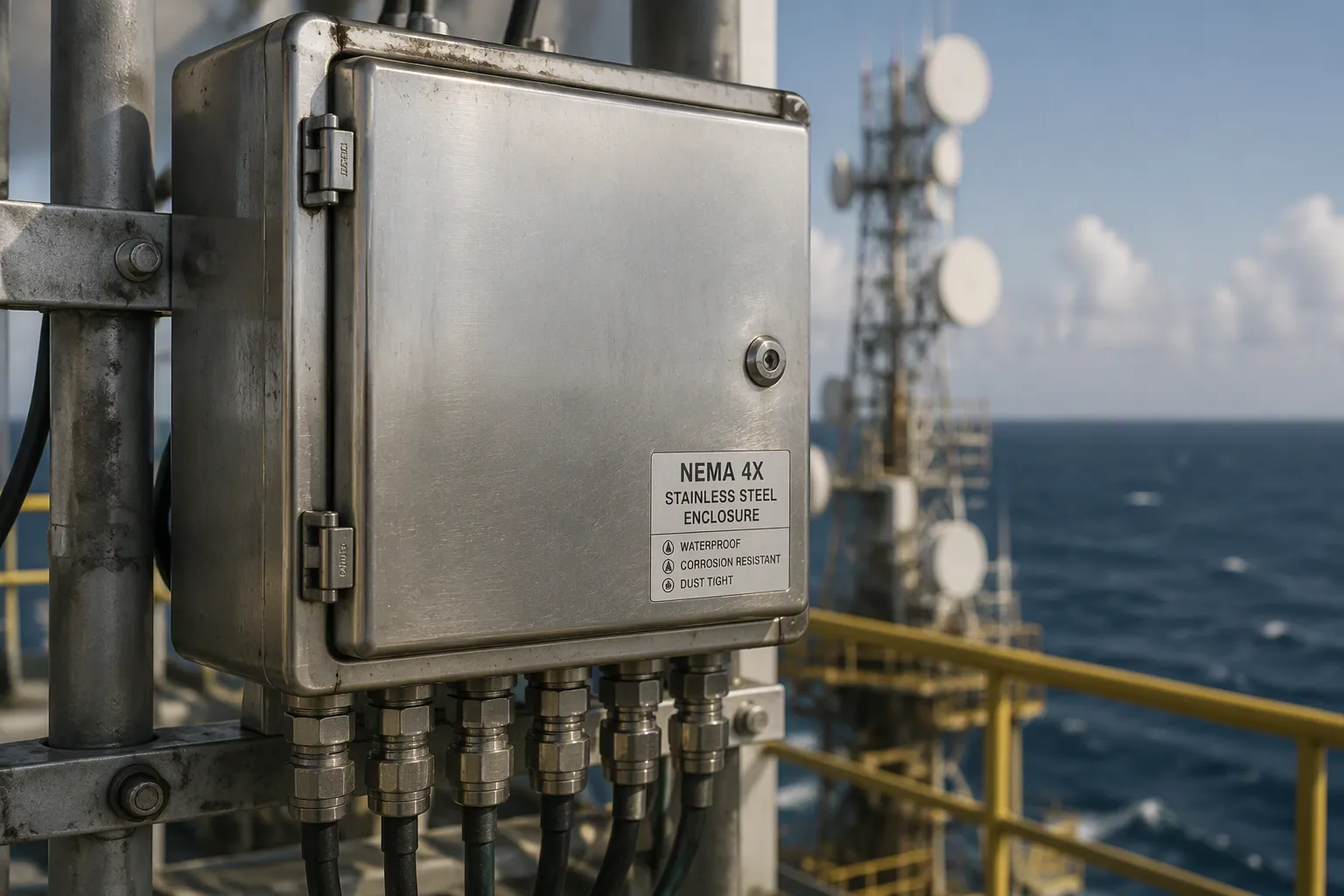
A sealed enclosure is your last physical barrier against salt air. You must choose the right rating for the environment, then seal every cable entry and plate every contact.
IP and NEMA Ratings Explained
Ingress protection ratings tell you how well an enclosure resists dust and water. They do not tell you how well it resists corrosion. This gap matters offshore. A manufacturer installed control panels in a coastal facility and specified IP66 enclosures because IP66 provides excellent protection against water jets, and the initial installation looked perfect. Within 18 months, the panels showed significant corrosion because salt air had compromised the enclosures, and IP66 doesn't include corrosion testing. The facility spent over $50,000 replacing panels and experienced production downtime during the swap when they should have specified NEMA 4X.
The test regimes differ in ways that matter to you.
Parameter | NEMA 4X water test | IP66 water test |
|---|---|---|
Flow rate | 240 L/min | 100 L/min |
Pressure | 31 kPa | 100 kPa |
Distance | 3 m | 3 m |
Corrosion testing | 1,200 h moist SO2/CO2 + 800 h salt spray | Not included |
Ice formation | Tested (latches/mechanisms operable) | Not tested |
NEMA 4X enclosures are recommended for most marine and offshore environments, providing protection against corrosive salt spray, high humidity, and water ingress, and are validated by a rigorous 200-hour salt spray test. For docks, coastal installations, vessels, and offshore platforms exposed to salt spray, water immersion, and fluctuating temperatures, IP68-rated connectors and sealed panel-mount enclosures are recommended. Corrosion-resistant materials such as nickel-plated brass or polymer housings are preferred to prevent liquid ingress and corrosion-related failure. On marine decks, specify IP66 plus NEMA 4X stainless. IP66 covers driving rain and deck wash, while NEMA 4X covers salt-water corrosion. Cross-rating mappings are approximate, so confirm that the manufacturer publishes both ratings.
Sealed Cable Entries and Plated Connectors
Cable entries are the weakest point in any sealed box. Exposed, air-insulated components generally fail offshore because moisture reaches bare metal. Start with the cable itself. Confirm its construction, bedding diameter, armor range, and overall diameter. Verify the thread type and size against the equipment entry. Then assess the environment. Offshore and corrosive locations may require stainless steel or suitable protective finishes. Check the IP rating and decide whether you need sealing washers, shrouds, or additional sealing methods.
Material choice drives long-term reliability. Use stainless-steel hardware, nickel-plated shells, UV-stabilized thermoplastics, and protected copper-alloy contacts. Gold-plated signal contacts resist film growth. Marine bronze coupling nuts resist galling. Dual O-rings with 90 Shore hardness resist extrusion under pressure, and replaceable Nitrile O-rings simplify field service. Seal elastomer selection matters too. Silicone suits broad temperature ranges, EPDM handles weathering and water, and Nitrile compounds suit petroleum-related environments. Prevent capillary water migration along conductors and avoid low collection points. Consider drainage, pressure equalization, potting, and breathable membranes alongside the connector seal.
ESTEL's Smart Power Distribution Unit shows how these principles come together. It includes a dehumidifying function that manages internal moisture, surge protection that guards connected equipment, and a cable plug system compliant with IEC60309 standards. Its robust build suits industrial environments, and the dehumidifying function supports humidity and condensation tolerance inside smart pdu cabinets. The unit offers 8 to 19 outlets, 16A maximum input, LCD monitoring, and remote management. That combination of sealed design, marine-grade connectors, and active moisture control gives your platforms a defensible corrosion strategy.
Selecting a Smart PDU for Offshore Duty
Specification Checklist for 2026
You need a written checklist before you compare quotes. Start with ingress protection. Demand a published IP rating plus a NEMA 4X claim for salt-spray exposure. Next, confirm the coating type on both the enclosure and the circuit boards. Ask for the conformal coating chemistry and the plating thickness on every connector shell.
The table below organizes the remaining items into a working checklist.
Checklist Item | What to Specify |
|---|---|
Ingress protection | IP rating plus NEMA 4X for salt spray |
Coating type | Named conformal coating chemistry; powder coat over galvanized base |
Connector plating | Gold-plated signal contacts; nickel-plated shells |
Dehumidification | Active internal moisture control |
Remote monitoring | Remote management plus LCD readout |
Outlet configuration | Outlet count matched to rack load |
ESTEL's smart pdu meets several of these points directly. It offers 8 to 19 outlets, a 16A maximum input, LCD monitoring, and remote management. The dehumidifying function handles internal moisture. Treat this list as your baseline and score every candidate against it.
Vendor Evaluation Criteria
Judge vendors on evidence, not sales language. Request test reports for salt spray and ingress protection. Ask whether the supplier builds the enclosure and the power distribution units in one facility, because integrated production simplifies sealing and cable entry design. Check quality management certification, then confirm the vendor publishes documentation you can audit.
Compare power distribution units across the same criteria. A qualified supplier should explain how its pdus handle condensation, surge events, and connector corrosion. ESTEL is one qualified supplier offering integrated outdoor telecom cabinet and smart pdu solutions, and you can evaluate it alongside other vendors using this framework. Ask each candidate about thermal monitoring and online monitoring support. Remote sensing helps you spot rising contact resistance before a link fails. Finally, confirm spare parts availability and technical support response for offshore platforms. Score each vendor on documented answers, and let the checklist decide.
Installation and Maintenance Best Practices
Mounting, Sealing, and Cable Routing
Mount your pdus above deck splash zones and away from low-lying wet areas. Elevate the cabinet from ground moisture and avoid spots with poor drainage. Face cable entries downward or sideways, never directly toward rain. Fit correctly sized cable glands rated to the required IP/NEMA level, add sealing washers where needed, and tighten each gland properly. Seal every unused hole. Avoid oversize holes you cannot seal. Use drip loops and gland plates to stop water from traveling along cables into the enclosure. Protect cut edges after any field drilling, and control all field modifications.
Gasket work decides whether the door seal holds. Follow these steps:
Match the gasket material to the environment: neoprene for general weathering, silicone for wide temperature range, EPDM for water and ozone resistance.
Size O-rings with slight stretch and moderate compression, and avoid over-compression that damages the ring.
Lubricate with compatible grease, avoid twisting, and use proper tools.
Ensure uniform compression with compression stops and fasteners placed around the perimeter.
Clean both mating surfaces and align the gasket correctly.
Inspect for hardening, cracking, or flattening, and replace gaskets at regular intervals.
Verify waterproofing rather than assume it. A submersion test of 30 minutes at 1 m depth and IP rating tests simulate real rain and splash conditions. Seals degrade with temperature changes and frequent use, so re-test regularly.
Inspection and Corrosion Monitoring
Build a scheduled inspection routine around seal integrity, connector condition, and busbar connection temperature monitoring. Loose or oxidized joints raise resistance, and busbar joint overheating often signals early busbar connection degradation. Thermal monitoring and online temperature monitoring catch these trends before a link fails. Online monitoring of busbar overheating gives your maintenance team a clear trigger for intervention on remote platforms.
Smart corrosion monitoring systems for offshore wind turbines use the ultrasound pulse-echo technique. A transducer injects a short ultrasonic burst, then reads the echo returning from the back wall. Wall thickness follows from the time of flight:
d = c × ToF / 2, where c is the speed of sound in the material and ToF is the measured time of flight.
Thickness loss tracks corrosion progress at the sensor location. Apply the same principle to inspection schedules for your PDUs. Trend the readings, then shorten or extend inspection intervals based on measured loss.
Compliance for Marine and Offshore Installations
Standards and Certifications to Verify
Compliance starts with a paper trail you can check. Ask each supplier which standards its smart PDU actually meets, then request the declaration that names them. The table below lists the categories worth verifying for 2026 projects.
Category | Items to Verify |
|---|---|
Applicable standards and certification | IEC 62368-1 (ICT equipment safety); IEC 60529 (enclosure protection); IEC 61000 series (electromagnetic compatibility); IEC 60092-504 (shipboard electrical installations, where applicable) — confirm via manufacturer declaration |
Class approval | Marine class approval is not universal for commercial rack PDUs; where required, use a model with documented type approval or acceptance from DNV, ABS, Lloyd's Register, Bureau Veritas, or ClassNK, per vessel project and flag requirements |
Add IEC 60309 plug compliance, the published IP and NEMA ratings, and ISO9001 quality management to your own list. Class approval depends on the vessel project and flag state, so confirm the requirement before you shortlist hardware for marine and offshore installations.
Documentation and Audits
Request a documentation package before you sign off a 2026 deployment. A Declaration of Conformity gives you the manufacturer's attestation, the standard reference, the applicable conditions, and the responsible person's name, position, and signature. An operating and maintenance manual supplies maintenance intervals, proof test procedures, and inspection criteria. Where a project includes safety-instrumented functions, ask for the safety requirements specification, the verification report, and the hardware fault tolerance analysis.
Fabrication records complete the picture. Collect these items for any welded or coated enclosure work:
Welding Procedure Specifications (WPS)
Procedure Qualification Records (PQR)
Welder Qualification Test Records (WQTR)
Material certificates, such as 3.1 or 3.2
Non-Destructive Testing (NDT) reports
These records form a linked golden thread from material source to final installation. Third-party certifiers use that thread to confirm fabrication history. Audits then close the loop. Walk the supplier's factory, check that the declared coating and plating match the build, and verify document revision control. Do the same on your platforms during commissioning. A signed audit report turns a stack of certificates into evidence you can defend.
Cost and Lifecycle Considerations
Upfront Cost Versus Total Cost of Ownership
A low purchase price rarely reflects the real cost of a smart PDU offshore. You pay for inspection labor, replacement parts, and downtime risk across the full service life. Each offshore maintenance trip carries vessel time, crew hours, and weather delays. A cheap unit that fails early forces repeated trips and erodes your budget fast.
Compare quotes on total cost of ownership instead of sticker price. Ask each vendor how its design reduces inspection frequency and part replacement. A sealed enclosure with proven ingress protection and marine-grade plating costs more upfront. It also cuts the number of fault-finding visits you schedule each year. Multifaceted corrosion protection approaches reduce costly failures over the asset lifecycle, so the higher initial spend often pays back through fewer emergency interventions.
Budgeting for Maintenance and Replacement
Build a maintenance line item into your 2026 budget from day one. Include scheduled seal inspections, gasket replacement, connector checks, and spare PDU units held on the platform. Track busbar joint overheating during routine rounds, because a loose or oxidized joint signals early degradation. Add thermal monitoring to your remote sensing plan and let it trigger intervention before a link drops.
Replacement budgeting deserves the same discipline. Corrosion damage rarely appears all at once, so trend your inspection records and forecast which units will need swapping. Hold critical spares offshore to avoid long supply delays. Review the budget annually against measured condition, and shift funds toward units that show the fastest degradation. This approach keeps platforms online and spreads cost predictably across the asset lifecycle.
You now have a clear path for 2026 procurement. Prioritize sealed enclosures with proven IP and NEMA ratings. Specify conformal-coated boards and marine-grade connectors. Build inspection and thermal monitoring into your maintenance plan from day one.
Treat the selection checklist and compliance documentation as your decision anchors. Score every candidate against them, then confirm the paperwork before you commit.
Weigh total cost of ownership, not sticker price. Engage qualified suppliers such as ESTEL for specification support on your smart pdu and cabinet package.
Looking ahead, monitoring-enabled PDUs will cut long-term corrosion risk. Online monitoring turns early warning signs into planned maintenance instead of emergency repairs on remote platforms.
FAQ
Which enclosure rating should you specify for salt-spray exposure?
Specify an enclosure with a published IP rating plus a NEMA 4X claim. NEMA 4X includes salt-spray and corrosion testing that IP ratings alone do not cover. For deck-level connectors, choose IP68-rated, corrosion-resistant hardware.
Does conformal coating alone protect a smart PDU?
No. Coating protects circuit boards, but salt air still reaches connectors, seals, and metal hardware. Combine coating with marine-grade plating, a sealed enclosure, and active dehumidification. Each layer blocks a different path for moisture.
How often should you inspect PDUs on offshore platforms?
Set intervals from measured condition, not a fixed calendar. Trend seal condition, connector resistance, and busbar joint temperature. Shorten intervals where readings show faster degradation. Ultrasound pulse-echo thickness readings can guide the schedule.
What documentation should you request before sign-off?
Ask for a Declaration of Conformity, an operating and maintenance manual, and material certificates. For welded or coated work, collect welding procedure specifications, qualification records, and non-destructive testing reports. Confirm ISO9001 certification and published IP/NEMA ratings.
Is a higher upfront price for a marine-grade PDU justified?
Often, yes. A sealed, plated unit costs more initially. It also reduces inspection trips, replacement parts, and downtime risk. Compare total cost of ownership across the full service life, not sticker price alone.
See Also
A Guide to Outdoor Communication Cabinet Structures for 2025
New and Emerging Trends Shaping Outdoor Telecom Cabinets Today
The Critical Importance of Outdoor Communication Cabinets in Modern Telecom
Exploring Outdoor Communication Cabinets and Their Telecom Network Functions
Essential Material Requirements for Outdoor Telecom Cabinet Construction
CALL US DIRECTLY
86-13752765943
3A-8, SHUIWAN 1979 SQUARE (PHASE II), NO.111, TAIZI ROAD,SHUIWAN COMMUNITY, ZHAOSHANG STREET, NANSHAN DISTRICT, SHENZHEN, GUANGDONG, CHINA
