How Smart PDUs Use Dual-Port Ring Network Topology for Self-Healing Redundant Communication Links and Zero Downtime


A smart PDU uses a dual-port ring topology, so every unit has two communication paths. The network detects a failed link and reroutes traffic automatically. Monitoring and control stay online with zero downtime.
A smart PDU combines power distribution with networked monitoring and remote control. Self-healing means the network restores its own communication path after a fault, without human intervention.
You gain three practical benefits: redundant links, millisecond-level recovery, and simpler cabling. Each unit connects to two neighbors, and that single loop replaces a tangle of parallel runs. The result is a management lifeline that keeps working when one path does not.
Key Takeaways
Smart PDUs use two network ports to create a loop. This loop gives every unit two communication paths.
If one link fails, the network reroutes traffic in milliseconds. Monitoring and control stay online without downtime.
Ring topology simplifies cabling. One loop replaces many parallel cables, saving time and money.
You gain reliability and fault tolerance. Your team avoids unplanned site visits and keeps remote control.
Ring topology suits data centers and edge sites. It handles high power density and harsh conditions well.
Why Smart PDUs Need Resilient Links
Networked Power Management Basics
A smart PDU does more than deliver electricity to your rack equipment. It combines power distribution with network-based monitoring and remote control. You can check outlet-level current draw, switch a receptacle on or off, and receive alerts from a browser or management platform. That network connection carries every command and every status update.
Treat that communication link as a management lifeline, not a convenience. Without it, the PDU still passes power, but you lose visibility and control. You cannot see a rising load, reboot a stalled server remotely, or confirm that a circuit behaves as expected. The device becomes a plain power strip with no eyes and no hands.
The Cost of a Dropped Link
When the link drops, the first loss is remote monitoring. Your dashboard goes dark for that unit. You no longer see live current, voltage, or outlet state, so you make decisions on stale information. The second loss is fault response. An alert that never arrives cannot trigger action, and a reboot command that never lands leaves a server down longer than necessary.
The third cost is the unplanned site visit. Someone must travel to the rack, inspect the unit, and restore connectivity by hand. That trip consumes staff time and delays recovery. A resilient link turns this chain of events into a brief reroute instead. The smart PDU keeps reporting, keeps accepting commands, and keeps your team out of the server room.
Inside the Smart PDU Dual-Port Ring
Two Ports, Two Neighbors, One Loop
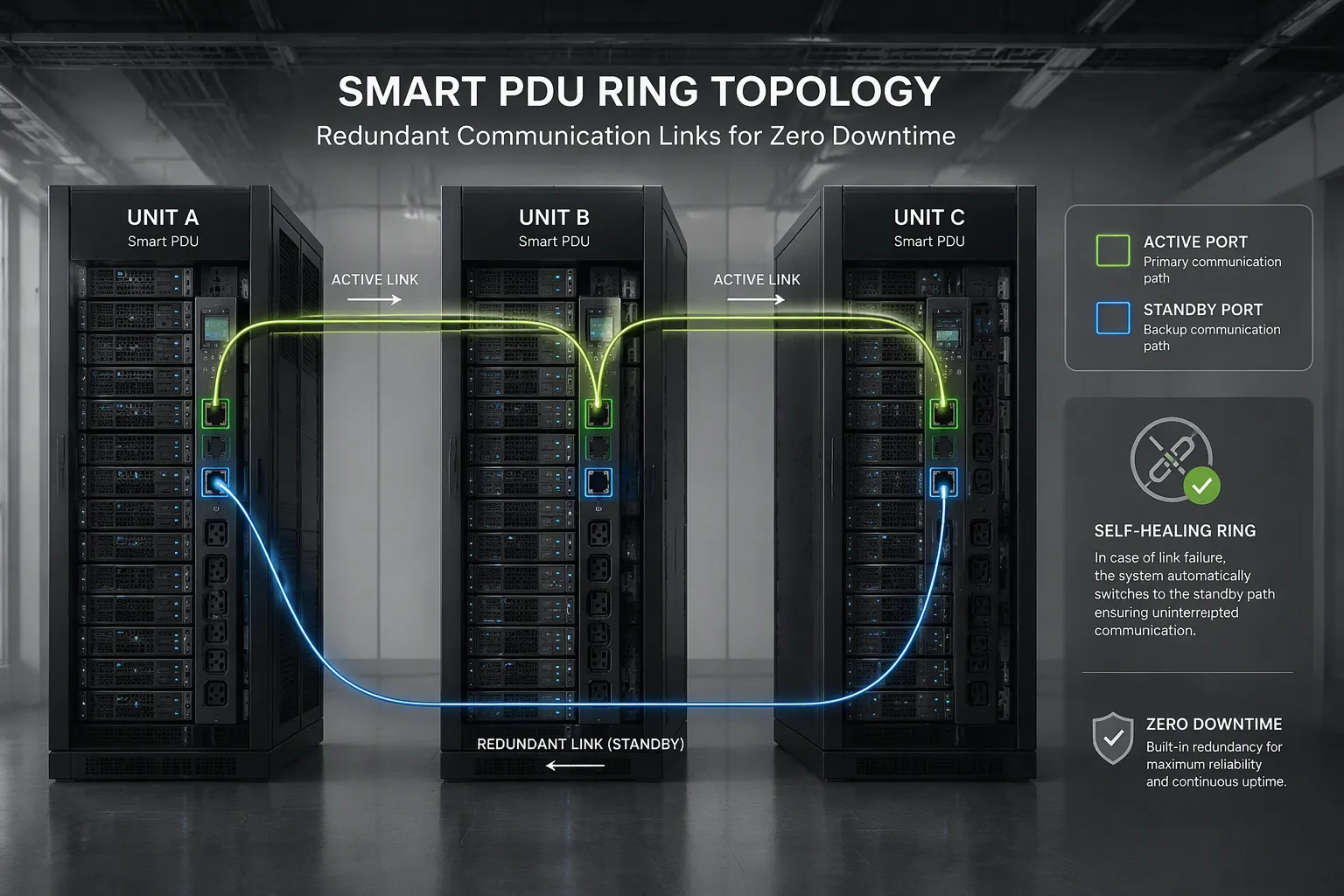
A self-healing ring (SHR) is a ring of bidirectional links between stations. Each station connects to two neighbors. If one connection fails, traffic travels the opposite direction around the loop. The ring closes the gap on its own.
A dual-ring architecture takes this idea one step further. Two rings run side by side, and traffic can shift seamlessly from one ring to the other on failure. An engineered ring assigns protection roles to each link and prevents loops. You get redundancy without broadcast storms.
Picture a row of racks. Unit A links to Unit B, B links to C, and C links back to A. Every unit holds two ports, so every unit has two neighbors. That single loop replaces a bundle of parallel cable runs. Cabling gets simpler, and the path count stays predictable.
How a Smart PDU Self-Heals
The ring behaves like an ERPS-style network. ERPS is defined under ITU-T G.8032. Under normal conditions, the redundant port stays blocked, so traffic cannot circle forever and create a loop. Industrial switches continuously monitor every link for fast failure detection. When a link fault appears, the ring switches to the standby link and unblocks the alternate path.
Recovery typically happens in milliseconds. The table below shows how ring protection compares with older spanning-tree methods:
Protocol | Typical Recovery Time |
|---|---|
ERPS (G.8032) | < 50 ms |
RSTP | 3–5 seconds |
STP | up to 30 seconds |
The gap matters. A smart PDU on an ERPS ring keeps reporting current draw and accepting remote commands through a brief blip. A unit on STP may sit silent for up to 30 seconds, long enough for an alert to miss its window.
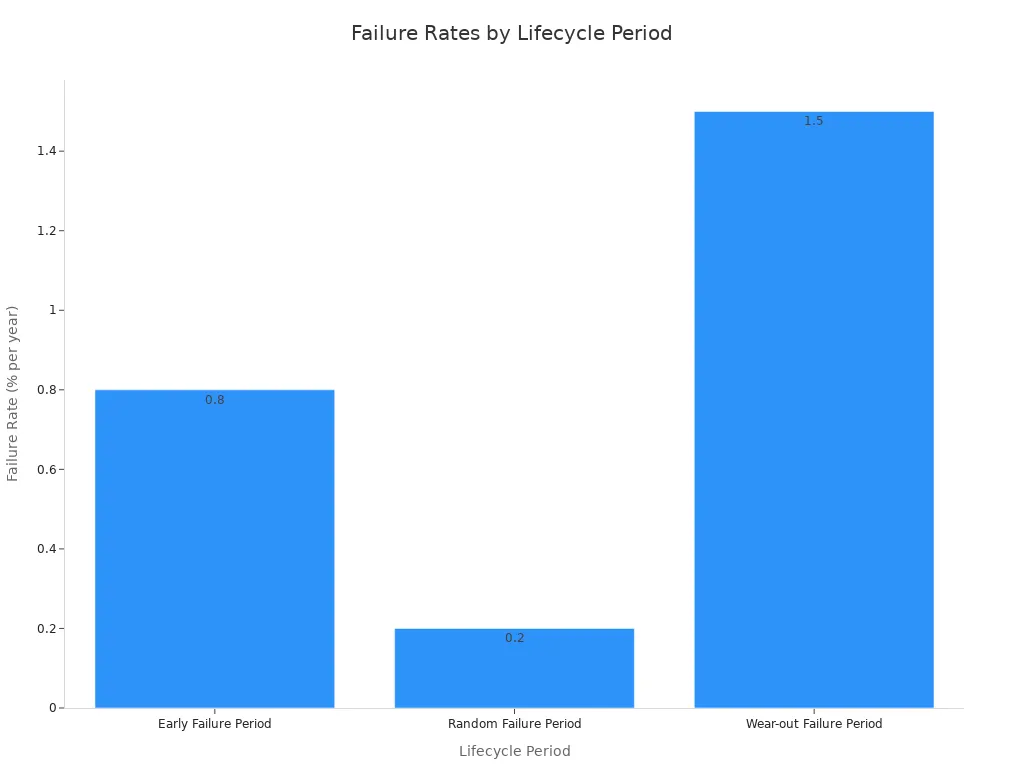
Hardware reliability supports the design. Field data from 200 industrial switches, analyzed with the Weibull distribution, shows failure rates of 0.8% per year in the first year, 0.2% per year from years one to five, and 1.5% per year after five years. The calculated MTBF reaches 68,000 hours, or 59,000 hours when maintenance time is included. A ring tolerates the occasional switch failure because the alternate path carries traffic.
One deployment shows the payoff. USR-ISG series switches ran in a smart factory with high temperature, strong vibration, and electromagnetic interference near a substation. The team paired dual power redundancy with an ERPS ring. MTBF rose from the industry average of 50,000 hours to 92,000 hours. Annual failure times dropped from 12 to 3, and operation and maintenance costs fell by 65%.
Redundancy Gains and Topology Comparison
Fault Tolerance and Simpler Cabling
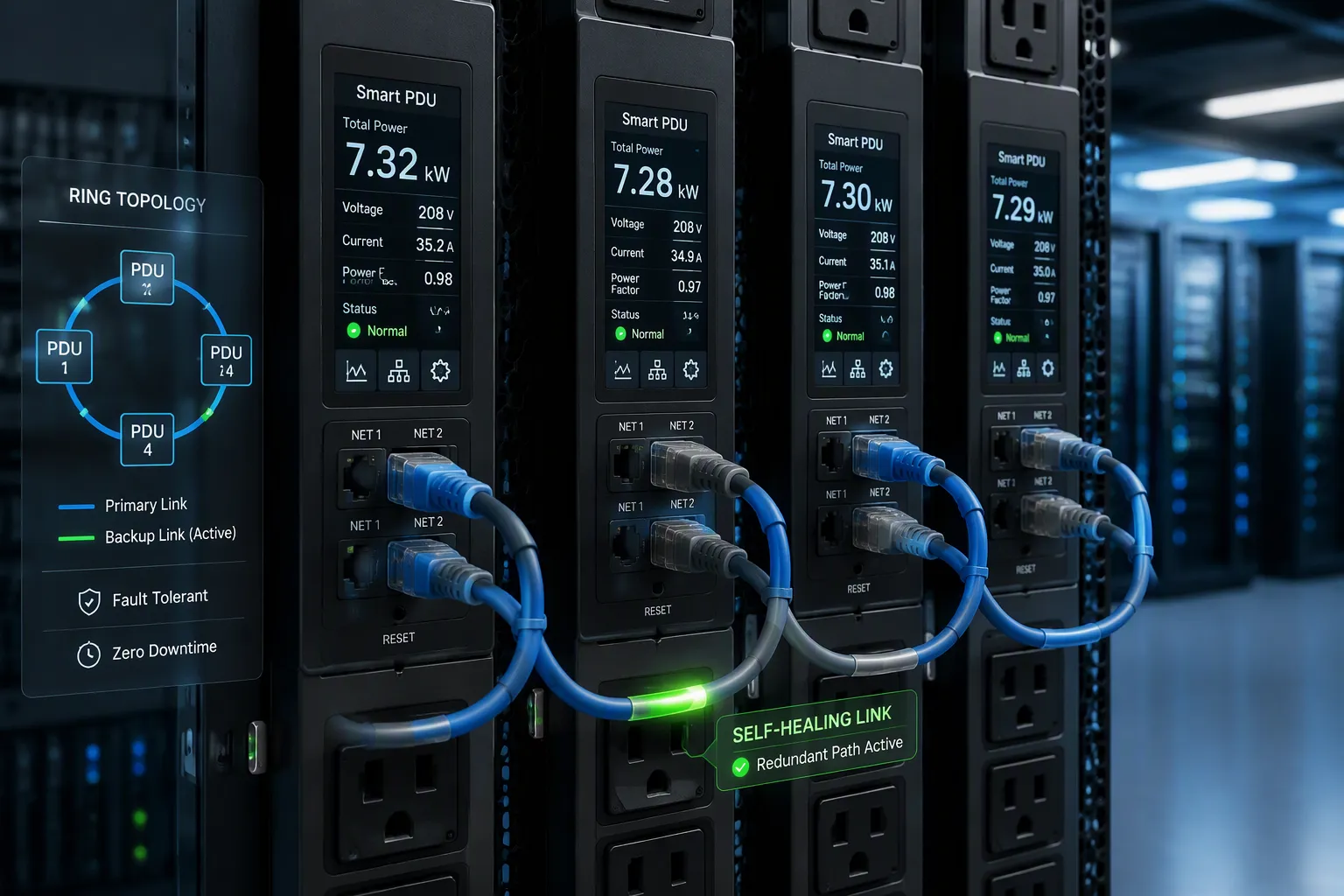
Ring topology delivers four practical gains. You get redundancy, because every unit holds two paths. You get fault tolerance, because one broken link does not stop traffic. You get zero downtime, because the reroute happens in milliseconds. You also get simpler cabling, because a single loop replaces parallel runs to a central point.
Data center planners describe this resilience with N+X notation. N is the number of primary components needed for normal operation, and X is the count of backup components. Common levels include N, N+1, N+2, 2N, and 2N+1. Uptime targets rise with each step. A ring gives your communication path a backup role much like the N+1 pattern gives your power path one.
Cabling savings add up across a rack row. Each unit needs one link to each neighbor, and no home-run cable back to a distant switch. You spend less on cable, less on conduit, and less on installation labor. Troubleshooting also gets easier, because you trace a loop instead of a bundle.
Ring vs. Star, Bus, and Mesh
Each topology fits a different job. The table below compares cost and cabling complexity:
Topology | Cost | Cabling Complexity |
|---|---|---|
Bus | Very low; minimal cabling, no central device | Simplest; single shared backbone cable |
Star | Moderate; needs a switch plus one cable per device | More cabling than bus; one dedicated link per node to central hub |
Ring | Moderate; less cabling than star, but token-passing hardware adds cost | Moderate; closed-loop wiring, less than star |
Mesh | High; full mesh requires n(n-1)/2 links plus advanced routing | Highest; full mesh cabling becomes unmanageable at scale |
Star topology is easy to install and manage, and it suits general office networks well. Bus topology uses one backbone cable shared by all devices, so it stays cost-effective for small or temporary setups. Mesh delivers strong redundancy and connectivity, and many enterprises adopt partial mesh to balance redundancy against cost. Ring sits between these options. It offers redundancy with less cabling than star, and it scales better than a full mesh.
Regulatory fit varies by site. Mission-critical facilities often demand concurrent maintainability, which favors ring or mesh designs. Smaller sites with modest uptime targets may find star sufficient and simpler to certify.
A Smart PDU built for resilient deployments should match the topology. ESTEL's Smart Power Distribution Unit offers remote management, surge protection, a dehumidifying function, and configurations from 8 to 19 outlets. You can wire these units into a ring and keep outlet-level control online through a link fault.
Where Ring Topology Fits
Data Centers and Edge Sites
Data centers give ring topology its clearest use case. Rack-level power monitoring and control demand continuous communication. You want live current readings, outlet state, and remote reboot commands available at every moment. A ring keeps those channels open when one link fails. Wire your PDUs into a loop across the rack row, and each unit keeps two paths to the management platform. That matters most when no technician stands in the aisle and the network is your only way to act.
Edge sites raise the stakes. Power density climbs with edge adoption. Traditional IT equipment typically draws 3–5 kW per rack, while edge workloads, especially AI inference, can push density to 10–15 kW per rack or higher.
Deployment type | Power density per rack |
|---|---|
Traditional IT equipment | 3–5 kW |
Edge workloads (esp. AI inference) | 10–15 kW or higher |
Higher density means more heat, tighter cooling margins, and less tolerance for a management link that goes dark. Edge power infrastructure relies on 48VDC power distribution combined with high-density, high-efficiency power modules. Vendors build edge compute platforms — servers, ruggedized mini data centers, gateways, embedded devices — for low power consumption, minimal footprint, and high reliability. These platforms must perform through fluctuating environmental conditions and uncertain power availability. A self-healing ring matches that design philosophy. It removes the single point of failure in the communication path.
Outdoor and remote sites add weather, vibration, and temperature swings to the list. ESTEL's experience with outdoor telecom cabinets and power systems supports these deployments. The company builds durable, standards-compliant telecom infrastructure for exactly these conditions. Pair a Smart PDU with that cabinet and power system, and the ring keeps monitoring online at a mountain site or a roadside shelter.
Two ports turn each unit into a neighbor on a loop. That loop creates redundant paths. Self-healing protection then converts a link failure into a millisecond reroute. Your smart PDU keeps reporting and keeps accepting commands, so monitoring and control never go dark.
You gain reliability, fault tolerance, and simpler cabling from one design choice. Weigh ring topology against your own uptime target and budget before you commit. Count the racks, trace the cable runs, and decide how much downtime your operation can absorb. ESTEL's Smart Power Distribution Unit gives you a practical starting point for that evaluation.
FAQ
What makes a smart PDU "dual-port"?
A dual-port smart PDU carries two network ports instead of one. You connect each port to a different neighbor, so the unit sits on a loop rather than a single cable run. That second port gives the PDU an alternate path for monitoring and control traffic.
How fast does the ring recover from a link failure?
Recovery typically happens in milliseconds on an ERPS-style ring. The standby link takes over as soon as the switch detects the fault. Your monitoring and control traffic keeps flowing through the brief reroute, so the management link stays online.
Do I need special switches to build the ring?
Yes. You need industrial switches that support ERPS under ITU-T G.8032. These switches block the redundant port under normal conditions to prevent loops. They also monitor every link continuously, so they can detect a fault and switch to the standby path quickly.
What happens to my PDU during a link fault?
The PDU keeps distributing power without interruption. Its communication traffic reroutes around the broken link through the opposite direction of the loop. You keep seeing current readings and keep sending remote commands, so no site visit is needed.
Which PDU features support a resilient ring deployment?
Look for remote management, surge protection, and a dehumidifying function. ESTEL's Smart Power Distribution Unit offers all three, plus configurations from 8 to 19 outlets. Those features keep outlet-level control available while the ring protects the communication path.
See Also
Understanding ESTEL PDUs And Their Function In Data Center Cabinets
Ensuring Reliable Power Supply For Telecom Cabinets
Simple Ways To Organize Cables In Data Center Cabinets
Ensuring Optimal Monitoring For Outdoor Telecom Cabinets
Why Outdoor Communication Cabinets Are Essential For Modern Telecom Networks
CALL US DIRECTLY
86-13752765943
3A-8, SHUIWAN 1979 SQUARE (PHASE II), NO.111, TAIZI ROAD,SHUIWAN COMMUNITY, ZHAOSHANG STREET, NANSHAN DISTRICT, SHENZHEN, GUANGDONG, CHINA
