How Smart PDUs Enable Real-Time Harmonic Monitoring and Filtering to Protect Sensitive Telecom Equipment from Interference


A smart pdu uses real-time harmonic monitoring and harmonic filtering to detect and mitigate harmonic distortion, protecting sensitive telecom equipment from interference.
Power quality problems disrupt delicate gear in telecom sites every day. Harmonics quietly distort the voltage and current waveforms that routers, switches, and radio units depend on. You may see signal errors, excess heat, or sudden failures long before anyone traces the cause.
The good news: modern monitoring and filtering respond to these conditions as they happen. You gain visibility into waveform quality and automatic mitigation in one unit. That combination turns a hidden risk into a manageable one, and it often costs far less than the downtime it prevents.
Key Takeaways
Harmonics distort power and cause heat, signal errors, and early equipment failure.
Smart PDUs track power quality in real time and alert you to rising harmonic distortion.
Active harmonic filtering cancels distortion in milliseconds to protect sensitive gear.
Real-time monitoring and filtering reduce outages and extend equipment life.
Smart PDUs cost more upfront but pay back through fewer site visits and less downtime.
Why Harmonics Matter for Telecom Power Quality
How Harmonics Reach Telecom Gear
Non-linear loads create most harmonic distortion in a power system. These devices draw AC power, convert it to DC, and rebuild an artificial AC waveform. The current no longer follows a smooth sine wave, so harmonic currents flow back into the distribution system. Harmonics repeat at multiples of the fundamental frequency. Transformers and rectifiers add waveform distortion of their own. Solar inverters introduce harmonic components during power conversion.
Sites host many of these loads. UPS systems, server power supplies, variable frequency drives, battery chargers, rectifiers, and LED lighting all contribute. Telecom rectifier systems sit at the heart of this picture. Telecom rectifier systems convert AC to DC for base station radios and optical transport systems. Telecom rectifier systems add harmonic content of their own. Load-generated harmonics then travel through shared circuits. These harmonics reach sensitive telecom hardware such as routers, switches, and radio units. Harmonic currents cross branch circuits inside a cabinet, so one polluted feed can spread distortion across a whole equipment row.
The Cost of Interference
Harmonic distortion shows up in practical ways. Distorted waveforms cause signal errors, interference, extra heating, and premature component failure. Equipment runs hotter than its design intends. A single failing rectifier module can inject distortion into every circuit it feeds. Downtime follows, and repair costs climb. Dense racks make the problem worse, because heat and harmonic distortion compound across neighboring units. You may see these symptoms long before anyone traces the cause.
Power quality is the umbrella concern here. Total harmonic distortion, or THD, measures how far a waveform departs from a pure sine. High THD values signal trouble across telecom networks. Electromagnetic interference can also slip past standard checks. An unnoticed harmonic disturbance may degrade links for weeks before anyone traces it. Filtering and clean power design reduce this risk. Monitoring makes the risk visible, and you can act before small power-quality drift becomes a site-wide outage. Both habits protect equipment and matter for telecom networks and telecom power planning.
Real-Time Harmonic Monitoring in Smart PDUs
Built-In Sensing and Measurement
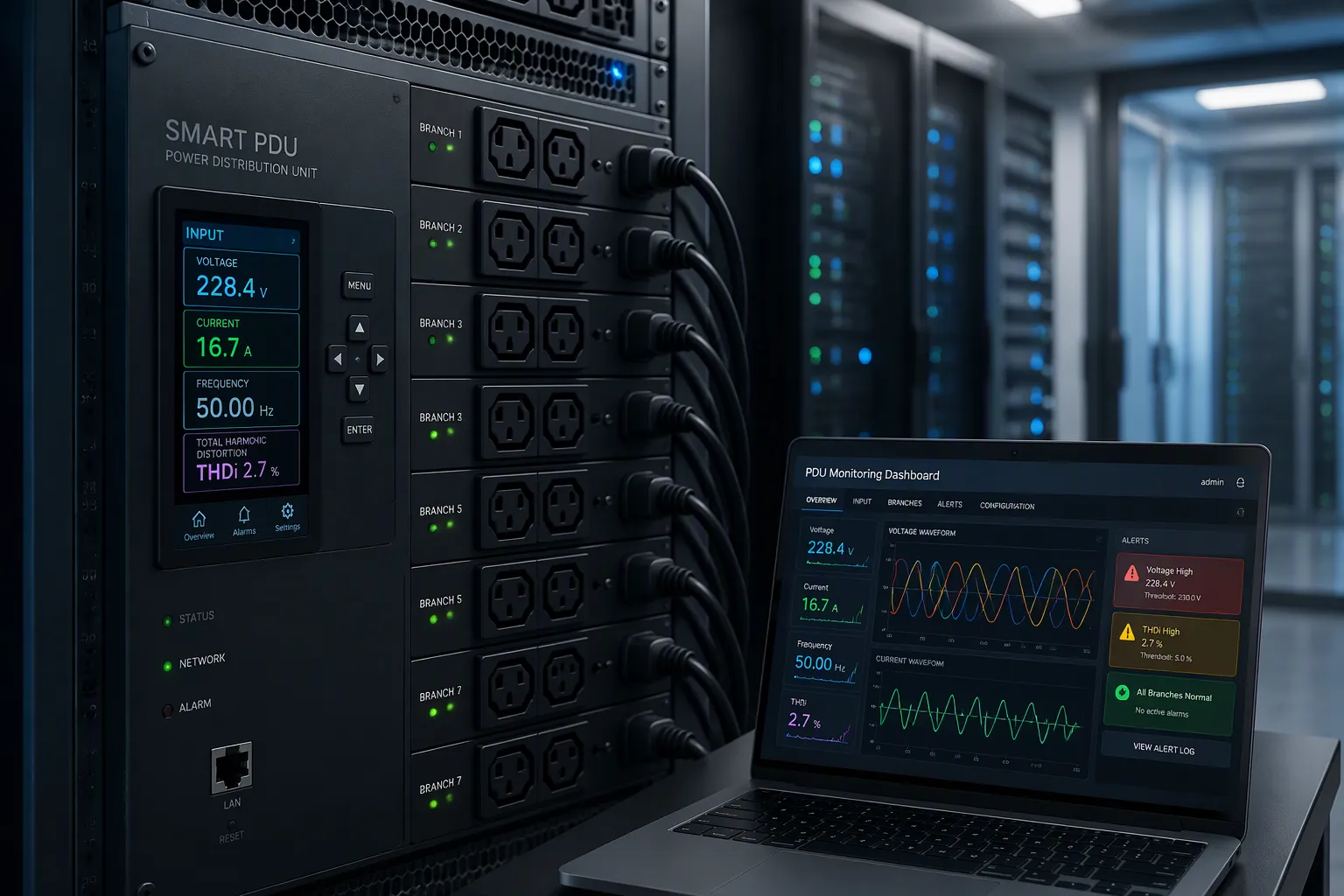
A smart pdu carries sensing hardware at its input and at each outlet branch. Voltage, current, temperature, humidity, and power usage flow into the unit's processor on a continuous basis. The processor also analyzes waveform shape, so it captures harmonic content as it develops. You see the full picture of power quality at the rack level, not just at the building service entrance.
This placement matters. The PDU infeed sits closest to the loads you care about, so it records what your telecom rectifier systems and radios actually receive. Readings from upstream panels miss the distortion that branch circuits add along the way. Infeed data also supports capacity planning. You can compare measured load against breaker and circuit ratings, spot stranded capacity on lightly used branches, and shift loads before a circuit runs tight. Real-time power quality monitoring turns those decisions into routine checks instead of guesswork.
ESTEL smart PDU monitoring capabilities follow this model. The units report electrical and environmental data through a network interface, and you can review trends over time. That visibility helps you plan growth and confirm that harmonics stay within expected bounds.
Thresholds and Actionable Alerts
Raw data alone does not protect equipment. You need to know when a reading crosses a line that matters. Smart PDUs let you set thresholds for current, temperature, humidity, and total harmonic distortion. When a value approaches its limit, the unit sends an alert through email, SNMP, or a web dashboard. You learn about a rising thd trend or a branch nearing its circuit limit before a breaker trips.
Threshold design deserves thought. Set current alerts below the breaker rating to leave room for transient peaks. Set thd alerts against the limit your telecom equipment vendors specify, and review them after you add new loads. Harmonic currents from a new rectifier bank can push a branch past its earlier baseline. Alerts catch that shift early.
The combination of sensing and alerting closes the loop. Monitoring shows you the trend, and thresholds tell you when to act. You can schedule maintenance, rebalance loads, or bring harmonic filtering online during a planned window rather than during an outage. For telecom networks that cannot tolerate downtime, that early warning carries real value. Clean power starts with knowing what your circuits carry, and a smart PDU gives you that knowledge continuously.
Harmonic Filtering Techniques in Smart PDUs
Active vs. Passive Filtering
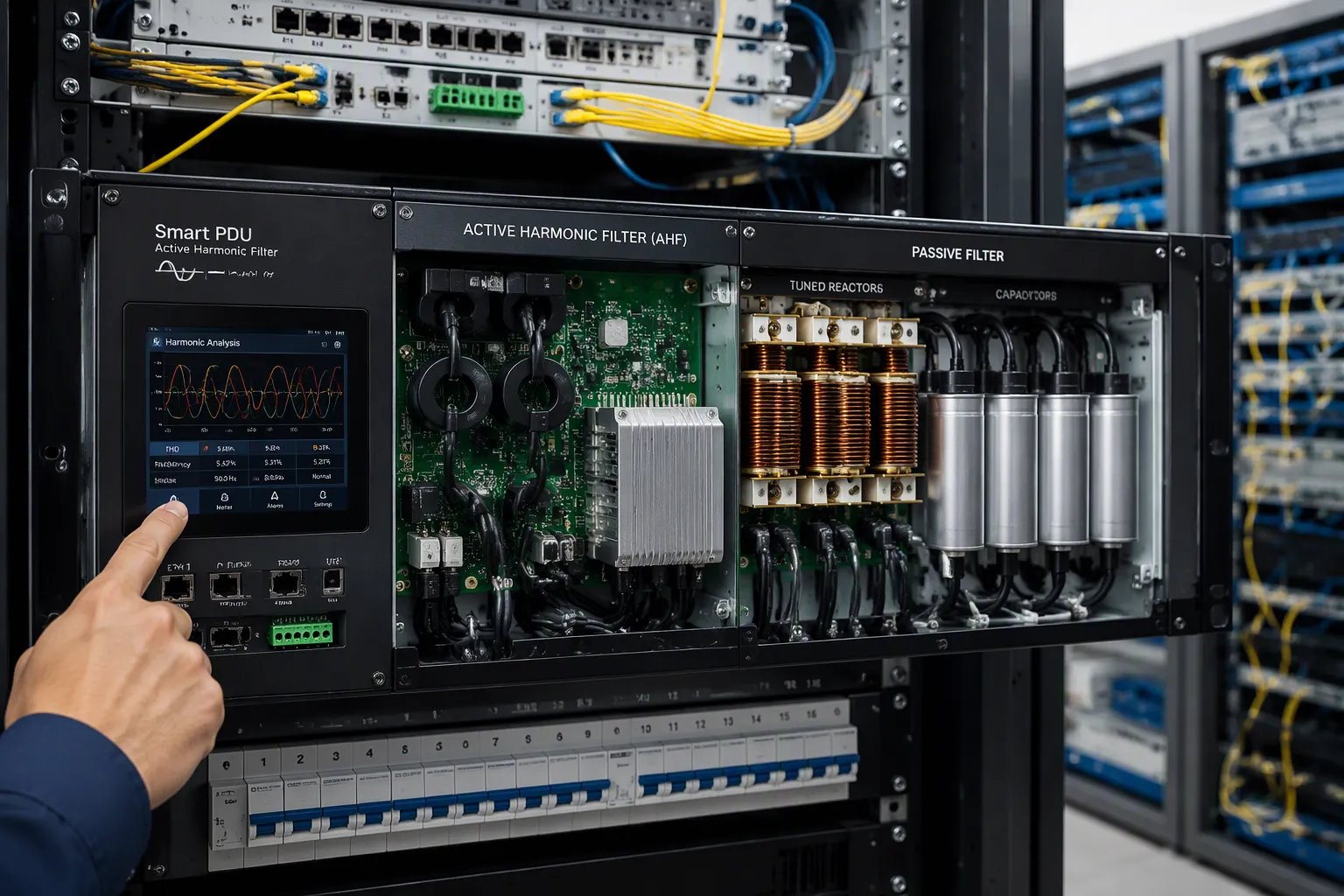
Active harmonic filtering works by sensing, calculating, and canceling. Current sensors watch the electrical system and detect waveform distortions from non-linear loads. Modern sensors capture harmonic information in roughly 50 microseconds and pass it to the main processing unit. That unit computes the magnitude and phase angles of each detected harmonic. Within about 1–2 milliseconds, IGBT-based inverters generate compensating currents that adapt as load conditions change. The filter's power electronics produce cancellation currents that match the harmonic frequencies but invert their polarity. A 150 Hz fifth-harmonic disturbance, for example, meets an equal 150 Hz current running 180 degrees out of phase. The main 50/60 Hz signal survives, and Fourier-analysis tests report about 98% reduction of harmonic content. Active power filters handle a broad spectrum, up to the 50th order, without fixed-tuned reactors or capacitors. Advanced designs add frequency tracking through a phase-locked loop, so detection stays accurate when system frequency drifts.
Passive filtering takes a different route. Tuned reactors and capacitors block specific harmonic orders, and telecom PDUs often pair this approach with surge protection. Passive filters cost less upfront. They suit steady, predictable loads. Their weakness is rigidity: external harmonics on the mains can affect them, sizing is difficult, and overheating is possible when conditions shift.
Criterion | Passive Filter | Active Filter |
|---|---|---|
Load type | Steady, predictable | Variable, fluctuating |
Harmonics covered | Specific orders | Broad spectrum, up to 50th order |
Response time | Fixed | Milliseconds |
Power factor correction | Limited | Integrated |
Relative cost | Lower upfront | Higher upfront, lower lifecycle |
Coordinating Filtering with Load
Effective harmonic filtering responds to real conditions, not assumptions. Active power filters read load and power quality data continuously, so mitigation tracks the actual harmonic currents on the branch. When you add a rectifier bank, the filter adapts without retuning. Passive systems cannot make that adjustment, and their fixed tuning may miss new distortion.
Telecom sites benefit from this coordination. Telecom rectifier systems convert AC to DC for radios and optical transport, and they inject distortion of their own. A filter that follows load steps keeps total harmonic distortion under 3%, while passive systems under the same stress reach 8–12%. The IEEE 519-2022 compliance target sits under 5%, so the margin matters. Pair filtering with advanced surge protection, and your smart pdu delivers a clean and stable power supply for sensitive equipment. That combination supports clean power across the rack and protects telecom gear from interference.
Key Benefits of Monitoring and Filtering
Uptime and Equipment Protection
Industry findings suggest that managed PDUs with real-time monitoring can cut outages by roughly 30%. Remote outlet control also enables reboots about 40% faster than a site visit. Treat these figures as general findings, not guarantees. The direction is clear: visibility and remote action shorten the path from fault to fix. You learn about a problem while it is still small.
Filtering adds a second layer of defense. Active harmonic filtering cancels harmonic currents before they reach sensitive equipment. That protection keeps telecom equipment cooler and extends service life. Harmonics from telecom rectifier systems and other non-linear loads distort the waveform. Left alone, harmonic distortion raises heat and erodes power quality across the rack. Filtering targets those harmonics at the source. Filtering responds to real conditions. You also gain early warning. Alerts fire when total harmonic distortion climbs or a branch nears its limit. You fix a rising thd trend during a planned window instead of reacting to a failure. For telecom networks that cannot tolerate downtime, that shift from reactive to proactive carries real value.
Efficiency and Capacity Planning
Power usage must be measured before you can optimize it. Outlet-metered PDUs reveal device-level consumption, which helps you locate new opportunities for power growth. Outlet-level measurement also supports precise billing and transparency across tenants. This data anchors capacity planning and supports smarter decisions about consolidating racks and planning future growth. Real-time power quality monitoring also exposes energy waste. You can right-size power, lower costs, and prevent overloads before they trip a breaker.
Environmental sensors add context. Temperature, humidity, and airflow readings inform efficiency decisions alongside electrical data. SNMP trap notifications trigger alerts on out-of-threshold conditions, so capacity management stays proactive. Pair this power monitoring with harmonic filtering, and you protect telecom rectifier systems and other equipment while you plan. Clean power and good data reinforce each other. Together they reduce risk and support long-term power-quality goals across your telecom sites.
Smart PDUs vs. Traditional PDUs
What Traditional PDUs Offer
A traditional PDU does one job well: it distributes power from a single input to many outlets. You get reliable delivery to every rack, sturdy construction, and a predictable price. Basic models add surge protection and simple filtering, which covers many everyday needs.
These units fit budget-sensitive sites and low-complexity installations. A small cabinet with a few loads needs distribution, not data. You save money upfront, and you avoid features nobody will use. For many deployments, that trade-off makes sense.
Where Smart PDUs Fit Best
A smart pdu earns its place when power quality becomes a business risk. Sites with sensitive telecom hardware, strict power quality targets, and capacity-planning demands gain the most. You see voltage, current, temperature, and power in real time, and alerts flag problems early. Automated recovery adds another layer: the unit detects a fault, isolates the affected channel, and restores power after a configurable delay without a site visit. A -48V DC model suits negative-voltage DC plants while keeping standard PDU capabilities.
Scenario | Why a smart PDU adds value |
|---|---|
Remote or distributed sites | Teams monitor and control power from a distance instead of traveling on-site |
Reliability-critical environments | Real-time visibility and per-rack management keep systems running |
Fault-prone or unmanned installations | Alerts and fault detection flag failing equipment early |
Harmonics and thd trends matter most at these sites, where telecom rectifier systems and other non-linear loads distort the waveform. Real-time data lets you act on harmonic filtering before critical telecom loads suffer. ESTEL's smart PDU lineup is one option among these choices, and it fits sites that need visibility, remote control, and clean power for telecom networks. The investment pays back through reduced risk and fewer site visits, which makes it cost-effective for telecom operators running sensitive equipment.
Harmonics pose a real threat to sensitive telecom equipment. Harmonics distort waveforms. That distortion causes signal errors, excess heat, and premature failure. Smart PDUs give telecom sites a direct answer. They monitor power quality continuously and apply harmonic filtering the moment conditions shift. You see harmonic distortion as it develops, and the filter cancels it before it reaches your gear.
The combination turns a hidden risk into a managed one. Your equipment runs cooler, uptime improves, and your team acts on data, not guesswork. The investment pays back through fewer outages and longer service life. For any telecom site running sensitive gear, real-time monitoring and filtering deliver measurable value year after year.
FAQ
How do harmonics actually damage sensitive telecom equipment?
Harmonics distort the voltage and current waveforms your gear receives. That distortion adds heat and causes signal errors. Over time, connected equipment runs hotter than its design intends. You see premature failure and downtime. The article notes that harmonics can reach routers, switches, and radio units through shared circuits.
Can a smart PDU filter harmonics on its own?
Yes. Active filtering senses distortion and generates canceling currents within milliseconds. The article cites roughly 98% reduction of harmonic content and coverage up to the 50th order. Passive filtering blocks specific orders and often pairs with surge protection. Either approach protects downstream equipment from interference.
What power quality readings should I watch?
Track total harmonic distortion, current, temperature, and humidity at the PDU infeed. Set thresholds below your breaker ratings and vendor limits. The article cites IEEE 519-2022, which targets THD under 5%. Alerts then flag rising trends before your telecom equipment suffers. Clean power depends on watching these values continuously.
Does filtering replace monitoring?
No. Monitoring shows you the trend, and filtering responds to it. The article notes that active filters keep THD under 3% while passive systems under the same stress reach 8–12%. Pair both functions, and your telecom site gains visibility plus automatic mitigation. That combination protects sensitive equipment across the rack.
Is a smart PDU worth the higher upfront cost?
For sites with sensitive telecom gear and strict power quality targets, yes. Industry findings cited in the article suggest roughly 30% fewer outages and about 40% faster reboots with managed PDUs. Treat those as general findings. The investment pays back through reduced risk and fewer site visits.
See Also
Understanding ESTEL PDUs and Their Function in Data Center Cabinets
Key Features You Should Know About Telecom Power Supplies
Ensuring Reliable Power Supply for Telecom Cabinet Operations
Achieving Optimal Monitoring for Outdoor Telecom Cabinet Systems
Photovoltaic Energy Storage Power Systems for Telecom Cabinet Applications
CALL US DIRECTLY
86-13752765943
3A-8, SHUIWAN 1979 SQUARE (PHASE II), NO.111, TAIZI ROAD,SHUIWAN COMMUNITY, ZHAOSHANG STREET, NANSHAN DISTRICT, SHENZHEN, GUANGDONG, CHINA
