What Are the Benefits of Open APIs in Smart PDUs for Third-Party O&M Platform Data Interconnection in Telecom?


Open APIs in smart PDUs unlock faster integration, real-time visibility, lower costs, and stronger security for third-party O&M platforms in telecom. You gain direct access to power and environmental data without building custom connectors for every vendor.
Closed PDUs create data silos. Your monitoring platform cannot see them, so faults surface late and vendor lock-in slows every change. A Smart PDU with open interfaces removes that wall and turns your cabinet into a live data source.
You can evaluate each benefit against your own cabinets, with concrete examples of integration, telemetry, cost, scalability, and security at work.
Key Takeaways
Open APIs let your O&M platform connect directly to smart PDUs without custom code.
You get live power and environmental data to spot faults fast and fix them remotely.
Reuse one integration profile across all cabinets to cut costs and save time.
Add new cabinets easily without rebuilding your system, thanks to versioned APIs.
Control access and encrypt data to keep your monitoring secure and compliant.
Seamless Integration with ESTEL Smart PDUs
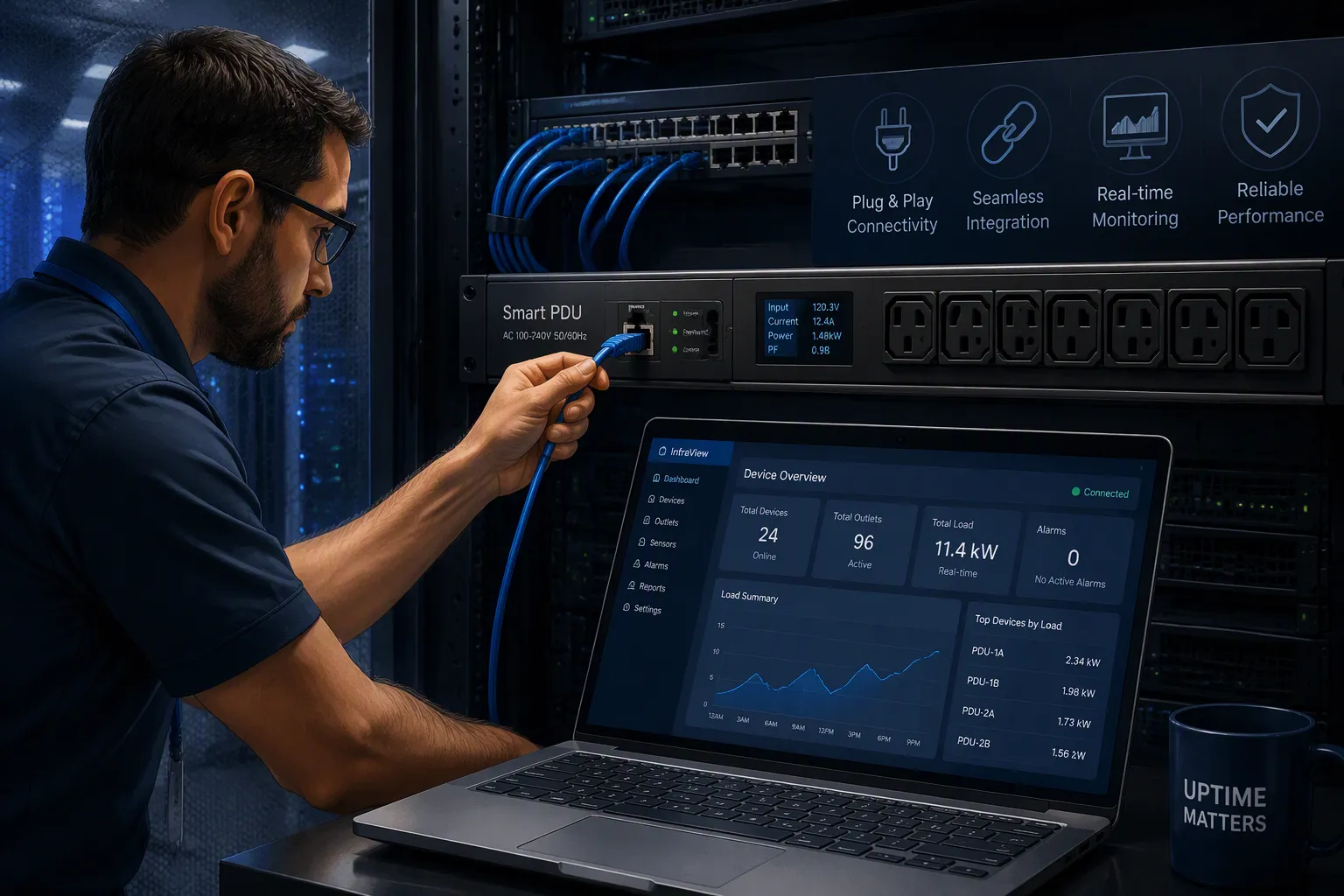
Standard Protocols Replace Custom Code
Open APIs expose RESTful and north-bound interfaces. Your third-party O&M platform consumes these interfaces directly. You do not write custom glue code for each cabinet model. The platform sends a standard request and receives structured data back. This pattern removes the fragile scripts that break every time a firmware update lands.
ESTEL's Smart Power Distribution Unit fits this model well. The unit supports remote management and intelligent protocols. Its IEC60309-compliant plug system gives you a predictable power interface. The 8–19 outlet configurations map cleanly to platform data models, so each outlet becomes a named object your dashboard can track. You assign a label once, and the platform reads power state and load from that outlet through the same API call every time.
Integration quality depends on manufacturing consistency. ESTEL follows an ISO9001 quality process. That discipline supports reliable long-term integration, because the unit you install this year behaves like the unit you install next year. Your API mappings stay valid across batches.
Plug-and-Play O&M Connectivity
You can connect a Smart PDU to your O&M platform in a short commissioning window. Power the unit, assign it a network address, and register it with the platform. The platform discovers the exposed data points through the north-bound interface. No middleware layer sits between the device and the platform.
This plug-and-play path changes how you plan projects. Your team spends time on cabinet placement and power planning instead of protocol translation. A new site joins the monitoring fleet on the day it goes live. The same approach works when you swap a unit in the field. The replacement registers with the same profile, and historical trends continue without a gap.
Standard protocols also simplify vendor conversations. You describe your platform's expected data model, and the PDU meets it through documented interfaces. Your integration team tests one profile and reuses it across sites. That reuse compounds as your cabinet count grows.
The result is integration you can repeat. Each Smart PDU you add follows the same path, and your platform stays the single source of operational truth.
Real-Time Smart PDU Data Access and Monitoring
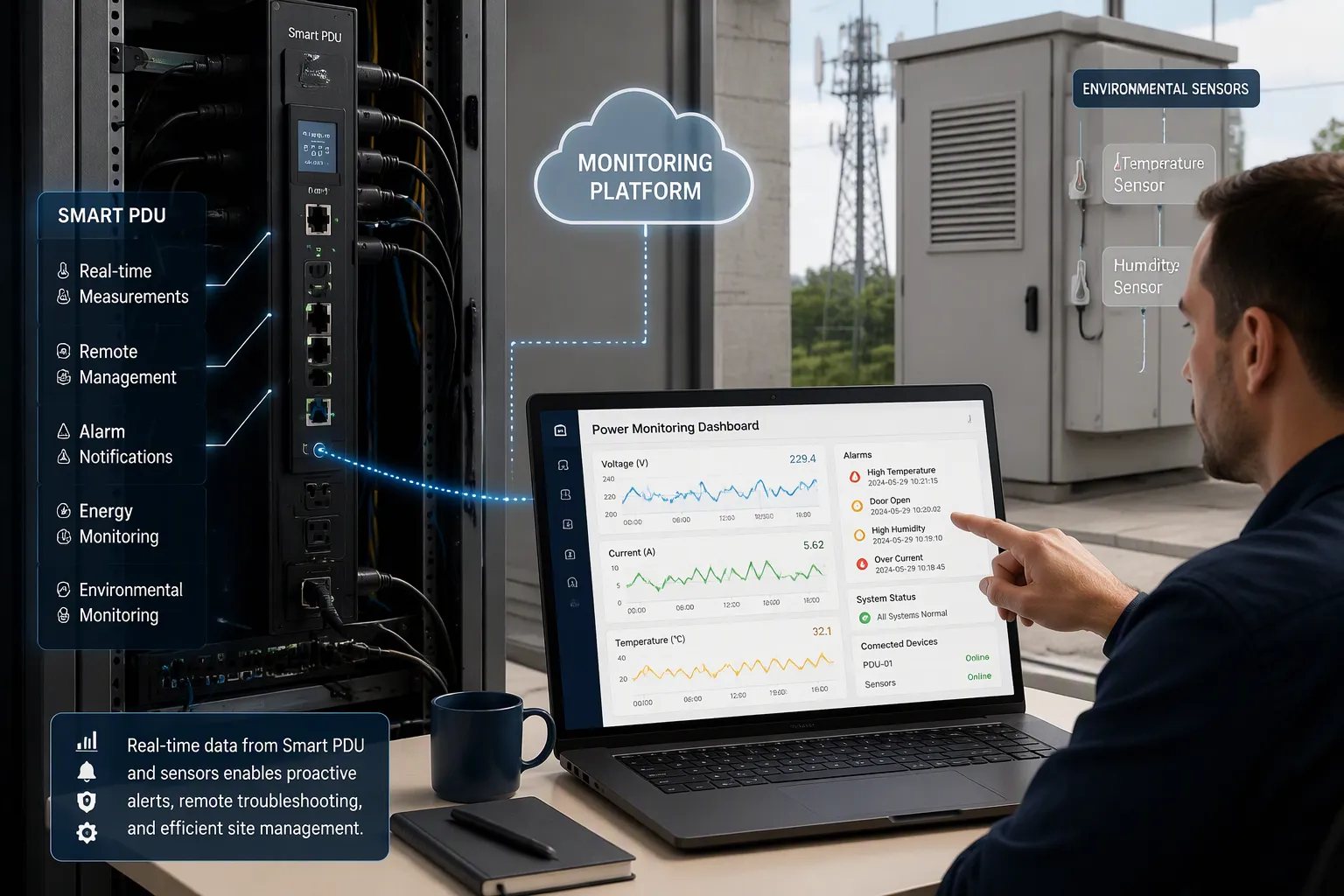
Live Power and Environmental Telemetry
Open APIs turn a Smart PDU into a continuous stream of operational data. Your platform reads voltage, current, frequency, power factor, and harmonics up to the 63rd order. It also collects basic kWh and power figures. These measurements arrive through industrial and IT protocols such as Modbus and MQTT. The unit uploads data to your central management system at second-level or millisecond-level frequencies, so you see conditions as they change rather than after the fact. Some deployments sample power data at 1 ms intervals, which supports fine-grained monitoring and control.
Event capture adds context to those readings. The PDU logs voltage drops, current overloads, and waveform distortions with precise timestamps. Your maintenance team can trace a fault back to the exact moment it began. Outlet-level current monitoring goes further. The unit reports how much current each RRU or BBU draws. You can then apply peak shaving so the site does not trip its main breaker during high-traffic power spikes. Threshold-based alarms notify you when a device draws unusual current, which catches failures before they occur.
Environmental sensing completes the picture. Sensor ports on the PDU let you monitor temperature, humidity, and door status of outdoor cabinets through the same interface. The dehumidifying function and LCD display readings feed into your platform as well. Remote power cycling lets you reboot a hung gateway or server from your desk, and that action protects uptime without a technician site visit. Modbus-RTU and SNMP support lets the unit feed data into your existing site monitoring system, so you do not replace the tools your team already knows.
The platform routes each alarm to the right on-call engineer. You set the threshold once, and the rule applies across every cabinet in the fleet. That consistency removes the guesswork from triage and keeps response times predictable.
Unified Multi-Vendor Dashboards
Your O&M platform aggregates this telemetry across cabinets from different vendors. Each Smart PDU exposes its data points through documented interfaces, and the platform normalizes them into one schema. You then view power draw, load balance, and environmental conditions on a single dashboard. A mixed fleet stops being a patchwork of separate tools. Native integration with tools such as Prometheus and Grafana lets you build that view without custom development.
This aggregation supports informed decisions. You compare load across sites, spot a cabinet running hotter than its neighbors, and schedule maintenance before a failure. Historical trends show whether a circuit is drifting toward its limit. Remote network access means your team reads critical infrastructure data from anywhere. The dashboard becomes the place where power, environment, and event history meet, and every decision rests on the same live picture.
You can also compare vendor performance on equal terms. The same metrics arrive from every cabinet, so a slow response from one model stands out clearly. That evidence guides your procurement and refresh planning. Your team spends less time reconciling spreadsheets and more time acting on what the data shows.
Cost Reduction and Operational Efficiency
Lower Integration and Maintenance Costs
Custom integration work drains budget before your platform ever shows value. Every new cabinet model demands its own connector, its own test cycle, and its own maintenance path. Open APIs remove that recurring cost. Your team builds one integration profile and reuses it across the fleet. The savings compound with each site you add.
Spares planning also gets simpler. ESTEL's Smart PDU comes in 8–19 outlet configurations, so a small set of SKUs covers your cabinet range. You stock fewer variants, train technicians on fewer models, and reduce the risk of holding the wrong spare. Maintenance visits become predictable tasks instead of troubleshooting sessions.
Faster Fault Detection and Remediation
Open API alerts shorten mean time to repair. The platform flags an anomaly the moment it appears, and your on-call engineer sees it on the dashboard. Remote power cycling then resolves many faults without a site visit. ESTEL's Smart PDU remote control supports that reboot directly from your desk.
The evidence shows the scale of the gain:
Mechanism | Reported Impact |
|---|---|
25% reduction in fault response times | |
Remote reboot and power cycling | 15% reduction in downtime |
Automated triage and remediation | Resolution time cut from about 4 hours to just over 2 hours |
Real-time monitoring tracks voltage, current, and power usage from any location. Remote management removes travel delay from remediation. Automated workflows cut manual intervention. Each mechanism feeds the next, and the combined effect shows up in your operating budget.
Scalability and Future-Proofing
Modular Expansion Without Rewrites
You can add cabinets one site at a time without rebuilding your O&M stack. Each new unit registers through the same documented interface your platform already consumes. Your integration profile stays unchanged, so growth becomes a provisioning task rather than a development project. A pilot site and a regional rollout share one architecture.
This modular path also covers platform changes. You can introduce a second O&M platform alongside the first and point both at the same data. Neither platform needs a custom connector, and neither one blocks the other. ESTEL's custom cabinet and power portfolio supports this growth pattern. You start with a single site, then extend to larger deployments using the same power distribution design and the same 8–19 outlet configurations. The Smart PDU you standardize on at the pilot stage remains the reference unit as your fleet expands.
API Versioning and Long-Term Compatibility
Versioned APIs protect your investment over time. The interface carries a version identifier, and the platform negotiates the version it supports. Older platforms keep working against newer firmware through backward compatibility. You upgrade on your own schedule instead of the vendor's.
That compatibility matters across a multi-year rollout. Cabinets installed early in a project still report cleanly after later units arrive with updated firmware. Your historical data stays comparable, and your dashboards do not break mid-deployment. ESTEL's ISO9001 quality process reinforces this consistency across production batches.
Future integration targets follow the same logic. Analytics tools can consume the telemetry stream to model load trends and predict failures. Provisioning platforms can push configuration to new cabinets automatically. Both connect through the same open interfaces, so each addition extends your capability without touching the core stack.
Improved Security and Compliance
Controlled Access and Encrypted Exchange
Open APIs give you a security model you can define and enforce. The Smart PDU authenticates each third-party O&M platform before it reads a single data point. You assign roles to users and services, so an analytics tool reads telemetry while a provisioning platform writes configuration. Encrypted exchange protects the data in transit between the PDU and the platform. Credentials stay scoped to the task, and you revoke access without touching the physical unit.
This layered approach keeps your monitoring data trustworthy. You decide which platform sees which cabinet, and you audit every request against that policy. A compromised credential exposes one role, not the whole fleet.
Audit Trails for Regulatory Reporting
The PDU logs access events and configuration changes with timestamps. Your platform stores these records and exports them for regulatory reporting. When an auditor asks who changed a threshold or rebooted an outlet, you produce the trail in minutes. Historical records also support incident reviews and internal compliance checks.
Physical protections complement the API layer. Surge protection guards the unit and connected equipment against voltage spikes. Anti-theft locks on ESTEL cabinets secure the hardware itself, so data security rests on a protected device. The two layers reinforce each other.
Closed interfaces still fit some deployments well. A single-vendor estate with fixed requirements gains simplicity from a closed system, and that simplicity has real value. Open APIs fit best where you run multiple platforms, face reporting obligations, or plan to grow. Match the interface to your operating model, and security follows the design you choose.
Open APIs in smart PDUs deliver faster integration, real-time visibility, lower costs, easier scalability, and stronger security for your third-party O&M platforms. Each benefit builds on the same foundation: documented interfaces that expose power and environmental data directly to the tools you already run.
This design turns the PDU into a strategic data layer, not just a power device. Your cabinet becomes a live source of telemetry that feeds dashboards, alerts, and compliance records across the fleet.
Start with a pilot. Connect an open-API-enabled Smart PDU such as ESTEL's unit to your existing O&M platform, then measure response times, downtime, and integration effort against your current baseline.
FAQ
Do open APIs require special software on the PDU?
No. The Smart PDU exposes RESTful and north-bound interfaces as part of its standard firmware. Your O&M platform sends standard requests and receives structured data back. You register the unit with the platform and start reading telemetry. No middleware layer or custom agent sits between the device and your monitoring tools.
Can I connect a Smart PDU to more than one O&M platform?
Yes. Multiple platforms can consume the same documented interface at once. You point each platform at the unit and assign roles for what each one may read or change. An analytics tool can pull telemetry while a provisioning platform pushes configuration. Neither connection blocks the other.
What happens to my integration when firmware updates arrive?
Versioned APIs protect your setup. The interface carries a version identifier, and your platform negotiates the version it supports. Backward compatibility keeps older platforms working against newer firmware. You upgrade on your own schedule, and your historical data stays comparable across the fleet.
How does the PDU secure data shared with third-party platforms?
The unit authenticates each platform before sharing any data point. Role-based access limits what each user or service can read or change. Encrypted exchange protects data in transit. The PDU also logs access events and configuration changes with timestamps, so you can audit every request and export records for reporting.
Which outlet configuration should I choose for my cabinets?
Match the outlet count to your equipment load. The Smart PDU comes in configurations from 8 to 19 outlets, and each outlet maps to a named object in your platform. Standardizing on one or two configurations simplifies spares planning and keeps your integration profile consistent across sites.
See Also
Understanding ESTEL PDUs And Their Function In Data Center Cabinets
Key Features You Should Know About Telecom Power Supplies
How To Maintain Reliable Power Supply For Telecom Cabinet Systems
An Overview Of The ESTEL Telecom Cabinet Power System
Exploring The Common Uses And Applications Of Telecom Cabinets
CALL US DIRECTLY
86-13752765943
3A-8, SHUIWAN 1979 SQUARE (PHASE II), NO.111, TAIZI ROAD,SHUIWAN COMMUNITY, ZHAOSHANG STREET, NANSHAN DISTRICT, SHENZHEN, GUANGDONG, CHINA
