How Smart PDU Sensor Auto-Recognition and Triggered Alerts Enable Precision Data Center Management

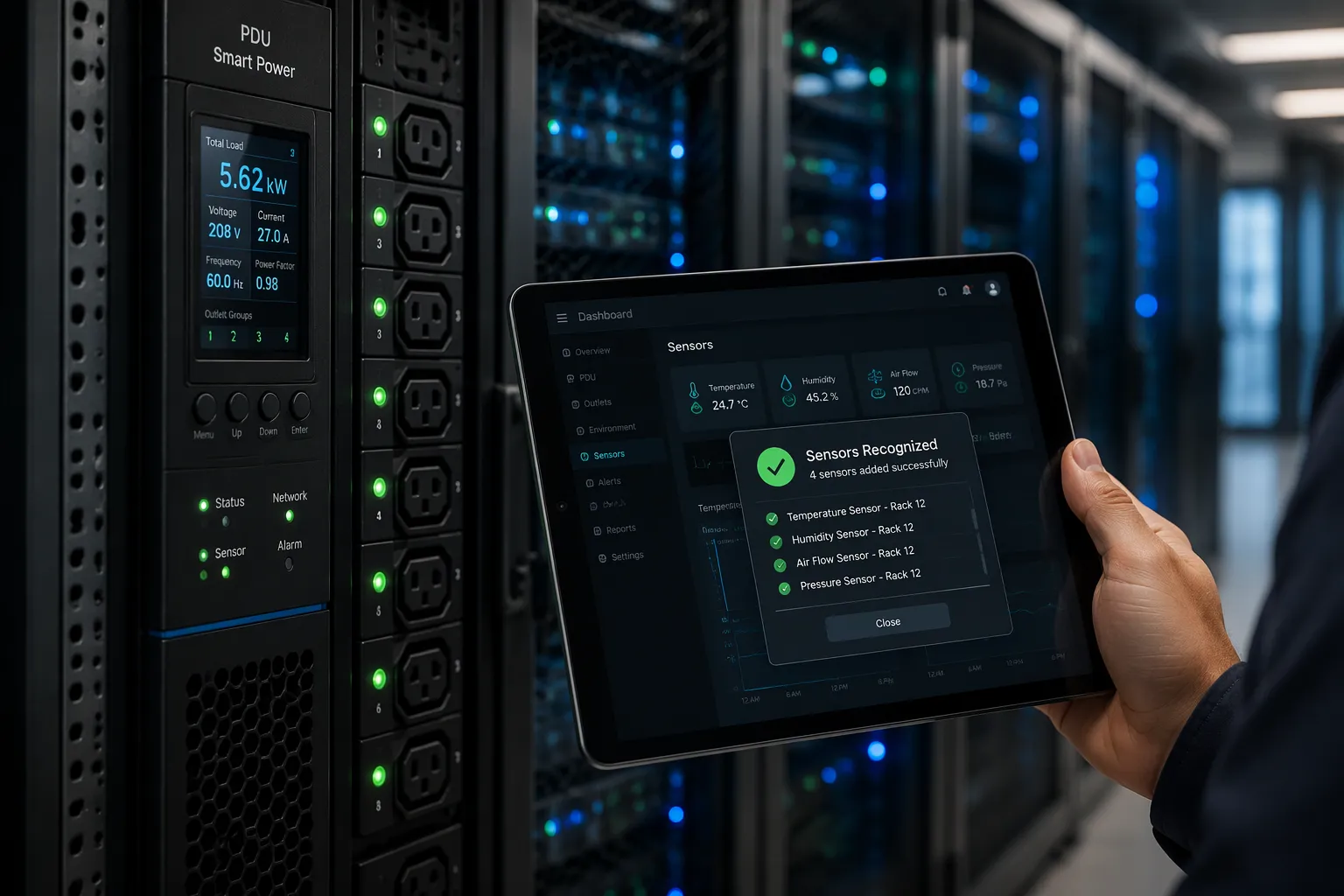
Smart PDU sensor auto-recognition and triggered alerts are the tools behind precise data center management. They link directly to uptime and fast response.
Manual sensor setup creates blind spots. Technicians must map each sensor by hand. Slow anomaly detection makes the problem worse. Faults grow unnoticed between inspection windows, and recovery slows while staff figure out complex error patterns. Raritan research shows that remote management capabilities deliver a 66% decrease in mean time to repair.
Smart PDUs close these gaps. Auto-recognition connects sensors without setup. Smart PDUs also trigger alerts from that data the moment conditions change. Teams see anomalies as they happen and act before small faults become outages.
Key Takeaways
Smart PDUs find sensors on their own, so you avoid setup mistakes and get accurate data fast.
Triggered alerts let you know right away when conditions change, so you can fix problems before they cause outages.
Smart PDUs cut repair time by up to 66%, keeping your data center running smoothly.
Smart PDUs send clear data to DCIM and BMS platforms. This gives you one simple view of your whole data center.
Using smart PDUs helps you shift from reacting to problems to preventing them. This keeps your operations steady as your infrastructure grows.
Smart PDU Sensor Auto-Recognition
Plug-and-Play Detection for Data Center PDUs
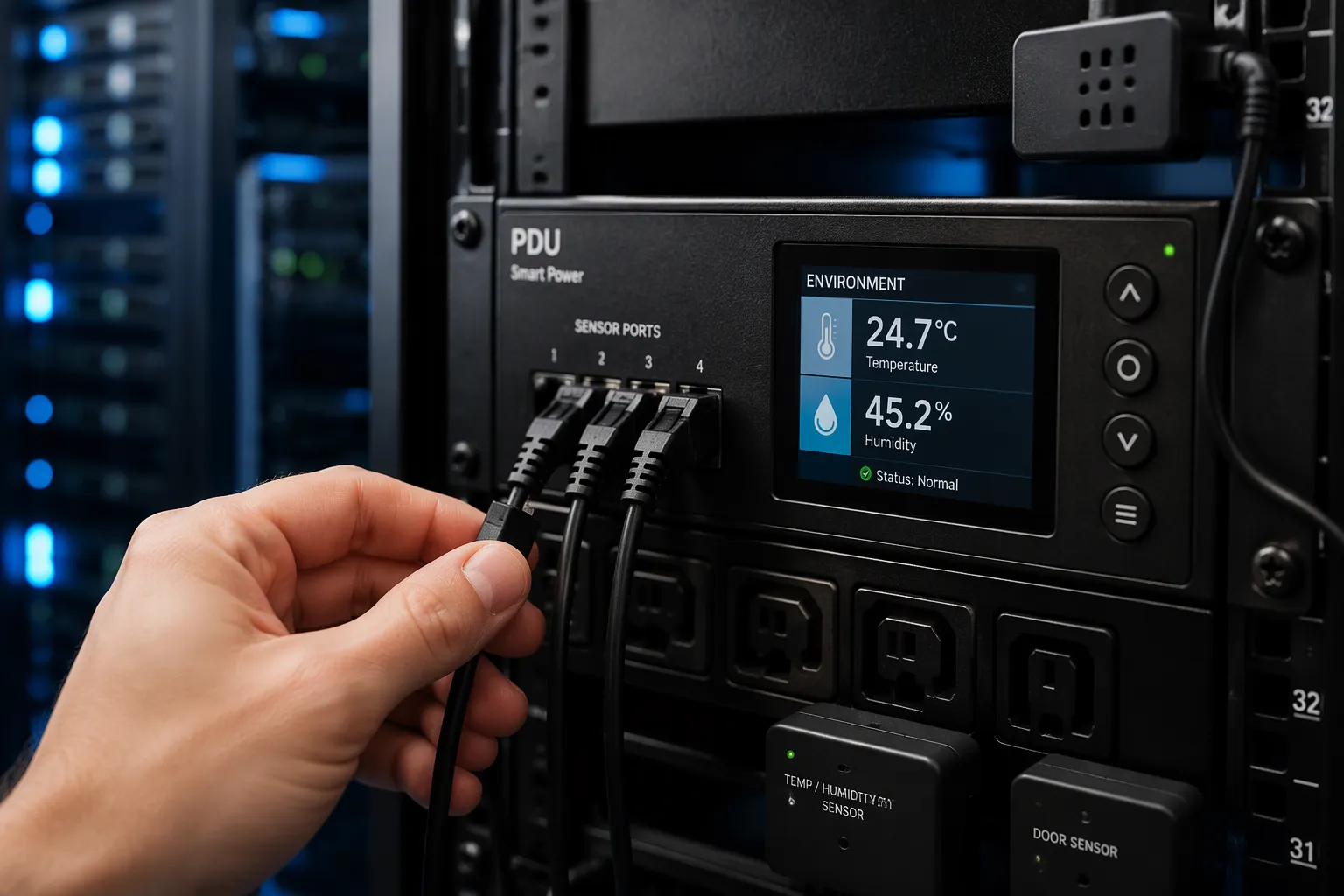
A plug-and-play sensor doesn't need an address book. The smart PDU checks its sensor bus at startup and each time something connects. It reads the sensor's identity, gives it a logical slot, and starts logging data within seconds. Server Technology PRO4X units support up to 32 sensor functions per device through plug-and-play sensor buses, according to Deipower. Raritan NX1 models use a wireless path with Zigbee 3.0 sensors and a five-year battery life. Both methods remove the manual mapping step that slows commissioning.
The same idea applies to environmental monitoring. Legrand's SmartSensors work as plug-and-play options with intelligent rack PDUs, and their metering parts deliver accurate data from the first reading, Server Technology notes. Panduit states the principle plainly: "Our PDUs automatically detect a variety of digital sensors, including environmental and rack access security." A technician plugs in the cable, and the data center PDU handles discovery, naming, and data collection without a configuration file.
ESTEL's Smart Power Distribution Unit follows this model. It supports environmental sensing for temperature and humidity, and its LCD display shows real-time readings at the rack. Operators see conditions on the unit itself before they open any software.
Eliminating Manual Configuration Errors
Manual configuration invites two failures. A technician can assign the wrong sensor to the wrong port. A sensor can also sit unconfigured and silent, which leaves a gap in the data record. Auto-recognition removes both risks. The device reports what it is, and the PDU records it against the correct outlet or rack position.
Centralized policy enforcement and granular device configuration across leading PDU vendors reduce misconfiguration risk and limit attack surfaces, according to Carrier. Automated discovery plays a similar role. It finds unauthorized devices before they hide in the inventory. These controls matter most in large estates, where monitored, switched, or intelligent PDUs from several vendors share one management plane.
The payoff is continuous visibility. A rack PDU that recognizes its sensors keeps a complete history, so a temperature spike has context. Teams compare the spike against baseline load and airflow data. Without auto-recognition, that history has holes, and holes hide trends.
ESTEL's power distribution unit pairs this accuracy with practical monitoring. Real-time power monitoring, remote management, and environmental sensors work together, and the LCD display confirms local status. The result is a clean data stream from the first connection onward.
Triggered Alerts for Proactive Data Center Management
Rule-Based Threshold Intelligence
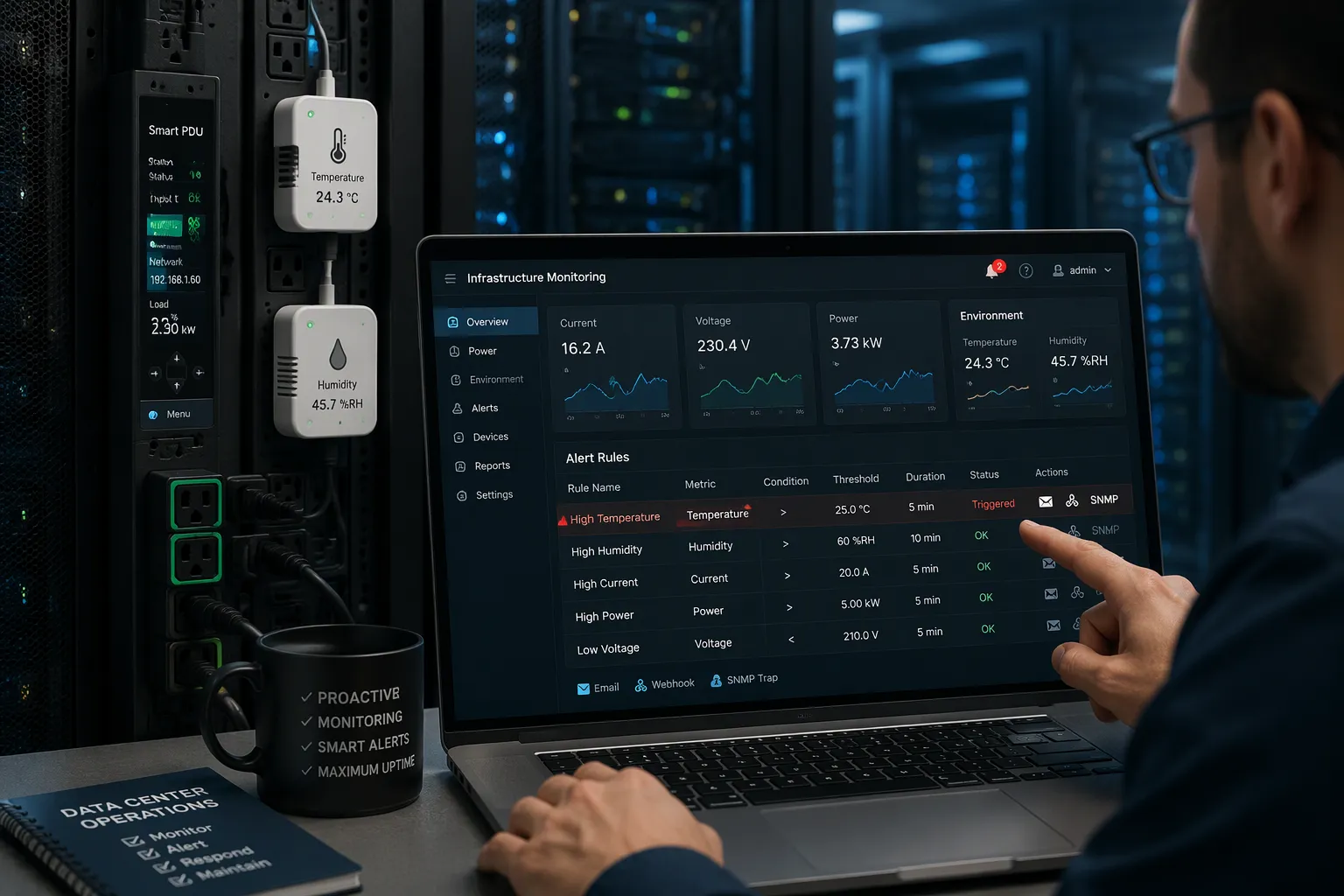
A smart PDU turns raw measurements into decisions. It constantly samples voltage, current, power, energy use, temperature, and humidity. Data center teams set warning and critical limits for each value. Rules trigger alerts on their own, with no human polling. When limits are crossed, the unit acts. Attom notes that an intelligent PDU can raise warnings for high current, overload conditions, voltage problems, and temperature or humidity limits. How detailed the measurements are depends on the design: some units report at the PDU level, while advanced models report per branch or per outlet. The unit checks each reading against its rule set on a fixed cycle, so a slow drift shows up as clearly as a sudden spike.
The rule set matters as much as the sensor. A delay duration filters out brief blips, and hysteresis stops an alert from flapping at the boundary. Synaccess describes this model well: each event is fully configurable, with adjustable thresholds, delay durations, and hysteresis to fine-tune response sensitivity. Smart PDUs apply these rules locally, so alerting keeps working during a network outage. The table below maps common triggers to notification paths.
Event Trigger | Notification Action |
|---|---|
Current threshold exceeded | Email notification to administrators |
Temperature or humidity breach | Webhook or HTTP request to dashboards and automation platforms |
Ping timeout (AutoPing) | SNMP trap to centralized monitoring |
Scheduled time or dry contact input | Chained actions, such as outlet reboot plus email |
Threshold alerting also covers environmental conditions. Vertiv explains that intelligent PDUs can include environmental sensors to monitor rack conditions without a separate monitoring system. ESTEL's Smart Power Distribution Unit adds surge protection and a dehumidifying function, so the unit guards equipment against spikes and excess moisture alongside its alerting role.
Real-Time Notification and Rapid Remediation
Detection only pays off when the message reaches the right person fast. Intelligent PDUs send remote alerts through SNMP traps, SMS, or email the moment thresholds are breached, per Vertiv. LDP Associates notes that these units offer remote monitoring and control through a web interface, so administrators manage power and environmental conditions from anywhere. Real-time power metering feeds the same stream, and real-time power monitoring at the outlet level shows which load caused the event. Monitored, switched, or intelligent PDUs all feed one management plane. A webhook can open a ticket, and an SNMP trap can update the network operations dashboard before an operator reads the first email.
The operational difference is measurable. WhatsUp Gold contrasts reactive monitoring, which responds after an issue occurs, with proactive alerting, which detects and prevents issues before impact. Incident.io reports that unplanned downtime can cost organizations $5,600 per minute on average. Faster acknowledgment shortens the path to repair. Rootly tracks MTTA and MTTR as core alert-management metrics, measuring acknowledgment speed and resolution speed respectively. Sherlocks notes that the investigation phase consumes 60 to 80% of total resolution time in distributed systems, so early, targeted warnings attack the largest cost.
Smart PDUs support the response side too. Nbyosun reports that hot-swappable controllers allow replacement without power interruption, and real-time visibility features reduce downtime by 15-25%. Smart PDUs pair threshold alerting with configurable alerts, so each event reaches the right channel. Smart PDUs log every event for later review. Smart PDUs close the loop between detection and action, and they turn a data center from a reactive posture into a managed one. The combination shortens mean time to repair and keeps capacity decisions grounded in current data.
Achieving Precision with Intelligent or "Smart" PDUs
Auto-recognition gives you clean data, and alerts turn that data into action. Incident.io reports that teams spend about a third of their time responding to disruptions, and much of that goes to finding the right responder. Automated escalation policies read alert attributes and page the correct engineer right away. Databank notes that automated alerting notifies staff when metrics cross set thresholds, so help starts early. Smart PDUs combine both functions, and the pairing shortens mean time to repair across the data center.
Intelligent or "smart" PDUs carry metering + monitoring + switching + environment sensing in one chassis. That mix gives granular metering & control and outlet-level metering and control. Smart PDUs also accept plug-and-play sensors without manual mapping.
Hot-Swappable Controllers and Latching Relays in ESTEL Smart Power Distribution Units
A hot-swappable controller lets a technician replace the management module without cutting power to the rack. Latching relays hold their last state through a power loss, so outlets return to the prior position on restart. Both features protect uptime during maintenance. The ESTEL Smart Power Distribution Unit carries a 16A maximum input current and 8 to 19 outlet configurations. Rated voltage and current reach 230VAC 32A, and the cable plug system complies with IEC60309. An LCD display shows local readings, and metering accuracy of ±1% is typical of smart PDUs. These smart PDUs support real-time power metering and per-outlet power measurement. Smart PDUs log each event for later review.
DCIM and BMS Integration for Data Center PDU Visibility
Integration with DCIM systems moves rack-level readings into one console. Integration with DCIM systems also links power data to asset and capacity records. A building management system adds cooling and environmental context. Smart PDUs feed both platforms through standard protocols, and the data center PDU becomes a managed node rather than a standalone strip. Data center PDUs from several vendors can report into the same platform. A rack PDU with outlet-level monitoring and real-time power monitoring gives operators the detail these platforms need. This combination delivers remote visibility, alerts, and centralized management for monitored, switched, or intelligent PDUs in the data center.
Auto-recognition and triggered alerts work together as one system. Sensor discovery gives you accurate data without any manual setup. Threshold rules then turn each reading into a fast, focused action. Every alert points to a specific rack or outlet. Together, they remove the blind spots that slow down recovery.
A smart PDU acts as the precision management layer for the data center. Smart PDUs improve uptime, keep real-time visibility strong, and shorten mean time to repair. Intelligent PDUs also send clean records to DCIM and BMS platforms. These units give operators a factual basis for capacity and efficiency decisions. Teams that adopt this layer can expect steadier operations as infrastructure grows.
FAQ
How does a smart PDU detect a newly connected sensor?
The unit checks its sensor bus at startup and every time a device connects. It reads the sensor's identity, gives it a logical slot, and starts logging within seconds. No manual mapping step is needed, so data collection begins with the first connection.
Which conditions can trigger an alert?
Rules cover voltage, current, power, energy use, temperature, and humidity. Teams set warning and critical limits for each value. The unit checks readings on a fixed cycle and raises warnings for overloads, voltage problems, and environmental breaches without human polling.
Do triggered alerts actually shorten repair time?
Yes. Remote management capabilities deliver a 66% decrease in mean time to repair, per Raritan research. Early, targeted warnings attack the investigation phase, which uses up most of total resolution time. Automated escalation then pages the correct engineer right away.
How do smart PDUs connect to DCIM and BMS platforms?
Smart PDUs report through standard protocols, so rack-level readings flow into one console. DCIM links power data to asset and capacity records. A BMS adds cooling and environmental context. The unit becomes a managed node rather than a standalone strip.
What specifications matter when specifying a unit?
Check input current, outlet count, and metering accuracy. The ESTEL Smart Power Distribution Unit offers 16A maximum input current, 8 to 19 outlets, 230VAC 32A rated voltage and current, an IEC60309-compliant plug system, and an LCD display. Metering accuracy of ±1% is typical of smart PDUs.
See Also
Understanding ESTEL PDUs and Their Functions in Data Center Cabinets
Ensuring Best Monitoring Practices for Outdoor Telecom Cabinet Performance
Improving Outdoor Cabinets Through Power, Cooling, and Monitoring Solutions
Installing and Maintaining Smoke Sensors Inside Communication Cabinets Properly
ESTEL Smart Microgrid Integrated Telecom Cabinet Energy Storage System Overview
CALL US DIRECTLY
86-13752765943
3A-8, SHUIWAN 1979 SQUARE (PHASE II), NO.111, TAIZI ROAD,SHUIWAN COMMUNITY, ZHAOSHANG STREET, NANSHAN DISTRICT, SHENZHEN, GUANGDONG, CHINA
