Collaboration Between Smart PDUs and Edge Servers: Dynamic Power Resource Allocation by Computing Load

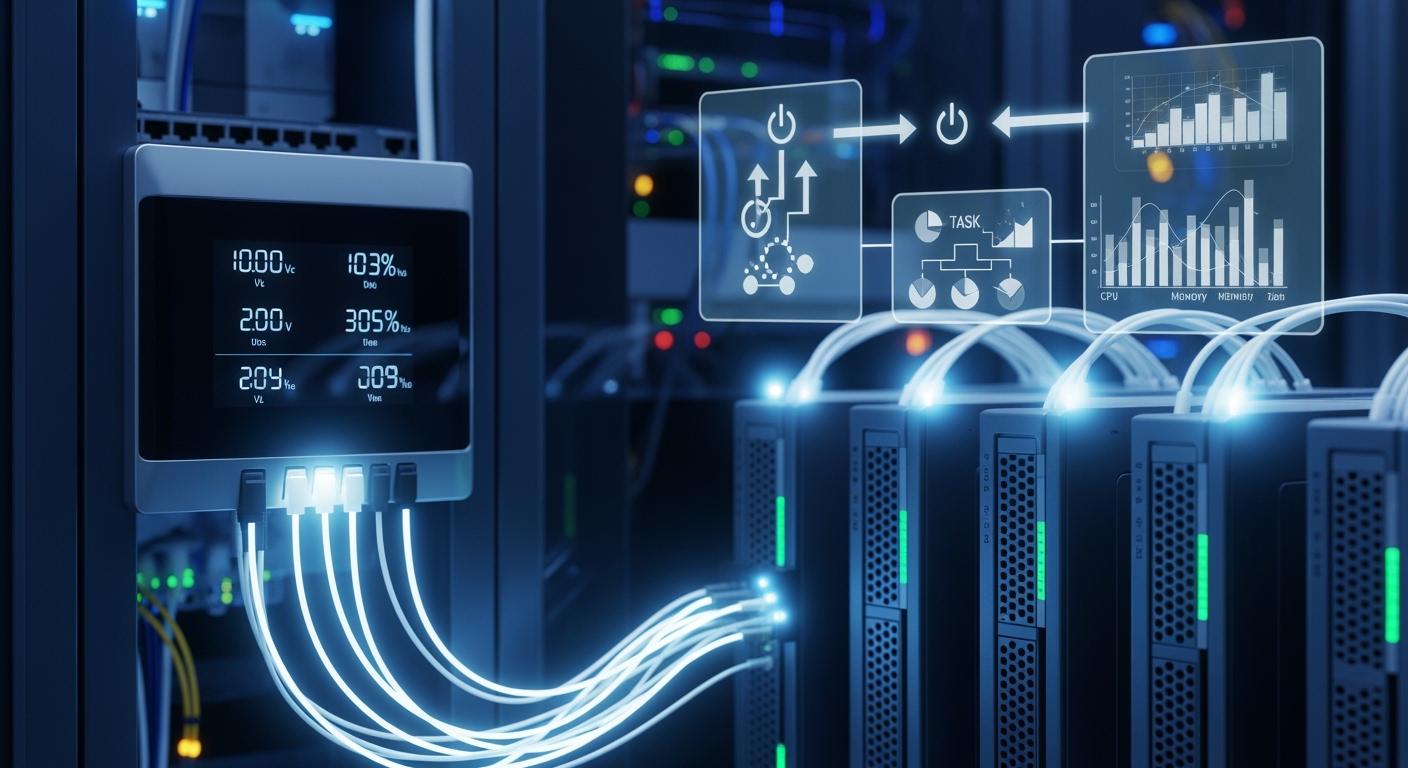
Dynamic power allocation has become vital as you face the rapid growth of edge computing and expanding data center needs. The table below shows how these markets continue to surge:
Metric | Value |
|---|---|
Edge Computing Market Size in 2024 | USD 153.50 Billion |
Edge Computing Market Forecast in 2030 | USD 248.96 Billion |
Growth Rate | CAGR of 8.1% (2025-2030) |
Data Center Power System Market Size 2025 | USD 21.52 Billion |
Projected Market Size 2034 | USD 56.50 Billion |
Growth Rate (Power Systems) | CAGR of 16.2% |
You use Smart Power Distribution Unit technology alongside edge servers to manage power efficiently. Edge computing lets you process data locally, respond instantly to changes, and reduce network delays. ESTEL leads the way in this field, providing reliable solutions that help IT professionals and decision-makers like you achieve better energy management and network reliability.
Key Takeaways
Dynamic power allocation is essential for managing the growing demands of edge computing and data centers.
Seamless integration between Smart Power Distribution Units and edge servers enhances energy efficiency and reliability.
Real-time data exchange allows for immediate responses to energy demands, reducing latency and improving operational efficiency.
Implementing Smart PDUs can lead to significant cost savings, energy efficiency, and reduced downtime.
Regular maintenance and proactive monitoring are crucial for maximizing the lifespan and reliability of your power infrastructure.
Collaboration Mechanisms
Communication and Integration
You need seamless communication between your Smart Power Distribution Unit and edge servers to achieve dynamic power allocation. This integration allows both systems to share real-time data, coordinate responses, and optimize energy use. When you connect these devices, you create a network that can monitor power consumption, detect anomalies, and adjust resources instantly.
The impact of this integration goes beyond basic monitoring. You gain the ability to visualize power trends and use digital twins, which are virtual models of your physical systems. These tools help you predict equipment conditions and schedule maintenance before failures occur. You can also use predictive analytics to forecast future power loads, which helps you avoid overloads and downtime.
Tip: Seamless integration means you can respond quickly to issues, reducing the risk of unexpected failures and improving overall reliability.
Here is a summary of how integration enhances reliability and predictive maintenance:
Evidence Description | Contribution to Reliability and Predictive Maintenance |
|---|---|
Real-time power data and fast decision-making | Enhances reliability by allowing operators to respond quickly to issues. |
Visualized power trends and digital twins | Helps predict equipment conditions and schedule maintenance, reducing unexpected failures. |
Predictive analytics using historical data | Forecasts future power loads to avoid overloads and downtime, enabling proactive maintenance. |
Real-Time Data Exchange
You benefit from real-time data exchange between your Smart Power Distribution Unit and edge servers. This process allows you to process information locally, which reduces latency and enables immediate action. You do not have to wait for cloud-based responses, so your system can react to changes in energy demand almost instantly.
Real-time data exchange supports localized processing and decision-making, which significantly reduces latency.
Intelligent algorithms analyze energy consumption and external factors, enabling immediate responses to changing demands.
Machine learning models at the edge can predict energy consumption, allowing for proactive adjustments in resource allocation.
You see improvements in response times, operational efficiency, and system stability. For example, edge-enabled systems can achieve an average system latency of 145 milliseconds and a 23.6% increase in energy efficiency. You also reduce bandwidth consumption by over 80%, which makes your network more resilient and cost-effective.
Evidence Description | Key Benefit |
|---|---|
Local processing of data reduces latency, leading to faster response times. | Faster response times |
Immediate action on data detected by smart PDUs without waiting for cloud response. | Improved operational efficiency |
Real-time data access allows for instant decision-making. | Enhanced reliability and stability |
ESTEL’s Role in Edge Solutions
You can rely on ESTEL for advanced edge power solutions. ESTEL specializes in integrating Smart Power Distribution Unit technology with edge servers, ensuring that your infrastructure operates efficiently and reliably. The company’s products support remote management, surge protection, and real-time monitoring, which are essential for dynamic power allocation.
ESTEL’s expertise in telecom infrastructure means you receive solutions that meet international standards and withstand harsh environments. You can deploy these systems in outdoor telecom sites, remote locations, or challenging conditions, knowing that they will deliver consistent performance. ESTEL’s commitment to innovation and quality ensures that your network remains resilient, scalable, and ready for future demands.
Note: By choosing ESTEL, you gain access to a partner who understands the complexities of edge computing and power management. You can trust their solutions to enhance your operational efficiency and network reliability.
Smart Power Distribution Unit Features
Intelligent Power Management
You gain advanced control over your power infrastructure with a Smart Power Distribution Unit. This technology gives you real-time tracking, remote management, and precise load balancing. You can monitor power usage at each outlet, which helps you plan capacity and prevent overloads. The system supports proactive management, so you can switch outlets or reboot devices without being on-site. You also benefit from integrated sensors that monitor temperature and humidity, which helps you avoid environmental risks. The table below summarizes the key features and benefits:
Feature Category | Key Features and Benefits |
|---|---|
Comprehensive Power Monitoring | Real-time tracking for optimal capacity planning and overload prevention |
Advanced Control | Remote management and outlet switching for proactive power management |
Energy Efficiency | Per-outlet metering for precise load management and reduced energy costs |
High Reliability | Durable construction and locking outlets to minimize downtime |
Environmental Sensing | Sensors for temperature and humidity to avert environmental risks |
Alerts & Notifications | Alarms for power or environmental issues before they escalate |
These features support dynamic power allocation by delivering electricity only when needed. You reduce energy waste and maintain high efficiency, even during low IT load periods. This approach lowers your energy costs and allows your infrastructure to scale as demand grows.
Remote Monitoring and Control
You can monitor and control your Smart Power Distribution Unit from anywhere. The unit includes an environment monitoring module, dual-core processing, and a user-friendly LCD display. You have access to multiple communication interfaces, such as RS485 and RS232, which support different modes like point-to-point and wireless remote options. The system provides analog and digital inputs and outputs, which you can redefine for your needs. Electrically isolated components ensure high reliability.
Remote monitoring gives you real-time insights into device performance. You can use predictive maintenance to identify potential issues before they cause failures. This capability reduces the need for on-site visits and minimizes downtime. Proactive maintenance using AI-driven analytics can cut unexpected disruptions by up to 50%. Intelligent PDUs prevent overloads, improving equipment uptime by 20%. Proactive monitoring can prevent up to 80% of outages.
Safety and Reliability
You protect your equipment with advanced safety features in the Smart Power Distribution Unit. Temperature monitoring and humidity control help maintain optimal conditions for your servers. Surge protection absorbs excess voltage during power spikes, which prevents damage to sensitive components. Overload protection ensures circuits shut down automatically if power loads exceed safe limits. This reduces the risk of overheating and equipment failure. You can trust the robust design to safeguard your critical systems and keep your network running smoothly.
Dynamic Power Allocation Process

Load Assessment
You start by assessing the current computing load on your edge servers. The Smart Power Distribution Unit collects real-time data from each connected device. This data includes power consumption, temperature, and workload levels. You use this information to understand which servers are active and which ones are idle. Accurate load assessment helps you identify where to allocate or reduce power. You can spot trends and predict when demand will rise or fall. This step forms the foundation for efficient power management.
Automated Adjustment
Once you have assessed the load, you move to automated adjustment. Your system uses intelligent algorithms to respond to changing demands without manual intervention. The Smart Power Distribution Unit works with edge servers to adjust power delivery instantly. Here are some common techniques used in real-world deployments:
Technique | Description |
|---|---|
Dynamic Voltage and Frequency Scaling | Adjusts the voltage and frequency of processors based on workload demands to save energy. |
Selective Activation of Processing Units | Activates only the necessary processing units to handle current tasks, reducing power usage. |
Adaptive Inference | Modifies model complexity based on input characteristics to optimize resource use. |
Sleep Mode Management | Puts idle components into low-power states to conserve energy during inactivity. |
You benefit from these automated adjustments because they help you save energy and extend equipment life. The system reacts in real time, so you do not need to worry about manual changes.
Load Balancing
You achieve optimal performance by balancing the computing load across all available resources. AI-driven load balancers use machine learning to distribute workloads efficiently. These systems consider energy efficiency and real-time power availability. Some advanced solutions use deep reinforcement learning to manage energy, which lowers consumption and reduces delays. Edge computing also supports energy monitoring, load forecasting, and collaborative management. You ensure that no single device becomes overloaded, which keeps your network stable and responsive.
Tip: Regular load balancing prevents bottlenecks and maximizes the lifespan of your equipment.
Benefits and Implementation
Efficiency and Cost Savings
You can achieve impressive efficiency gains by using dynamic power allocation with Smart Power Distribution Units. These systems help you reduce energy waste, lower operational costs, and extend the lifespan of your equipment. The table below shows measurable improvements you can expect:
Metric | Efficiency Gain |
|---|---|
Energy efficiency | Up to 97.8% |
Reduction in energy use | 30% |
Reduction in downtime | 25% |
Reduction in CO2 emissions | 40% |
Reduction in power consumption | 18% |
Annual savings | About $120,000 |
Energy savings in facilities | Up to 20% |
Decrease in downtime incidents | 30% |
Faster maintenance response | 40% |
Prevention of outages | Up to 80% |
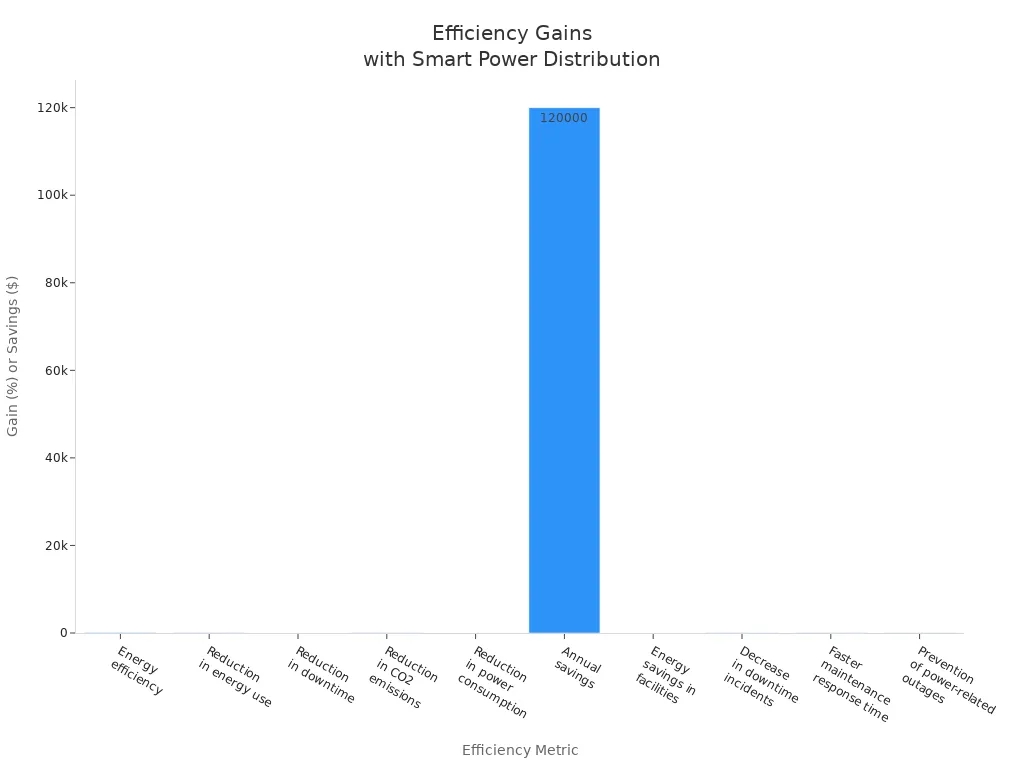
You maximize resource utilization and avoid unnecessary energy consumption. You also lower your operational costs and support a greener environment.
Scalability and Resilience
You can scale your infrastructure easily with Smart Power Distribution Units. These units use smart outlets, microcontrollers, and sensors to adapt to growing demands. Intelligent field devices detect faults and reroute power within seconds. Edge-enabled smart meters collect real-time data, helping you make better decisions. You also improve resilience. Dynamic power allocation keeps your system stable during outages or load spikes by optimizing power flow and supporting emergency controls.
Evidence Description | Explanation |
|---|---|
Dynamic power allocation optimizes initial conditions | Maintains stability during power system events |
Grid component hardening programs | Ensures robust operation under severe conditions |
Integration with Telecom Power System
You can integrate Smart Power Distribution Units with your telecom power system by following a few steps:
Install IoT-enabled PDUs in your telecom cabinets.
Connect PDUs to an AI system for predictive analytics.
Enable automated power settings for dynamic adjustment.
You should also use high-efficiency converters, smart grid technologies, and uninterruptible power supplies. Routine maintenance and daily monitoring help prevent outages and keep your system running smoothly.
Best Practices with ESTEL
You can follow these best practices for successful deployment:
Best Practice | Description |
|---|---|
Scalability | Ensure PDUs can grow with your needs |
Compliance with Standards | Meet safety and performance benchmarks |
Regular Maintenance | Prevent failures and extend equipment lifespan |
Advanced Features | Use alarm monitoring and fault detection |
Tip: You can reduce risks by customizing features, building in redundancy, and focusing on cost-effectiveness. ESTEL recommends regular inspections and proactive monitoring to keep your network reliable.
You gain significant advantages by integrating Smart Power Distribution Units and edge servers for dynamic power allocation. This approach brings more outlet flexibility, higher power capacity, and improved resilience to your network.
Benefit | Description |
|---|---|
More outlet flexibility | Supports diverse equipment and reduces installation issues |
More outlets | Powers more devices in taller racks |
Higher power | Delivers up to 35kW for dense deployments |
Higher resilience | Real-time monitoring enhances uptime |
Telecom and IT organizations see improved efficiency as 5G and edge networks expand.
You can select ESTEL models tailored for high-density, affordable, or unstable power environments.
ESTEL’s solutions help you build a reliable, scalable, and future-ready infrastructure.
FAQ
How does a Smart Power Distribution Unit help you manage power at the edge?
A Smart PDU lets you monitor and control power use in real time. You can track each outlet, switch devices remotely, and respond quickly to changes. This helps you save energy and prevent overloads.
Can you control ESTEL’s Smart PDU from a remote location?
Yes! You can use remote management features to monitor, switch, or reboot devices from anywhere. This reduces the need for on-site visits and helps you solve problems faster.
What safety features protect your equipment?
ESTEL’s Smart PDU includes surge protection, overload shutdown, and a dehumidifying function. These features keep your equipment safe from power spikes, overheating, and moisture.
How do you integrate a Smart PDU with your telecom power system?
You connect the Smart PDU to your network and use its communication ports. The system works with your existing telecom power setup, making integration simple and efficient.
Why should you choose ESTEL for edge power solutions?
Reason | Benefit |
|---|---|
Quality products | Reliable performance |
Advanced features | Better control and safety |
Proven expertise | Trusted by telecom leaders |
See Also
Understanding ESTEL PDUs and Their Importance in Data Centers
Telecom Cabinet Energy Storage System with ESTEL Microgrid Integration
Enhancing Outdoor Cabinets Through Power, Cooling, and Monitoring
Ensuring Consistent Power Supply for Telecom Cabinet Operations
Solar Energy Storage Solutions for Telecom Cabinet Efficiency
CALL US DIRECTLY
86-13752765943
3A-8, SHUIWAN 1979 SQUARE (PHASE II), NO.111, TAIZI ROAD,SHUIWAN COMMUNITY, ZHAOSHANG STREET, NANSHAN DISTRICT, SHENZHEN, GUANGDONG, CHINA
