Power Anomaly Traceability of Smart PDUs: Visual Topology Path for Fault Point Location

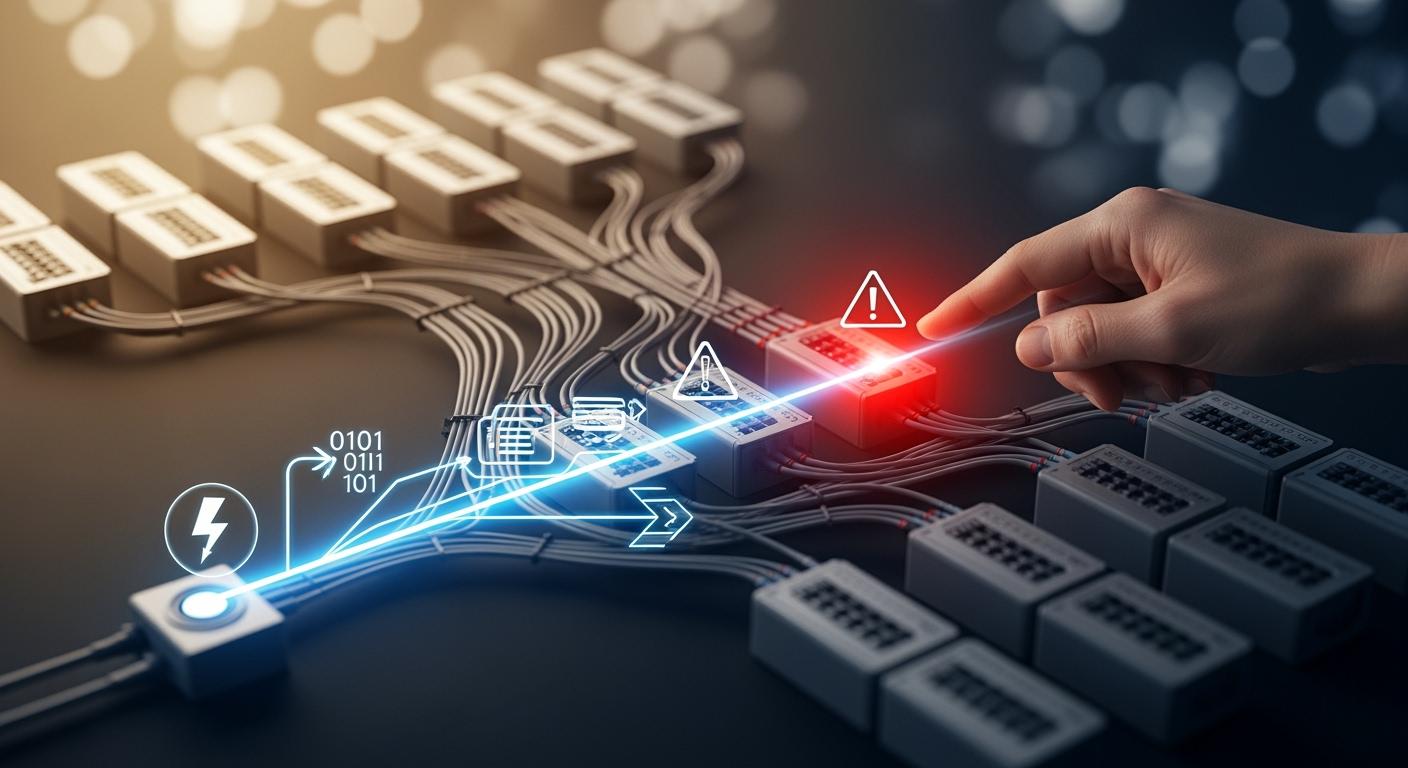
Imagine a busy data center facing an unexpected power anomaly. You need to find the fault quickly to prevent downtime. Visual topology paths in a Smart Power Distribution Unit help you locate the exact fault point with speed and precision. ESTEL delivers reliable solutions that make your job easier. You gain clear insight into your power network, saving time and reducing risk.
Key Takeaways
Visual topology mapping allows you to quickly locate faults in your power network, saving time and reducing errors.
Using a Smart Power Distribution Unit enhances power management with real-time monitoring and remote control capabilities.
Implementing advanced AI techniques improves anomaly detection accuracy, helping you spot issues before they escalate.
Regular training and system evaluations keep your team prepared for new challenges and ensure compliance with regulations.
Adopting ESTEL’s solutions can lead to significant reductions in outages, maintenance costs, and energy waste.
Smart Power Distribution Unit Overview
What Is a Smart Power Distribution Unit?
You use a Smart Power Distribution Unit to manage and distribute electrical power in data centers and telecom environments. This device goes beyond basic power strips. It gives you advanced control, monitoring, and safety features. You can see the main components and their functions in the table below:
Component | Function |
|---|---|
Remote control connections | Lets you access the power system from anywhere. |
EMI filters | Blocks unwanted electromagnetic noise. |
Control board | Lets you adjust settings and view power data. |
Auxiliary output | Checks breaker status and connections. |
Main output | Delivers power to your devices. |
AC inlet and outlet | Connects to power sources and devices. |
Individual outlets | Offers multiple outputs with remote monitoring. |
GFI module | Protects against electrical accidents. |
Relays | Switches and monitors power flow. |
Main circuit breaker | Controls the main power source. |
Environmental sensors | Tracks heat and moisture. |
Key Features and Benefits
A Smart Power Distribution Unit gives you more than just power delivery. You get advanced power control, real-time monitoring, and remote management. These features help you respond quickly to changes and keep your equipment safe. You can see the most common features and their benefits in the table below:
Feature | Benefit |
|---|---|
Advanced Power Control | Manages power efficiently and reduces waste. |
Real-Time Monitoring | Tracks power use and spots problems early. |
Remote Control | Lets you manage power from any location. |
Environmental Tracking | Alerts you to heat or moisture issues. |
You improve operational efficiency and reliability with these features. You also save energy and lower costs.
ESTEL’s Product Innovations
ESTEL leads in Smart Power Distribution Unit technology. You benefit from modular and scalable solutions that make maintenance easy and reduce downtime. ESTEL’s units offer advanced monitoring for voltage regulation and equipment protection. You get high energy efficiency, which means less waste and lower bills. ESTEL’s products meet ISO9001 and VDE standards, so you know you are getting safe and reliable equipment. You can find more about ESTEL’s Smart Power Distribution Unit on their official website.
Traditional Fault Detection Challenges
Manual Methods and Limitations
You often rely on manual inspection and troubleshooting when you use traditional PDUs. This process can take hours. You must check each connection and device one by one. You may use paper records or basic spreadsheets to track faults. These methods make it hard to spot problems quickly. You risk missing hidden issues. You also face challenges when you try to merge new maintenance systems with older setups. The table below shows common operational challenges:
Challenge | Description |
|---|---|
Integration with Legacy Systems | Difficulty in merging new predictive maintenance systems with older setups, causing inefficiencies. |
Data Management | Importance of securing sensitive data through encryption and access controls. |
Training | Necessity for training staff to effectively interpret and respond to predictive alerts. |
Impact on Operations and Costs
Manual fault detection affects your daily operations. You spend more time searching for faults. You may delay repairs. This increases downtime and can lead to lost revenue. You must manage rising energy costs and maintain continuous uptime. You need to enhance system resiliency. Capacity planning becomes more complex. You must also think about current and future scalability. These factors drive up operational costs and make your job harder.
Maintaining Continuous Uptime
Enhancing System Resiliency
Complexities of Capacity Planning
Current and Future Scalability
Why Visual Topology Is Better
Visual topology mapping changes how you find faults. You see the entire power network in one view. You trace the path of power flow and spot the exact fault point. You save time and reduce errors. You use a Smart Power Distribution Unit to get real-time data and clear visualization. This approach improves efficiency and lowers costs. You respond faster to anomalies and keep your systems running smoothly.
Visual Topology Mapping

How Visual Topology Works
Visual topology mapping lets you see your entire power network as a clear, interactive diagram. You can follow the flow of electricity from the main source to each device. This process uses advanced digital tools to create a virtual model of your physical power system. You get a real-time map that updates as conditions change.
The technical processes involved in visual topology mapping within Smart Power Distribution Units include digital twin mapping, image processing techniques, and data classification methods. Specifically, the study highlights the use of specialized compression and filtering techniques for enhancing fault processing efficiency, establishing a K-level neighbor structure topology diagram for comprehensive mapping, and employing bilinear interpolation for image data compression to improve processing efficiency.
You benefit from these methods because they make the mapping fast and accurate. The system compresses and filters data to show only what matters. You see a K-level neighbor structure, which means you can trace connections several steps away from any point. This helps you understand how a problem in one area might affect others. The Smart Power Distribution Unit uses these techniques to give you a clear, up-to-date view of your power network.
Traceability and Fault Location
When a fault occurs, you need to find it quickly. Visual topology mapping gives you the tools to trace the exact path of the problem. You can follow the power flow and see where the issue started. This method uses advanced algorithms to match virtual circuits with real ones, making fault location precise and reliable.
Description | |
|---|---|
D-S Evidence Theory | Utilized for accurate fault location by analyzing the mapping relationship between virtual and real circuits. |
Deep Search Fault Inference Algorithm | Maps secondary physical links to virtual circuits for enhanced visualization and fault inference. |
Breadth First Search Algorithm | Enables hierarchical querying and radial traversal of fiber optic circuits for comprehensive monitoring and fault management. |
You use these algorithms to analyze the network and pinpoint the fault. The Smart Power Distribution Unit supports these processes, so you can act fast and reduce downtime. You do not have to guess where the problem is. You see it on the map and can take action right away.
Real-Time Monitoring and Visualization
You need to monitor your power system at all times. Real-time visualization helps you spot issues before they become serious. ESTEL’s Smart Power Distribution Unit integrates advanced monitoring features that keep you informed and in control.
Real-time sensory data collection helps maintain optimal conditions for equipment.
Instant alerts for voltage drops or battery issues prevent outages.
Intrusion sensors deter theft and vandalism.
Early detection of overheating, water leaks, and power anomalies.
Predictive maintenance anticipates failures using sensor data.
Intelligent power management optimizes energy usage.
Integration with management tools enhances oversight and decision-making.
Monitoring critical parameters helps spot issues before they escalate.
You get instant notifications if something goes wrong. You can check the status of every outlet and device. The system collects data from sensors and displays it in a way that is easy to understand. You can use this information to plan maintenance, prevent failures, and keep your network running smoothly.
ESTEL’s Smart Power Distribution Unit brings all these features together. You gain a powerful tool for managing your power network with confidence. You see problems as they happen and can respond before they cause damage. This approach improves reliability and saves you time and money.
Anomaly Detection Implementation
Step-by-Step Setup
You can set up anomaly detection in your power management system by following a clear process. Start by evaluating your current systems to find areas that need improvement. Next, implement real-time monitoring tools to keep a constant watch on your power distribution. Train your team so everyone understands how to use AI tools for predictive maintenance. Finally, review all regulations to make sure you follow standards like the EU AI Act and GDPR.
Step | Description |
|---|---|
Evaluate Current Systems | Assess existing power management systems to identify improvement areas. |
Implement Real-Time Monitoring | Use tools that provide continuous oversight of power distribution. |
Train Team | Educate staff on AI tools for predictive maintenance. |
Review Regulations | Ensure compliance with relevant standards like the EU AI Act and GDPR. |
Tip: Regular training and system reviews help you stay ahead of new threats and changes in technology.
AI and Data-Driven Techniques
You can use advanced AI and data-driven methods to improve anomaly detection. The most effective frameworks use autoencoders for feature transformation and multi-layer perceptrons for detecting anomalies. These techniques increase detection accuracy by about 25% compared to older methods. They also reduce false positives and work well against different types of cyberattacks. With this approach, you can reach an accuracy of 92%, an F1-Score of 92%, and a specificity of 94%.
Autoencoders transform raw data into useful features.
Multi-layer perceptrons analyze these features to spot unusual patterns.
This method lowers the chance of missing real problems.
You get better results across different network threats.
Practical Examples with ESTEL Solutions
When you use ESTEL’s Smart Power Distribution Unit, you can detect issues like abnormal load patterns, overloads, and sudden changes in power use. In real-world telecom cabinets, these units help you find power leaks and spot energy spikes before they cause bigger problems. Studies show that effective monitoring and load balancing can prevent up to 80% of outages, making your network more reliable and lowering costs. Regular analysis of power data lets you catch small issues early, so they do not turn into major failures.
Improvement Type | Percentage/Outcome |
|---|---|
Reduction in outages | 15% |
Improvement in energy efficiency | Up to 20% |
Lower maintenance costs | 30% |
Improvement in operational performance | 25% |
Reduction in equipment failure risk | Up to 30% |
Decrease in troubleshooting time | 30% |
Decrease in battery failure rates | 98% (2018-2024) |
Improvement in equipment uptime | 20% |
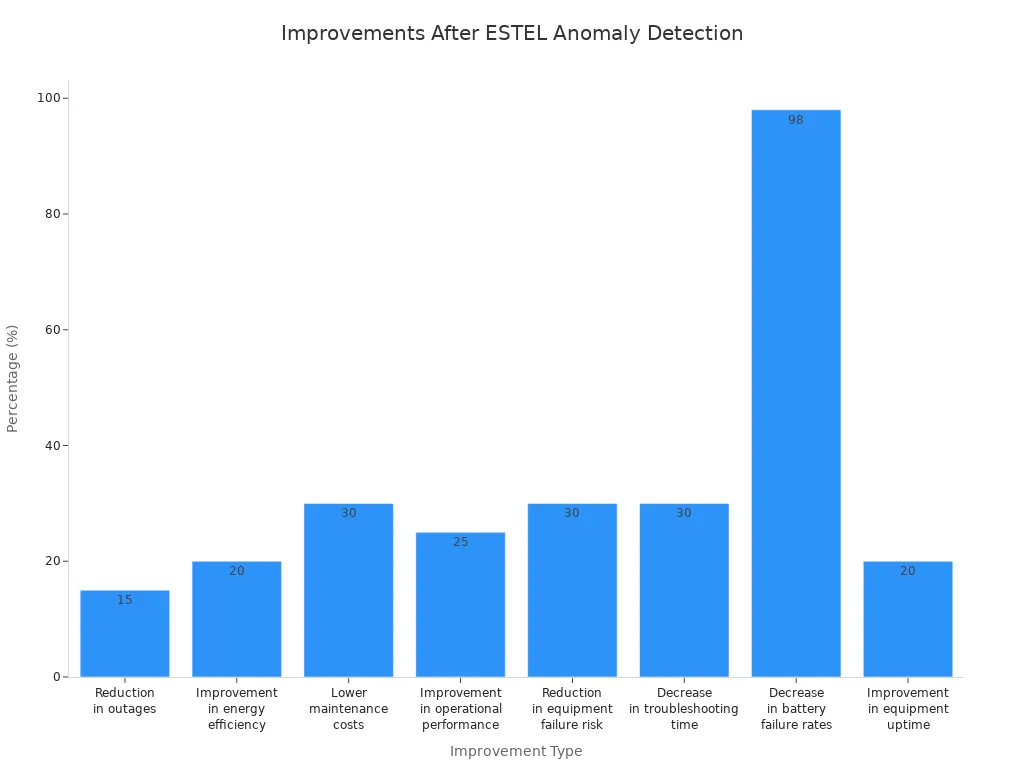
You can expect to see fewer outages, better energy efficiency, and lower maintenance costs when you use these solutions. This approach helps you keep your equipment running longer and reduces the risk of failure.
Visual topology mapping helps you find faults fast and keep your network stable. You gain long-term benefits by using real-time monitoring and alerts to address issues before they grow. ESTEL leads the way with proactive risk analysis, predictive analytics, and advanced safety features. To improve your operations, you should:
Adopt visual topology mapping for better traceability.
Use ESTEL’s Smart Power Distribution Unit for active energy management.
Stay updated on trends like AI, IoT, and modular designs.
Explore ESTEL’s solutions to boost efficiency and reliability in your power management.
FAQ
How does visual topology mapping help you locate faults faster?
Visual topology mapping shows you the power flow in real time. You can trace the path and spot the exact fault point. This method reduces troubleshooting time and improves accuracy.
Can you monitor your Smart PDU remotely?
Yes, you can monitor and control your Smart PDU from any location. Remote access lets you check power status, receive alerts, and manage settings without being onsite.
What safety features does ESTEL’s Smart PDU offer?
ESTEL’s Smart PDU includes surge protection, dehumidifying functions, and environmental sensors. These features protect your equipment and help maintain optimal conditions.
Is visual topology mapping easy to integrate with existing systems?
You can integrate visual topology mapping with most modern power management systems. ESTEL’s solutions support flexible connectivity and compatibility with standard protocols.
What benefits do you gain from using ESTEL’s Smart PDU in telecom environments?
You improve uptime, reduce maintenance costs, and enhance energy efficiency. ESTEL’s Smart PDU helps you detect anomalies early and keeps your network stable.
See Also
Understanding ESTEL PDUs And Their Importance In Data Centers
Ensuring A Consistent Power Supply For Telecom Cabinets
A Complete Overview Of Telecom Cabinet Battery Risk Assessment
Solar Energy Storage Solutions For Telecom Cabinet Applications
Achieving Effective Monitoring For Outdoor Telecom Cabinet Systems
CALL US DIRECTLY
86-13752765943
3A-8, SHUIWAN 1979 SQUARE (PHASE II), NO.111, TAIZI ROAD,SHUIWAN COMMUNITY, ZHAOSHANG STREET, NANSHAN DISTRICT, SHENZHEN, GUANGDONG, CHINA
