How to Design Tamper-Proof Smart PDUs in Telecom Cabinets with Hardware-Level Protection for Configuration Security


In unmanned telecom cabinets, anyone with a key can reach the PDU's console, ports, and configuration store. Software passwords alone are not a security boundary. You need protection anchored in hardware, so tampering is prevented, detected, or neutralized before configuration can change.
Hardware-level methods give you that anchor. Physical hardening, a hardware root of trust, secure boot and configuration locking, tamper detection and response, and encrypted communication each close a different gap. Together they form a layered design checklist you can apply to your own smart PDU architecture, from the secure element outward to the enclosure and the network.
Key Takeaways
Harden the PDU enclosure with strong materials and multi-point locks to block physical access.
Use a hardware secure element to anchor keys and enable secure boot for configuration integrity.
Deploy sensors to detect tampering and trigger automatic key erasure to protect sensitive data.
Encrypt all management communications and authenticate every session to prevent remote attacks.
Manage cryptographic keys carefully throughout their lifecycle with unique keys and scheduled rotation.
Hardening the Smart PDU Enclosure in Telecom Cabinets
Defining the Trust Boundary
Physical protection starts at the chip level and extends outward through the enclosure. Each layer presents a different challenge. Before you choose materials for telecom cabinets, identify the security assets: the configuration store, the console port, the key material, and the switching path. Draw a trust line boundary around them. Everything inside that line needs physical and electrical protection. These cabinets sit in unmanned sites, so the boundary must hold without staff on hand.
Material selection follows the boundary. Weigh each option against durability and tamper resistance.
Material | Durability | Tamper-Resistance |
|---|---|---|
Carbon Steel | Cost-effective, prone to corrosion | Standard |
Stainless Steel | Corrosion-resistant, flexible | Excellent |
Galvanized Steel | Zinc-coated corrosion resistance | Moderate, weak against salt water |
Fiberglass | Strong, heat-dissipating, insulating | High |
Polycarbonate | Corrosion-resistant | Good |
Stainless steel suits high-security sites. Fiberglass and polycarbonate give insulation and corrosion resistance for outdoor cabinets. Metals add an EMI barrier. Surge-resistant and tamper-proof enclosures pair these materials with surge protection, so the wall that blocks a pry bar also anchors ac surge protection hardware. That combination delivers protection in one layer, and the enclosure adds a second.
Tamper-Resistant Covers and Locks
Concealed or welded-pin hinges only. External pins get punched out quickly. Use a 3-point or 5-point latching system with a hardened swinghandle. A single-point lock with a cheap cam is security theater. Continuously welded seams resist prying better than riveted panels. Specify 2 mm minimum wall thickness for steel and 3 mm for aluminum. Add magnetic door switches tied to the site alarm.
Secure locking mechanisms include multi-point compression latching, flush-mounted lock handles, and digital audit-capable locks. Choose lock hardware with tamper-evident seals and access logging. Good lock hardware supports theft and vandalism deterrence across a fleet of cabinets. Pair it with ingress protection ratings and access control and security features on the PDU. The power path needs surge protection too. This protection extends to surge-protected telecom cabinets. Reinforced telecom cabinets resist forced entry. ESTEL's outdoor telecom cabinets apply anti-theft locks and reinforced construction as part of this physical layer.
Building a Hardware Root of Trust for Telecom Equipment
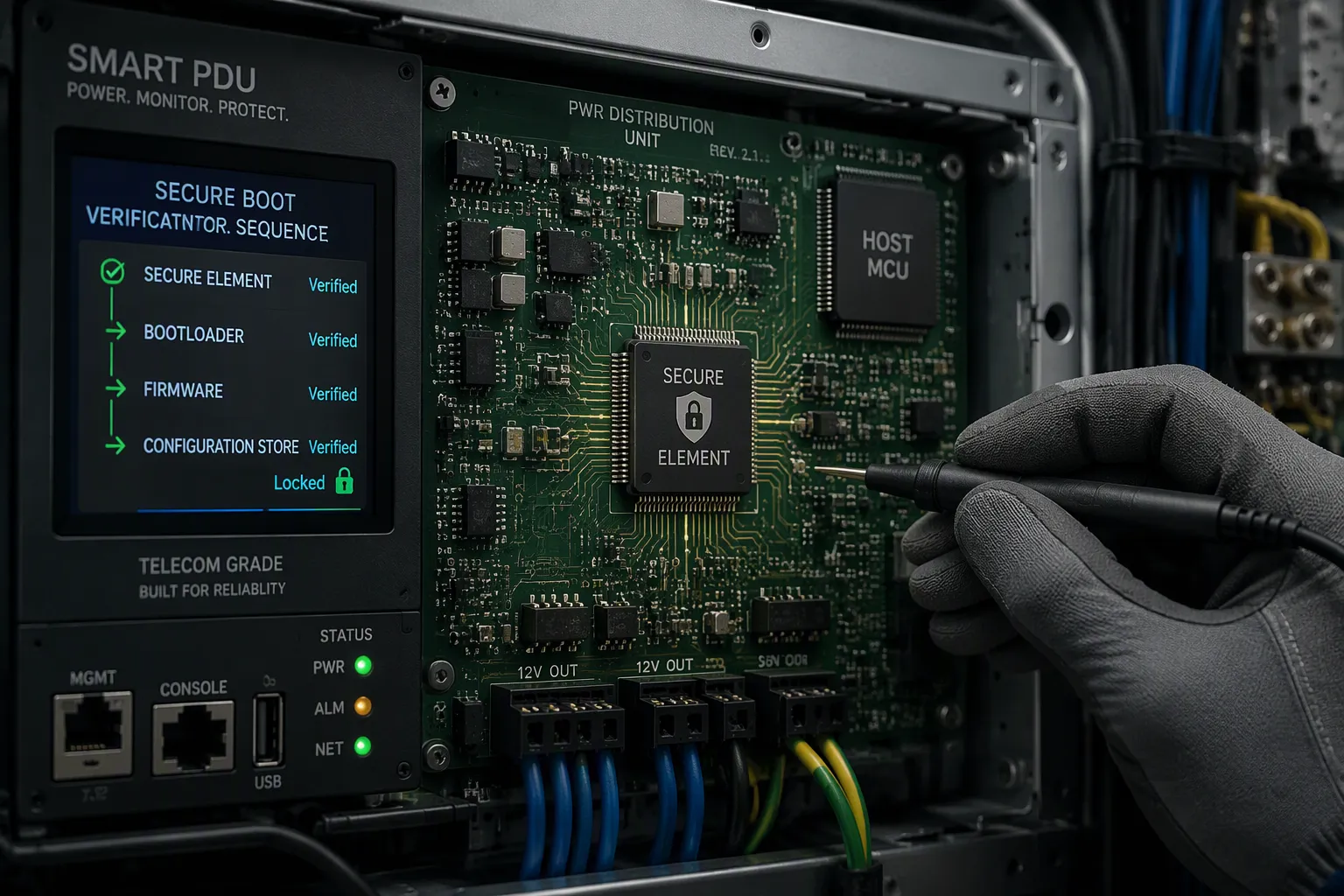
Secure Element Integration
A secure element gives your smart pdu a fixed anchor for keys and identity. Select the part against clear criteria. Secure boot and hardware secure elements establish a trusted boot chain and hardware-rooted protection for configuration. AES-256 encryption secures communications. VAPT certification validates resistance to attacks. NISTIR 8259 compliance aligns the device with an IoT cybersecurity baseline. Multi-factor authentication and role-based access control restrict access to configuration functions.
Secure boot and hardware secure elements for a trusted boot chain
AES-256 encryption for communications
VAPT certification to validate attack resistance
NISTIR 8259 compliance for an IoT cybersecurity baseline
MFA and RBAC to control configuration access
Integration follows a fixed sequence on the board. Solder the secure element first, then route its bus to the host controller on inner layers. Keep those traces short and encrypt the link between the element and the MCU. Give the element dedicated power and ground, separate from the rest of the circuit. This isolation reduces side-channel risk. Place the element centrally, surrounded by other components, so a probe cannot reach it easily.
Secure Boot and Configuration Locking
Secure boot chains trust from the secure element through firmware to configuration. The element holds the root key. It verifies the bootloader signature before the processor runs any code. The bootloader then verifies the firmware image. The firmware finally verifies the configuration store before it loads settings. A break anywhere in the chain halts the boot. Configuration locking adds a write barrier. The store accepts writes only from signed firmware, so an attacker at the console cannot alter settings directly.
PCB layout carries much of this protection. Route critical traces on inner layers between ground planes. Use blind and buried vias with controlled-depth drilling to raise reverse-engineering difficulty. Add a mesh layer that triggers an alarm or wipes data if drilling is attempted. Apply conformal coating or potting to resist physical probing. Disable secure JTAG and debug interfaces permanently in production. Keep secure components below 85°C with thermal vias, because heat degrades encryption modules. Source authenticated, traceable components to block counterfeit backdoors.
ESTEL's Smart Power Distribution Unit pairs remote management with hardware-anchored configuration control. The platform suits telecom cabinets that need both remote visibility and a locked configuration path. Its surge protection and dehumidifying function support stable operation in outdoor sites. Power distribution units built this way give operators a reference design for hardware-rooted trust.
Tamper Detection and Equipment Protection
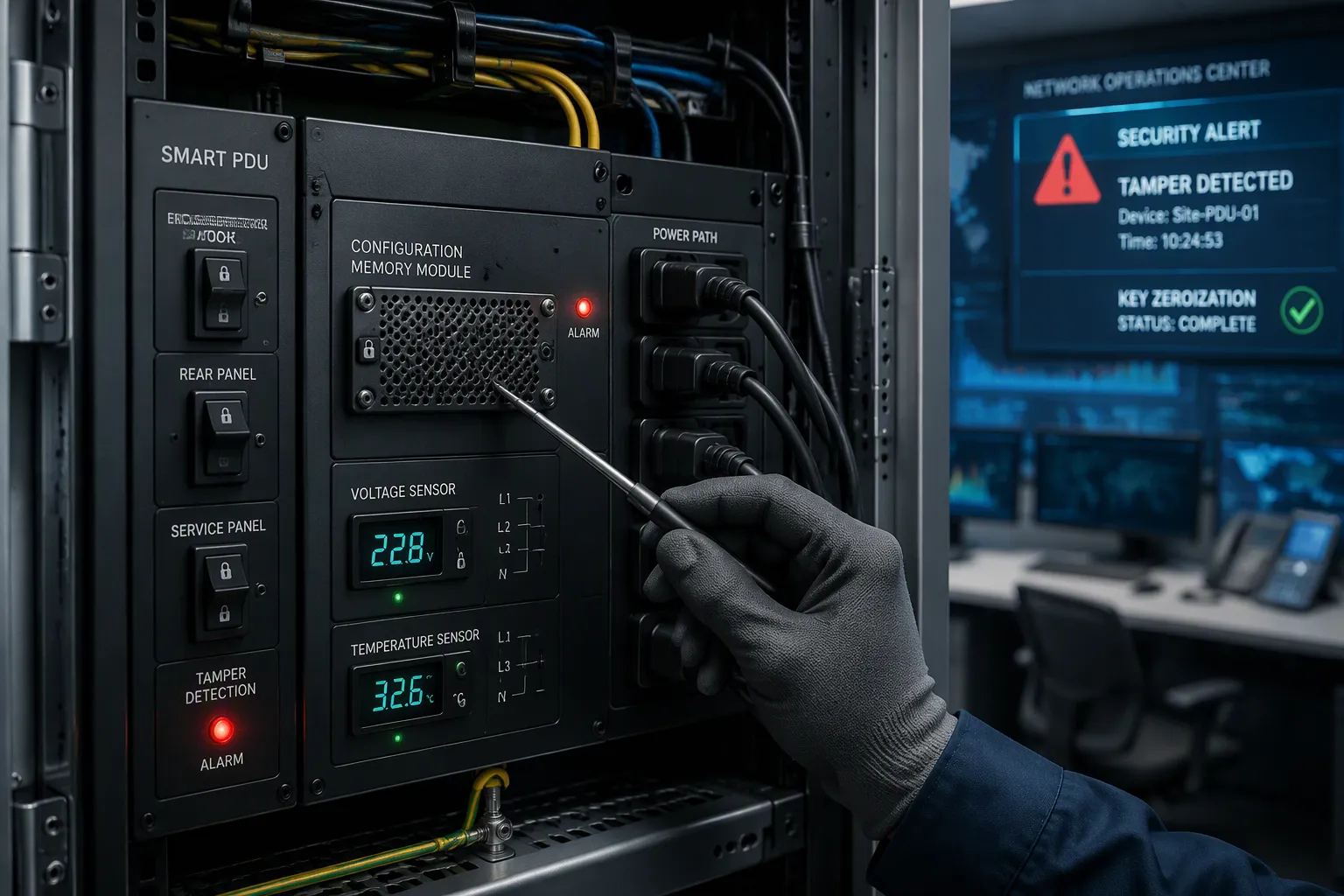
Sensor Placement and Thresholds
You need sensors that cover every entry path and every critical component. Enclosure switches detect door openings. Mesh covers with electrical properties catch drilling and probing. Voltage and temperature sensors flag anomalies inside the smart pdu. Place switches at each access point, route mesh layers over the configuration store and key memory, and mount environmental sensors near the power path. This layout gives full coverage across telecom cabinets.
Threshold design demands care in harsh outdoor sites. Moisture, dust, debris, and temperature swings disrupt sensor accuracy and drive false alarms. Start by collecting baseline data before you define any threshold. Set initial values from historical statistics and trend visualization. Test candidate thresholds in a controlled environment and track both false alarms and missed detections. Refine them with ROC curve analysis and Youden's J statistic to balance sensitivity against specificity. Apply moving averages and anomaly detection to suppress repetitive alerts. Re-review thresholds quarterly or after any significant system change, because aging equipment and shifting conditions degrade fixed settings.
Active Response and Key Zeroization
Your response policy should be active, not passive. When a sensor detects malicious tampering, the device reports an alarm to the network operations center. It can also lock the configuration store, so no writes pass until an operator clears the event. Key zeroization is the final safeguard. Dedicated zeroization circuits erase battery-backed key memory the moment a breach is confirmed. Multi-layered conductive meshes detect drilling or probing and feed that signal to the tamper-response logic. FIPS 140-3 Level 3 formalizes this expectation, requiring tamper response and zeroization alongside identity-based authentication.
If someone physically tampers with the device, it zeroizes all stored keys. The device becomes a paperweight, but the keys are protected.
Equipment protection extends beyond tamper response. Surge protection devices shield the power path, and integrated surge protection modules handle telecom-grade surge protection. ESTEL's Smart Power Distribution Unit includes surge protection and a dehumidifying function that maintains optimal operating conditions. Pair these features with surge protection and ac power conditioning for complete defense. The unit's ac surge protection and surge protection devices work together to guard telecom equipment in unmanned cabinets. This layered approach to protection keeps your pdu reliable across the fleet.
Securing Configuration Across Telecom Cabinets
Authenticated Communication Channels
Intelligent PDUs rely on built-in network communication modules for remote monitoring and control. That channel carries configuration commands, so you must authenticate and encrypt every session. Use mutual authentication, where both the management server and the PDU prove their identity with certificates stored in the secure element. Encrypt traffic with TLS and reject any connection that fails the handshake. Bind each command to a signed session token, so a replay attack cannot reissue an old instruction. These steps keep remote operations trustworthy across distributed telecom cabinets.
Treat the network path as an extension of your trust boundary. Segment management traffic onto a dedicated VLAN, and disable unused services and ports on each device. Log every configuration change with a timestamp and the identity of the requester. This audit trail lets you trace an incident back to its source. Hardware-level security features in rack PDUs improve reliability and future-proof operations, because the cryptographic work happens in silicon rather than in software alone.
Lifecycle Key Management
Keys age, and people leave. Plan the full lifecycle from the first day of deployment. Provision each PDU with a unique identity key during manufacturing, and never share a global key across a fleet. Rotate session keys on a fixed schedule, and rotate identity keys when staff change or a device moves between sites. Revoke a compromised key immediately through the management platform, so the device rejects it on the next handshake.
Automate this process wherever you can. A central key manager tracks every device, issues new credentials, and records revocation events. Manual key handling across hundreds of cabinets invites mistakes. ESTEL's Smart Power Distribution Unit offers remote management and LCD monitoring, which supports secure remote operations for telecom sites. Pair that capability with surge protection and a dehumidifying function, and the unit delivers both protection and stable performance in unmanned cabinets.
No single mechanism secures a smart pdu. Physical hardening, a hardware root of trust, locked boot paths, active tamper response, and encrypted links must reinforce one another. Assume any layer can fail. Design the next layer to contain the damage, and let key zeroization stand as the final safeguard.
Sequence your work:
Integrate the secure element and secure boot.
Lock the configuration store.
Add sensors and response logic.
Encrypt management channels.
Apply this model to telecom cabinets, and your configuration stays intact. Add surge protection to the telecom power path. Vendors such as ESTEL build telecom cabinets with surge protection. That gives you a reference point for telecom sites and telecom operators, and it keeps all cabinets consistent.
FAQ
Where should you draw the trust boundary in a smart PDU?
Draw it around the configuration store, console port, key material, and switching path. Everything inside that line needs physical and electrical protection. These telecom cabinets often sit unmanned, so the boundary must hold without staff on site.
Which secure element criteria matter most?
Look for protected key storage, cryptographic acceleration, and tamper-responsive packaging. The part anchors your boot chain and identity. Pair it with AES-256 encryption and NISTIR 8259 alignment to meet a recognized telecom cybersecurity baseline.
How do you avoid false tamper alarms at outdoor sites?
Collect baseline sensor data first. Set initial thresholds from historical statistics, then test them in a controlled environment. Track false alarms and missed detections, and refine with ROC analysis. Re-review thresholds quarterly, because aging equipment shifts conditions in telecom cabinets.
What happens when a tamper sensor trips?
The device reports an alarm to your network operations center and can lock the configuration store. Key zeroization is the final safeguard. Dedicated circuits erase battery-backed key memory once a breach is confirmed, which matches FIPS 140-3 Level 3 expectations.
How do you manage keys across a fleet of cabinets?
Provision each unit with a unique identity key at manufacturing. Rotate session keys on schedule and revoke compromised keys immediately through your management platform. Automate the process centrally, since manual handling across many cabinets invites mistakes. Add surge protection to the power path for stable operation.
See Also
Expert Advice For Safeguarding Telecom Cabinets In Dangerous Locations
Ways To Safeguard Gear Using Outdoor Telecommunication Enclosures
Essential Tactics To Enhance Telecom Cabinet Theft Prevention Features
Methods To Guarantee Consistent Power For Telecommunication Cabinets
Structural Design Guidelines For ESTEL Telecom Cabinet Systems
CALL US DIRECTLY
86-13752765943
3A-8, SHUIWAN 1979 SQUARE (PHASE II), NO.111, TAIZI ROAD,SHUIWAN COMMUNITY, ZHAOSHANG STREET, NANSHAN DISTRICT, SHENZHEN, GUANGDONG, CHINA
