The Evolution of Telecom Power: From Analog Rectifiers to Smart, Digital DC Systems


Telecom Power Evolution reflects a dramatic shift from early centralized systems to advanced digital DC solutions. Mercury arc rectifiers once powered exchanges, laying the foundation for improved efficiency and reliability. Today, DC systems dominate with a 62.3% market share and offer lower energy losses, easy integration with renewables, and reduced maintenance. The adoption of smart grid technologies and IoT-driven management has transformed network oversight. Historical milestones shaped this progress:
Centralized switching began in 1878.
Automation advanced with the Strowger switch in 1892.
Digital technology enhanced capacity and reliability.
Aspect | Details |
|---|---|
Energy Losses | DC systems experience less loss |
Complexity | Fewer components, less downtime |
Key Takeaways
Telecom power systems have evolved from analog rectifiers to smart DC systems, enhancing efficiency and reliability.
Switching power supplies improve energy efficiency, achieving up to 98% efficiency and reducing operational costs.
Digital controls enable proactive monitoring and predictive maintenance, minimizing downtime and enhancing network performance.
The adoption of -48V DC standard simplifies infrastructure, lowers costs, and supports the integration of renewable energy sources.
Future trends in telecom power include increased use of renewable energy, 5G deployment, and advancements in AI for better network management.
1. Telecom Power Evolution: Analog Rectifiers
Mercury Arc Rectifiers
Mercury arc rectifiers marked a significant milestone in the early days of Telecom Power Evolution. Invented in 1902, these devices enabled the conversion of alternating current (AC) to high-voltage direct current (HVDC). This capability proved essential for operating radio transmitters and powering large-scale systems like the New York subway network. Mercury arc rectifiers became the leading technology for high-voltage rectification until the 1970s. Their role in early telecom applications cannot be overstated, as they provided the necessary power for expanding communication networks.
Note: Mercury arc rectifiers required external circuits to turn off the valves. They also demanded careful maintenance due to their sensitivity to contamination and their large size, which made cooling a challenge.
Early AC to DC Conversion
The transition from AC to DC power formed the backbone of early telecom infrastructure. Engineers relied on analog rectifiers to supply stable DC power to telephone exchanges and radio stations. This process allowed for more reliable signal transmission and supported the growing demand for telecommunication services. The use of analog rectifiers in Telecom Power Evolution set the stage for future advancements by establishing a foundation of dependable power delivery.
Limitations of Analog Systems
Despite their importance, analog systems faced several technical and operational challenges:
Analog systems struggled to meet the evolving demands of modern businesses.
They lacked advanced interaction tools for better data insights and flexibility.
Existing setups did not support the increasing use of mobile phones by contractors and field personnel.
Sound quality degraded over long distances due to signal loss.
Modern features such as voicemail and call forwarding were absent.
Traditional analog setups were not easily expandable, limiting growth as businesses expanded.
These limitations highlighted the need for innovation in Telecom Power Evolution. The industry recognized the importance of moving beyond analog rectifiers to meet the needs of a rapidly changing world.
2. Switching Power Supplies
Decentralized Power Sources
Switching power supplies marked a turning point in telecom infrastructure. These systems enabled decentralized power sources, which improved network resilience and flexibility. Decentralized energy systems distribute power generation across multiple locations. This approach reduces vulnerability to disruptions and allows telecom networks to operate independently during outages. For example:
During Hurricane Sandy, residents in Red Hook, Brooklyn, maintained connectivity using a self-built local mesh network after major providers failed.
In Dharamsala, India, Tibetan exiles established a decentralized wireless network to address unreliable power.
Community-deployed networks in developing regions now provide internet access where traditional infrastructure is lacking.
Decentralized power sources, such as microgrids, can function independently from the main grid. This capability ensures continuous service and enhances the reliability of communication networks.
Efficiency Improvements
Switching power supplies brought significant efficiency improvements to telecom systems. Early analog rectifiers converted only about 50% of input power into usable energy. Modern switching power supplies now achieve efficiencies between 80% and 98%. The 80PLUS Titanium standard requires a minimum full-load efficiency of over 96%. These advancements have reduced data center power consumption and prevented an increase of 620 million kWh in total energy use. Telecommunications devices like base stations and routers operate directly on DC power, which minimizes energy loss by avoiding unnecessary conversions. Power supply efficiency improvements also lower Power Usage Effectiveness (PUE), making networks more sustainable.
Tip: DC power systems are inherently more energy-efficient than AC systems, as they directly supply the required energy to devices.
Adoption of -48V DC Standard
The adoption of the -48V DC standard transformed telecom power system design. This standard offers several benefits:
Benefit | Explanation |
|---|---|
Lower infrastructure costs | DC power supplies and distribution gear are simpler and require less space than AC systems. |
Lower maintenance costs | Fewer power conversions reduce heat generation and equipment failures. |
Lower operating costs | Reduced energy consumption and cooling needs lower ongoing expenses. |
Capital cost savings | Well-designed DC systems can save at least 15% in capital cost and 20% in installation cost. |
Reduced facility footprint | DC systems can shrink the facility footprint by at least 25% compared to AC systems. |
Regulatory standards also play a key role. They ensure safety, reliability, and interoperability in telecom power systems. Compliance with these standards supports the adoption of new technologies and smooth integration with existing infrastructure. The shift to switching power supplies and the -48V DC standard represents a major milestone in Telecom Power Evolution.
3. Digital Power Management
Introduction of Digital Controls
Digital controls have transformed how telecom operators manage power systems. They allow operators to move from simply consuming energy to producing and regulating it. This shift supports the construction of energy-efficient sites and helps reduce operational costs. Operators now use ICT for Power to generate and control green electricity. These changes have improved resource usage and operational efficiency. Digital controls also help companies comply with regulatory requirements, making them leaders in national digital transformation. Many operators now bring data operations back in-house because of stricter local data storage rules and increased security needs.
Operators become energy prosumers, boosting site efficiency.
Energy-efficient sites lower operational costs.
ICT for Power enables green electricity generation and regulation.
Digital controls improve efficiency and resource management.
Compliance with regulations positions firms as digital leaders.
In-house data operations address security and local storage rules.
Enhanced Monitoring
Enhanced monitoring through digital power management gives operators continuous oversight of network health and performance. Real-time alerts help teams resolve issues before they cause downtime. Proactive monitoring tools predict and prevent problems by setting baselines and thresholds for normal behavior. These features increase network uptime and make maintenance more efficient.
Continuous network health monitoring
Real-time alerts for quick issue resolution
Proactive tools prevent potential problems
Tip: Proactive monitoring helps operators avoid costly outages and keeps networks running smoothly.
Improved Fault Tracing
Digital telecom power systems offer major benefits over analog systems in fault tracing. The table below highlights key differences:
Feature | Analog Systems | Digital Systems |
|---|---|---|
Monitoring Capability | Limited to critical parameters | Monitors multiple parameters precisely |
Fault Indications | Generic indications with multiple meanings | Specific fault monitoring for each parameter |
Control of Parameters | Minimal control | Extensive control over various parameters |
Communication | Multiple control wires required | Single network cable for connectivity |
Digital systems allow precise monitoring and control, making fault tracing faster and more accurate. Operators can quickly identify and fix issues, which supports the ongoing Telecom Power Evolution.
4. Smart DC Power Systems
Remote Monitoring Features
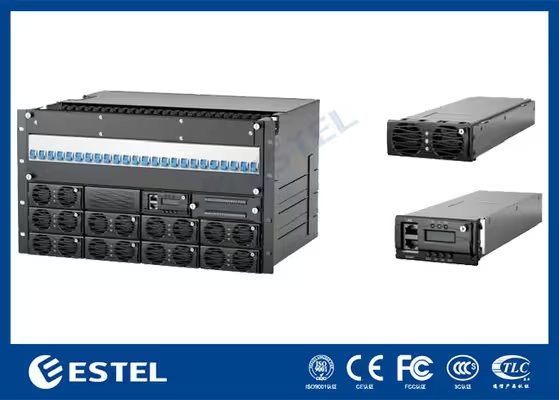
Modern smart DC power systems have transformed telecom networks by introducing advanced remote monitoring capabilities. Operators now access real-time data from multiple devices through a unified interface. This aggregation reduces hardware clutter and minimizes the need for frequent service visits. Mark Haisler, Chief Technology Officer at OmniOn Power, explained,
"Its modular design gives customers the flexibility to scale across sites and integrate with modern energy platforms, helping them improve uptime, efficiency, and overall agility."
Key benefits of remote monitoring include:
Aggregated data from diverse devices streamlines troubleshooting.
Fewer on-site visits lower operational costs.
Faster identification of issues improves network reliability.
Smart DC power systems also feature high-efficiency rectifiers and intelligent cooling, which reduce energy losses and extend equipment lifespan. These advancements support the ongoing Telecom Power Evolution by making networks more sustainable and cost-effective.
Feature | Description |
|---|---|
Reliability | Ensures continuous operation during outages with redundancy and failover. |
Efficiency | Reduces wasted energy and balances power use to avoid overloading. |
Scalability | Supports future technologies like 5G and integrates renewable energy sources. |
Advanced Monitoring | Monitors power flow, battery health, and system performance to prevent issues. |
Predictive Maintenance
Predictive maintenance technologies in smart DC power systems use real-time analytics to anticipate equipment failures before they occur. Operators benefit from reduced maintenance costs and improved reliability. These systems analyze battery health, power flow, and system performance, allowing teams to schedule repairs proactively.
Benefit | Description |
|---|---|
Reduction in maintenance costs | Maintenance costs can be reduced by 20% to 30%, leading to significant savings. |
Increase in equipment reliability | Predictive maintenance enhances equipment reliability, reducing the likelihood of failures. |
Decrease in unplanned downtime | Unplanned downtime can be reduced by as much as 75%, preventing costly interruptions in service. |
Energy storage solutions play a vital role by integrating renewables and providing dispatchable power. Storage systems ensure reliable supply and reduce reliance on traditional backup generators, further lowering operational costs.
Integration with Network Management
Integration with network management platforms enhances the performance of smart DC power systems. Operators monitor legacy and modern systems through a single dashboard, eliminating fragmented tools. Proactive issue identification maintains network reliability and improves customer experience. Predictive analytics and AI automate maintenance responses, reducing downtime and operational expenses.
Unified monitoring streamlines oversight across all systems.
Predictive analytics optimize maintenance schedules.
Automated responses minimize service interruptions.
Smart DC power systems support the transition to renewable energy, making telecom networks more sustainable. These innovations mark a significant step in Telecom Power Evolution, enabling operators to deliver reliable, efficient, and future-ready services.
5. ESTEL and Future Trends
ESTEL’s Innovations
ESTEL has introduced several groundbreaking solutions that shape the future of telecom power. Their innovations focus on efficiency, safety, and adaptability. The table below highlights some of the most notable advancements:
Innovation Type | Description |
|---|---|
Battery Technology | Lithium-based batteries improve efficiency and resilience in backup systems. |
Renewable Energy Integration | Solar and wind energy support sustainable telecom backup systems. |
Smart Management Systems (BMS) | Advanced BMS detects anomalies early, increasing safety and reliability. |
Customizable Solutions | Power systems adapt to different operational needs and scale as networks grow. |
Modular Designs | Modular systems expand or change with network demands, ensuring long-term value. |
Enhanced safety measures have led to a 98% reduction in battery failure rates since 2018.
Hybrid renewable energy systems deliver about 4 kWh more energy per dollar spent.
Customizable solutions serve both small stations and large networks.
Real-World Impact
ESTEL’s technologies have made a measurable difference in real-world telecom operations. Their batteries improved response times by 83% during hurricane emergencies, keeping critical communication lines open. Instant microgrids powered field hospitals and communication relays when the main grid failed. Diesel generator upgrades nearly doubled performance and reduced fuel use during long outages.
A telecom company in a small village used ESTEL rectifiers, resulting in batteries lasting 30% longer and fewer network disruptions.
Reliable power from ESTEL rectifiers kept rural areas connected during storms and outages.
Note: These examples show how ESTEL’s solutions support network stability and community resilience.
Future of Telecom Power
The future of telecom power will see several important trends. The industry will adopt more renewable energy sources, making networks greener and less dependent on fossil fuels. The rollout of 5G networks will require power systems that are both resilient and scalable. Edge computing will need efficient power solutions for local data processing.
Trend Description | Impact on Telecom Power Systems |
|---|---|
Adoption of renewable energy | Increases sustainability and reduces reliance on fossil fuels. |
Deployment of 5G networks | Demands more resilient and scalable power systems. |
Rise of edge computing | Requires efficient power for local data processing. |
Non-terrestrial networks will extend mobile connectivity to remote locations.
Advanced antennas and signal processing will enable these new networks.
Artificial intelligence will drive improvements in network performance and efficiency.
Investments in AI and next-generation networks will shape the next phase of Telecom Power Evolution.
Telecom operators can expect more autonomous networks and better customer experiences as these trends continue.
Telecom power systems have evolved through five key stages, each bringing new benefits. The shift from analog rectifiers to smart, digital DC systems delivers major improvements:
Benefit | Description |
|---|---|
Energy Efficiency | Up to 97.8% efficiency lowers costs and energy loss. |
Scalability | Modular designs support seamless upgrades and 5G expansion. |
Reliability | Operators report a 25% decrease in downtime. |
Sustainability | New systems cut energy use by 30% and CO₂ emissions by 40%. |
Modern networks gain reliability and scalability through hybrid architectures, lithium battery modules, and advanced control systems. Operators should watch for trends like AI integration, digital infrastructure, and sustainability. Brands such as ESTEL lead the way in shaping future telecom power solutions.
FAQ
1. What is the main advantage of smart DC power systems in telecom networks?
Smart DC power systems increase efficiency and reliability. Operators monitor and control power remotely. These systems reduce downtime and energy loss. Networks become more sustainable and easier to manage.
2. Why do telecom companies use -48V DC as a standard?
Telecom companies use -48V DC because it improves safety and reduces corrosion. This voltage level protects equipment and lowers maintenance costs. The standard also supports efficient power distribution across large networks.
3. How does predictive maintenance benefit telecom operators?
Predictive maintenance uses real-time data to spot issues early. Operators fix problems before failures occur. This approach lowers repair costs and prevents unexpected outages. Networks stay online longer and serve customers better.
4. What role does ESTEL play in modern telecom power solutions?
ESTEL develops advanced batteries, smart management systems, and modular designs. Their solutions support renewable energy and improve network resilience. Many telecom operators choose ESTEL to ensure stable, efficient, and scalable power for their networks.
See Also
Essential Insights for Newcomers on Telecom Power Supply Systems
Key Information Regarding Features of Telecom Power Supplies
Tips for Maintaining Dependable Power Supply in Telecom Cabinets
Methods for Calculating Power Systems and Batteries in Telecom Cabinets
CALL US DIRECTLY
86-13752765943
3A-8, SHUIWAN 1979 SQUARE (PHASE II), NO.111, TAIZI ROAD,SHUIWAN COMMUNITY, ZHAOSHANG STREET, NANSHAN DISTRICT, SHENZHEN, GUANGDONG, CHINA
