Multi-Energy Input Compatibility for Telecom Power Systems: Seamless Switching Among Mains, Generators, PV

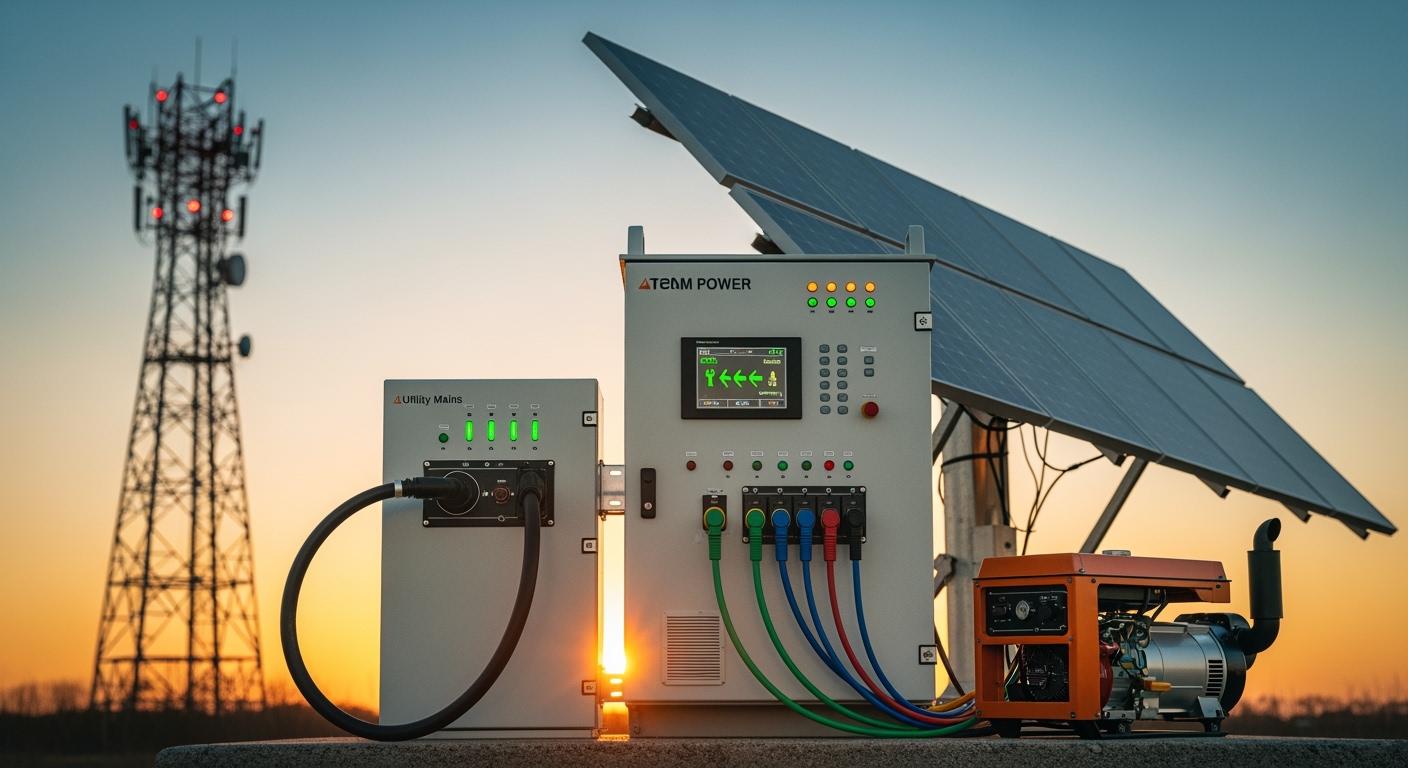
You rely on seamless switching among mains, generators, and PV to keep your telecom equipment running without interruption. Uninterrupted power supports your network, preventing outages and downtime. Multi-energy input compatibility lets you use different power sources efficiently. ESTEL leads the industry with integrated outdoor telecom cabinets and advanced Telecom Power System solutions. You benefit from reliable performance, efficient energy use, and smart control systems.
Key Takeaways
Seamless switching among mains, generators, and solar power ensures uninterrupted telecom service, protecting against outages.
Automatic transfer switches monitor power quality and switch to backup sources instantly, keeping your equipment safe and operational.
Real-time monitoring allows you to track power usage and prioritize energy sources, optimizing efficiency and reducing costs.
Multi-energy input systems enhance reliability and reduce operational costs by combining solar, battery, and diesel power sources.
Regular maintenance and remote management tools help extend equipment life and ensure your telecom network runs smoothly.
Seamless Switching in Telecom Power Systems
Automatic Transfer and Control
You depend on seamless switching to keep your telecom network running. Automatic transfer switches play a key role in this process. These switches monitor the quality of utility power. When they detect a fault or outage, they activate a backup power source. The switch safely transfers the load to the backup. Once utility power becomes stable again, the system restores the load to the main source. This process happens without manual intervention, so your equipment stays powered.
Here is how automatic transfer switches function in telecom power systems:
Continuous monitoring of utility power quality.
Detection of faults or outages.
Activation of backup power source.
Safe transfer of load to backup.
Automatic restoration to utility power once stable.
You gain several benefits from this technology:
Communication continuity remains intact.
Sensitive equipment stays protected from power disruptions.
Downtime and financial loss are minimized.
The Telecom Power System from ESTEL integrates these technologies. It combines mains, generators, and PV sources for continuous power supply. The system uses continuous power logic to ensure smooth transitions between sources. You do not need to worry about interruptions. The smart control systems support advanced monitoring and performance management. You get reliable power for your telecom operations.
Technology Type | Description |
|---|---|
Multi-source integration | Combines solar PV, battery storage, and grid or generator fallback for continuous power supply. |
Continuous power logic | Ensures smooth transitions to generator or grid mode when solar or battery power is insufficient. |
Smart control systems | Supports SNMP, IoT telemetry, and advanced control logic for monitoring and performance management. |
Real-Time Monitoring and Source Priority
You need real-time monitoring to make informed decisions about power source selection. ESTEL's telecom power systems use advanced remote monitoring and management technologies. These tools give you real-time insights into power usage, environmental conditions, and equipment status. You can track which source is active and how much power each source provides.
Smart control units help you set source priority. You can choose to use solar power first, then switch to mains or generator as needed. The system automatically selects the best source based on current conditions. You get efficient energy use and maximum uptime.
You benefit from these features:
Real-time data helps you respond quickly to changes.
Source priority settings optimize energy use.
Remote management reduces the need for on-site intervention.
The Telecom Power System from ESTEL gives you the flexibility to manage multiple energy inputs. You can rely on its advanced control and monitoring features to keep your network running smoothly.
Why Multi-Energy Input Matters
Ensuring Network Uptime
You need a reliable power supply to keep your telecom network running. Every dropped signal and moment of downtime erodes performance and trust. Continuous and clean backup power ensures communications stay seamless during outages and disturbances. The Telecom Power System helps you maintain network uptime by switching smoothly between mains, generators, and PV sources. You avoid costly interruptions and protect your equipment from power fluctuations.
Note: Uninterrupted power supply is critical for telecom network uptime. High efficiency and proven reliability are essential for modern networks.
Impact Type | Description |
|---|---|
Revenue Losses | A global internet outage lasting one minute could cost over $20 million. |
Increased Operational Costs | Outages lead to productivity losses and increased demand for customer service. |
Customer Churn | The telecom industry had a customer churn rate of 21% in 2020 due to reliability issues. |
Damage to Reputation | Outages can negatively affect Net Promoter Score (NPS), indicating customer dissatisfaction. |
Adapting to Power Variability
You face changing power conditions in many telecom environments. Wide input voltage rectifier systems enhance adaptability by handling fluctuations in grid voltages. These systems ensure reliable power supply in urban and remote areas. You protect your telecom equipment from voltage surges and sags, which helps maintain uptime and reduces service interruptions. Modular designs allow you to upgrade and maintain your infrastructure easily.
Wide input voltage rectifier systems handle grid fluctuations.
Reliable power supply supports diverse environments.
Equipment stays protected from voltage surges and sags.
Modular design allows easy upgrades and maintenance.
Supporting Remote Sites
You often operate telecom sites in remote locations. These sites face unique challenges in maintaining stable power supply. Weather conditions like typhoons, snowstorms, heatwaves, sandstorms, and lightning can disrupt power and damage equipment.
Weather Condition | Challenges Faced |
|---|---|
Typhoons & Heavy Rain | Grid outages, water ingress causing short circuits, risk of tower or pole collapse |
Snow & Ice Storms | Power line icing and breakage, battery failure at low temperatures, frost accumulation on equipment |
Heatwaves | Rapid battery capacity decay, rectifier derating due to overheating, air-conditioning overload |
Sandstorms & Salt Spray | Blocked ventilation pathways, corrosion of PCBs and connectors, decreased insulation performance |
Lightning | Surge damage to power modules, failure of monitoring units |
You also deal with high operational costs, frequent maintenance needs, environmental impact, reliability issues, and security concerns. Multi-energy input compatibility lets you use solar, generator, and mains power to overcome these obstacles. You reduce fuel transportation costs, minimize maintenance, and improve reliability. You protect your network and ensure stable communications even in harsh environments.
Technical Challenges and ESTEL Solutions
Multi-Source Hardware Integration
You face many challenges when you connect mains, generators, and PV sources to your telecom equipment. Each power source has unique characteristics. You must use hardware that can handle these differences. ESTEL designs cabinets and systems that support seamless integration. The Telecom Power System and Telecom Rectifier System use modular designs. You can add or remove modules based on your needs. You get flexibility and easy maintenance. Redundant-ready power modules ensure your service continues even if one module fails. Configurable architectures support N+1 or parallel setups. You protect your network from unexpected disruptions.
Modular designs allow easy upgrades.
Redundant modules keep your service running.
Flexible setups adapt to changing requirements.
Robust thermal protection and surge immunity safeguard your equipment.
Voltage Range and Cooling
You often deal with unstable grid conditions. Advanced rectifier systems support wide input voltage ranges. You can operate your equipment in urban and remote locations. The Telecom Power System adapts to power fluctuations and ensures reliable performance.
Wide input voltage range supports diverse environments.
Reliable operation in unstable grid conditions.
Adaptability keeps your network stable.
Natural cooling plays a key role in efficiency and reliability. You avoid extra energy use and reduce maintenance. The Telecom Power System uses smart dampers to adjust airflow. You maintain stable temperatures and lower operational costs.
Benefit | Description |
|---|---|
Stable temperatures | Maintains stable temperatures without extra energy use. |
Reduced maintenance and noise | Lowers operational disruptions and enhances user experience. |
Improved efficiency | Enhances performance in low-heat environments, optimizing energy use. |
Lower costs | Reduces operational costs and supports eco-friendly operations. |
Enhanced cooling efficiency | Smart dampers adjust airflow based on temperature, improving cooling. |
Compliance and Standards
You must follow strict international standards when you deploy telecom power systems. Compliance ensures safety, reliability, and resilience. ESTEL designs systems that meet UL, CE, IEC, and ISO requirements. You get peace of mind knowing your equipment meets global standards.
Standard | Purpose |
|---|---|
UL | Ensures safety and performance in electrical systems |
CE | Indicates compliance with European safety standards |
IEC 61508 | Focuses on functional safety of electrical/electronic systems |
UL 508 | Covers safety for industrial control equipment |
IEC 62368 | Addresses safety in audio/video, information, and communication technology |
ISO 14971 | Relates to risk management for medical devices |
You benefit from safe operation, reliable performance, and protection against voltage dips. SEMI F47 compliance protects your equipment during grid fluctuations. You can deploy the Telecom Power System in diverse environments with confidence.
Benefits of Multi-Energy Input
Reliability and Redundancy
You gain higher reliability when you use multiple energy sources for your telecom sites. Multi-energy input systems stabilize input voltage, which reduces unwanted diesel generator auto-starts. You see improved electricity board availability, leading to better network uptime. You also reduce energy costs and equipment stress by optimizing generator loading and maintenance.
A 2N redundancy model gives you two independent power distribution systems. This setup lets you perform maintenance without interrupting operations. If one system fails, the other takes over instantly. You keep your network running and avoid downtime.
Stabilized input voltage reduces generator starts
Improved network uptime with better electricity board availability
Lower equipment stress and maintenance needs
Energy Efficiency and Cost Savings
You save energy and money by combining solar, battery, and diesel sources. Hybrid systems use less diesel fuel and cut operating costs. The table below shows the difference:
Parameter | Diesel-Only Setup | Hybrid System (Solar + Battery + Diesel) |
|---|---|---|
Diesel consumption | ~4,000 L/year | ~1,500 L/year |
CO₂ emissions | 10.6 tons | 3.8 tons |
Operating cost reduction | — | 40–60% |
Battery energy storage systems paired with renewables give you a sustainable alternative to diesel. You can store energy during low-cost periods and use it during peak demand. This approach lowers your energy bills and increases network resilience. You also reduce your need for expensive grid power.
Environmental Impact
You help the environment when you use renewable energy in your Telecom Power System. Companies like Verizon aim to use 100% renewable energy by 2030, moving toward net-zero carbon emissions by 2035. Switching from diesel to renewables at telecom towers, such as those in Bangladesh, shows that cleaner energy works well in real-world settings. This shift reduces environmental damage and improves operational resilience.
Integrating PV solar panels reduces your reliance on diesel fuel
You lower operational expenses and logistics for remote sites
Solar energy increases your energy independence and reduces grid outage risks
Tip: By choosing multi-energy input systems, you support sustainability and protect your network from power disruptions.
Deployment Considerations for Telecom Power System
System Selection and Integration
You need to choose a power system that matches your site’s needs and supports seamless integration. Start by reviewing key factors such as input voltage range, output power, efficiency, and safety certifications. These factors help you ensure compatibility with different energy sources and protect your equipment.
Factor | Description |
|---|---|
Input Voltage Range | Accepts various voltages from mains, generators, and PV sources. |
Output Power Requirements | Delivers enough power for all telecom equipment. |
Efficiency | Converts energy with minimal loss, saving costs. |
Thermal Management | Controls heat for reliable operation. |
Form Factor | Fits into your existing racks or cabinets. |
Safety Certifications | Meets international safety standards. |
Electromagnetic Compatibility | Prevents interference from outside sources. |
Surge Protection | Shields equipment from voltage spikes. |
ESTEL’s solutions support open APIs and a microservices architecture. You can connect new systems or upgrade old ones without major changes. The scalable design lets you add more capacity as your network grows.
Installation and Maintenance
You should follow a step-by-step process for installation. Begin with site planning and surveys. Next, install cabinets, rectifiers, and batteries. Connect transmission lines and test all components before handing over the system for operation.
Plan the site and wiring layout.
Survey the site and complete civil works.
Install cabinets, rectifiers, and batteries.
Set up transmission and backhaul links.
Integrate and test the system.
Complete final checks and handover.
Regular maintenance keeps your system reliable. Inspect equipment monthly, check batteries, and review monitoring results. Every quarter, measure voltages and check temperatures. Clean and test the system every six months. Once a year, run a full inspection and operational test.
Maintenance Interval | Tasks to Perform |
|---|---|
Monthly | Visual inspection, check ventilation, test batteries, review monitoring results |
Quarterly | Inspect for damage, measure cell voltage, check battery temperatures |
Semi-Annual | Inspect connections, clean equipment, test system operation |
Annual | Full inspection, load test, measure connections, run operational tests |
Monitoring and Remote Management
You can improve efficiency with remote monitoring tools. These systems give you real-time data on power status and environmental conditions. Early detection of issues helps you prevent outages. Predictive maintenance lets you schedule repairs during low-traffic times, reducing service disruption. Automation reduces the need for on-site visits and speeds up response times.
Tip: Use remote management to extend equipment life, lower costs, and keep your network running smoothly.
The Telecom Power System from ESTEL supports advanced monitoring and remote management. You gain peace of mind and better control over your telecom infrastructure.
You gain reliable, efficient, and sustainable power when you choose multi-energy input systems for your telecom sites. To ensure long-term reliability and compliance, follow these steps:
Identify all relevant standards before deployment.
Choose certified components for safety and environment.
Test for temperature, humidity, and electrical hazards.
Keep detailed records of tests and certifications.
Train your team on compliance requirements.
You should also use real-time monitoring and predictive maintenance. As telecom power solutions evolve, you will see greater sustainability and network reliability. ESTEL stands ready to support your journey.
FAQ
What is multi-energy input compatibility in telecom power systems?
Multi-energy input compatibility lets you connect mains, generators, and solar panels to your telecom equipment. You can switch between sources automatically. This feature helps you keep your network running during power outages.
How does seamless switching protect my telecom equipment?
Seamless switching prevents sudden power loss. Your equipment stays safe from voltage spikes and surges. You avoid downtime and protect sensitive devices from damage.
Can I monitor power sources remotely?
You can monitor power sources using ESTEL’s advanced control systems. Real-time data shows you which source is active. Remote management tools help you respond quickly to any issue.
What maintenance does a multi-energy telecom power system require?
You should inspect your system monthly. Check batteries, connections, and ventilation. Clean equipment every six months. Run operational tests yearly. Regular maintenance keeps your network reliable.
Does ESTEL’s Telecom Power System support international standards?
ESTEL’s Telecom Power System meets UL, CE, IEC, and ISO standards. You get safe, reliable, and compliant equipment for your telecom site.
See Also
Telecom Cabinets Powered by Grid-Connected Solar Inverter Systems
Solar Energy Storage Solutions for Telecom Cabinet Applications
Essential Information on Features of Telecom Power Supplies
Introductory Guide to Telecom Power Supply System Basics
Smart Energy Storage Systems for Telecom Cabinets with Microgrid
CALL US DIRECTLY
86-13752765943
3A-8, SHUIWAN 1979 SQUARE (PHASE II), NO.111, TAIZI ROAD,SHUIWAN COMMUNITY, ZHAOSHANG STREET, NANSHAN DISTRICT, SHENZHEN, GUANGDONG, CHINA
