Auto Parameter Adjustment for Telecom Rectifier Systems: Intelligently Match Output Efficiency by Load


You need power systems that respond quickly to changing demands. Auto parameter adjustment in a Telecom Rectifier System keeps output efficiency high as network loads shift. This technology helps maintain stable voltage and current, which protects your equipment from damage and reduces the risk of downtime. You also benefit from energy savings and lower carbon emissions, thanks to efficiency rates above 96%. ESTEL leads the way with innovative solutions that set new standards for reliability and performance in telecom infrastructure.
Key Takeaways
Auto parameter adjustment enhances efficiency by matching power output to actual demand, leading to energy savings and lower costs.
Intelligent control algorithms improve system reliability by using real-time data to adapt to changing loads, reducing downtime.
Modular designs allow for easy upgrades and scalability, ensuring your telecom infrastructure can grow with your needs.
Real-time monitoring provides instant alerts for faults, helping you maintain a stable network and protect your equipment.
Compliance with industry standards ensures safety and reliability, protecting your network from unexpected failures.
Telecom Rectifier System Fundamentals
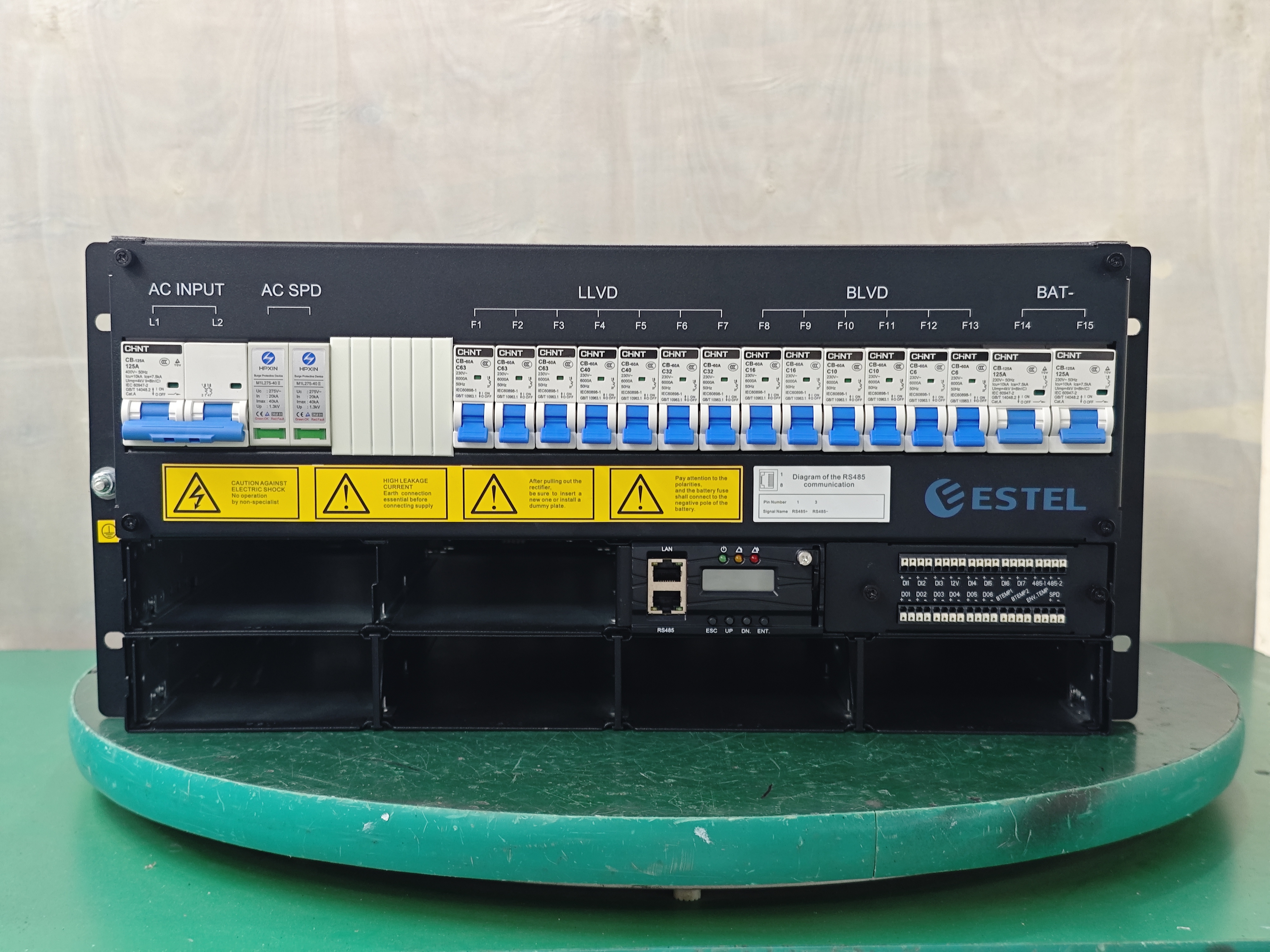
Role in Telecom Power
You rely on a Telecom Rectifier System to keep your network running smoothly. This system converts alternating current (AC) from the power grid into direct current (DC) that telecom equipment needs. Without this conversion, your devices cannot operate safely or efficiently. The system also supports battery backup, which prevents service interruptions during power failures. You can monitor the system remotely, which helps you detect faults quickly and maintain safety. If your network grows, you can expand the system easily because of its modular design.
Here is a table that summarizes the main functions of a Telecom Rectifier System:
Function Description | Details |
|---|---|
AC to DC Conversion | Converts grid AC to reliable DC for telecom devices. |
Battery Backup Support | Supports battery backup systems to prevent service interruptions. |
Enables remote monitoring and advanced fault management for safety. | |
Modular Expansion | Allows modular expansion to meet growing network needs. |
Importance of Load Matching
Matching the output of your Telecom Rectifier System to the actual load is essential for efficiency. When the system adjusts its output to meet the current demand, you save energy and reduce costs. Proper load matching also lowers maintenance needs and increases reliability. If your system can scale with your network, you can support future growth without major upgrades.
The following list highlights the benefits of effective load matching:
Reduces energy costs
Lowers maintenance needs
Enhances reliability
Supports scalability for future growth
You can see how efficiency changes with different load levels in this table:
Load Range | Efficiency Impact |
|---|---|
25% | Moderate |
50% | High |
75% | Optimal |
Full Load | Consistent |
By understanding these fundamentals, you can make better decisions about your telecom power infrastructure and ensure your network stays reliable and efficient.
Challenges in Traditional Systems
Manual Adjustment Limitations
You may find that older power systems require you to adjust parameters by hand. This process can take a lot of time and often leads to mistakes. When you need to change voltage or current settings, you must rely on skilled technicians. If you make an error, you risk damaging your equipment or causing service interruptions. Manual adjustments also slow down your response to sudden changes in network demand.
Tip: Automated systems help you avoid these risks by making adjustments quickly and accurately.
You may also notice that manual systems do not scale well. As your network grows, you need to manage more equipment. This increases the chance of human error and makes it harder to keep everything running smoothly.
Efficiency and Reliability Issues
Traditional systems often waste energy because they cannot match output to the actual load. When your system runs at a fixed setting, it uses more power than necessary during low-demand periods. This leads to higher energy bills and more heat, which can shorten the life of your equipment.
You may also face reliability problems. If your system cannot adjust to changing loads, you risk voltage drops or surges. These issues can cause downtime and affect your service quality. In a modern Telecom Rectifier System, you avoid these problems by using intelligent controls that respond to real-time conditions.
Here is a quick summary of the main challenges:
Slow response to load changes
Higher risk of human error
Increased energy waste
More frequent equipment failures
By understanding these challenges, you can see why many operators now choose advanced, automated solutions.
Auto Adjustment Technologies in Telecom Rectifier Systems
Intelligent Control Algorithms
You can optimize your Telecom Rectifier System by using intelligent control algorithms. These algorithms use artificial intelligence and machine learning to analyze real-time data from sensors. Sensors connect rectifiers, batteries, and cooling subsystems. This setup helps your system respond quickly to changes in load and temperature. You get better efficiency and adaptability because the algorithms adjust power output based on demand.
Here is a table that shows how sensor integration and advanced control algorithms work together:
Component/Method | Description | Benefit |
|---|---|---|
Sensor Integration | Connects rectifiers, batteries, cooling systems | Enhances system performance and efficiency |
Advanced Control Algorithms | Uses AI and ML for optimization | Improves operational efficiency and adaptability |
Thermal Energy Storage | Facilitates power-to-cooling strategies | Minimizes dependence on grid power during peak demand |
Modular Designs | Supports scalability and interoperability | Allows for multi-vendor solutions and reconfiguration of nodes |
You can see that these technologies help your system adapt to different situations. You save energy and reduce operational costs. You also support scalability, which makes it easier to expand your network.
Real-Time Monitoring and DSP
You gain more control over your Telecom Rectifier System when you use real-time monitoring and digital signal processing (DSP) technologies. Real-time monitoring uses microcontrollers to track grid conditions with up to 99% accuracy. DSP circuits detect and hold peak values of input signals, which is important for telecom applications. Operational amplifiers improve the response rate and accuracy of these circuits, so you get minimal signal loss.
Here are some ways real-time monitoring and DSP improve your system:
Peak detection circuits identify and hold the highest value of input signals, which protects your equipment.
Operational amplifiers enhance the accuracy and response rate, ensuring high signal integrity.
Real-time digital power microcontrollers process data with low latency, making your system more responsive.
MCUs provide up to 99% accuracy in monitoring grid conditions, which increases reliability.
On-chip programmable real-time units handle time-critical tasks efficiently, improving overall performance.
You benefit from faster response times and better reliability. Your system can adjust output quickly, which prevents downtime and keeps your network stable.
ESTEL Telecom Rectifier System Innovations
ESTEL has introduced several innovations in Telecom Rectifier System technology. You get efficiency rates over 97%, which can reduce costs by up to 30% compared to older designs. Maintenance costs drop to 7%, so you spend less on repairs and replacements. The system provides a stable DC power supply, minimizing energy waste and ensuring efficient operations.
Here is a table that summarizes ESTEL’s innovations and their benefits:
Innovation | Benefit |
|---|---|
Efficiency over 97% | Up to 30% cost reduction compared to older designs |
Maintenance costs reduced to 7% | Lower operational expenses and improved reliability |
Stable DC power supply | Minimizes energy waste and ensures efficient operations |
Energy waste reduction by 20% | Enhances energy management and reduces downtime |
Energy consumption reduction by 15% | Supports sustainability goals and lowers costs |
Modular design | Allows for easy upgrades and scalability |
Advanced monitoring tools | Provides real-time insights for effective power management |
You also help achieve sustainability goals and comply with environmental regulations. ESTEL’s system optimizes energy consumption and reduces carbon emissions. You can earn green certifications like PUE, CUE, and WUE. The modular design lets you upgrade and scale your system easily, so you can meet future demands without major changes.
Tip: ESTEL’s advanced monitoring tools give you real-time insights, making power management more effective and reliable.
You see that auto adjustment technologies make your Telecom Rectifier System more efficient, adaptable, and sustainable. You get reliable power delivery, lower costs, and support for environmental goals.
Benefits of Intelligent Parameter Adjustment
Enhanced Energy Efficiency
You gain significant energy savings when you use intelligent parameter adjustment. Your system automatically matches power output to the actual demand, which reduces waste and lowers your electricity bills. You see efficiency rates above 96%, which means less energy gets lost as heat. Optimized resource allocation through data-driven insights helps you support sustainability initiatives. You also benefit from fewer site visits, which cuts down on unnecessary travel and further reduces your carbon footprint.
Energy efficiency gains help you meet environmental targets and make your network more sustainable.
Reduced Operational Costs
You notice lower operational costs when your system adjusts parameters automatically. Predictive maintenance lets you anticipate component failures by analyzing long-term data trends. You schedule repairs during low-traffic periods, which minimizes service disruptions. Fewer site visits save you money and improve efficiency. You spend less on maintenance because your system detects issues early and prevents major breakdowns.
Here is a table that shows how intelligent parameter adjustment supports future scalability and cost savings:
Feature | Description |
|---|---|
Multi-protocol support | Supports SNMP and Modbus for easy integration |
Local intelligence | Enables on-site decision-making with edge computing |
Scalability | Modular inputs and expansion options facilitate future upgrades |
Improved System Reliability
You experience greater reliability with intelligent parameter adjustment in your Telecom Rectifier System. Proactive remote monitoring of 48V rectifiers prevents up to 80% of outages by identifying minor power issues early. Real-time monitoring enables rapid response to deviations, which reduces cascading failures and operational costs. Facilities using predictive maintenance through continuous environmental monitoring see a 25% increase in operational reliability and a 20% improvement in equipment uptime. Integration of intelligent control systems enables adaptive operation under varying load conditions, which maximizes reliability in high-traffic telecom networks.
You keep your network stable and minimize downtime, ensuring consistent service for your customers.
Implementation and Best Practices
Industry Standards Compliance
You need to ensure your telecom rectifier system meets international standards. Compliance with ISO9001 and other industry benchmarks guarantees safety, reliability, and performance. When you choose a system that follows these standards, you protect your network from unexpected failures and regulatory issues. ESTEL designs its rectifier systems to meet strict quality requirements, so you can trust the equipment in any environment.
High efficiency and modular design support industry best practices.
Systems operate below 55dB, providing a quiet and unobtrusive solution.
Consistent DC48V output ensures compatibility with telecom applications.
Wide input voltage support increases flexibility for different sites.
Integration with Existing Systems
You can integrate ESTEL’s Telecom Rectifier Systems into your current infrastructure with minimal disruption. The modular design allows you to upgrade or expand your power system as your network grows. You do not need to overhaul your entire setup. Instead, you can add new modules or replace old ones quickly.
Flexible installation options fit standard 19-inch racks or cabinets.
Adaptable systems work in various environments and support different power sources.
Predictive maintenance features help you avoid unexpected downtime and reduce operational costs.
The modularity and flexibility of installation contribute to high customer satisfaction.
Steps for Deployment
You can follow a clear process to deploy intelligent rectifier systems:
Assess your current power needs and future growth plans.
Select a system that meets efficiency, reliability, and scalability requirements.
Plan the integration to minimize service interruptions.
Install modules in existing racks or cabinets.
Set up real-time monitoring and predictive maintenance tools.
Train your team on system operation and maintenance.
Tip: Predictive analytics can prevent equipment failures and optimize energy use, which improves your network’s reliability and reduces costs.
You can measure your return on investment by tracking metrics such as uptime, latency, and operational overhead. After implementing AI-driven parameter adjustment, you will notice improvements in network performance and customer satisfaction.
Metric | Before AI Implementation | After AI Implementation |
|---|---|---|
Latency | Higher | Lower |
Throughput | Lower | Higher |
Packet Loss | More | Less |
Uptime | Lower | Higher |
ESTEL’s commitment to quality, innovation, and customer satisfaction ensures you receive a reliable and future-ready power solution for your telecom network.
You see how auto parameter adjustment improves efficiency and reliability in telecom rectifier systems. ESTEL’s advanced solutions help you future-proof your network and reduce operational costs. To evaluate and implement intelligent rectifier systems, follow these steps:
Select algorithms that boost data rates and lower power usage.
Apply machine learning for real-time optimization.
Test new systems with field trials and prototypes.
You gain better performance and long-term value by adopting these strategies.
FAQ
What is auto parameter adjustment in a telecom rectifier system?
Auto parameter adjustment lets your rectifier system change voltage and current settings automatically. You get optimal efficiency and reliability without manual intervention. The system uses sensors and intelligent algorithms to match output to your network’s load.
How does real-time monitoring improve reliability?
Real-time monitoring tracks power conditions and system performance. You receive instant alerts about faults or abnormal readings. This helps you fix issues quickly and prevents downtime. You keep your network stable and your equipment safe.
Can you integrate ESTEL’s rectifier systems with existing infrastructure?
You can install ESTEL’s rectifier systems in standard 19-inch racks or cabinets. The modular design allows easy upgrades and expansion. You do not need to replace your entire setup. Integration is simple and efficient.
What efficiency rates can you expect from ESTEL’s rectifier systems?
ESTEL’s rectifier systems deliver efficiency rates above 96%. You save energy and reduce operational costs. High efficiency also means less heat and longer equipment life. You support sustainability goals with lower carbon emissions.
Why is intelligent parameter adjustment important for telecom networks?
Intelligent parameter adjustment helps your network adapt to changing loads. You avoid energy waste and reduce maintenance needs. The system keeps your power supply stable, which improves service quality and reliability for your customers.
See Also
Understanding Power System Calculations for Telecom Cabinets
Essential Features of Power Supply in Telecom Systems
Calculating Air Conditioning Needs for ESTEL Telecom Cabinets
Integrating Solar Inverters and Batteries in Telecom Cabinets
Ensuring Consistent Power Supply for Telecom Cabinet Operations
CALL US DIRECTLY
86-13752765943
3A-8, SHUIWAN 1979 SQUARE (PHASE II), NO.111, TAIZI ROAD,SHUIWAN COMMUNITY, ZHAOSHANG STREET, NANSHAN DISTRICT, SHENZHEN, GUANGDONG, CHINA
