Multi-Source Telecom Rectifier System: Smart Integration of Solar and 48V DC


You rely on stable power to keep telecom networks running smoothly. A modern Telecom Rectifier System, like those from ESTEL, uses smart integration of solar energy and 48V DC to ensure consistent operation. Intelligent control and seamless switching between sources help you avoid outages and reduce costs. The table below shows how these features improve your system’s performance and sustainability:
Feature | Benefit |
|---|---|
Stable -48VDC power supply | Ensures continuous operation |
Integration of solar PV energy | Reduces energy costs and carbon emissions |
Intelligent energy management | Optimizes usage for efficiency and reliability |
Key Takeaways
A multi-source Telecom Rectifier System combines solar and grid power to ensure reliable energy for telecom networks.
Integrating solar energy reduces operational costs and carbon emissions, supporting sustainability goals.
Intelligent power management automatically switches between energy sources, maintaining stable power delivery.
Modular design allows for easy upgrades and scalability, adapting to growing network demands without downtime.
Real-time monitoring and predictive maintenance enhance efficiency and reduce the risk of outages.
Multi-Source Telecom Rectifier System Overview
System Definition and Purpose
You need a reliable power solution for your telecom network. A multi-source Telecom Rectifier System combines different energy sources, such as solar power and grid electricity, to deliver stable DC power. This system ensures your network equipment receives consistent voltage, even during power fluctuations or outages. ESTEL designs these systems to support modern telecom demands, focusing on efficiency, sustainability, and easy integration. You benefit from uninterrupted service and reduced operational costs when you use a system that manages multiple power inputs intelligently.
The purpose of a multi-source Telecom Rectifier System is to keep your telecom infrastructure running smoothly. It converts incoming AC or solar energy into DC power, usually at 48V, which is the standard for telecom equipment. You can rely on these systems to maintain battery charge, support backup power, and optimize energy use. ESTEL’s solutions meet international standards, including ISO 9001 for quality management and CE for safety, so you know your network is protected and compliant.
Key Components and Architecture
You will find several key components in a multi-source Telecom Rectifier System. Each part plays a vital role in delivering efficient and reliable power. The table below shows the main components and their functions:
Component/Feature | Description |
|---|---|
Rectifier Modules | Convert AC to DC power and maintain battery charge, focusing on efficiency and modularity. |
Controllers | Manage rectifiers, batteries, and power distribution, providing network communication for monitoring. |
Batteries | Supply backup power, often arranged in series to meet telecom demands. |
Power Distribution Units | Deliver DC power to telecom equipment, ensuring correct voltage and current for each device. |
Modular Design | Allows easy upgrades and maintenance, supporting scalability for growing networks. |
High Efficiency | Reduces energy costs and downtime, improving overall network reliability. |
Integration with Renewables | Supports eco-friendly operations by utilizing renewable energy sources. |
You also need to consider regulatory standards and certifications. ESTEL’s Telecom Rectifier System complies with important safety and quality standards. The table below highlights some of these certifications:
Standard/Certification | Description |
|---|---|
IEC 61000-4-2/4/5 | EMI/EMC standards compliance |
EN 61000-6-2 | EMI/EMC standards compliance |
Telcordia GR-63-CORE | Telecom equipment reliability |
CE | European safety certification |
FCC | Federal Communications Commission compliance |
RoHS | Restriction of Hazardous Substances compliance |
ISO 9001 | Quality management system certification |
OSHA | Occupational Safety and Health Administration compliance |
IEC 61010-1 | Safety standards for electrical equipment |
IP Rating | Up to IP65 |
You gain peace of mind knowing your system meets global standards for safety, reliability, and environmental protection. ESTEL’s architecture supports modular upgrades, easy maintenance, and integration with renewable energy, making it a future-ready choice for your telecom network.
Smart Integration of Solar and 48V DC

Solar Power Incorporation
You can boost your telecom network’s efficiency by adding solar power to your Telecom Rectifier System. ESTEL designs its systems to accept both traditional grid power and solar photovoltaic (PV) input. This hybrid approach lets you use renewable energy when it is available, which reduces your reliance on the grid and lowers your energy costs. The modular design means you can scale the system as your power needs grow.
The technical specifications for solar integration in ESTEL’s systems show how flexible and robust these solutions are:
Category | Specification |
|---|---|
482.0(W) x 350.0(D) x 13U(H) | |
Weight | ≤20kg (without rectifier module) |
Cooling Mode | Natural cooling |
Input Voltage (AC) | 353-406Vac |
Rated Input Voltage (AC) | 380Vac |
Input Capacity (AC) | 63A/3P |
Photovoltaic Input Voltage | 120-425Vac |
Rated Input Voltage (PV) | 340Vac |
Input Capacity (PV) | 25A/2P*8 MCB |
Output Voltage (DC) | -42-58VDC, rated: -53.5VDC |
Maximum Capacity | 24kW |
Rectifier Efficiency | ≥96%@340Vdc/53.5VDC rated load |
Rated Power | 3000W (200-425Vdc) |
Operating Temperature | -40°C~+75°C (fully output below 55°C) |
Communication Port | LAN/RS232/RS485, LAN-SNMP, TCP/IP |
You can see that ESTEL’s Telecom Rectifier System supports a wide range of photovoltaic input voltages and offers high efficiency. The natural cooling feature helps reduce maintenance, and the system works in harsh environments. You can monitor and manage the system remotely using standard communication ports.
Tip: By integrating solar power, you not only cut operational costs but also support sustainability goals for your telecom network.
48V DC Role in Telecom
You rely on 48V DC as the backbone of your telecom power system. This voltage level has become the industry standard for several important reasons:
Safety: 48V DC poses a lower risk of electric shock than higher voltage systems.
Reliability: It delivers stable power, even in tough conditions.
Compatibility: Most telecom equipment uses 48V DC, so you can easily find replacement parts.
Efficiency: Modern systems make -48V DC very efficient for power delivery.
Standardization: Using a common voltage simplifies installation and maintenance.
-48V DC power has a long history in telecommunications. It became the standard because it transmits power efficiently over long distances with minimal loss. This voltage level fits well with the design of critical network components, which helps you maintain reliability and safety.
You also benefit from specific technical advantages:
-48V DC is safe, operating below the 50V DC limit set by safety regulations.
You can use 12-volt lead-acid batteries for backup, which keeps your network running during outages.
The negative voltage helps prevent electrochemical reactions that could damage buried copper cables.
The table below highlights the reliability and safety benefits of using 48V DC in your Telecom Rectifier System:
Benefit | Description |
|---|---|
Enhanced Reliability | DC power supplies are more stable, ensuring consistent power for uninterrupted operation of telecom equipment. |
Increased Safety | Lower voltage reduces electrical shock risks, creating a safer environment for maintenance personnel. |
Efficiency in Energy Conversion | Direct use of -48V DC simplifies energy conversion, reducing losses and operational costs. |
Intelligent Power Management
You need more than just multiple power sources. You need a smart system that manages them efficiently. ESTEL’s intelligent power management ensures your Telecom Rectifier System delivers stable power, even when solar generation fluctuates or grid power is unreliable.
The system uses advanced controllers to monitor energy input and output. It automatically switches between solar and grid power, always choosing the most efficient and reliable source. This seamless switching prevents outages and keeps your network running smoothly.
Feature | Description |
|---|---|
Maintains consistent energy output despite fluctuations in renewable generation. | |
Enhanced Performance | Ideal for hybrid energy systems, especially in grid-constrained sites. |
Sustainability Support | Reduces reliance on traditional energy sources, aligning with sustainability goals. |
You can monitor the system remotely through LAN or SNMP interfaces. This lets you track performance, spot issues early, and optimize energy use. The modular design means you can expand or upgrade your system as your network grows.
Note: Intelligent power management not only improves reliability but also helps you meet environmental targets by maximizing the use of renewable energy.
By choosing a Telecom Rectifier System from ESTEL, you gain a future-ready solution that combines solar and 48V DC power with smart controls. This integration supports your network’s reliability, efficiency, and sustainability.
Telecom Rectifier System Features and Benefits
High Efficiency and Reliability
You want your telecom network to run with minimal energy loss and maximum uptime. ESTEL’s rectifier modules deliver efficiency rates approaching 97%, which means you save energy and reduce costs. The system’s fault-tolerant design and advanced thermal management allow it to operate reliably, even in extreme temperatures. Real-time monitoring and self-diagnostic tools help you detect issues early, so you can prevent unexpected failures and keep your network running smoothly.
Metric | Value |
|---|---|
Efficiency of rectifier modules | Approaching 97% |
Future efficiency goal | Approaching 98% |
Energy Efficiency | >90%, up to 97% and 99%+ |
Feature | Description |
|---|---|
Efficiency | Over 98% efficiency, reducing energy losses and operational costs. |
Fault-tolerance | Ensures reliability in critical environments. |
Thermal Management | Operates in extreme temperatures up to 175°C. |
Real-time Monitoring | Alerts for proactive management, enhancing reliability. |
Regular maintenance checks and redundancy features, such as N+1, ensure continuous operation even if one module fails.
Sustainability and Cost Savings
You can lower your carbon footprint and save money by choosing a solar-integrated Telecom Rectifier System. ESTEL’s systems use MPPT controllers to cut diesel generator runtime by half, which reduces emissions and maintenance costs. Hybrid modules, now included in 28% of new installations, help you use more renewable energy and support sustainability goals.
Feature | Environmental Impact |
|---|---|
MPPT Controllers | Cut generator runtime by 50%, reducing emissions. |
High-Efficiency Design | Minimize energy waste, supporting lower carbon output. |
Hybrid Modules | Lower carbon footprints by integrating renewables. |
Intelligent Management | Optimize performance and support sustainability. |
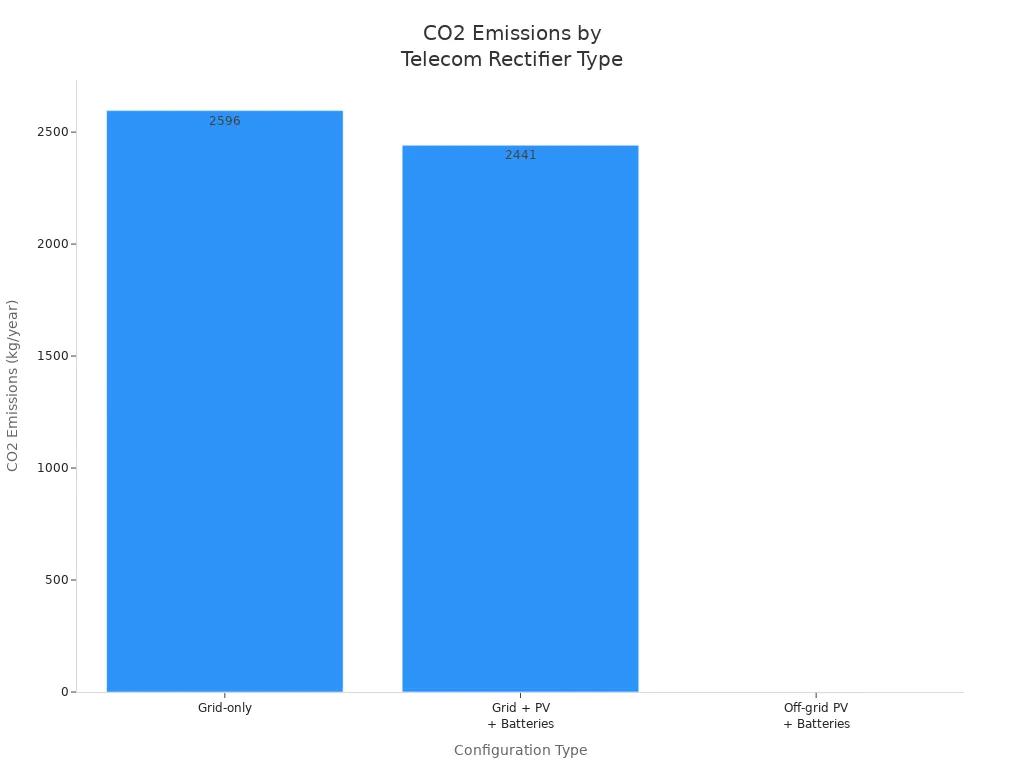
Configuration Type | CO2 Emissions (kg/year) | Renewable Fraction (%) | Energy Efficiency |
|---|---|---|---|
Grid-only | 2593 - 2599 | < 0.3 | Stable electricity |
Grid + PV + Batteries | 2441 | 6.1 | Improved |
Off-grid PV + Batteries | 0 | 100 | Significantly improved |
You can save over $600 per year in electricity costs for each cabinet by upgrading from a traditional 92% efficient system to one that exceeds 96% efficiency.
Scalability and Flexibility
You need a power system that grows with your network. ESTEL’s modular design lets you add or replace rectifier units without shutting down the entire system. Hot-swappable modules minimize downtime and support quick maintenance. You can choose configurations that fit your site, whether you operate a small remote base station or a large urban network.
Modular designs allow easy scaling as your network expands.
Hot-swappable modules enable quick maintenance without system shutdowns.
Redundancy features ensure continuous operation during component failures.
Hybrid power solutions combine solar, wind, and grid sources for diverse environments.
Advanced monitoring technologies optimize performance and minimize downtime.
Customization options let you select battery capacities and rectifier types for specific needs.
You gain flexibility to adapt to future growth and new technologies, making your investment future-proof.
Applications and Implementation
Deployment Scenarios
You can deploy ESTEL’s systems in a variety of challenging environments. Outdoor telecom sites on remote roads, mountain tops, and coastal regions often face unstable grid power and harsh weather. You may need reliable backup power for base stations in rural areas or emergency communication hubs during natural disasters. ESTEL’s Telecom Rectifier System supports hybrid solar and grid integration, making it ideal for off-grid installations and locations with frequent outages. You benefit from robust construction that withstands extreme temperatures, floods, and hurricanes. This durability ensures your network stays online even when environmental conditions threaten energy supply.
Tip: Choose modular systems for remote sites. You can scale power capacity as your network grows or as local energy needs change.
Performance Metrics
You should evaluate your system using key metrics. These indicators help you measure reliability, efficiency, and suitability for modern telecom demands.
Measurement / Feature | Impact on Telecom Infrastructure | |
|---|---|---|
Energy Efficiency | Over 91% AC to DC conversion | Reduces energy loss and costs |
Power Capacity | Nearly double previous generations | Supports higher power demands |
Protection Mechanisms | Advanced safeguards | Ensures uninterrupted power delivery |
Environmental Operating Range | -25°C to +55°C | Reliable in harsh environments |
Scalability | Modular, hot-swappable design | Easy expansion, minimal downtime |
Power Factor | Near unity with PWM rectifiers | Improves power quality |
Harmonic Distortion | Reduced by modern designs | Essential for telecom reliability |
Dynamic Response | Handles load fluctuations | Maintains stable operation |
Durability | Robust construction | Long-term reliability |
You can expect ESTEL rectifiers to deliver above 95% efficiency, advanced load handling, and fault-tolerant designs. These features help you prevent downtime and keep your network reliable.
Design and Integration Considerations
You should follow best practices for successful integration. Start by verifying system specifications and compatibility with your existing infrastructure. Prepare the necessary tools and equipment before installation. Always follow safety precautions to protect yourself and your equipment. Position the rectifier module properly and connect the input power supply with care. Wire output connections securely and integrate battery backup systems for added reliability. Synchronize the system with your communication equipment and configure settings for optimal performance. Test and validate the installation to ensure everything works as expected. Maintain proper ventilation and grounding to prevent overheating and electrical hazards.
Maintain proper cooling to avoid overheating.
Inspect connections regularly for optimal performance.
Use surge protection to shield against voltage spikes.
Monitor efficiency and replace components when needed.
Update firmware and software to keep your system current.
You can extend the lifespan of your rectifier by addressing minor problems early. Real-time monitoring tools help you track energy conversion rates and detect anomalies. Regular maintenance ensures your system remains reliable and efficient.
You gain reliable telecom operations when you choose ESTEL’s smart integration of solar and 48V DC. This hybrid approach ensures continuous service, even during outages, and supports sustainability by lowering energy costs and carbon emissions. Advanced power management and modular design help you expand your network easily and adapt to new technologies.
Real-time monitoring improves energy efficiency.
Predictive maintenance reduces downtime.
Modular systems simplify upgrades and support long-term growth.
FAQ
What is the main advantage of using a multi-source telecom rectifier system?
You gain reliable power for your telecom network. The system combines solar and grid energy, so your equipment stays online during outages. You also reduce energy costs and support sustainability goals.
Can I expand my ESTEL rectifier system as my network grows?
Yes, you can. ESTEL’s modular design lets you add or replace rectifier modules easily. You scale your power system without shutting down your network.
How does the system switch between solar and grid power?
The intelligent controller monitors both sources. It automatically selects the best option for efficiency and reliability. You do not need to make manual adjustments.
Is remote monitoring available for ESTEL rectifier systems?
Yes! You can monitor your system remotely using LAN, SNMP, or TCP/IP. This feature helps you track performance, receive alerts, and optimize energy use from anywhere.
See Also
Integrated Solar Inverter And Battery Solutions For Telecom Cabinets
Solar Energy Storage Solutions For Telecom Cabinet Systems
Smart Energy Storage Systems For Telecom Cabinets In Microgrids
Ensuring Consistent Power Supply For Telecom Cabinet Operations
Calculating Power Systems And Battery Needs For Telecom Cabinets
CALL US DIRECTLY
86-13752765943
3A-8, SHUIWAN 1979 SQUARE (PHASE II), NO.111, TAIZI ROAD,SHUIWAN COMMUNITY, ZHAOSHANG STREET, NANSHAN DISTRICT, SHENZHEN, GUANGDONG, CHINA
