How Cloud Remote Monitoring Enables Centralized Status Management and Fault Early Warning for Telecom Rectifier Systems

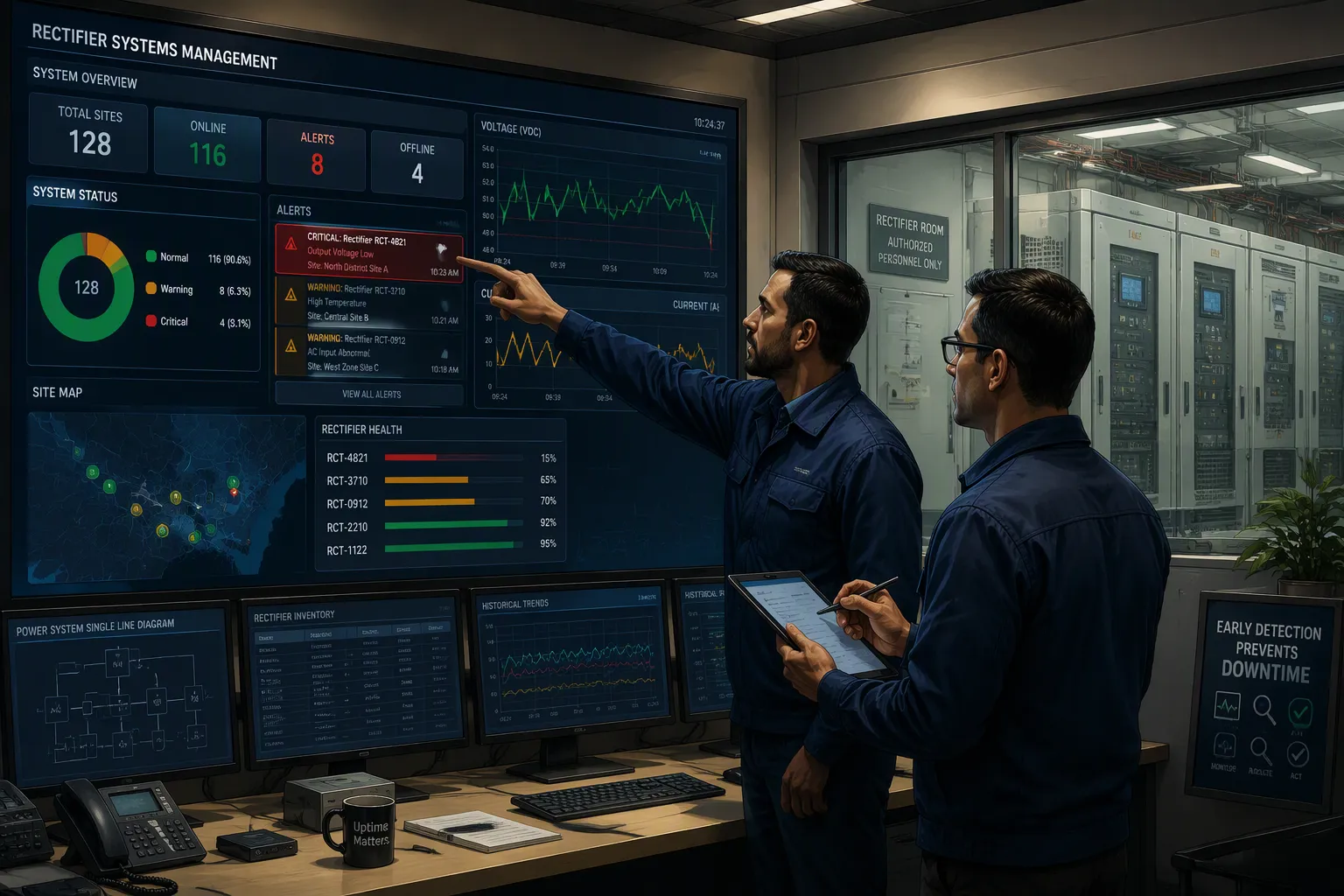
Cloud remote monitoring pulls rectifier status data from every distributed site into one platform. That same data then flags faults before they escalate into outages. You no longer need to guess which site needs attention.
Scattered rectifiers make this hard. Routine site visits consume crews, and maintenance stays reactive. Cloud monitoring changes the picture. Predictive maintenance capabilities reduce site visits by up to 70%, and truck roll costs drop from a range of $6,000–$12,000 to $1,500–$3,000.
Telecom Rectifier Systems sit at the center of this shift. Connected rectifiers report their condition continuously, so your team acts on evidence instead of assumptions.
Key Takeaways
Cloud monitoring shows all rectifier data on one screen. You see every site's status without driving there.
Early warning systems catch problems before they cause outages. You fix issues before they grow.
Remote monitoring cuts site visits and truck rolls. You save money and time.
Start with a small pilot group of sites. Test the system and then expand to all sites.
Faster alerts help your team respond quickly. You keep power running and avoid downtime.
Cloud Monitoring Architecture for Telecom Rectifier Systems
Sensors, Gateways, and Cloud Layer
Data moves through three layers. Smart meters and environmental sensors at the rectifier measure voltage, current, power factor, frequency, and energy. They pass readings over RS485 or Modbus RTU links to an on-site controller. An edge gateway then bundles that data using standard industrial protocols and streams it to a central server over 4G LTE, LoRaWAN, WiFi, or a secure local network. Cloud software ingests the stream, builds dashboards, stores history, and pushes real-time anomaly alerts to field teams. You view the whole picture from a control center.
The gateway does more than forward data. It runs local logic, so alarms still fire within milliseconds when backhaul is limited. It forwards data upward through MQTT for lightweight event streaming, RESTful APIs for platform integration, SNMP traps for legacy OSS/NMS tools, and Kafka connectors for cloud-scale analytics.
Hardware design shapes how cleanly this works. ESTEL's Telecom Rectifier System uses a modular 6U, 3U, or 2U rack-mount layout with efficiency above 96%, a steady DC48V output, and AC220V or 380VAC input options. Standard 19-inch rack compatibility and a documented register map make gateway wiring and data collection straightforward.
Alarm Contacts and Analog Readings
Remote monitoring of a rectifier combines two signal types, and each answers a different question.
Aspect | Discrete alarm contacts | Analog voltage readings |
|---|---|---|
Signal type | Binary contact closure (on/off) | Continuous numerical measurement |
What it reveals | That a fault exists | The actual output level and its trend |
Monitoring role | Triggers investigation | Shows slow voltage drop or incremental over-voltage |
The rectifier latches a contact when it detects a fault. The remote terminal unit reads that state and sends an alarm to the NOC or directly to a technician by email, text, or SNMP trap. Analog inputs measure voltage directly, and some units monitor the power feeding their own input circuits.
Together, the two signals give you a full status view. Binary alarms flag that something is wrong. Analog readings quantify it and show direction. A baseline DC output reading lets you compare rectifier, generator, and battery plant voltages, so you can see which source is out of range before a hard fault lands.
Centralized Status Management Across Sites
Real-Time Dashboards and Remote Configuration
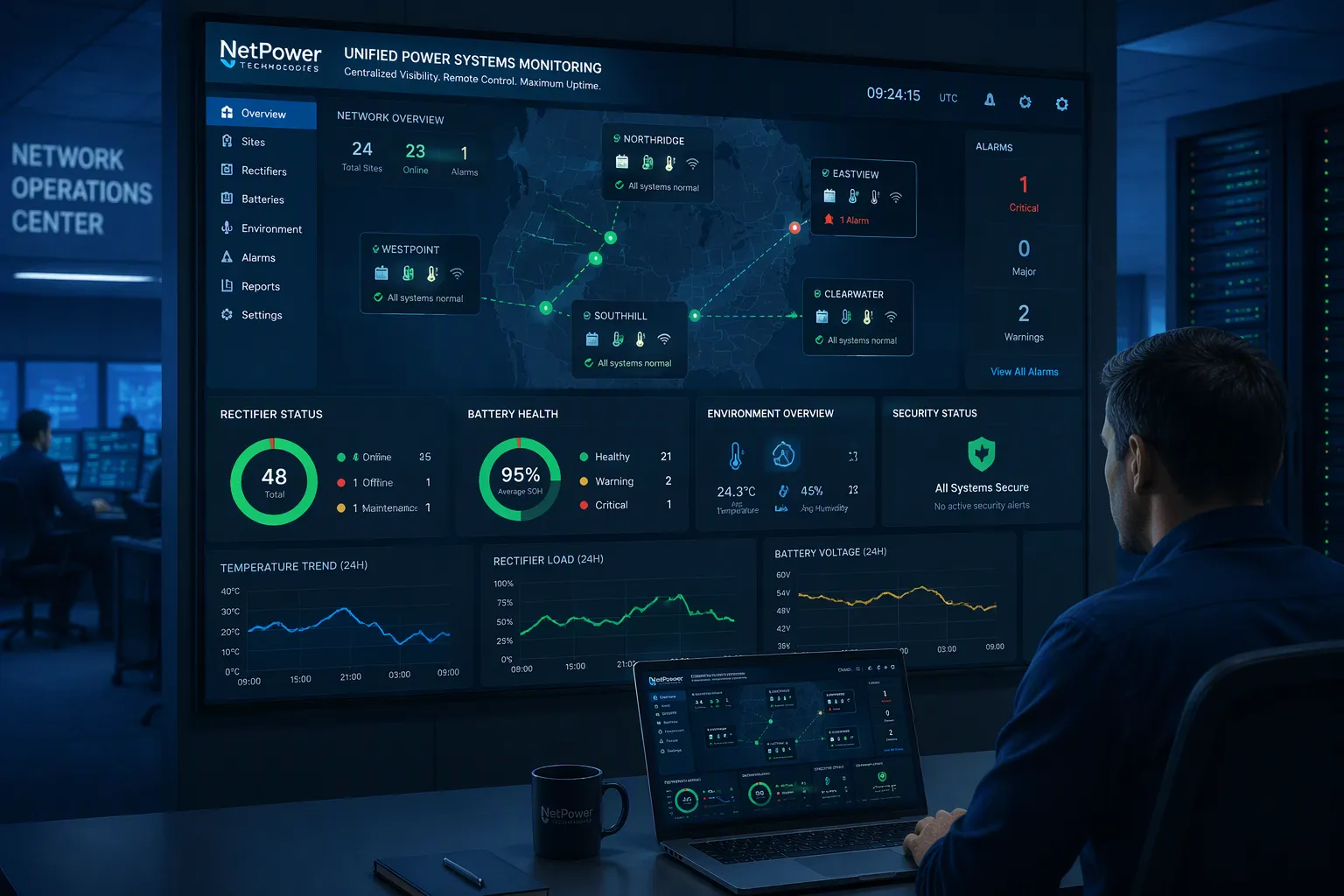
A single console changes how you run a network. You open a browser, view every rectifier state over the internet, and adjust setpoints without sending anyone to the site. Fault recall and diagnosis happen from the same screen. You pull the history, compare it against the alarm log, and identify the root cause in minutes.
Fragmented systems create the problem this solves. Rectifiers often ship with limited standalone alarm interfaces, batteries need separate manual checks, and network devices feed yet another alarm system. Built-in rectifier monitoring typically reports only major failures, so operators are already in trouble by the time an alarm appears. A centralized master station collects real-time data from remote sites over the LAN and presents rectifier status, battery performance, environmental conditions, and network alarms in one view.
The payoff shows up in response speed and cost. A single-pane-of-glass view dramatically reduces response times and confusion, because it shows exactly what is happening at each site at all times. Customizable notifications via SNMP, email, SMS, and voice dial-outs enable immediate corrective action before outages occur. Proactive tracking of battery and rectifier health stretches equipment life, reduces emergency site visits, and lowers total network disruptions.
Benefit | What it delivers |
|---|---|
Unified visibility across sites | Aggregates environmental, power, and security sensor data into one interface for status monitoring, trend review, and compliance reporting |
Real-time alerts | Threshold-based alerts on temperature, humidity, power fluctuations, and security cut detection delay versus 1–5 min polling and speed root-cause analysis |
Reduced site visits | An Alaska mountain-top case cut visits from four to one per year while tracking 85+ alarm points |
Centralized control and scalability | Modular PDUs and remote management cover distributed cabinets; a 500-site deployment yielded 30% energy reduction and 25% downtime decrease |
Unified Multi-Site Visibility
Centralized visibility removes the routine site visit for data gathering. Technicians travel only when needed, which lowers fuel costs and emissions. You monitor power usage across sites, spot inefficiencies, and support PUE optimization. Every site connects to one unified telemetry network, so asset management becomes simpler and more transparent.
The operational gains compound. Real-time telemetry with precise fault context reduces MTTR, because you dispatch the right parts and the right knowledge. Long-term trend analysis lets you schedule predictive maintenance in low-traffic periods and minimize disruption. Edge-based local control logic, such as automatic HVAC backup, cuts human intervention and dependence on central connectivity. This architecture scales from a handful of sites to hundreds, which supports rapid 5G expansion at lower operating cost and higher ROI.
NOC-style monitoring depends on this foundation. Your Network Operation Center watches all Telecom Rectifier Systems alongside ATS, batteries, generators, and HVAC, so issues are detected and addressed before they impact service. Predictive analytics and AI then forecast failures, optimize maintenance, and automate responses. The result is fewer truck rolls, smarter budgeting, and targeted maintenance investment. Field teams arrive with the right information instead of hunting for it on site.
Fault Early Warning for Telecom Rectifier Systems
Early warning starts with continuous condition tracking. Your IoT sensors sample voltage, current, temperature, humidity, airflow, and power metrics every second. Analytics compare actual behavior against expected performance. Subtle deviations surface in real time, long before a hard alarm trips. Environmental monitoring keeps cabinet conditions within safe limits, so heat and moisture never quietly shorten equipment life.
Anomaly Detection and Predictive Analytics
Not every failure announces itself. Two common modes hide from standard polling:
Failure Mode | Precursor Signature | Detection Requirement |
|---|---|---|
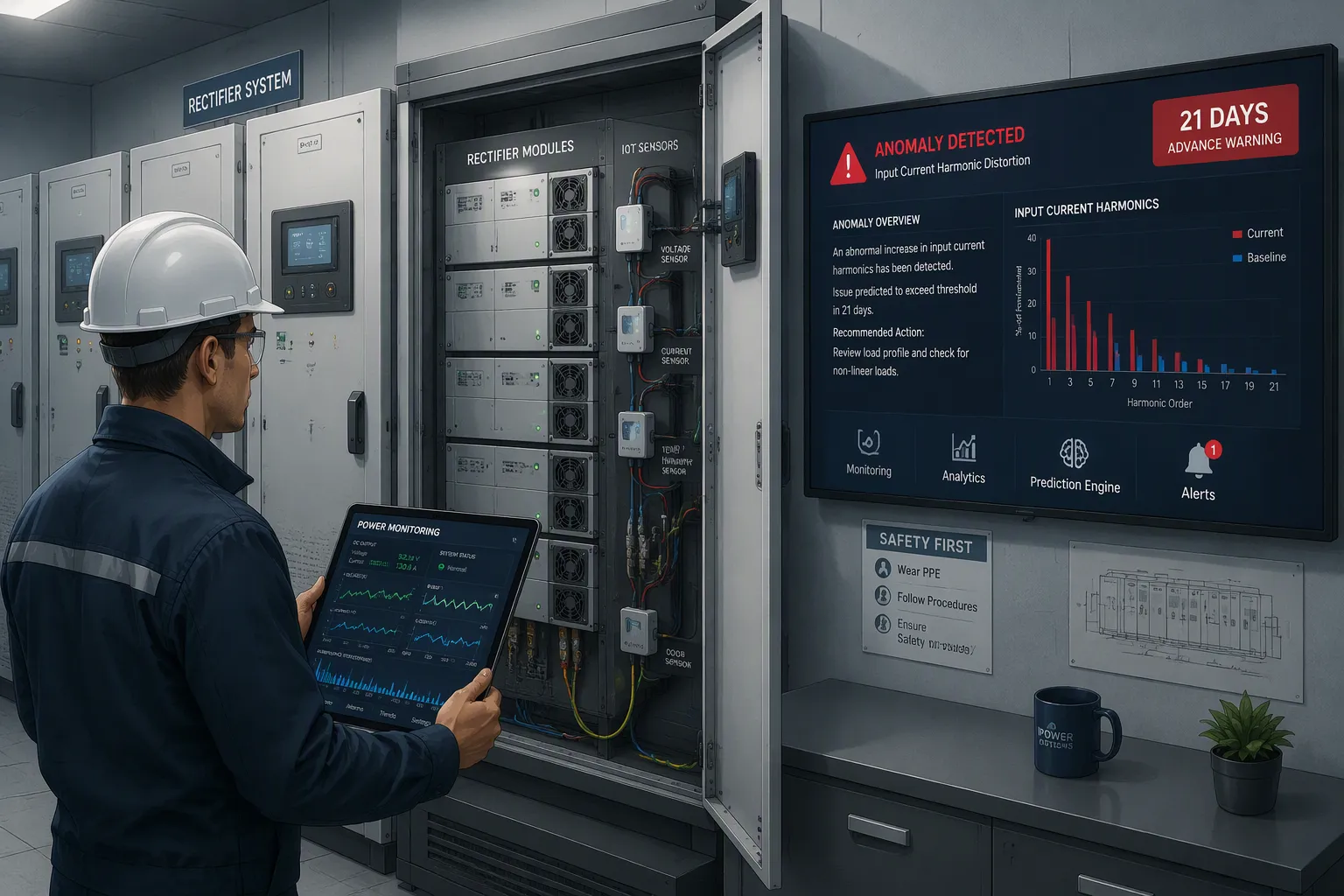
Rectifier capacitor degradation | Rising 5th and 7th harmonic content in input current, before capacitance changes; average power draw stays flat | Waveform-level metering |
Insulation breakdown or incipient arcing | Sub-cycle current spikes lasting a few milliseconds that self-extinguish | High sampling rate, around 8 kHz |
Waveform-level metering catches what consumption-class meters cannot. A field deployment across more than 800 rectifiers in T-Mobile's critical telecom power infrastructure proved the point. Anomaly detection identified equipment degradation in 4% of monitored rectifiers that the existing BMS had missed entirely — zero standard alarms had fired. The signature lived in input current harmonics, not average power, and the system delivered a 21-day advance warning window. Standard polling would have shown those units as nominal.
Machine learning extends this reach. Algorithms trained on years of waveform data recognize degradation patterns, capacitor ESR drift, and harmonic failure signatures. Automated pattern recognition runs at roughly 25 ms per inspection, with improved accuracy and fewer false detections than manual review. AI-driven alerts fire only on significant condition changes and adapt as machine behavior shifts, which cuts alert fatigue and delivers up to 50% less downtime, about 30% lower maintenance cost, and roughly 20% energy savings.
ESTEL's predictive maintenance solutions use advanced algorithms and real-time monitoring to detect potential failures before they happen, leading to lower downtime and maintenance costs compared to traditional methods.
Alerting and NOC Escalation
A warning only matters if it reaches the right person. The alerting path follows a clear sequence. The site generates an alarm from a threshold breach or an anomaly score. The gateway forwards it to the Network Operation Center over MQTT, SNMP trap, or API. The NOC correlates the event with site history, assigns severity, and routes a work order to the right technician with the right parts. Escalation tiers matter here. A minor deviation opens a ticket; a critical alarm pages the on-call engineer immediately.
Threshold-based alerts cover temperature, humidity, and security cut detection. You set custom limits, and notifications arrive by email, SMS, or dashboard. Fault detection systems also watch smoke, water ingress, door status, and battery health. Real-time parameter monitoring of airflow and power spots unusual patterns before an outage. Each signal feeds the same escalation logic, so nothing sits unread in a separate silo.
This routing discipline keeps response fast. The NOC sees which Telecom Rectifier Systems need attention and why, then dispatches accordingly. Technicians arrive with context instead of hunting for it. Fewer repeat visits follow, and availability rises across the fleet. You gain a documented trail for every event, which supports root-cause reviews and budget planning.
Implementation Best Practices
Integration, Security, and Cost Planning
Start with integration. Map every existing rectifier's alarm contacts and analog outputs before you connect anything. Confirm protocol support for Modbus RTU, SNMP, or API-based integration with your network management system. Then lock down the connection. Protect data in transit and at rest with encryption, authenticate devices and users before granting access, and apply role-based access control so each user sees only what their role requires. Add firewalls and intrusion detection to guard the communication network, and run software checks that flag erroneous sensor readings. Adherence to standards such as IEC 62040 and IEEE 1625 supports safe battery and system behavior, and regular maintenance and testing keep degradation from becoming failure.
Cost planning deserves the same rigor. Budget CAPEX for sensors, data acquisition units, communication modules, installation labor, and platform licensing. Budget OPEX for monthly per-site connectivity, software subscriptions, sensor replacement, and data storage and processing. Two barriers can stall a project early:
Barrier Type | Description |
|---|---|
High Initial Investment Costs | Deploying advanced telecom power systems can exceed $1.5 million per site, deterring smaller operators. |
Regulatory Compliance Complexities | Compliance with regulations such as EU energy efficiency directives can incur costs over $250,000 per site. |
Build the business case on savings from fewer truck rolls, optimized maintenance, lower energy costs, and improved uptime.
Phased Rollout
Roll out in stages. Instrument a pilot group of sites first, validate alarm routing and dashboard accuracy, then expand. This approach limits risk and lets your NOC team refine escalation rules before the fleet scales. Choose hardware that fits a cloud-ready site from day one. ESTEL's Telecom Rectifier System offers modular 6U, 3U, and 2U rack-mount designs, efficiency above 96%, and DC48V output with AC220V or 380VAC input options. Paired with ESTEL's outdoor cabinet power solutions, these Telecom Rectifier Systems give operators a practical foundation for phased cloud monitoring deployment.
Cloud monitoring gives you two capabilities that work together. Centralized status management unifies real-time data from every site into one console, so you see each rectifier's condition without travel. Fault early warning applies analytics and alerting to that same stream, so you catch degradation before it becomes an outage.
The payoff is operational. Routine site visits drop, your NOC responds faster, and availability across your Telecom Rectifier Systems rises.
Adopt in phases. Instrument a pilot group of sites, validate alarm routing and dashboard accuracy, then expand across the fleet. ESTEL's rack-mount rectifier systems and outdoor cabinet power solutions offer a practical foundation for that rollout.
FAQ
What does cloud remote monitoring actually do for a rectifier system?
It collects rectifier status data from every site into one platform. You view voltage, current, alarms, and environmental readings from a control center. The same data feeds analytics that flag faults early. You act on evidence instead of assumptions, and you send crews only when a site truly needs them.
Can I add cloud monitoring to rectifiers I already have?
Often yes. Most rectifiers expose discrete alarm contacts and analog voltage outputs. Map those signals first, then confirm protocol support for Modbus RTU, SNMP, or API integration with your management system. A gateway handles the rest. Check each unit's documentation before you commit to a retrofit plan.
Which readings matter most for early fault detection?
Continuous tracking of voltage, current, temperature, humidity, and airflow forms the base layer. Waveform-level metering adds more. It catches harmonic shifts and short current spikes that average-power readings miss. In one deployment, this approach flagged degradation in 4% of rectifiers that standard alarms had missed, with a 21-day warning window.
How does an alarm reach the right person?
The site generates the alarm from a threshold breach or an anomaly score. The gateway forwards it to your Network Operation Center over MQTT, SNMP trap, or API. The NOC assigns severity and routes a work order to the right technician with the right parts. Escalation tiers keep critical events from waiting.
How should I start a rollout?
Instrument a pilot group of sites first. Validate alarm routing and dashboard accuracy there. Let your NOC team refine escalation rules before you scale. Then expand across the fleet. ESTEL's Telecom Rectifier System, with its 6U, 3U, and 2U rack-mount designs and DC48V output, gives you a practical foundation for that phased approach.
See Also
Ensuring Consistent Power Delivery for Telecom Cabinet Operations
Calculating Telecom Cabinet Power Systems and Battery Requirements
Key Features to Understand in Telecom Power Supplies
Achieving Best Monitoring Practices for Outdoor Telecom Cabinets
Solar Energy Storage Power Systems for Telecom Cabinet Applications
CALL US DIRECTLY
86-13752765943
3A-8, SHUIWAN 1979 SQUARE (PHASE II), NO.111, TAIZI ROAD,SHUIWAN COMMUNITY, ZHAOSHANG STREET, NANSHAN DISTRICT, SHENZHEN, GUANGDONG, CHINA
