What Certifications Does an ESTEL 48V Telecom Power System Hold

You will see five certification families on an ESTEL 48V telecom power system: UL, CE, IEC/EN, RoHS, and ISO 9001. Each mark answers a different question. UL and IEC/EN address electrical safety. CE covers safety and electromagnetic compatibility. RoHS restricts hazardous substances. ISO 9001:2015 confirms quality management across manufacturing and sales.
Certification matters for three reasons. It protects people and equipment from electrical faults. It signals reliability, so operators trust the system in remote sites. It also opens market access, because regulators and telecom operators expect recognized marks before approval.
This post decodes each mark in plain language. You will learn what each standard tests and which regions accept it. The goal is clarity, not a sales pitch.
Key Takeaways
UL and IEC/EN certifications prove the system meets electrical safety standards for North America and global markets.
CE marking shows the system meets European safety and electromagnetic compatibility rules.
RoHS limits hazardous substances, and ISO 9001:2015 ensures consistent quality in manufacturing and sales.
Match certifications to your region: UL for North America, CE/EN for Europe, and IEC for international tenders.
Certified systems reduce accident risk, equipment failure, and downtime, and they simplify regulatory approval.
ESTEL Telecom Power System Overview
ESTEL is a China-based supplier of outdoor telecom cabinets and power systems. The company holds ISO 9001:2015 certification for quality management, which covers both manufacturing and sales. That certification gives you a documented baseline for how the company controls production quality.
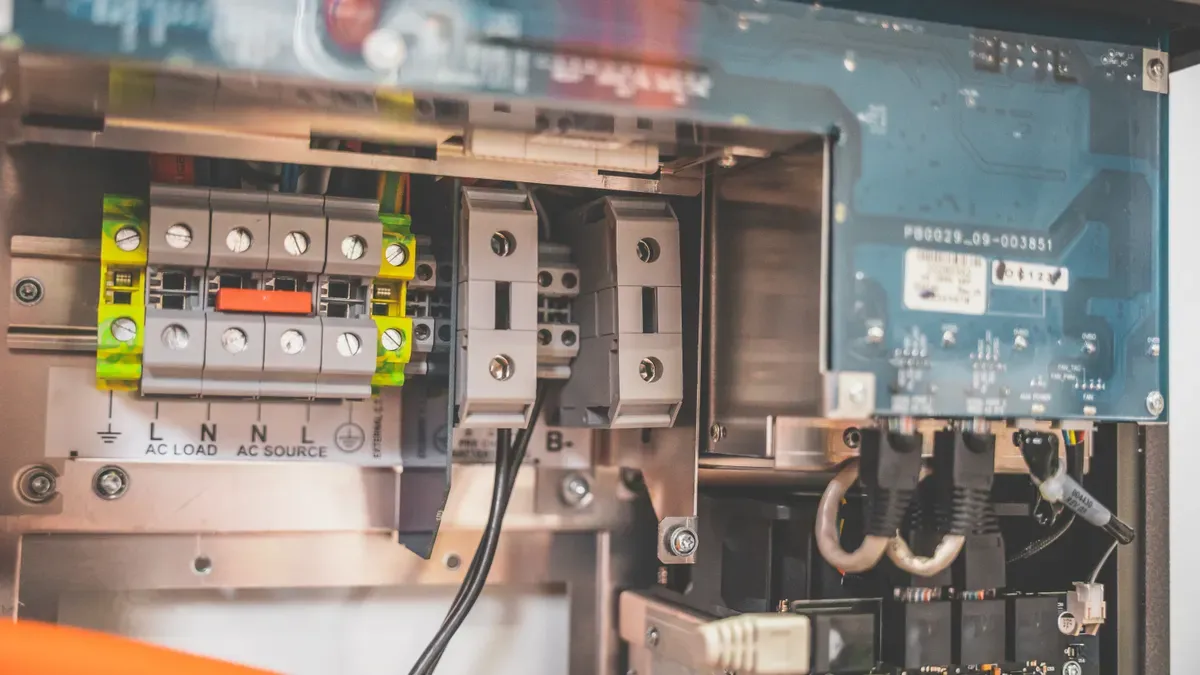
The ESTEL Telecom Power System accepts an AC input voltage of 90 V. It uses natural cooling, installs on a standard 19-inch rack or inside a cabinet, and relies on a modular rectifier design with efficiency up to 96%. These traits matter in remote sites, where power quality varies and maintenance visits are costly.
Specification | Value |
|---|---|
DC Output Voltage | 48 V |
DC Output Current | 20 A |
AC Input Voltage | 90 V |
Max Rated AC Current | 13.55/6.33 A |
Efficiency | Up to 96% |
Operating Temperature | -40°C to +65°C |
Why Certification Matters
The -48V DC standard underpins telecom networks for good reasons. It delivers power safely, supports reliable battery backup, reduces corrosion, and simplifies network design. A 48V telecom power system sits at the heart of that architecture, so its failure can take an entire site offline.
Certification gives you independent proof that the system meets recognized safety and performance benchmarks. You can compare vendors on shared terms instead of trusting marketing claims. That proof also speeds regulatory approval in your target market.
Core Marks at a Glance
Five mark families appear on the system: UL, CE, IEC/EN, RoHS, and ISO 9001. UL and IEC/EN cover electrical safety. CE covers safety and electromagnetic compatibility. RoHS restricts hazardous substances. ISO 9001:2015 covers quality management.
Each mark answers a specific question. UL tells you the system passed North American safety evaluation. CE tells you it meets European safety and EMC requirements. IEC/EN gives you a global reference point. Together, these marks let you match the system to your region and application with confidence.
Safety Standards for 48V Telecom Power Systems
Safety standards give you a shared yardstick for judging a power system. They define how the equipment must behave under normal operation and under fault conditions. They also set rules for construction, insulation, and enclosure design. Two standard families dominate this field: UL for North America and IEC/EN for global and European markets.
UL and North American Safety
UL 62368-1 is the key standard you will meet in North American deployments. It evaluates electrical safety under normal and abnormal operating conditions. Normal conditions cover everyday running: rated input, rated output, and steady load. Abnormal conditions cover faults such as short circuits, overloads, and component failure. The standard asks whether the equipment stays safe when something goes wrong, not just when everything works.
UL 62368-1 also examines mechanical construction and the enclosure. Inspectors look at creepage and clearance distances, insulation barriers, and the strength of the housing. They check that a technician cannot touch live parts during routine service. They also verify that the enclosure contains internal faults without letting fire or debris escape.
For a 48V telecom power system, these checks matter at the site level. A rectifier cabinet often sits in an outdoor shelter or at the base of a tower. A fault inside the enclosure must not endanger the technician who opens the door. UL listing gives you documented evidence that the design passed those tests.
IEC and EN Global Standards
IEC standards form the global electrical-safety baseline for telecom rectifiers and DC power plants. The IEC 60950 and IEC 62368 families define hazard-based safety engineering for information and communication technology equipment. IEC 62368-1 replaced the older 60950 approach and now anchors most new designs. It classifies energy sources and requires safeguards matched to the energy level.
EN standards adopt the IEC text for the European market. An EN mark therefore tells you the product meets the same technical requirements as its IEC counterpart. European regulators accept EN compliance as proof of safety. Many operators in Asia, Africa, and Latin America also reference IEC standards in their procurement specs, even when local law does not mandate them.
Certifications are fit-for-purpose tools, not a ranking. UL suits a North American rollout. IEC/EN suits Europe and international tenders. A vendor may hold one, the other, or both, depending on the markets it serves. Your job is to match the mark to the destination, not to assume one standard is universally superior.
Both families share a common goal: prove the system fails safely. A well-designed unit limits fault energy, isolates live parts, and keeps temperatures within safe bounds. The ESTEL system's natural cooling and 90 V AC input reduce stress on internal components, which supports stable behavior across both test regimes. Read the certificate scope carefully. Confirm the standard number, the edition, and the product family it covers. That habit turns a logo on a datasheet into real confidence for your project.
EMC, Environmental, and Quality Marks

Safety marks tell you the system will not harm people. The next layer of marks tells you the system will not disturb other equipment, will not pollute the environment, and comes from a controlled factory. You will meet three mark families here: CE, RoHS, and ISO 9001.
CE Marking and EMC Compliance
CE marking covers two things at once: safety and electromagnetic compatibility. The safety side confirms the product meets European electrical-safety requirements. The EMC side confirms the product limits electromagnetic emissions and resists interference from nearby equipment.
EMC matters at a shared telecom site. A rectifier that emits excessive noise can disrupt radio equipment or sensitive control circuits. A rectifier that cannot tolerate incoming interference may trip or reset at the wrong moment. CE testing checks both directions: what the unit emits and what it withstands.
A well-designed 48V telecom power system can achieve a high power factor. A high power factor means the system draws current efficiently and presents a lighter load on the upstream supply. That efficiency supports stable operation and helps you meet site power budgets. CE compliance gives European regulators and operators documented proof of these qualities.
RoHS and ISO 9001
RoHS restricts hazardous substances in electrical and electronic equipment. Telecom equipment falls within its scope because circuit boards, connector plating, and shielding materials can contain restricted materials. RoHS sets no separate limits for telecom power systems; the general limits apply to all covered equipment.
Restricted Substance | Maximum Allowable Limit (% by weight) |
|---|---|
Lead (Pb) | 0.1% |
Mercury (Hg) | 0.1% |
Cadmium (Cd) | 0.01% |
Hexavalent Chromium (Cr6+) | 0.1% |
Polybrominated Biphenyls (PBBs) | 0.1% |
Polybrominated Diphenyl Ethers (PBDEs) | 0.1% |
Bis(2-Ethylhexyl) Phthalate (DEHP) | 0.1% |
Benzyl Butyl Phthalate (BBP) | 0.1% |
Dibutyl Phthalate (DBP) | 0.1% |
Diisobutyl Phthalate (DIBP) | 0.1% |
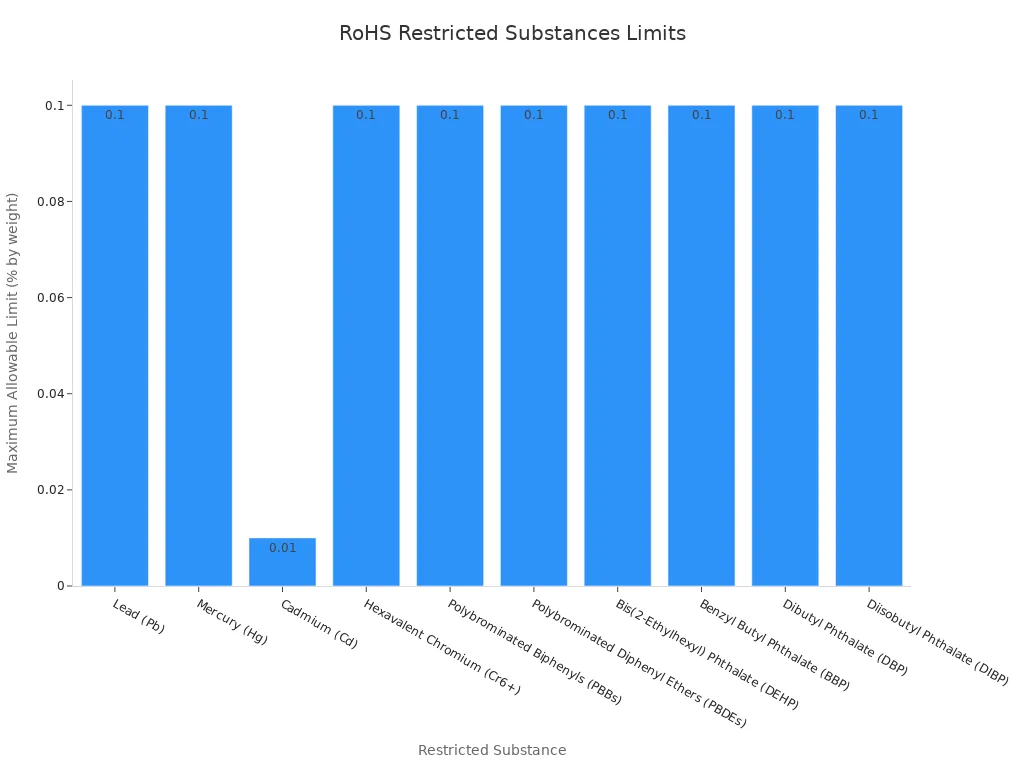
Notice that cadmium carries a tighter limit than the other substances. That difference reflects its higher toxicity. A RoHS-compliant system gives operators confidence that the equipment meets environmental rules in Europe and in many other markets that adopted similar restrictions.
ISO 9001:2015 is a quality-management certification. It covers manufacturing and sales processes, not a single product. The standard requires documented procedures, traceable production records, and a system for correcting defects. ESTEL holds ISO 9001:2015 certification for both manufacturing and sales.
Each mark connects to reliability in a practical way. CE proves the system behaves well in an electrically noisy site. RoHS proves it meets environmental rules. ISO 9001 proves the factory follows repeatable processes, so the unit you receive matches the unit that was tested. Together, these marks support regulatory acceptance and give telecom operators a documented basis for procurement decisions.
Regional Compliance and Industry Comparison
Regional Fit for 48V Telecom Power Systems
You match the mark to the market. UL serves North American deployments, where regulators and operators expect a recognized safety listing. CE and EN standards serve Europe, where the mark is a legal condition for sale. IEC standards serve global tenders and align closely with requirements across Asia and the Asia Pacific.
Regional schemes add local layers on top of these baselines. Telecom battery systems in Asia Pacific often carry KC, BSMI, PSE, and CB marks alongside IEC 62133. European buyers may ask for UKCA, CB, and ISO documentation. A 48V telecom power system that holds UL, CE, and IEC marks covers the three main blocs, and you add local marks only where your destination demands them.
Comparing Certifications to Benchmarks
Industry procurement specs often reach beyond electrical safety. They ask for environmental durability too. ETSI GR-487 tests outdoor equipment against rain, snow, ice, salt spray, sand storms, vibration, and humidity from below 10% to 100%. UL standards focus on electrical safety and performance instead. ESTEL designs its power systems for dual compliance, pairing UL electrical safety with ETSI GR-487 environmental durability.
Requirement | ESTEL Certification Set | Typical Industry Benchmark |
|---|---|---|
Electrical safety | UL, IEC/EN | UL 60950-1 / UL 62368-1 |
EMC and European access | CE | CE Mark |
Environmental durability | ETSI GR-487 design target | ETSI GR-487, IP ratings |
Hazardous substances | RoHS | RoHS |
Quality management | ISO 9001:2015 | ISO 9001 |
Ingress protection | IP-rated enclosures | IP and NEMA ratings |
Each mark fits a purpose. UL suits a North American rollout. CE and EN suit Europe. IEC suits international tenders. ETSI GR-487 suits harsh outdoor sites. NEBS Level 3 suits central office deployments. Check your tender document, list the marks it names, and confirm the certificate scope covers your model.
The certification set on the ESTEL 48V telecom power system answers three questions at once. UL and IEC standards confirm safety, because the system passed rigorous electrical safety and performance testing. IEEE standards support reliability, because they target dependable operation inside telecom environments. Local and regional requirements confirm regulatory acceptance, so you avoid penalties and regulatory issues at your site.
Certification / Standard | Key Factor Addressed | Value to the ESTEL 48V System |
|---|---|---|
IEC standards | Safety and performance | Confirms the system passed rigorous electrical safety and performance testing |
UL certification | Safety | Verifies adherence to strict safety guidelines, reducing accident and equipment-failure risk |
IEEE standards | Reliability | Ensures dependable operation specifically within telecom environments |
Local/regional requirements | Regulatory acceptance | Confirms the system meets site-specific regulations, avoiding regulatory issues and penalties |
Treat each mark as a fit-for-purpose tool. Match UL to North America, CE and EN to Europe, and IEC to global tenders. A compliant system lowers accident risk, equipment failure, and downtime. It also simplifies future upgrades and inspections. Compare quoted prices against the marks your tender names, then confirm the certificate scope covers your exact model. That step keeps cost aligned with real application fit.
FAQ
Which marks do I need for a North American deployment?
Look for UL listing first. North American regulators and operators expect a recognized safety listing, and UL 62368-1 evaluates electrical safety under normal and abnormal conditions. Pair it with RoHS compliance for environmental rules. CE and IEC marks add value for international tenders, but UL anchors the regional approval.
What does the CE mark actually cover on a power system?
CE covers two areas at once: electrical safety and electromagnetic compatibility. The safety side confirms European requirements. The EMC side confirms the unit limits emissions and resists outside interference. A well-designed 48V system can reach a high power factor, which supports stable site operation.
Do RoHS and ISO 9001 test the product itself?
They answer different questions. RoHS restricts hazardous substances such as lead and cadmium in the equipment. ISO 9001:2015 certifies the quality-management system behind manufacturing and sales, not a single unit. Together they show environmental compliance and repeatable factory processes, so the unit you receive matches the tested design.
How do I match certifications to my tender document?
List every mark your tender names, then confirm each certificate scope covers your exact model. Match UL to North America, CE and EN to Europe, and IEC to global tenders. Add ETSI GR-487 where the site demands outdoor durability. This step keeps cost aligned with real application fit.
See Also
Understanding The ESTEL Telecom Cabinet Power System Explained Clearly
How ESTEL Maintains Correct Voltage Levels For Communication Cabinets
ESTEL Guide To Telecom Cabinet Requirements For Communication Equipment
How To Guarantee Reliable Power Supply In Telecom Cabinets
Energy Storage Batteries Designed For ESTEL Telecom Cabinets
CALL US DIRECTLY
86-13752765943
3A-8, SHUIWAN 1979 SQUARE (PHASE II), NO.111, TAIZI ROAD,SHUIWAN COMMUNITY, ZHAOSHANG STREET, NANSHAN DISTRICT, SHENZHEN, GUANGDONG, CHINA
