Full-Link Monitoring Telecom Power System for Root Cause Localization and Rapid Repair of Power Failures

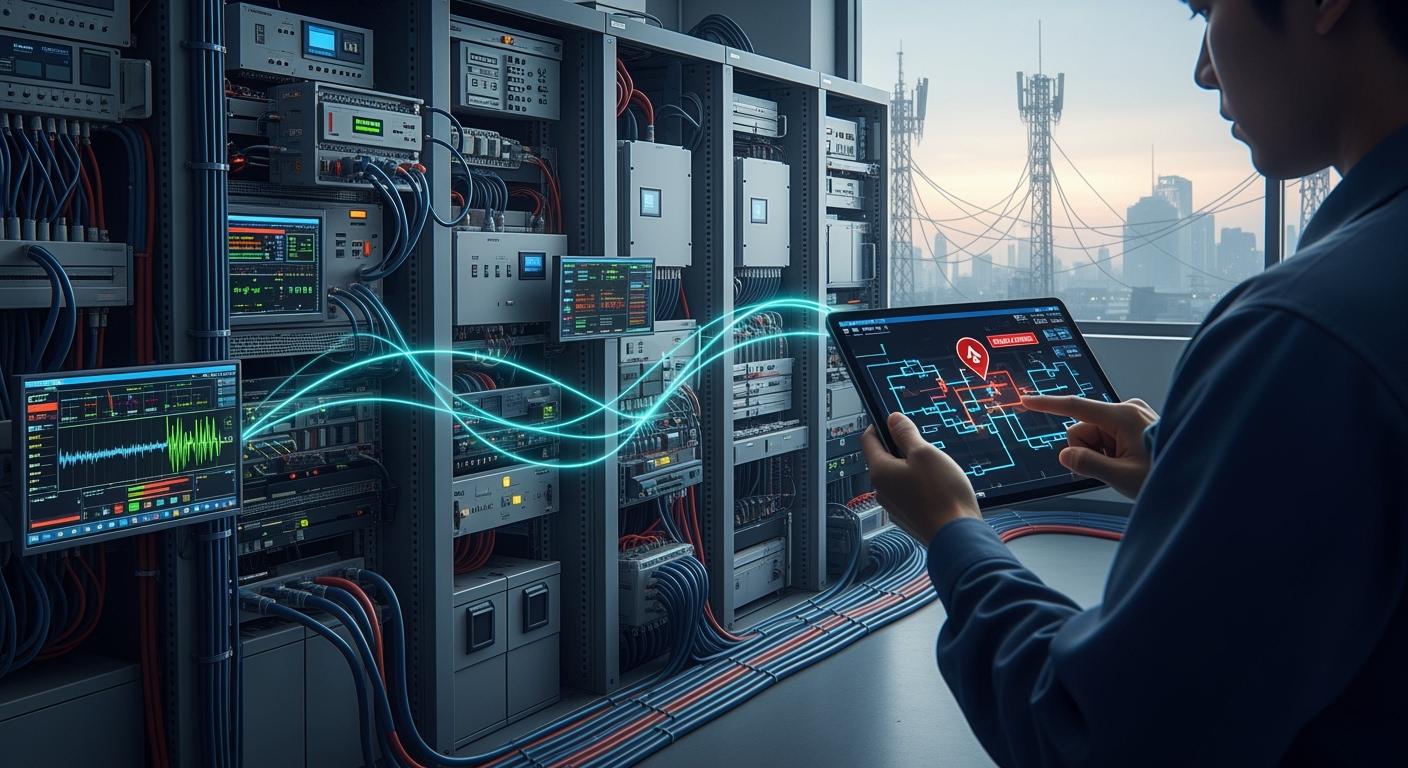
Full-link monitoring changes how you maintain a Telecom Power System by giving you real-time visibility across your network. You minimize downtime, which improves service reliability and boosts customer satisfaction. Industry trends show that AI-driven predictive maintenance and cloud-native architecture now enable you to detect and resolve issues faster than ever. ESTEL leads the market with innovative solutions that use advanced sensors and IoT integration, helping you localize root causes quickly and repair power failures with confidence.
Key Takeaways
Full-link monitoring provides real-time visibility, allowing you to detect power failures in minutes instead of hours, which keeps your network running smoothly.
Rapid root cause localization helps you find the exact problem quickly, reducing downtime and improving your team's efficiency in repairs.
Using advanced technologies like AI and IoT integration, ESTEL's solutions enhance operational efficiency and can lead to significant cost savings.
Automated fault detection and response streamline the repair process, allowing for faster repairs and fewer service interruptions for customers.
Regular monitoring and predictive maintenance help you avoid unexpected outages, ensuring your telecom power system remains reliable and efficient.
Value of Full-Link Monitoring
Faster Fault Detection
You gain a clear advantage with full-link monitoring in your Telecom Power System. This technology gives you end-to-end visibility, so you can spot power failures almost instantly. Traditional methods often require hours to detect faults. With full-link monitoring, you reduce detection time to just minutes. This means you can act before service interruptions affect your customers.
Fault detection time drops from hours to minutes.
Service downtime decreases by over 60%.
Maintenance costs go down because you target the exact problem.
You no longer need to wait for customer complaints or manual checks. The system alerts you as soon as an issue arises. This proactive approach keeps your network running smoothly and your customers satisfied.
Rapid Root Cause Localization
Full-link monitoring does more than just detect faults. It helps you find the exact cause quickly. You see the status of every component in your Telecom Power System, from the main power source to the distribution units. This level of detail allows you to pinpoint the problem area without guesswork.
For example, when Lake Country Power adopted advanced fault detection and localization, they achieved complete visibility into their network. They could respond to outages even before customers noticed. This kind of efficiency is possible when you use a system that monitors every link in the chain.
Tip: Rapid root cause localization means you spend less time searching for issues and more time fixing them. Your team becomes more efficient, and your network becomes more reliable.
Here is how full-link monitoring benefits your operations:
Benefit | Description |
|---|---|
You monitor environmental conditions to keep operations safe. | |
Compliance | You meet regulations and avoid legal penalties. |
Operational Efficiency | You use real-time data to optimize your processes. |
Financial Savings | You lower costs by reducing downtime and unnecessary maintenance. |
Telecom operators measure the return on investment by looking at improved business performance and operational stability. Many report that observability helps them meet key business goals. Some even see returns as high as five to ten times their initial investment. When you use full-link monitoring in your Telecom Power System, you set your network up for long-term success.
Challenges in Traditional Power Failure Management
Manual Monitoring Limitations
You face several obstacles when you rely on manual monitoring for telecom power systems. Manual testing does not always catch risks like thermal runaway. This can lead to catastrophic failures that disrupt your network. You often depend on technicians to check equipment and record data. Human error becomes a major concern. Industry data shows that about 80% of outages involve process mistakes or overlooked warnings. You may miss early signs of trouble, which increases the risk of downtime.
Manual monitoring can leave failed batteries in the field for long periods. Damaged batteries may harm other batteries and cause service outages. You must replace batteries quickly to avoid these problems, but manual checks often delay this process. You also struggle to manage battery health effectively. Regular maintenance is necessary, but manual methods make it hard to track aging and capacity degradation.
Note: Manual monitoring increases the risk of human error and delays in identifying faults. You need proactive solutions to improve reliability.
Limitations in AC/DC power conversion can cause high temperatures and reduce battery life.
Instability from sudden changes in power system parameters may disrupt services.
Rapid increases in power demand or overloads raise the likelihood of failures.
Safety risks during equipment handling include electric shock incidents.
Poor fuel management for backup generators leads to inefficiencies.
Delays in Fault Localization
You often experience delays when trying to locate the root cause of power failures. Manual monitoring provides limited visibility into your network. You must check each component one by one, which takes time and resources. Load imbalances and inefficiencies in rectifiers affect performance and complicate troubleshooting. Limited monitoring capabilities for energy consumption make it harder to prevent problems before they escalate.
Battery aging and capacity degradation add another layer of complexity. You may not notice these issues until they cause outages. Poor fuel management for backup generators and inefficient rectifiers further slow down the localization process. You spend more time searching for faults, which increases downtime and impacts service reliability.
Battery aging and capacity degradation over time.
Poor fuel management for backup generators.
Load imbalances and inefficiencies in rectifiers.
Limited monitoring capabilities for energy consumption.
You need advanced monitoring tools to overcome these challenges and ensure rapid fault localization.
ESTEL Telecom Power System Solutions

Key Features and Technologies
You need a power system that adapts to changing demands and keeps your telecom network running smoothly. ESTEL delivers this with a combination of advanced engineering and smart technology. The Telecom Power System, Telecom Rectifier System, and Smart Power Distribution Unit work together to create a reliable foundation for your operations.
You benefit from a wide input voltage range. The Telecom Power System operates efficiently from 90 to 300 Vac. This flexibility means you can deploy it in different environments without worrying about unstable power sources. The modular design lets you scale your system as your network grows. You can add or replace modules without shutting down the entire system, which saves time and reduces service interruptions.
The rectifier system uses dynamic non-uniform current sharing. This technology adjusts the current sharing ratio to match the load, which boosts efficiency across a wide range of conditions. You see 2% to 7% higher efficiency compared to conventional designs, even when input voltages change. The system maintains this performance without increasing size or cost.
Intelligent monitoring forms the core of proactive fault management. Real-time monitoring detects anomalies early and sends immediate notifications. You can set custom alert thresholds, so you only get alerts that matter. Predictive maintenance features help you schedule repairs before issues become critical, reducing downtime and protecting your equipment.
Here is how intelligent monitoring supports proactive fault management:
Feature | Contribution to Proactive Fault Management |
|---|---|
Real-time monitoring | Enables early detection of anomalies and swift response to critical events. |
Customizable alert thresholds | Helps avoid alert fatigue by focusing on relevant incidents. |
Predictive maintenance | Allows scheduling of maintenance before issues escalate, reducing downtime. |
Immediate notifications | Ensures quick action to prevent equipment damage and service interruptions. |
Tip: Intelligent monitoring not only keeps your network safe but also helps you meet compliance and sustainability goals.
Integration with Rectifier and Smart PDU
When you integrate the Telecom Rectifier System and Smart Power Distribution Unit, you unlock new levels of efficiency and control. The rectifier system achieves conversion efficiency above 98%, which means less energy is wasted as heat. Active power factor compensation improves energy efficiency, reaching a power factor of 0.99. This reduces your electricity costs and helps you meet strict energy standards.
The Smart Power Distribution Unit brings remote management and real-time monitoring to your setup. You can balance loads, optimize energy use, and minimize on-site interventions. This saves time and labor costs while ensuring your system stays compliant with regulations.
The following table shows how these features contribute to energy savings:
Feature | |
|---|---|
High efficiency | Reduces electrical energy consumption, leading to less heat |
Active power factor compensation | Improves energy efficiency with a power factor greater than 0.98 |
Reduced heat generation | Minimizes cooling needs, resulting in extra energy savings |
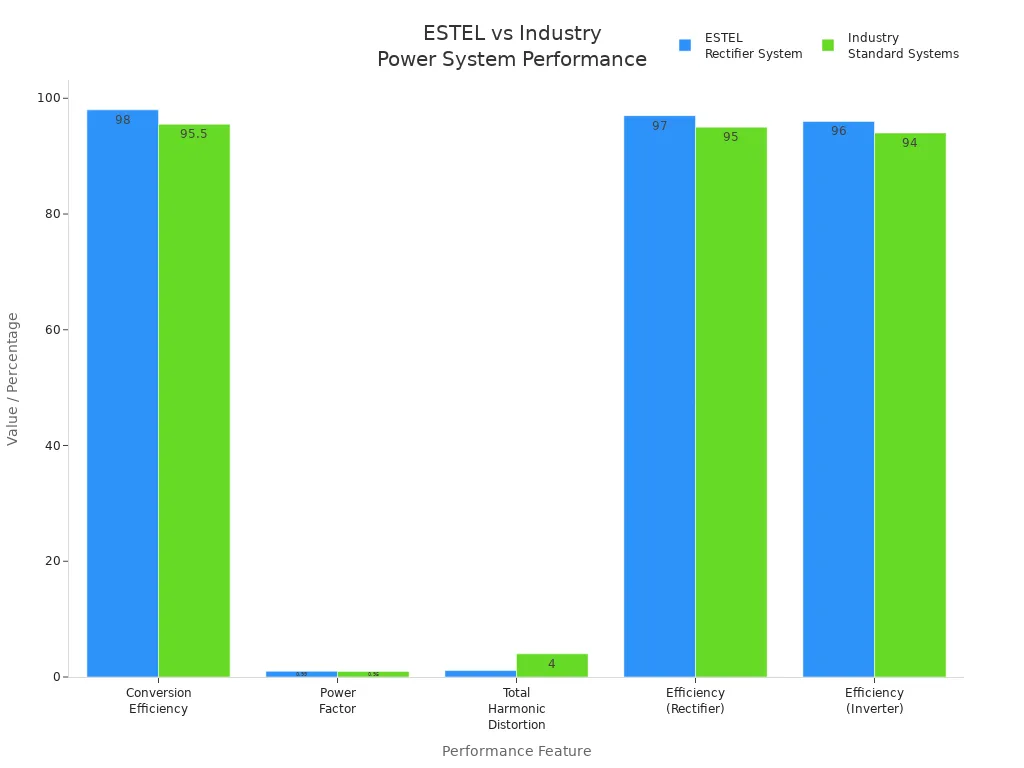
You can see how ESTEL’s rectifier system outperforms industry standards in key areas:
Feature | ESTEL’s Rectifier System | Industry Standard Systems |
|---|---|---|
Conversion Efficiency | >98% | 95–96% |
Power Factor | 0.99 | 0.95 |
Total Harmonic Distortion | 1.12% | 3–5% |
Efficiency (Rectifier) | >97% | 95% |
Efficiency (Inverter) | >96% | 94% |
You also gain these advantages:
The system achieves high efficiency across a wide load range using dynamic non-uniform current sharing.
You can optimize efficiency for varying loads without increasing system size or cost.
Experimental results show efficiency gains of 2% to 7% using different input voltages.
Remote management, load balancing, and real-time monitoring all help you identify inefficiencies and optimize your Telecom Power System. These features support compliance with energy efficiency standards and sustainability goals.
Feature | Benefit | Impact on Compliance |
|---|---|---|
Real-time monitoring | Identifies inefficiencies in power consumption | Helps meet energy efficiency standards |
Load balancing | Optimizes energy usage and reduces power waste | Aligns with sustainability goals |
Remote management | Minimizes on-site interventions, saving time and labor costs | Ensures compliance with stricter regulations |
You can trust ESTEL’s integrated solutions to deliver reliable performance, energy savings, and intelligent control. These technologies help you maintain a robust Telecom Power System that adapts to your needs and supports your business goals.
Fault Detection and Repair Process

Continuous Monitoring Workflow
You need a clear process to keep your Telecom Power System reliable. Continuous monitoring uses a series of steps that help you detect and address faults before they cause major issues. Here is how the workflow usually unfolds:
Fault detection: The system filters event data and generates alarms when it finds a problem in the network.
Fault location by alarm enrichment: You can quickly isolate the affected device and understand what caused the fault.
Alarm suppression: The system reduces unnecessary alarms, so you do not get overwhelmed by too many notifications.
Alarm isolation: By correlating alarms, you can identify the root cause and focus your efforts on the real issue.
This workflow gives you a structured way to manage faults. You spend less time searching for problems and more time fixing them. You also avoid alarm fatigue, which helps your team stay alert and effective.
Tip: A well-designed monitoring workflow keeps your network stable and your maintenance team focused on what matters most.
Automated Localization and Response
Automation brings speed and accuracy to fault management. Modern systems use geospatial intelligence to pinpoint faults, which removes guesswork and helps you dispatch repair teams faster. Automated task routing sends jobs to the nearest field teams, so you do not waste time with manual assignments.
AI-powered monitoring watches real-time data from every network component. It can alert you to potential issues before they become failures. This proactive approach helps you avoid unexpected outages. Automated systems also identify root causes and failure locations quickly. Your repair teams respond more effectively, which lowers the mean time to repair (MTTR).
Geospatial tools locate faults with high accuracy.
Automated routing gets the right team to the right place fast.
AI monitoring prevents small issues from turning into big problems.
Quick root cause identification means less downtime for your network.
You gain a faster, more reliable repair process. Your Telecom Power System stays resilient, and your customers experience fewer interruptions.
Real-World Results with ESTEL
Improved Response Times
You see real change when you use ESTEL’s full-link monitoring in your telecom power system. Operators report faster repairs and fewer site visits. For example, a mobile operator in Southeast Asia reduced site visits by 38%. Repair times dropped from 12 hours to just 4 hours. Annual operations and maintenance costs fell by $500,000. You spend less time waiting for repairs and more time delivering reliable service.
European tower companies also benefit. They improved system uptime by 22% and cut emergency maintenance trips in half. You notice fewer interruptions and smoother operations. These improvements help you manage your network with less effort.
Case Study | Key Results | Impact on Maintenance Workload |
|---|---|---|
Southeast Asia Mobile Operator | 38% fewer site visits, repair time cut by 8 hours, $500,000 saved annually | Less maintenance, faster repairs |
European Tower Company | 22% better uptime, half as many emergency trips | More reliable, less frequent repairs |
Telecom Power Systems | 25-30% lower energy use with efficient power supplies | Lower costs, less maintenance needed |
You gain faster response times and lower costs when you choose ESTEL’s solutions.
Enhanced Reliability and Uptime
You achieve higher reliability and uptime with ESTEL’s advanced monitoring. Operators report a reduction in downtime by 15-25%. Uptime improves by 22%. You see a significant decrease in maintenance workload and cost savings.
Metric | Improvement |
|---|---|
Reduction in downtime | 15-25% |
Improved uptime | 22% |
Decrease in maintenance workload | Significant |
Cost savings | Significant |
Operational efficiency also improves. MTN South Sudan reduced fuel costs by 30%. CO2 emissions dropped by 55%. You optimize energy use with hybrid systems and modular designs. Outlet-level monitoring helps you eliminate energy waste and improve power usage effectiveness.
Metric | Result |
|---|---|
Reduction in fuel costs | 30% (MTN South Sudan) |
CO2 emissions reduction | 55% (current), 58% (with 5G) |
Energy optimization | Enhanced through hybrid systems |
Maintenance requirements | Minimal, ensuring cost-effectiveness |
You deliver reliable service and meet sustainability goals with ESTEL’s intelligent power solutions.
You gain major advantages by adopting full-link monitoring for your telecom power system. These include energy savings, better operational efficiency, and improved grid stability:
Benefit | Industry Benchmark Result |
|---|---|
Energy Efficiency | Up to 30% reduction in energy costs |
Operational Efficiency | 30% improvement with real-time IoT data |
Grid Stability | 15% less energy loss with smart grid integration |
Rapid root cause localization and repair use advanced AI and automation to cut repair times and boost service reliability. You can reduce labor costs and automate up to 71% of fault resolution tasks. To get started, assess your power needs, choose durable equipment, and match components for best results. For future growth, explore remote management, modular DC systems, and predictive maintenance. Regular monitoring, proactive issue detection, and disaster recovery planning will keep your network strong.
FAQ
What is full-link monitoring in a telecom power system?
Full-link monitoring gives you real-time visibility across every part of your power system. You can track performance, detect faults, and see the status of all components from a single dashboard.
How does ESTEL’s system help reduce downtime?
You get instant alerts and automated fault localization. This means you can respond quickly to issues, fix problems faster, and keep your network running smoothly.
Tip: Fast response times mean fewer service interruptions for your customers.
Can I integrate ESTEL’s solutions with my existing telecom infrastructure?
Yes, you can. ESTEL designs its systems for easy integration. You can install them in standard 19-inch racks or cabinets and connect them with your current equipment.
What maintenance benefits do I get with intelligent monitoring?
You receive predictive maintenance alerts. These help you schedule repairs before failures happen. You save time, reduce costs, and extend equipment life.
Benefit | Result |
|---|---|
Fewer breakdowns | Lower repair costs |
Early warnings | Less downtime |
See Also
Ensuring Consistent Power Supply for Telecom Equipment Cabinets
A Complete Overview of Telecom Cabinet Battery Risk Assessment
Calculating Power Systems and Battery Needs for Telecom Cabinets
Best Practices for Monitoring Outdoor Telecom Equipment Cabinets
CALL US DIRECTLY
86-13752765943
3A-8, SHUIWAN 1979 SQUARE (PHASE II), NO.111, TAIZI ROAD,SHUIWAN COMMUNITY, ZHAOSHANG STREET, NANSHAN DISTRICT, SHENZHEN, GUANGDONG, CHINA
