How Multi-Protocol BMS Intelligent Communication Enables Seamless Integration of Mainstream Lithium Batteries in Telecom Power Systems

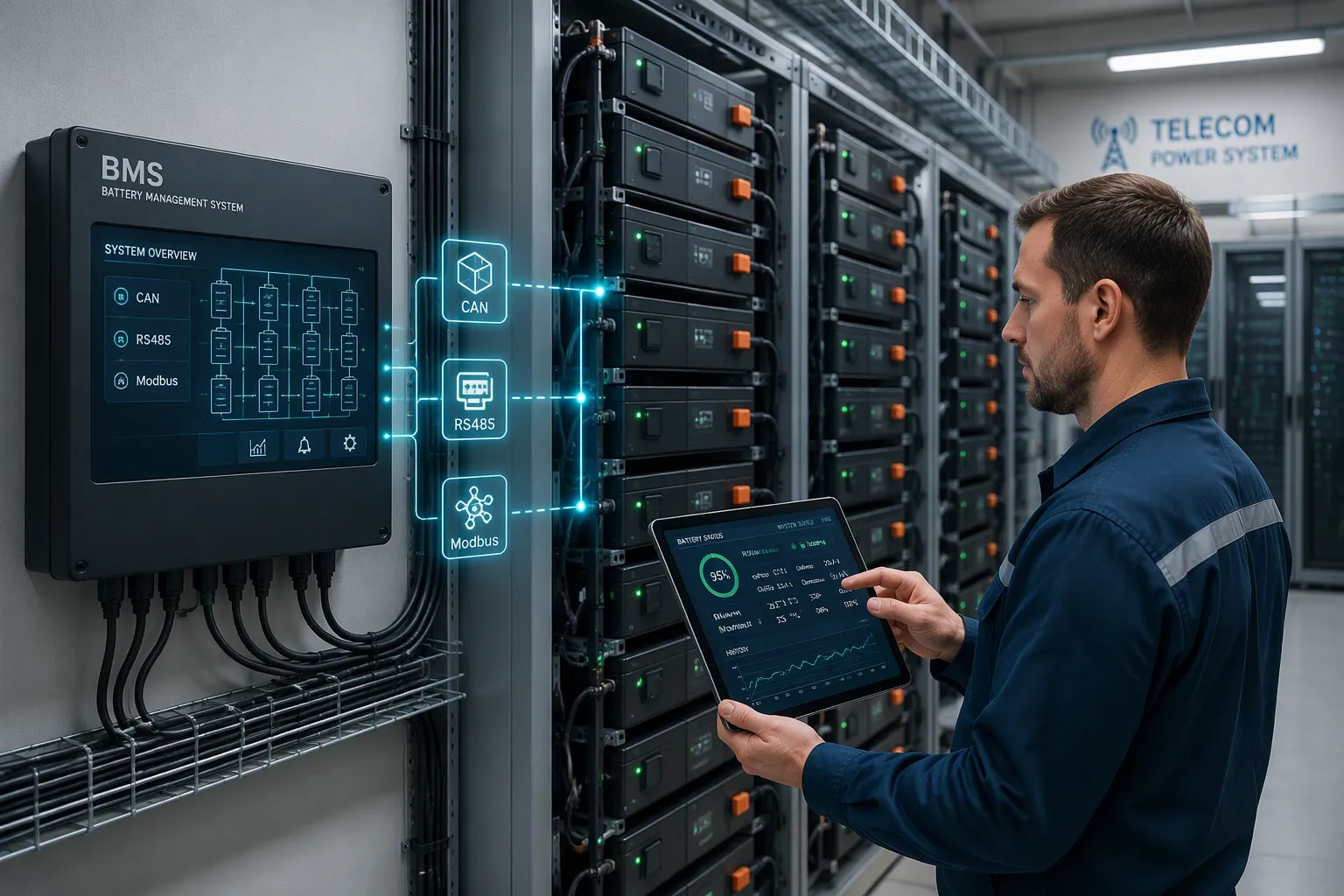
Multi-protocol BMS communication lets a lithium battery negotiate charging, protection, and monitoring directly with a wide range of rectifiers and telecom power systems. That single capability removes the compatibility barrier that once slowed lithium adoption at cell sites.
You care about three outcomes: site reliability, expansion flexibility, and total cost. A battery that speaks the right language protects all three. It charges safely under rectifier control, reports its state clearly, and swaps into existing sites without a redesign.
Protocol diversity no longer blocks seamless integration or limits compatibility. The sections below explain the protocols, the integration mechanics, an ESTEL solution example, and deployment practices.
Key Takeaways
Multi-protocol BMS communication lets lithium batteries work with many rectifiers and telecom power systems without redesign.
Smart BMS automatically detects and configures connections, saving time and reducing errors during installation.
Protocol compatibility supports parallel battery strings for redundancy and easy expansion at cell sites.
Real-time monitoring through BMS improves maintenance efficiency and extends battery life.
ESTEL's telecom power system offers a scalable solution with broad protocol support for seamless integration.
Battery Coordination in Telecom Power Systems
The Battery's Role in DC Backup
A battery string sits at the heart of the DC plant. Rectifiers convert AC into a stable DC bus, distribution feeds the loads, and monitoring watches the whole chain. The battery holds that bus steady when mains power fails. It also absorbs load transients and carries the site until the generator starts or the outage ends.
This role makes the battery a managed asset, not a passive block. You need charge control, protection, and status visibility to work together. That is why 48V lithium battery systems now anchor most new telecom energy storage designs. They pack more usable capacity into the same footprint and report their own health. The catch is that they must cooperate with the rest of the plant.
The Coordination Gap With Rectifiers
Rectifiers and batteries must agree on voltage and current. A lithium battery operates within defined voltage and current ranges. The rectifier must deliver accurate charging voltage, controlled charging current, and a stable DC bus during load changes. Smooth charge and discharge transitions matter too. Without that alignment, cells face abnormal stress and lose service life.
Communication closes the gap. Battery management systems monitor cell and module voltage, current, temperature, state of charge, and state of health. They exchange this data with rectifiers and controllers over CAN or RS485. That link enables intelligent charging, alarm reporting, protection coordination, and remote monitoring. Incompatible protocols between the battery and existing telecommunication power infrastructure cause suboptimal performance and higher maintenance overhead. Retrofits often hit this wall, alongside tight physical space and weak grounding. Protocol compatibility therefore decides whether integration succeeds. Strong compatibility also supports redundancy and parallel operation, where multiple strings share load, isolate faults without shutdown, and expand in steps. These gains serve any telecommunication infrastructure and every telecommunications infrastructure upgrade alike.
How Advanced Battery Management Systems Enable Integration
Electrical Matching and Protocol Communication
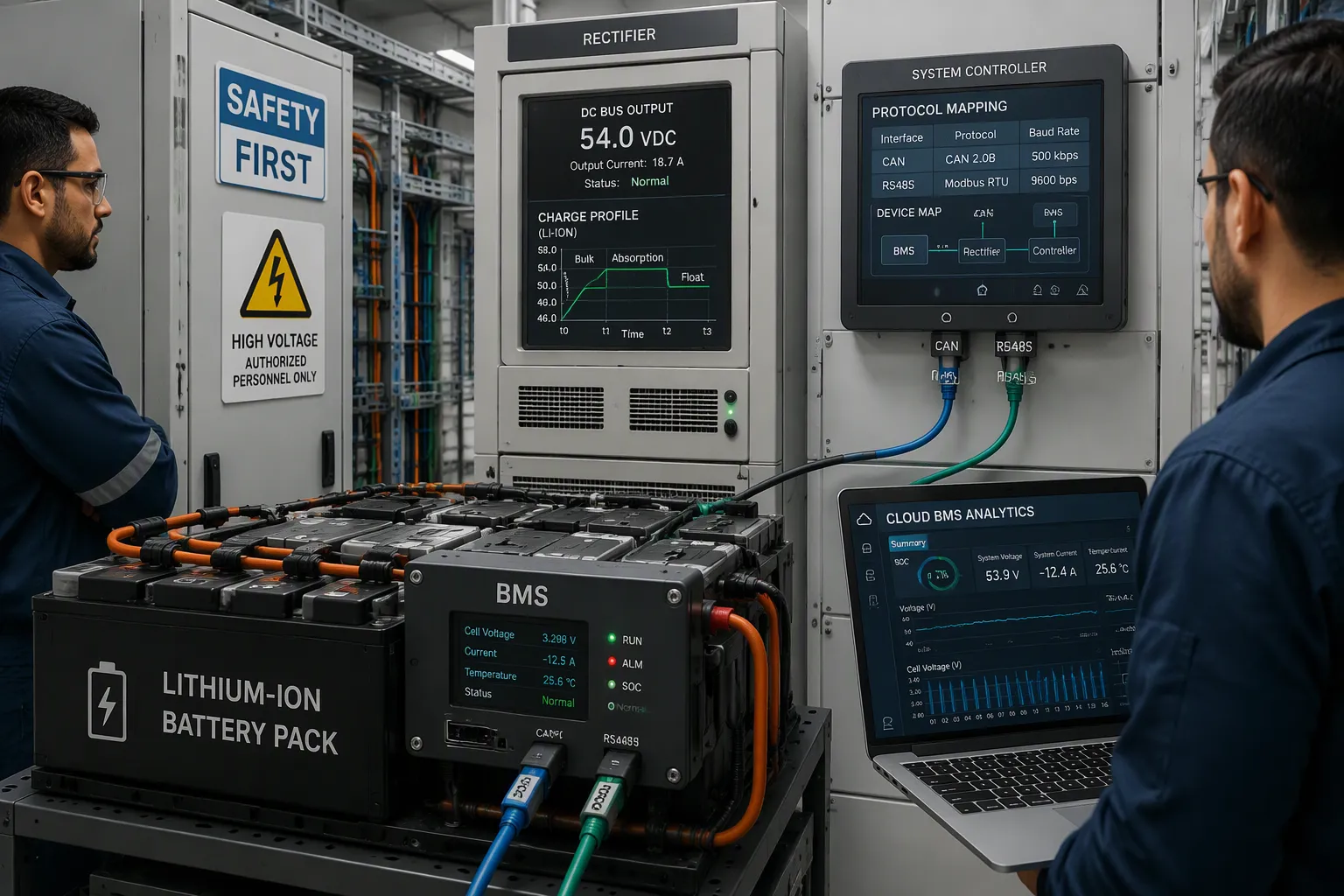
Advanced battery management systems do two jobs at once. They align the electrical behavior of the battery with the plant, and they translate that behavior into a language the rectifier and controller understand. Advanced battery management systems also guard the safety envelope, so a lithium-ion pack never drifts outside its rated window.
Electrical matching starts with voltage and current alignment. The battery management system defines the charge voltage window and the current limit the rectifier must respect. It also tracks cell voltage, current, and temperature in real time. The rectifier then adjusts its output to hold a stable DC bus and a safe charge profile. This is where battery management system control strategies matter. A well-tuned unit raises a charge request, the rectifier answers, and both stay inside safe limits.
Communication protocols carry that exchange. CAN and RS485 are the common lithium battery protocols in telecom. CAN is a multi-master bus. Any node can send data, and the bus stays reliable if one node fails. CAN bus length stays within 10–40 m at 1 Mbps, and lower bit rates extend that reach. RS485 is half-duplex and uses differential signaling to resist EMI in noisy industrial environments. It supports long-distance links between distributed battery packs. I2C handles brief intra-board data sharing at lower speeds. Cloud-based BMS platforms now push large datasets over 5G for fleet-wide analysis.
Protocol | Telecom Application | Why It Fits |
|---|---|---|
RS485 | Telecom batteries / telecom backup system | Useful for remote monitoring; stable long-distance, noise-resistant communication suitable for industrial/telecom environments |
A smart BMS can complete integration without manual configuration. It detects the connected rectifier, charger, or inverter and applies the right can/rs-485 mappings. That removes hours of site tuning and reduces human error. Communication protocol matching also protects inverter compatibility, because the same unit speaks to the inverter and the rectifier. Compatibility testing before shipment confirms each link. You gain interoperability across brands instead of a single-vendor lock. Advanced battery management systems even let you update bms firmware over the link, so new can or rs-485 dialects arrive without a site visit. One communication protocol now covers the whole rack.
Redundancy and Parallel Operation
Telecom energy storage rarely runs on one string. Sites add parallel strings for capacity and redundancy. Consistent protocol compatibility keeps those strings balanced. Each battery management system reports its state of charge and health over the shared bus. The controller then steers current so no string overworks. If one string faults, it isolates itself and the rest carry the load.
This design also supports lithium-ion technologies with different chemistries on one site. A unified communication protocol lets the monitoring software read every string the same way. Battery and inverter protocols stay aligned, so inverter compatibility holds across the fleet. You can expand in steps and keep real-time monitoring intact. That flexibility serves any telecommunications infrastructure, from a single cabinet to a large hub. Cross-string and cross-vendor compatibility both come from the same protocol discipline. Battery management systems that follow this model turn a mixed fleet into one managed pool, and that integration pays off at every expansion.
ESTEL Solution for Lithium Battery Compatibility
Protocol Coverage and Product Fit
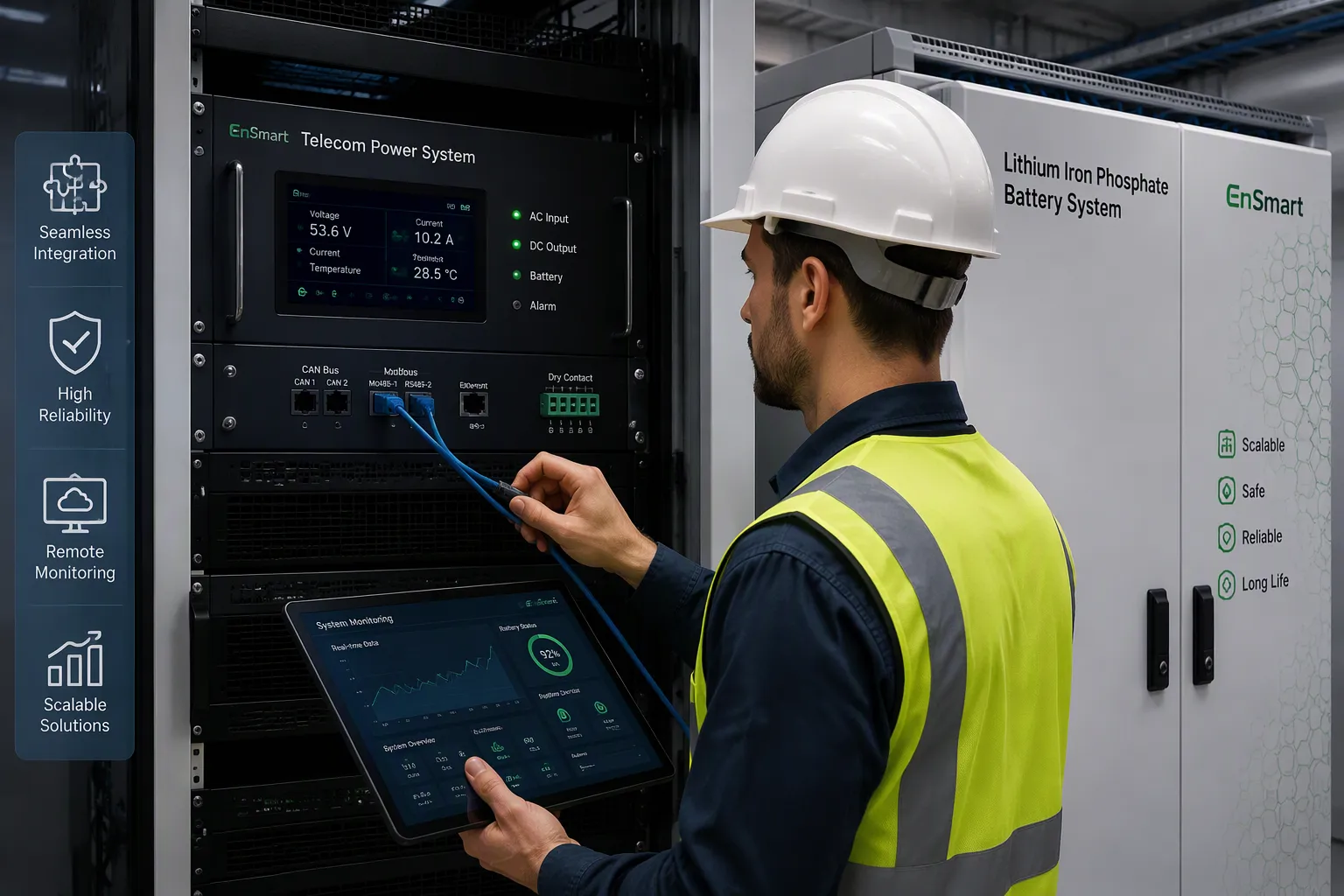
ESTEL's Telecom Power System shows how this integration works in practice. The unit accepts a wide AC input of 90–300 Vac, so it tolerates the voltage swings common at remote sites. Natural cooling removes the need for fans and extra cooling gear. You install it on a standard 19-inch rack or inside a cabinet, and multiple communication ports handle networking and system integration.
The system speaks the languages lithium batteries use. Supported communication protocols include:
Modbus
These links let ESTEL's lithium battery systems connect to smart energy management systems for real-time monitoring and predictive diagnostics. You track voltage, current, and temperature as they change. The BMS reports the data, and the controller acts on it.
ESTEL's lithium iron phosphate batteries and outdoor battery cabinets complete the site solution. The cabinets use anti-corrosion powder coating and stand up to harsh weather. Together, the power system, the batteries, and the cabinet form one matched package. Protocol coverage drives lithium battery compatibility here. The rectifier reads the battery's charge request, and the battery accepts the rectifier's output. Communication protocol matching keeps both sides inside safe limits. The same discipline protects inverter compatibility, because the inverter reads the same bus data. Compatibility testing before shipment confirms each link works. You gain a site that runs as one system, not a pile of parts.
Scalable Deployment Design
The design scales from a single cabinet to a multi-site rollout. You size capacity to current need and leave room for future upgrades. A small remote site and a large urban base station use the same platform. The table below shows how the design fits different scenarios.
Site / Deployment Scenario | How ESTEL's Scalable Design Supports It |
|---|---|
Modular design allows customization and expansion; capacity can be sized to current need with room for future upgrades, adapting seamlessly to either scale. | |
Remote off-grid locations | High energy density enables efficient storage and uninterrupted operation during outages; robust construction withstands extreme temperatures and humidity; can integrate with renewable sources (e.g., solar) to reduce grid reliance. |
Urban 4G/5G base stations | Fast response times and efficient energy storage; compatibility with telecom equipment enables seamless integration; BMS optimizes energy use and minimizes losses during charge/discharge. |
Diverse telecom equipment | Rectifiers convert AC to DC for device power; the Power Distribution Unit (PDU) delivers the appropriate power to each device based on its requirements. |
Hybrid / varying energy conditions | Supports hybrid setups combining renewable energy with traditional sources; can switch to grid power or diesel generators during low-renewable periods while maintaining performance. |
This flexibility matters for telecom energy storage planning. You deploy one proven platform across sites with different power needs. The protocols stay the same, so commissioning follows a familiar path. Compatibility across sites comes from that shared design. Inverter compatibility holds whether the site runs on grid power or solar. You expand without re-engineering the plant.
Deployment, Monitoring, and Maintenance
Installation and Commissioning Workflow
You begin by mounting the ESTEL Telecom Power System on a standard 19-inch rack or inside the cabinet. The chassis slides into place, and you secure it before any cabling starts. Next, you connect the lithium-ion battery string to the DC bus and route the communication port hookup between the battery management systems and the rectifier controller. Label every link as you go. A clean wiring map saves hours during troubleshooting later.
Commissioning follows a fixed sequence. You power the rectifier, confirm the DC bus holds steady, and verify that the BMS reports voltage, current, and temperature. Then you run compatibility testing on each link: battery to rectifier, battery to monitoring software, and inverter compatibility where the site includes one. The system should detect the connected device and apply the right protocol mappings without manual tuning. You finish by logging the site configuration and confirming remote visibility. This workflow keeps integration predictable across every site in a rollout.
Monitoring and Maintenance Efficiency
Ongoing monitoring turns battery data into maintenance savings. Standardized communication protocols carry real-time battery parameters, diagnostic information, and performance metrics to external systems. That data stream forms the backbone for remote monitoring across distributed sites.
Cloud connectivity and data logging give you centralized visibility of every site and support predictive analytics for maintenance scheduling.
Real-time performance analytics enable predictive maintenance and fault detection, which reduces the need for on-site inspections.
Edge computing processes critical data locally, so time-sensitive operations keep running where network coverage is intermittent.
Redundant communication and remote diagnostic tools resolve a large share of issues without a site visit.
This visibility extends battery life. You spot a weak string before it fails, schedule replacement during planned work, and avoid emergency callouts. Real-time monitoring through the BMS also supports firmware updates over the link, so bms firmware changes reach the site without travel. For any telecommunication infrastructure or telecommunications infrastructure fleet, that efficiency lowers maintenance costs and keeps backup capacity ready.
Reliability Gains and Business Value
Network Resilience Through Intelligent Communication
Intelligent communication turns backup power into a managed system. Battery management systems report cell voltage, current, and temperature to the rectifier and the monitoring platform. You see a weak string before it drops offline. That early warning lets you act during planned maintenance instead of during an outage.
Protocol compatibility also protects the site when conditions change. A rectifier that reads the battery's charge request will not overcharge the cells. A battery that understands the rectifier's output will not trip on a false alarm. This coordination keeps the DC bus steady through mains failures and load swings. For any telecommunication infrastructure, that steadiness is the difference between a site that stays up and one that fails.
Cost and Scalability Advantages
Protocol-ready design lowers cost across the whole lifecycle. You avoid the engineering work of matching a new battery to an old rectifier. You skip the site visits that manual configuration once required. Real-time monitoring further cuts travel, because remote diagnostics resolve most issues without a technician on site.
Scalability follows the same logic. One proven platform serves a small remote cabinet and a large urban hub. You add strings as demand grows, and the shared protocol keeps every string balanced. Inverter compatibility holds across the fleet, so a solar-assisted site and a grid-only site use the same integration path. That consistency makes telecom energy storage planning simpler and cheaper. Compatibility across sites also reduces spare-parts inventory, because you standardize on fewer variants. The result is a lithium-ion deployment that scales without re-engineering the plant, and a telecommunications infrastructure that grows on a predictable budget.
Protocol diversity once blocked lithium adoption. Multi-protocol BMS communication now turns that diversity into a bridge. Your battery negotiates charging, protection, and monitoring with the rectifier, so mainstream lithium batteries join telecom power systems without redesign.
The payoff lasts. You gain reliability through early fault warnings, scalability across sites, simpler operations, and lower costs. ESTEL's Telecom Power System delivers this integration capability as a matched partner.
Site needs keep shifting. Advanced BMS platforms now adopt smart grid standards such as IEEE 2030 and IEC 61850 for real-time utility interaction. Protocol-ready lithium-ion design will keep your compatibility strong and inverter compatibility intact as those demands evolve.
FAQ
Which protocols do telecom lithium batteries use to talk to rectifiers?
Common lithium battery protocols include CAN and RS485. CAN is a multi-master bus that keeps working when one node fails. RS485 resists electrical noise over long cable runs. I2C shares brief sensor data inside a board. Cloud-based BMS platforms send large datasets over 5G. This protocol range supports broad compatibility across rectifier brands.
Do you need manual configuration to connect a smart BMS to a rectifier?
No. A smart BMS detects the connected rectifier, charger, or inverter and applies the right protocol mappings on its own. That removes hours of site tuning and cuts human error. You gain faster integration and fewer callbacks. Compatibility testing before shipment confirms each link works before the unit leaves the factory.
Can you run several lithium strings in parallel on one site?
Yes. Each battery management system reports state of charge and health over the shared bus. The controller then steers current so no string overworks. A faulted string isolates itself and the rest carry the load. Consistent protocol handling keeps this balance stable and preserves compatibility across mixed strings.
How do you commission an ESTEL Telecom Power System with lithium batteries?
Mount the chassis on a standard 19-inch rack or inside the cabinet. Connect the battery string to the DC bus, then route the communication port hookup to the rectifier controller. Power up, confirm a steady DC bus, and verify BMS readings. Finish by testing each link and logging the configuration.
What does BMS communication do for maintenance costs?
Standardized protocols carry real-time battery parameters and diagnostic data to your monitoring software. You spot a weak string before it fails and schedule replacement during planned work. Remote diagnostics resolve most issues without a site visit. That efficiency lowers maintenance costs and extends battery life, while compatibility across sites keeps spares simple.
See Also
Why Lithium Batteries Outperform Other Options In Telecom Cabinets
Grid-Connected Photovoltaic Inverter And Battery System For Telecom Cabinets
Calculation Methods For Telecom Cabinet Power Systems And Telecom Batteries
ESTEL Smart Microgrid Integrated Telecom Cabinet Energy Storage System
Energy Storage Batteries Designed For ESTEL Telecom Cabinets
CALL US DIRECTLY
86-13752765943
3A-8, SHUIWAN 1979 SQUARE (PHASE II), NO.111, TAIZI ROAD,SHUIWAN COMMUNITY, ZHAOSHANG STREET, NANSHAN DISTRICT, SHENZHEN, GUANGDONG, CHINA
