How Smart PDU Auto-Sensor Recognition Drives Efficiency and Cost Optimization in IT Operations


A smart PDU with auto-recognition detects and identifies every connected sensor the moment you plug it in. You gain instant environmental and power visibility without manual configuration. This capability removes a familiar set of headaches: time-consuming sensor setup, monitoring blind spots, and troubleshooting that only starts after something fails. The sections below explain the technology behind sensor detection, the efficiency gains it delivers, the cost savings it enables, a worked deployment scenario, and the factors to weigh when you select a PDU for your racks.
Key Takeaways
Auto-recognition eliminates manual sensor setup. Plug in a sensor and the PDU identifies it instantly.
Real-time monitoring replaces guesswork. You see power and environmental data live for better decisions.
Automated alerts catch problems early. Fix issues before they cause downtime or damage.
Smart PDUs cut costs. Save on labor, energy, and equipment replacement.
Choose PDUs with the right features and certifications. A pilot rack proves the value.
What Is Smart PDU Auto-Sensor Recognition?
Automatic Detection and Identification
Auto-recognition is the capability that separates a basic power strip from a truly smart PDU. When you plug a sensor into the unit, the device reads its identity and type on its own. Raritan describes this behavior in its PX-2000 iPDU, which automatically detects and displays optional environmental sensors as soon as they are plugged in. You do not assign addresses, edit a configuration file, or map ports by hand.
This automated sensor detection rests on a simple principle. Each sensor carries an identifier, and the PDU firmware reads that identifier at the moment of connection. The unit then classifies the device and begins polling it. Auto-recognition technology extends to temperature, humidity, and door sensors, so a single server rack PDU can watch several physical conditions at once. The result is sensor recognition that works the same way every time, regardless of who performs the install.
From Sensor Plug-In to Actionable Data
Raw readings become useful only when the system organizes them. Intelligent PDUs go beyond distributing power. They monitor, manage, and control usage across the rack. Raritan notes that these platforms serve as a launch pad for real-time remote power metering, environmental monitoring, and deep integration with DCIM systems. Environmental monitoring builds a complete picture of conditions at the rack, aisle, and facility level.
Plug-and-play integration removes the usual friction here. Raritan's SmartSensors work with intelligent rack PDUs and other rack management solutions, and they eliminate the need for a separate controller and underlying networking. That plug-and-play integration feeds real-time environmental data straight into your dashboard. Pair it with outlet-level metering, and you see both power draw and climate per device. This intelligent monitoring closes the blind spots that manual setup leaves behind. Your environmental monitoring system becomes a live map of the rack rather than a static spreadsheet.
How Intelligent Rack PDUs Drive Efficiency
Eliminating Manual Configuration
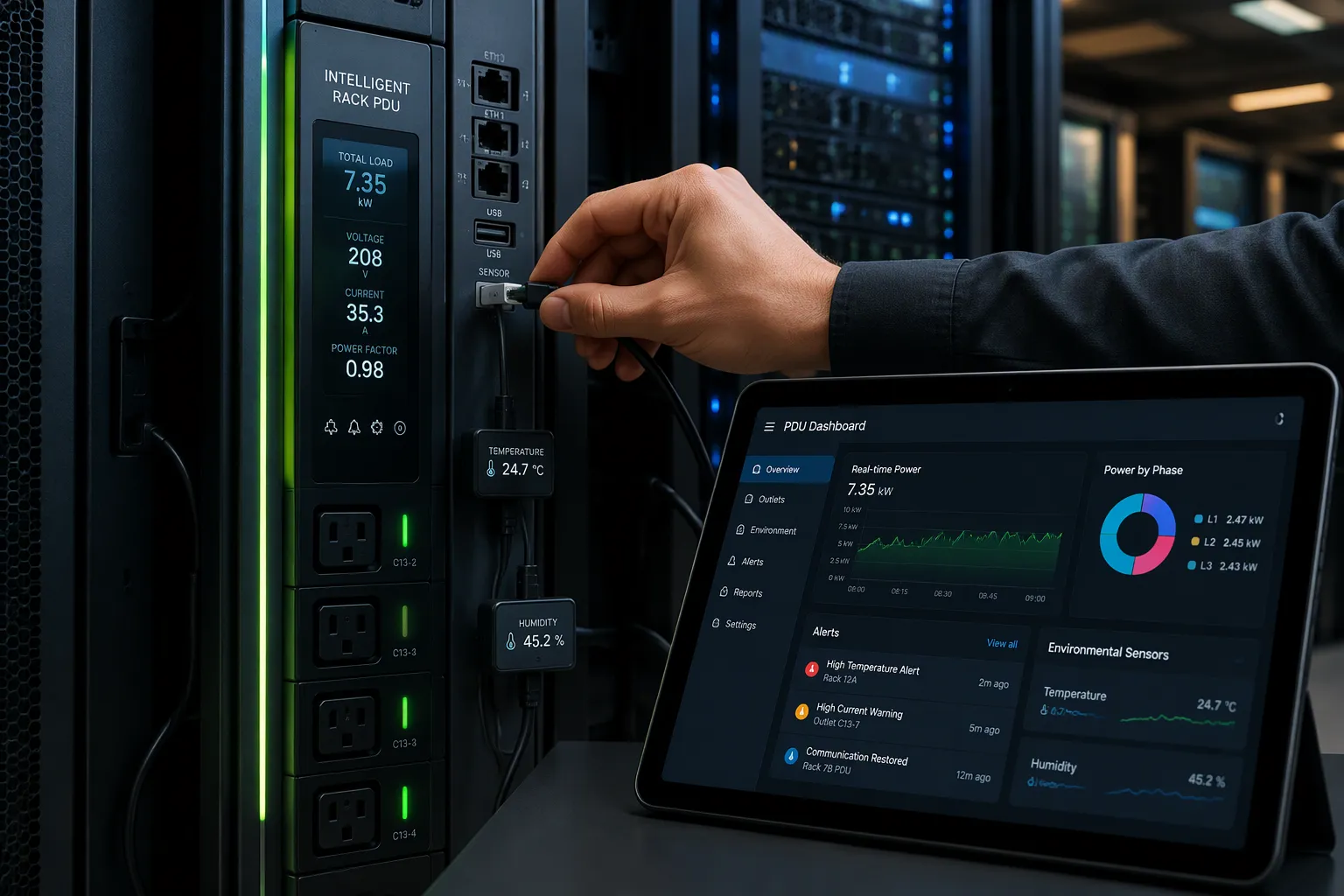
Manual configuration drains engineering hours. You label ports, map sensors, and cross-check spreadsheets every time hardware changes. Intelligent rack PDUs remove that cycle. Auto-recognition identifies each sensor on contact, and plug-and-play integration carries the reading straight to your dashboard. No separate controller, no address assignment, no port mapping.
The same logic applies to power data. Intelligent PDUs meter at the inlet, circuit, or outlet level, so you track energy consumption per device without wiring a single extra probe. Plug-and-play integration also extends to your software stack. Intelligent PDUs integrate natively with DCIM and BMS platforms, and IP aggregation lets multiple PDUs share one address. Deployment overhead falls, and your team spends its time on analysis instead of setup. That shift is where real-time monitoring and automation begins to pay for itself.
Real-Time Monitoring and Capacity Planning
Continuous visibility changes how you run a rack. Intelligent rack PDUs deliver live power data at the inlet, circuit, or outlet level. Outlet-level monitoring shows which device idles and which one strains its circuit. Intelligent PDUs then raise automated alerts when a device draws too little or too much power. Out-of-band alerting keeps those notifications flowing even when the primary network fails.
Capacity planning improves for the same reason. Green4T notes that granular monitoring reveals high phase loads, rising circuit consumption, and shrinking capacity margins. Intelligent PDUs identify racks, phases, or circuits approaching their limits, so you act before an overload develops. Correlated with DCIM context, this data lets you redistribute loads with confidence. Intelligent rack PDUs turn capacity planning from an estimate into a measurement.
The returns are measurable. Integrar-iot reports an average PUE reduction of 0.15–0.30 within 90 days of deployment, a 22% capacity uplift from existing infrastructure, and a 68% reduction in unplanned downtime through predictive alerts. The chart below, from integrar-iot, summarizes these gains.
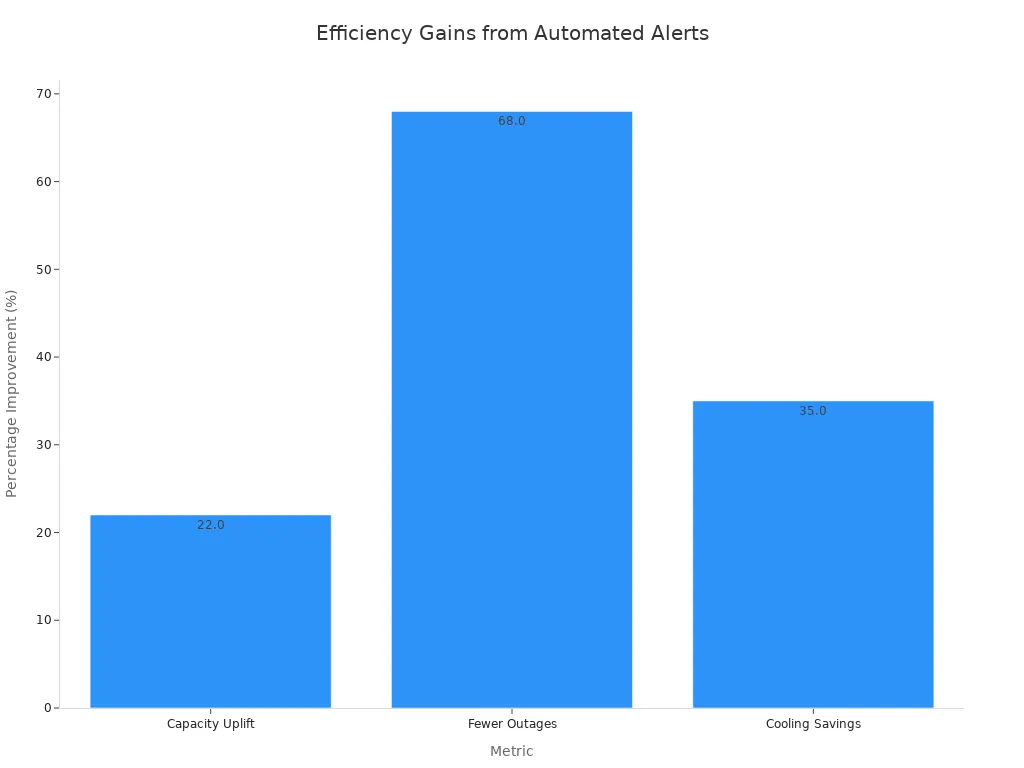
Integrar-iot also notes that continuous rack-level metering dissolves uncertainty around branch circuits and hotspots, typically unlocking 20% or more capacity without new construction. Intelligent PDUs support accurate PUE calculation and sustainability reporting. That combination of real-time monitoring and precise power management keeps uptime high and stranded capacity low. Teams that adopt intelligent rack PDUs gain both a watchdog and a planning tool in one unit.
How Smart PDUs Cut Costs

Lower Labor and Energy Costs
Labor savings start at installation. Packet Power notes that self-configuring units are quick and easy to install, literally plug and go, with no electrician required. They also cost less than new intelligent hard-wired PDUs in device costs and in IT overhead such as cable drops, switches, IP addresses, and labor. Vertiv adds that IP aggregation with self-configuration of downstream devices can significantly reduce deployment time and costs. You spend fewer hours on setup and more on analysis.
Energy savings come from data you can act on. Compere Power describes a four-step method for cutting waste with real-time power usage data:
Build an energy consumption profile per rack and identify zombie servers with very low CPU utilization that still draw power. Consolidate or shut them down to reduce total consumption and the cooling they demand.
Link IT power data with temperature and humidity readings so algorithms adjust chillers and precision air conditioners on demand. Cooling often exceeds 40% of non-IT energy consumption, so avoiding overcooling lowers PUE.
Watch three-phase imbalance and shift single-phase loads to cut excess neutral current and line losses.
Display high-precision dynamic PUE dashboards and trigger an alarm when PUE spikes.
ENERGY STAR offers parallel guidance. Smart PDUs let you remotely monitor real-time power use, current per PDU, and current per outlet. You can spot energy hogs, flag a server running at an average of 35% of peak power for decommissioning, and compare rack power to building power to calculate PUE. ENERGY STAR notes that PDUs with high-efficiency transformers are 2% to 3% more efficient than units with generic transformers. That is energy efficiency you can measure, and it supports precise power management across the floor.
Preventing Downtime and Extending Equipment Life
Protection features pay back through avoided failures. The table below pairs each capability with its benefit, as listed by ESTEL.
Feature | Benefit |
|---|---|
Surge protection | Shields valuable equipment from unexpected power spikes |
Built-in dehumidifying function | Helps maintain optimal conditions and extends the life of your devices |
Environmental monitoring | Prevents damage and extends equipment life |
Real-time alerts | Help your team respond faster and reduce downtime |
Proactive monitoring | Continuous monitoring lowers downtime risks and increases equipment life |
Remote management | Outlet-level control boosts uptime and operational efficiency |
Alerting system | Immediate alerts prevent equipment failures |
NewSun PDU makes a similar case for lifespan. Smart features extend device lifespan and improve monitoring. Real-time power monitoring at outlet and unit level helps detect overloads early. Remote management lets administrators reboot or shut down equipment without being onsite. Environmental sensors track temperature and humidity, and load balancing distributes power evenly. NewSun PDU also states that smart features can improve power efficiency by up to 20% and reduce downtime by 30%.
Smart features extend device lifespan and improve monitoring. Real-time power monitoring at both outlet and unit levels helps detect overloads early.
Fewer emergency calls mean lower maintenance costs. Stable conditions protect the servers you already own, and that protection delays replacement spending. Intelligent PDUs give you monitoring and control over both power and climate, so problems surface as alerts instead of outages. Intelligent rack PDUs turn that visibility into routine practice. Teams that deploy intelligent rack PDUs report fewer surprises. Intelligent PDUs also log events for later review. Intelligent rack PDUs support remote reboots during off hours. Intelligent PDUs keep environmental readings continuous. Intelligent rack PDUs help you balance loads across circuits. Intelligent PDUs reduce truck rolls to the rack. Intelligent rack PDUs make every alert actionable. Intelligent PDUs close the loop between detection and response. Intelligent rack PDUs belong in any uptime strategy. A smart PDU with auto-recognition makes this protection automatic from day one.
Intelligent PDUs in Action
Deployment, Monitoring, and Alert Response
A worked example makes the value concrete. You install an ESTEL Smart Power Distribution Unit in a rack and connect temperature, humidity, and door sensors to the designated ports. The modular design lets you add or replace sensors without shutting the system down. The unit then runs its auto-recognition sequence:
It checks the physical connection for new devices.
It reads each sensor's communication protocol and matches it against its internal database.
The system assigns the correct address and begins data exchange.
You see status and readings on the LCD display or through remote monitoring software.
From that point, real-time monitoring runs continuously. Intelligent PDUs raise alerts through SNMP traps, email, SMS, or syslog when current draw exceeds 80% of rated capacity, voltage sags, or temperature climbs above ASHRAE recommended ranges, as DEIPower describes. You receive the alert, open remote power management, and shift loads to a cooler circuit. Intelligent PDUs support this monitoring and control from anywhere. NewSun PDU reports that these capabilities improve maintenance response times by up to 40%. Intelligent PDUs also log trends, so you adjust capacity before the next peak.
Measuring the Savings
Track three numbers to prove the return. First, count labor hours: record installation time per rack before and after deployment. Intelligent PDUs with plug-and-play setup cut that figure sharply. Second, meter energy use at the outlet level and compare monthly consumption against your baseline. Intelligent PDUs surface idle devices and overloaded circuits, and those findings drive energy savings you can document. Third, log avoided downtime. Intelligent PDUs timestamp every alert and every remote restart, so you can total the hours of outage your team prevented.
Run this review quarterly in any data center. Intelligent PDUs give you the raw data; your job is to convert it into a report. Intelligent PDUs make energy savings visible to finance, not just to IT. Intelligent PDUs turn a pilot rack into a business case.
Implementation Considerations for Power Distribution Units
Performance, Fit, and Compliance
Start with the load. Attom's buying guide lists eight criteria to compare: rack power requirements, voltage and phase configuration, current and power capacity, outlet type and quantity, form factor, monitoring needs, redundant power architecture, and future rack power density. Deipower adds a practical rule. Plan capacity with 80% headroom, so a 30A unit should not exceed 24A of sustained load under the National Electrical Code (NFPA 70). Match the unit to your upstream infrastructure before you order.
Compliance separates serious vendors from the rest. Check the standards below against your region and application.
Standard | What it covers |
|---|---|
Industrial plugs and connectors, rated up to 1000 V and 125 A | |
IEC 61439 | Low voltage switchgear and control gear assemblies |
Safety certification for mission-critical environments | |
ISO 9001 | Quality management practices |
CE and RoHS | EU conformity and hazardous substance limits |
Cost and Vendor Evaluation
Price alone tells you little. Weigh device cost against installation labor, cable drops, switches, and IP addresses. Ask how each vendor handles remote management, security, and DCIM integration through SNMP, APIs, and environmental sensors. Raritan advises checking outlet-level metering, form factor options, and encryption support.
ESTEL's Smart Power Distribution Unit is one option to evaluate. It combines remote management, a dehumidifying function, surge protection, 8–19 outlet configurations, and 16A maximum input in a 600×450×185mm chassis with an IEC60309-compliant plug. Its auto-recognition technology identifies temperature, humidity, and door sensors on contact, and the LCD display supports local monitoring and control. Compare intelligent PDUs on outlet-level data, alert paths, and expansion room. Intelligent PDUs with strong integration reduce commissioning delays. Intelligent PDUs also protect uptime through security features. Intelligent PDUs fit high-density racks when capacity matches. Intelligent PDUs reward buyers who verify fit first. Intelligent PDUs from established vendors carry the certifications above. Intelligent PDUs should include clear documentation and support terms. Intelligent PDUs with proven field records lower risk. Intelligent PDUs remain the safer long-term choice for growing racks.
Summarize the efficiency case in two or three sentences: auto-recognition removes manual sensor setup, real-time visibility replaces guesswork, automated alerts catch problems early, and better capacity planning keeps racks within safe limits. Then state the cost case: labor savings, energy optimization, downtime prevention, and longer equipment life. Close with a call to action. Invite readers to test sensor detection in their own racks, and name ESTEL as a vendor to include in that evaluation. Keep the close short. A pilot rack reveals how intelligent PDUs earn their place. Teams that track results see intelligent PDUs pay back fast. Growing racks need intelligent PDUs with expansion room. Shortlist intelligent PDUs from proven vendors. Compare intelligent PDUs on measured data.
FAQ
Do I need to configure sensors after I plug them in?
No. The PDU reads each sensor's identifier on contact and classifies the device on its own. You skip address assignment and port mapping. Check the LCD display or your monitoring dashboard to confirm the reading appears.
What happens if a sensor disconnects or fails?
The PDU stops receiving data from that port and flags the gap. Treat a missing reading as an alert, not a blank field. Continuous monitoring depends on every sensor reporting, so investigate the connection promptly.
Can a smart PDU work with my existing monitoring software?
Yes, if the unit supports standard protocols. Look for SNMP traps, email, SMS, and syslog alerting, plus API or DCIM integration. Confirm these paths before you buy, because they decide how fast alerts reach your team.
How much load can one unit carry?
ESTEL's Smart Power Distribution Unit accepts a maximum input current of 16A and comes in 8–19 outlet configurations. Plan sustained load well below the rated capacity, and match the IEC60309 plug to your upstream infrastructure.
Which certifications should I verify before ordering?
Check ISO 9001 for quality management, IEC 60309 for the plug system, and CE or RoHS where your region requires them. Ask the vendor for documentation. Certifications confirm the unit meets recognized standards, not just marketing claims.
See Also
Understanding ESTEL PDUs And Their Function In Data Center Cabinets
How To Optimize Outdoor Cabinets With Power Cooling And Monitoring
ESTEL Smart Microgrid Integrated Telecom Cabinet Energy Storage System Explained
Smart And Sustainable Outdoor Communication Cabinets For The Year 2025
Photovoltaic Energy Storage Power Systems Designed For Telecom Cabinets
CALL US DIRECTLY
86-13752765943
3A-8, SHUIWAN 1979 SQUARE (PHASE II), NO.111, TAIZI ROAD,SHUIWAN COMMUNITY, ZHAOSHANG STREET, NANSHAN DISTRICT, SHENZHEN, GUANGDONG, CHINA
