How Smart PDUs Enable Plug-and-Play Environmental Monitoring in High-Density Cabinets

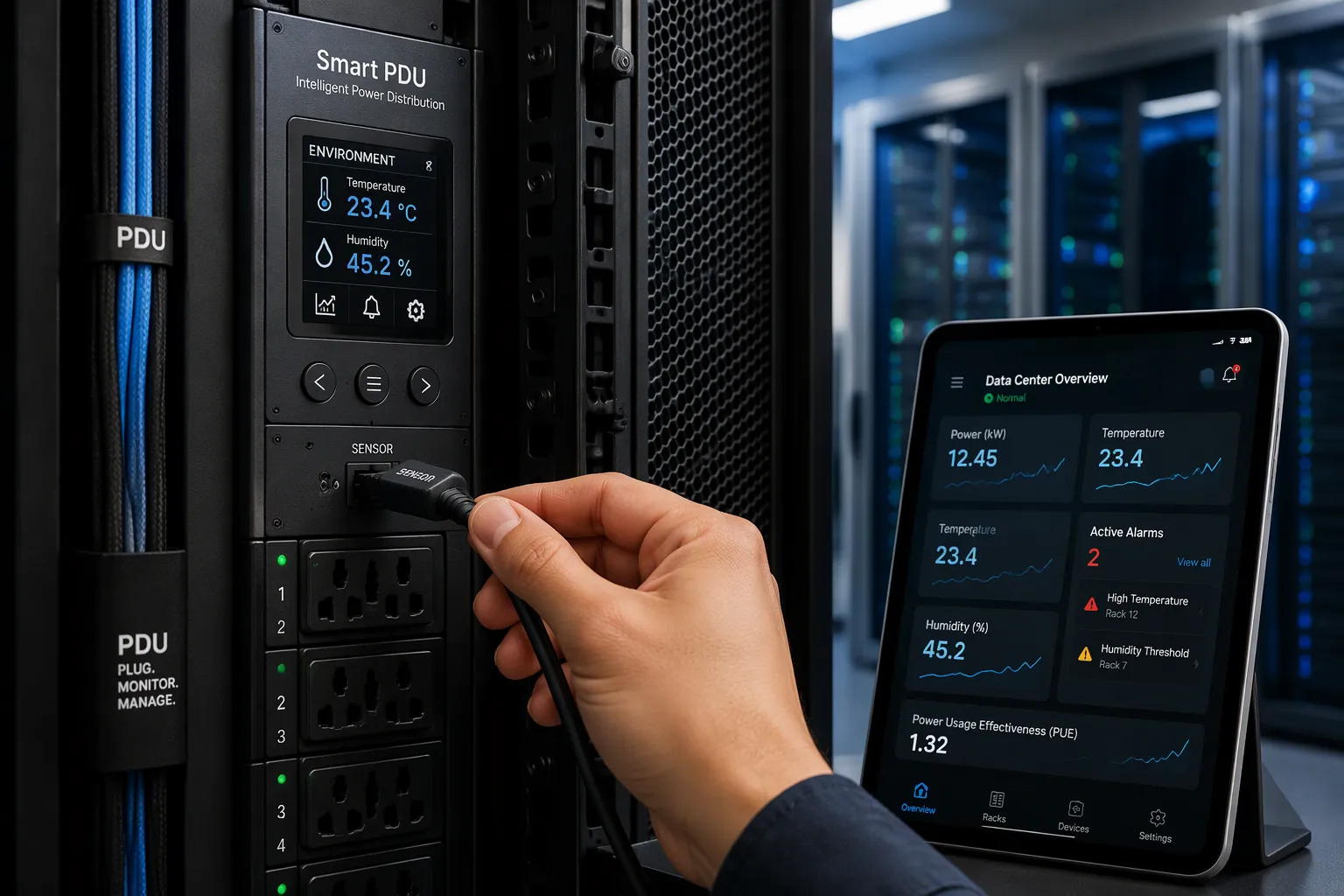
High-density cabinets concentrate heat and power risk into a small space. A smart PDU with plug-and-play sensors turns cabinet-level environmental monitoring from a complex project into a simple deployment. You plug in a sensor, and the unit detects it and starts reporting.
Traditional monitoring approaches struggle to keep pace with rising rack densities and expanding sensor needs. Room-level readings average out the detail you need, and manual sensor setup slows every rollout. This article examines the risks that dense cabinets create, the growing set of parameters worth tracking, the design challenge of high sensor density, and the architecture that solves it. A smart power distribution unit sits at the center of that architecture, and it changes how you plan power distribution and environmental visibility together.
Key Takeaways
Smart PDUs with plug-and-play sensors make setup easy: plug in a sensor and the PDU detects it automatically.
Cabinet-level monitoring catches hot spots and power risks that room-level sensors miss.
Track more than temperature and humidity: monitor airflow, pressure, air quality, and leaks to protect equipment.
Daisy-chain sensors and use magnetic mounts to cover many racks without extra cabling.
Start with critical cabinets, choose plug-and-play PDUs, and scale sensor coverage as needed.
Why High-Density Cabinets Need Cabinet-Level Monitoring
Concentrated Heat and Power Risks
Rising rack density packs more heat and more current into the same footprint. AFCOM's 2026 State of the Data Center Report puts average rack density at around 27 kW, roughly 4.5 times the 6.1 kW reported in 2016. A 451 study of 750 enterprise users found that 45 percent expect an average of 11 kW per rack or higher over the next year. Every watt a server draws leaves the rack as heat, so concentrated power distribution raises the local heat load in step.
That combination creates hot spots. Restricted airflow, poor cabinet arrangement, or uneven air distribution traps hot air in specific zones. KVMGalore notes that hot spots can degrade performance, trigger hardware failures, and even cause electrical outages if left unchecked. On the power side, a circuit that runs continuously must follow the 80 percent rule. A 208 V, 30 A three-phase circuit carries roughly 8.6 kW on a sustained basis, and redundant A+B feeds must each carry the full load. You need readings at the rack to see these risks forming.
Limits of Room-Level Monitoring
Room-level monitoring suits general ambient oversight. One sensor on the wall or ceiling gives you an averaged picture of the space, and that is enough for broad trend tracking. It cannot see inside a single cabinet, though. DPS Tele points out that a single wall sensor tells you almost nothing about conditions at the server inlet, and hot spots form at individual cabinets.
Cabinet-level visibility closes that gap. ASHRAE recommends measuring at the server air inlet, roughly two inches in front of the equipment, with sensors at the top, middle, and bottom of each rack. RF Code notes that this placement identifies hot spots that room sensors average away and compares intake against exhaust to measure server heat load. Per-rack granularity also speeds fault isolation. You see which rack is drifting before the alarm becomes an outage, and you act on that rack alone.
The Expanding Scope of Environmental Parameters
Beyond Temperature and Humidity
Temperature and humidity remain the baseline, but modern telecom cabinets demand a wider sensing set. Amphenol outlines the range: humidity sensing guards against condensation and static, differential pressure sensing confirms airflow, and air quality detection tracks CO2 and volatile organic compounds. Dew point sensing protects liquid cooling loops, leak detection catches underfloor water, and smoke detection triggers suppression. Envigilance specifies 20-80% relative humidity non-condensing with a recommended dew point of 41.9-59°F. TSI notes that dust and particulates obstruct airflow and insulate components, so air quality detection matters too.
Sensor Type | Function |
|---|---|
Humidity | Prevents condensation and static |
Differential pressure | Confirms airflow and cooling |
Air quality | Tracks CO2 and VOCs |
Dew point | Protects liquid cooling loops |
Leak detection | Catches underfloor water |
Smoke | Triggers fire suppression |
Intelligent PDUs can incorporate environmental sensors and security-handle accessories with integrated humidity sensing. These sensors broaden coverage without adding separate monitoring hardware to your telecom cabinets. That matters as telecom cabinets multiply across edge sites and remote shelters. Raritan also lists airflow around individual racks and proximity detection as useful parameters.
Power and Airflow Correlations
Power and heat move together. DEI Power explains that unexpected power spikes at the rack often precede hot spot formation, and real-time monitoring can trigger alerts before temperatures reach damaging thresholds. Cooling failure shows a distinct pattern: IT power draw holds steady while ambient temperatures climb. Without environmental and power data in one platform, that signal stays hidden.
Differential pressure adds the airflow dimension. Packet Power notes that low differential pressure reveals racks starved of cold air, while high readings point to leaks or bypass paths. Correlating pressure with temperature validates containment changes and supports set point decisions. Power data monitoring against rated capacity at the circuit, panel, and PDU level prevents breaker trips and protects your power distribution. NEC Section 210.20(A) sets the 80% rule for continuous loads, and DEI Power recommends warning alerts at 70-75% utilization and critical alerts at 80%. This correlation supports capacity planning and overload prevention across your power distribution. An intelligent PDU ties these readings into one view, and real-time monitoring keeps power distribution honest across every rack.
Solving High Sensor Density Challenges
Wiring, Addressing, and Configuration Burden
Dense sensor deployments create practical work long before any data arrives. Each sensor needs a cable route, a physical address, and a configuration entry. The IFMA Foundation notes that a 10,000 square foot data hall might require dozens of monitoring points to capture vertical temperature stratification. Multiply that across rows of telecom cabinets, and the cabling alone becomes a project.
Cable management compounds the problem. Remee recommends planning pathways before installation, with capacity for future expansion rather than just today's device count. Overcrowded bundles trap heat and complicate service. Color-coded jackets and clear labeling at both ends help technicians trace individual runs later. Addressing adds another layer. Every sensor must map to the correct rack, and a mislabeled point sends you to the wrong cabinet during an alarm.
Manual configuration suits small, static installations well. A handful of sensors in a single room rarely justifies automation. The burden grows with density, though. Chatsworth observes that as sensor counts and types increase, the challenge shifts from sensing capability to how monitoring is connected and scaled. Crowded cabinets and constrained connectivity raise service complexity. Commissioning time stretches, and every added sensor becomes another task on a checklist.
Plug-and-Play Integration with Smart PDUs
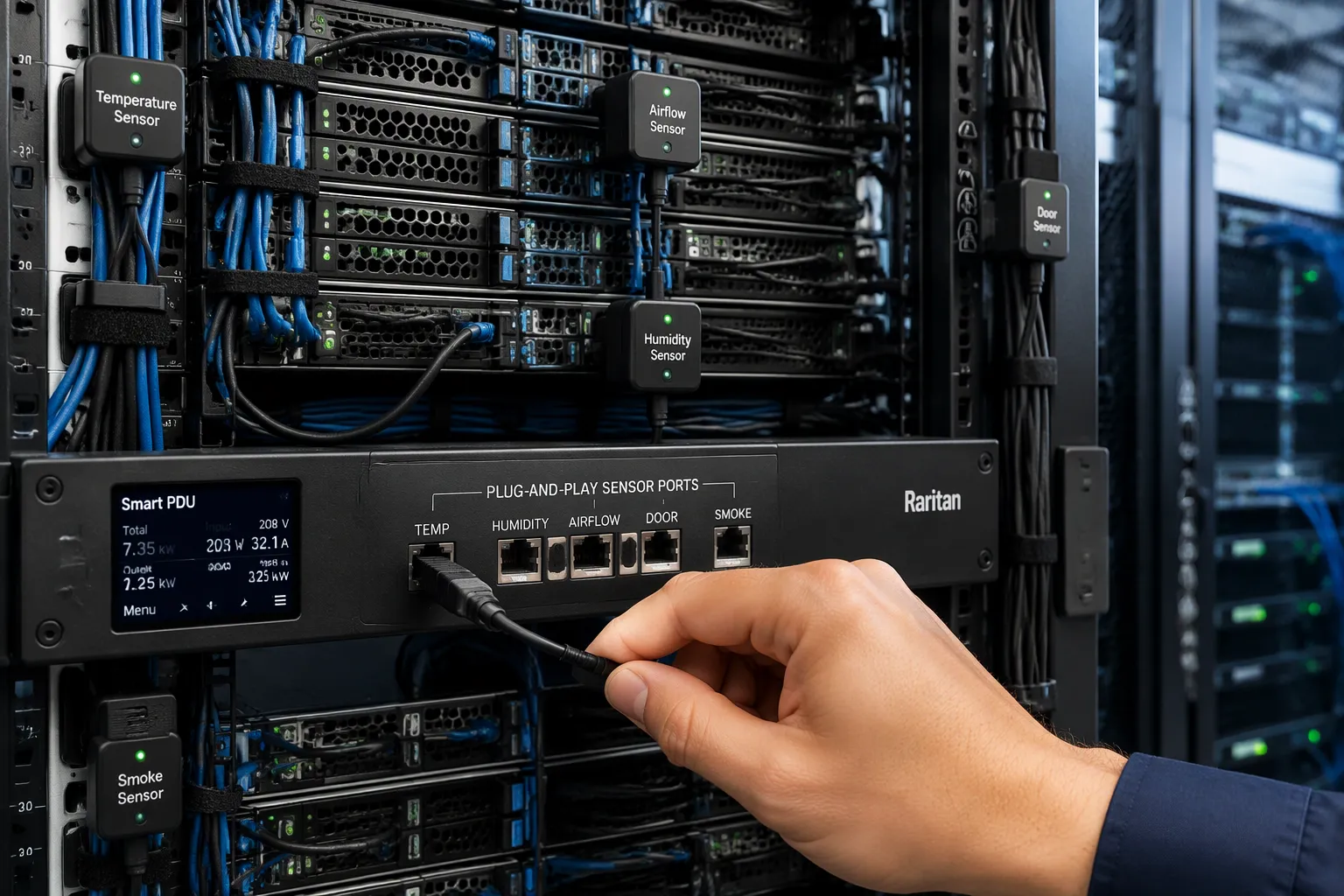
Plug-and-play sensor ports change that equation. A smart PDU detects connected sensors and configures them automatically, so installation becomes a matter of plugging in and confirming. Panduit states the principle plainly:
Our PDUs automatically detect a variety of digital sensors, including environmental and rack access security.
Environmental monitoring modules connect directly to Smart and Switched PDUs. Attom describes the supported set: temperature, humidity, and other rack-level environmental conditions. Some PDUs include a dedicated sensor port for environmental and security monitoring, which keeps sensing traffic separate from outlet control. BGASales lists the available sensor types, including temperature, humidity, airflow, door position, and liquid detection.
This plug-and-play architecture reduces setup effort at every stage. You avoid manual addressing, and the PDU handles configuration as part of a plug-and-play installation. The intelligent PDU becomes the aggregation point for sensor networks in each cabinet. That integration matters across distributed telecom cabinets, where technicians may visit a site only occasionally. A smart power distribution unit with auto-detection shortens each visit and lowers the chance of a configuration error.
Manual and third-party approaches still fit specific cases. Legacy equipment, specialized sensors, or sites with existing monitoring platforms may call for them. The choice depends on density and growth plans. Where sensor counts climb, the intelligent PDU approach scales with less labor per point.
PDU-Sensor Network Integration Explained
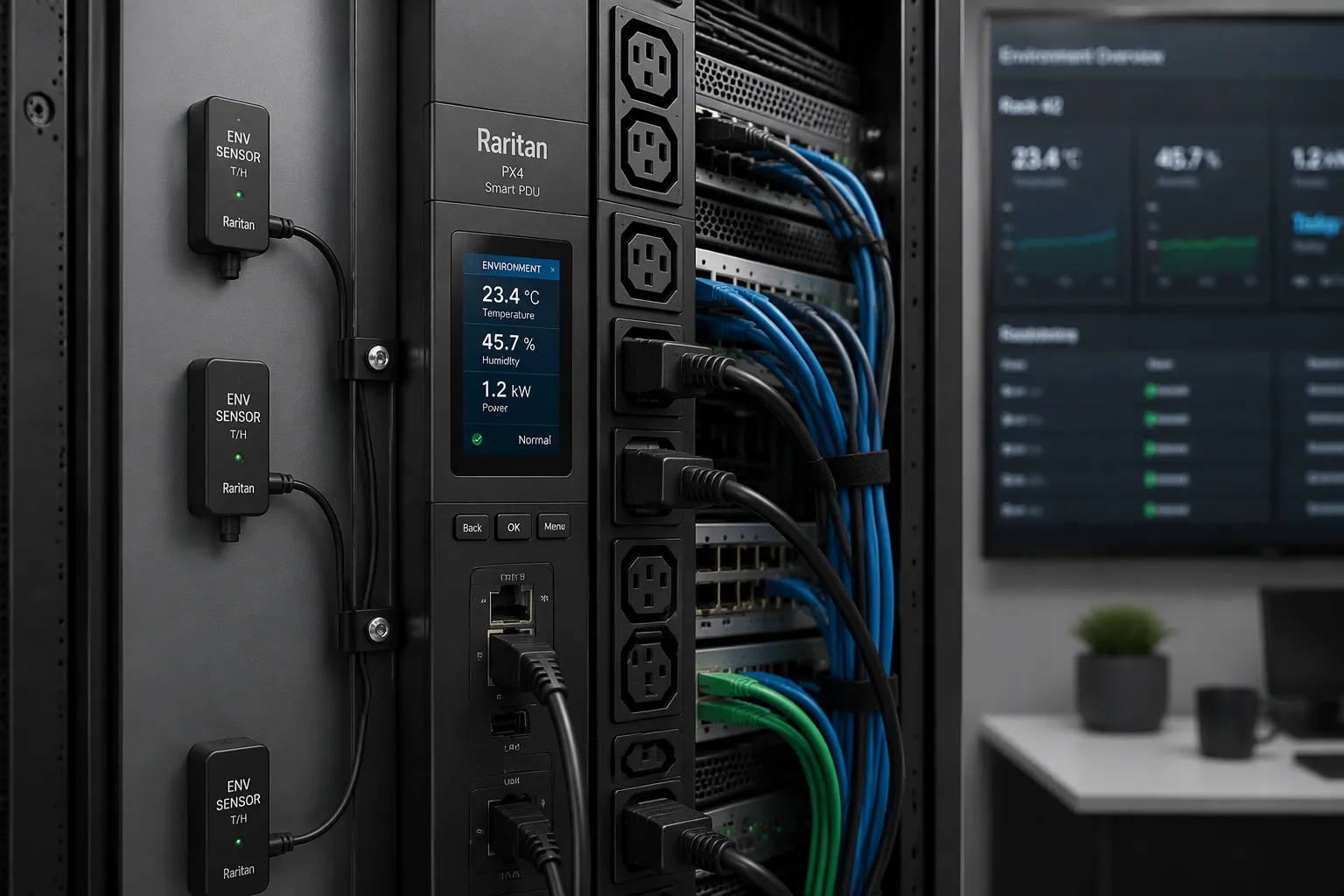
The architecture follows a simple path. Environmental sensors connect to the PDU, the PDU aggregates their readings, and the PDU links to DCIM or BMS platforms for centralized visibility. This chain turns scattered measurements into one view. You see every rack from a single dashboard.
Protocols vary by domain. The table below shows the common pairings.
Domain | Common Systems | Protocol |
|---|---|---|
IT Monitoring | Network gear, rack PDUs | SNMP v3 |
Power Equipment | UPS, meters, ATS, switchgear | Modbus RTU/TCP |
BMS/HVAC | Chillers, CRAC/CRAH units | BACnet (BACnet/SC preferred) |
Northbound Integration | DCIM to NOC/ITSM/Cloud | HTTP/HTTPS APIs, MQTT |
iRecruit recommends separating southbound telemetry from northbound data flows. Southbound traffic moves device data to gateways. Northbound flows push that data to dashboards and NOC systems. Keeping the two distinct stops raw device data from triggering false alarms. An integration contract helps here. Document every source system, destination platform, protocol, and data point before commissioning begins.
Daisy-Chaining and Magnetic Mounting
Daisy-chaining extends coverage across multiple racks. You link units in a chain, and each one passes its data along the path. One network drop can serve a full row of telecom cabinets. This approach cuts switch ports and cabling runs.
Magnetic mounting speeds placement. Sensors attach to steel surfaces without tools, so you reposition them as airflow patterns change. Installation becomes a quick task rather than a scheduled job. The plug-and-play architecture handles detection once the sensor sits in place.
Modular Scalability with the ESTEL Smart Power Distribution Unit
The ESTEL Smart Power Distribution Unit fits this design. It delivers a 16A maximum input current and comes in configurations from 8 to 19 outlets. An LCD display gives you real-time monitoring at the rack. A dehumidifying function keeps conditions stable inside telecom cabinets. Surge protection guards connected equipment, and remote management lets you check status from a distance. The cable plug complies with IEC60309, and the unit measures 600×450×185mm, so it fits standard rack space.
Real-time monitoring and alerts help you detect overloads before they cause downtime. You watch unit-level and outlet-level remote monitoring data alongside environmental readings. That combination supports monitoring, managing, and controlling power consumption across the fleet. Real-time power and environmental data also feed capacity planning.
The smart power distribution unit grows with your site. You start with a small module count and add capacity as demand arrives. The smart power distribution unit keeps upfront costs controllable this way. A smart power distribution unit with a common chassis lets you design once and run anything. The smart power distribution unit supports intelligent power monitoring and control at every outlet. Each smart power distribution unit in the chain reports upward without extra gateways. The smart power distribution unit also handles intelligent power monitoring and control for branch circuits. You gain real-time power data from every smart power distribution unit you deploy. The smart power distribution unit pairs with environmental sensors through a dedicated port. A monitored PDU of this type simplifies sensor network integration across sites. The intelligent PDU aggregates readings, and the intelligent PDU forwards them to DCIM. Power distribution units built this way scale in function, not just in outlets. Good power distribution starts with clean data, and clean power distribution depends on steady sensing. Reliable power distribution protects every load you add. Balanced power distribution keeps phases even across the chassis. Your power distribution plan should match module count to projected load. Solid power distribution design defers spend until you need it. The smart PDU and the smart PDU chain both report through one interface. Integration with DCIM tools provides unified monitoring and control. That integration keeps sensor networks manageable as they grow. Sensor networks spread across rows without new cabling. Sensor networks stay visible through one dashboard. Sensor networks scale with your cabinet count. Real-time monitoring shows power-hungry equipment and wasteful patterns. Real-time monitoring also flags equipment failure and power surges. Real-time monitoring supports faster fault isolation. The plug-and-play installation model shortens every site visit. Environmental sensors and power data monitoring work as one system. Outlet level monitoring completes the picture. Integration work pays off at commissioning. The integration contract prevents scope creep. This integration model suits distributed telecom cabinets. The PDU sits at the center of the sensor network integration story.
Smart PDUs simplify deployment, deliver granular visibility, scale sensor density, and cut overhead. You gain real-time monitoring and alerts without complexity.
Roll out in three steps:
Start with critical cabinets.
Choose plug-and-play PDUs.
Scale sensor coverage modularly.
ESTEL's Smart Power Distribution Unit fits this model. The smart power distribution unit supports unit-level and outlet-level remote monitoring in telecom cabinets. Each smart power distribution unit anchors rollout. A smart power distribution unit scales with demand. One smart power distribution unit serves a full row. The intelligent PDU aggregates sensors; integration with DCIM keeps sensor networks visible. That integration scales sensor networks across telecom cabinets. Real-time monitoring speeds fault isolation in telecom cabinets. Rising densities keep pushing sensor counts up.
FAQ
How do plug-and-play sensors work with a smart PDU?
You plug a sensor into the port. The PDU detects it and configures it automatically. No manual addressing is needed. The unit then reports readings to your DCIM or BMS platform. This setup shortens commissioning time across your telecom cabinets.
Which environmental parameters can I track at the cabinet level?
You can track temperature, humidity, airflow, differential pressure, door status, and power metrics. Some PDUs also support leak and smoke detection. Correlating these readings with power data supports capacity planning and overload prevention in your telecom cabinets.
Can I extend sensor coverage across multiple racks?
Yes. You daisy-chain units so one network drop serves a full row. Magnetic mounting lets you place sensors without tools. This approach scales monitoring across rows of telecom cabinets without new cabling runs.
What power features support cabinet-level monitoring?
The ESTEL Smart Power Distribution Unit offers a 16A maximum input current and 8 to 19 outlets. An LCD display shows real-time data. Surge protection and a dehumidifying function protect equipment. Remote management supports power distribution oversight across telecom cabinets.
How do alerts help prevent downtime?
Real-time alerts flag overloads and rising temperatures before they cause failures. You isolate the fault to a single rack. Fast fault isolation protects your power distribution and keeps telecom cabinets online. Solid power distribution design depends on steady sensing.
See Also
Understanding ESTEL PDUs And Their Function In Data Center Cabinets
Ensuring Optimal Monitoring For Outdoor Telecom Cabinets Effectively
Optimizing Outdoor Cabinets With Power Cooling And Monitoring Solutions
Installing And Maintaining Smoke Sensors In Communication Cabinets Properly
Sustainable And Smart Outdoor Communication Cabinets For 2025 And Beyond
CALL US DIRECTLY
86-13752765943
3A-8, SHUIWAN 1979 SQUARE (PHASE II), NO.111, TAIZI ROAD,SHUIWAN COMMUNITY, ZHAOSHANG STREET, NANSHAN DISTRICT, SHENZHEN, GUANGDONG, CHINA
