How Smart PDU plug-and-play sensors are reshaping environmental sensing and next-gen O&M efficiency


Smart PDU plug-and-play sensors move environmental sensing from periodic manual checks to continuous, automated visibility. That shift is a primary driver of next-gen O&M efficiency. Your team stops chasing readings and starts acting on them.
Three mechanisms make this possible:
Real-time monitoring of conditions at the rack and cabinet level
Predictive maintenance triggered by early warning signals
Remote management that removes site visits from routine work
What makes plug-and-play integration different, and what results can teams expect? The answer shapes your budget, your staffing plan, and your uptime record. This article gives you the evidence to judge both.
Key Takeaways
Smart PDU sensors give you real-time data on temperature, humidity, and other conditions in your racks.
Plug-and-play setup saves time and money by eliminating manual configuration and specialist labor.
Early warnings from sensors help you fix problems before they cause downtime or equipment damage.
Sensor data can cut energy costs by optimizing cooling and power usage.
Start with a small pilot to measure results and build a case for wider deployment.
What Smart PDU Sensors Do
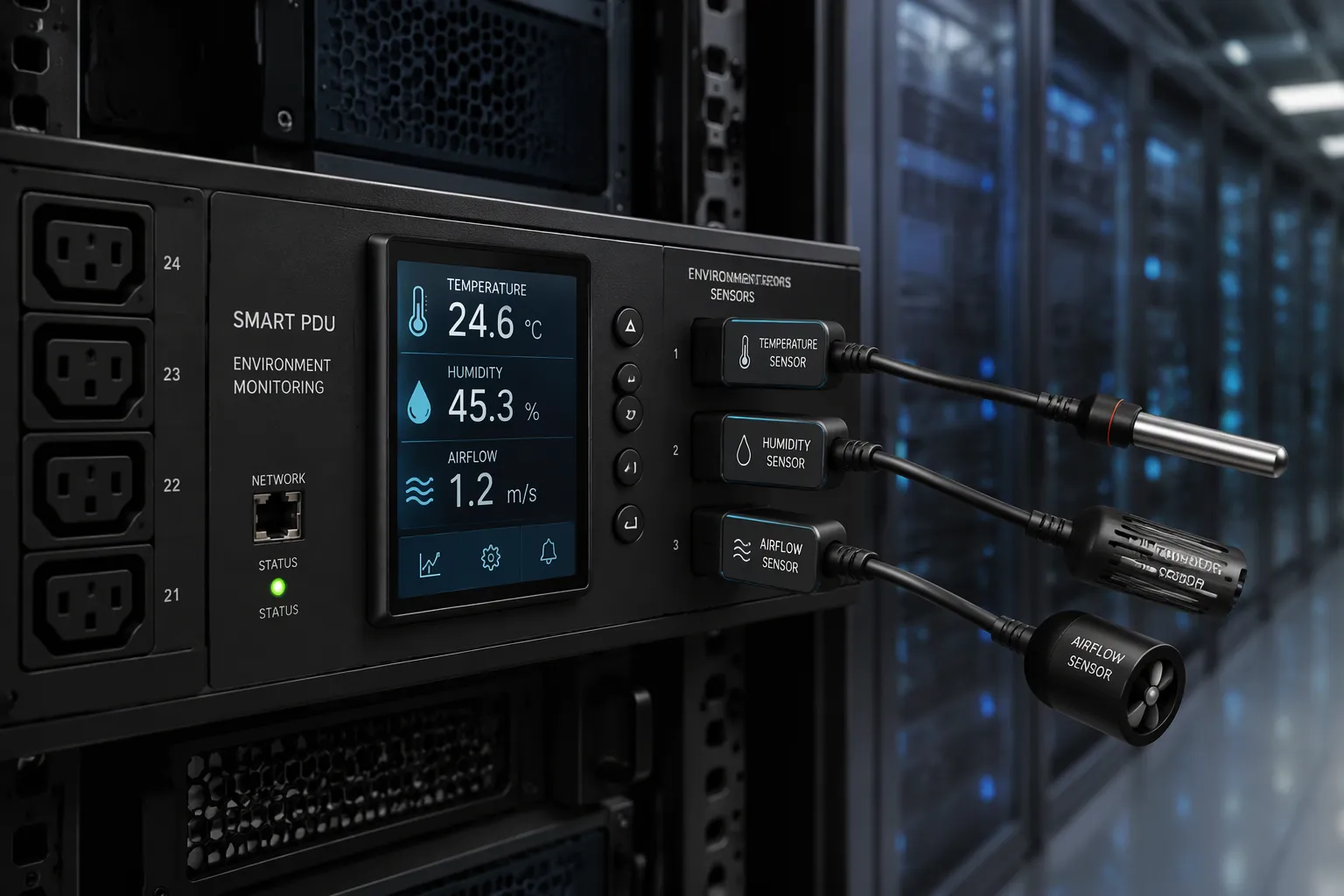
Power distribution meets environmental data
A smart PDU is a power strip with a brain. It distributes power to racks and cabinets, and it also carries a controller that collects data and reports it over a network. Plug-and-play sensors connect to that controller and start working on their own. You plug the sensor into its port, and the PDU recognizes it without any manual configuration. Raritan describes this model plainly: temperature, air pressure, humidity, vibration, proximity, and contact closure data points arrive through a plug-and-play sensor connected to an intelligent PDU, and you can build custom alerts on top of that stream.
Vendors organize these sensors into families. ServerTech, for example, sells DX2 SmartSensors for its PRO4X and PRO3X rack PDUs, plus a separate module line for older PRO2 and PRO1 units. The table below shows how the two families differ.
Sensor Family | Compatibility | Monitored Parameters |
|---|---|---|
DX2 SmartSensors | PRO4X and PRO3X intelligent rack PDUs only | temperature, humidity, airflow, differential air pressure, water/leaks, dust/particles, contact closures, dry contacts, proximity/motion, vibration |
Environmental Monitoring Module and Sensors | PRO2 and PRO1 intelligent rack PDUs only | temperature/humidity, water/fluids, contact closure |
The pattern matters for planning. You match the sensor family to the PDU generation, and the controller handles discovery and reporting.
The metrics that matter
Each sensor type answers a specific question about the cabinet. Temperature sensors catch hot spots. ServerTech recommends mounting them at the inlet of IT equipment, at the top, middle, and bottom of the rack, following ASHRAE guidance. Humidity sensors protect against two opposite failures: low humidity builds electrostatic discharge, and high humidity causes condensation. ASHRAE recommends keeping relative humidity between 40% and 60%. Airflow and differential pressure sensors confirm that cooling reaches the equipment and that containment holds. Water leak sensors sit under raised floors and near cooling units. Contact closure sensors report door status and physical security. Proximity detection flags movement near a cabinet.
Accuracy separates useful data from noise. Legrand's SmartSensors, cited by ServerTech, rate temperature at plus or minus 0.2°C and relative humidity at plus or minus 5%. That precision lets you trust a single reading instead of averaging several.
Real-time readings keep conditions inside safe limits. Raritan notes that data center managers can save 4% in energy costs for every degree of upward change in the cooling set point, and granular temperature data shows how far you can move that set point safely. One deployment report on the ESTEL blog records energy consumption dropping by up to 15% after installation. Your smart PDU turns those readings into alerts, and the alerts turn into action before equipment suffers.
Why Plug-and-Play Matters
Zero-touch deployment
Auto-discovery does the setup work for you. You plug a sensor into the PDU's sensor port, and the controller identifies the device type and starts reporting its readings. You skip address assignment, parameter entry, and the checklist of manual steps that older monitoring gear demanded. Nybsys frames the contrast sharply: manual configuration of a site takes 4–8 weeks, while zero-touch provisioning finishes in under 2 hours. Per device, Nybsys reports that a technician plugs in the unit and it pulls its configuration securely in under 60 seconds.
Metric | Manual Configuration | Zero-Touch Provisioning |
|---|---|---|
Install and commissioning | 4–8 weeks | Under 2 hours |
Skilled labor | RF engineers, fiber techs | General IT or field tech |
The labor profile changes with the timeline. General IT staff or field technicians can complete the work, and you no longer schedule specialist crews for routine sensor installs. ZPE Systems puts the operational payoff plainly:
With zero touch, you don't have to be on site for days or weeks manually configuring individual devices. And when it comes to scaling, it eliminates so many of the shipping costs and technician expenses, and instead lets you spin up new sites in a single day.
Scaling coverage with less effort
Coverage grows without a matching rise in labor. Raritan describes plug-and-play deployment with scalable sensor technology, and its dual RJ45 connectors simplify installation and servicing without rewiring the rack or daisy chaining. You cascade different sensor types on a single bus using Cat5/6 cables through the PDU's sensor port. That design suits data centers, labs, network closets, and remote sites such as colocation, POP, and telecom locations.
Remote sites benefit most from this model. ZPE Systems notes that you simply connect USB-type sensors to any Nodegrid device and let zero-touch provisioning install them automatically. You monitor every sensor through a cloud platform, whether you stand on-site or across the globe. Add a rack in another city, and the same workflow applies. Your team expands coverage across racks and remote cabinets without proportional increases in labor.
O&M Benefits of Smart PDU Sensing

Energy efficiency and cost savings
Sensor data turns cooling and power decisions into measured choices. Integrating smart PDUs with sensor networks improves energy efficiency and can reduce costs by up to 30 percent. You see where power goes, and you stop paying for cooling that no rack needs.
A Major League Baseball stadium shows the pattern in practice. Synaccess reports that five SynLink Smart PDUs, each managing four controllable outlets, powered speakers inside a 400-foot-high enclosed dome. Plug-and-play temperature and humidity sensors fed real-time readings to the control system. The results: 60% longer speaker life, 75% less maintenance, and roughly 2 amps saved per speaker. Remote power control let staff match output to crowd size instead of running every speaker around the clock.
You can apply the same logic to a telecom cabinet or a server room. Measure first, then adjust set points and schedules against real readings. The savings compound across every rack you instrument.
Predictive maintenance and uptime
Real-time monitoring prevents downtime by catching problems while they stay small. Nlyte explains that environment monitoring systems connect to sensors across a data center and track temperature, humidity, and airflow in real time. Alerts fire when conditions cross a threshold, and you act before equipment fails. High heat overheats servers, and low heat raises condensation risk. High humidity corrodes equipment, and low humidity builds static electricity. Each failure mode gives you a warning window, and each warning gives you a maintenance task.
Power events deserve the same attention. Dataspan notes that a UPS failure can shut off air conditioning, and the room then overheats fast. Voltage sensors detect brownouts by spotting line voltage loss. You plan a controlled shutdown instead of absorbing a surprise outage.
Relay output alarms make notification immediate. A relay closes on a threshold breach and triggers a light, buzzer, or building system. Your team learns about a leak or a heat spike in seconds, not at the next manual walkthrough.
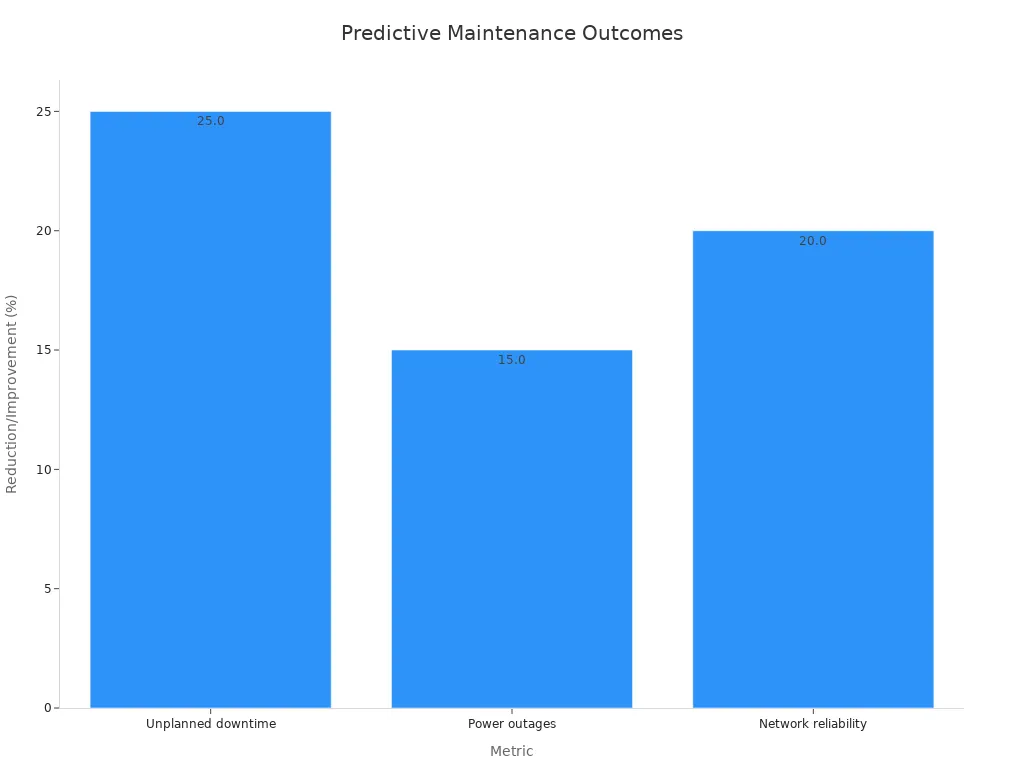
Predictive maintenance extends the payoff. ESTEL's blog reports that smart PDU deployments cut unplanned downtime by 25%, cut power outages by 15%, and improve network reliability by 20%. The chart below, from ESTEL's blog, summarizes those outcomes.
The mechanism is straightforward. Sensor readings and event logs feed models that forecast which component will fail and when. You stock the right part before failure, and you replace it on a planned schedule. Tierpoint cites SolarWinds on the stakes: downtime costs range from $427 to $9,000 per minute, depending on organization size. Early detection protects both uptime and budget.
Deploying ESTEL's Environment Monitoring System
Protocols and centralized management
ESTEL's Environment Monitoring System fits telecom facilities, industrial sites, and computer rooms. It supports RS485 and RS232 communication, and the RS485 interface uses balanced differential signaling to cancel electrical noise across long cable runs. That noise immunity matters at a telecom site with many sensors and controllers on one bus. The system also supports Modbus and SNMP, so you can pull real-time readings into a web interface and manage several rooms from one screen. ESTEL certifies the unit to ISO9001 and CE, and the temperature and humidity transmitter operates from -20°C to 80°C.
Specification | Detail |
|---|---|
Communication | RS485, RS232, Ethernet, Modbus, SNMP |
Certification | ISO9001, CE |
Transmitter range | -20°C to 80°C |
Alarm output | Relay (dry contact) |
Centralized management changes how your team works. You watch every monitored room from a single dashboard instead of walking each aisle with a handheld meter.
Best practices for rollout
Plan every monitoring domain before you install the first sensor. Guidance from ASHRAE TC 9.9, TIA-942-C, and the Uptime Institute converges on seven domains worth monitoring in any data center, and retrofitting the later ones costs more than including them at the start. Keep the sensor layer open: accept standard 0-5VDC or 4-20mA analog inputs from third-party sensors so you avoid lock-in at that level.
Build for growth. A modular design lets you expand from one site to a networked architecture spanning dozens of sites without replacing edge hardware. Add an out-of-band alert path, usually cellular backup, so alarms still leave a remote cabinet when the primary link drops. Edge buffering preserves alarm history through WAN interruptions. Finally, decide who receives each alert and what action it triggers before go-live. A threshold with no owner produces noise, not uptime.
Challenges and Risk Mitigation
Data security and segmentation
Sensor data travels over your network, so treat the management path as a security boundary. Nbyosun recommends deploying PDUs on a dedicated, isolated management network, separate from general user traffic. Network zoning and micro-segmentation contain a breach, and strict separation between IT and OT networks keeps a compromised endpoint from moving laterally. Role-based access control with granular permissions limits standard users to read-only access, and IP-based access control lists block unauthorized traffic to the PDU management interface.
Security Category | Recommended Practices |
|---|---|
Segmentation and access control | Isolated management network, zoning, micro-segmentation, RBAC, IP ACLs |
Encryption | HTTPS/SSH by default, TLS with AES-128/256-bit ciphers, SNMPv3 with authentication and privacy |
Password policy | Minimum 8 characters, mixed case, numerals, special characters, no reuse of last 3 passwords |
Raritan adds practical controls on top of that baseline. Enable HTTPS with TLS 1.2/1.3, use SSH public key authentication for scripts, and encrypt SNMPv3 traffic. Force a password change on first login, because default passwords are the easiest way for attackers to take control of connected devices. Block access after repeated failed logins, time out inactive sessions, and enable Secure Boot so the device only runs trusted firmware. Send logs to a SIEM tool for centralized anomaly detection.
Legacy compatibility
You do not need to rip out working infrastructure to gain sensor visibility. Plug-and-play designs support rapid retrofitting of legacy equipment, and careful planning with expert support clears most integration hurdles. ESTEL's blog notes that Modbus and EtherNet/IP work well for most telecom setups, while OPC UA adds platform independence and strong security when you connect different brands. A centralized platform consolidates data from many sensor types on one dashboard, and API access plus SNMP support links the system to your existing IT management tools.
Stage the migration in phases. Audit your current environment first, then map data and integration touchpoints before go-live. Run the new monitoring layer in parallel with existing systems, test each outlet and sensor, and label every cable to avoid setup mistakes. This phased path preserves uptime while you expand coverage.
Case Study: Results in the Field
Scope and baseline
Consider a representative deployment: a telecom operator instruments a set of outdoor cabinets and a small computer room with ESTEL's Environment Monitoring System. The baseline is manual. Technicians visit each site on a fixed schedule, read a handheld meter, and log the numbers. Between visits, a heat spike or a water leak goes unnoticed until equipment fails.
The new layer changes that baseline. Temperature, humidity, smoke, and water sensors connect over RS485 and report to a central dashboard. You now hold a continuous record of conditions at every cabinet, and you can compare sites against each other.
Outcomes and lessons
The ESTEL blog reports results from comparable deployments. GreenConnect recorded a 30% reduction in energy use, a 25% reduction in downtime, and a 40% reduction in CO2 emissions. A Southeast Asia mobile operator saw 38% fewer site visits, repair time falling from 12 to 4 hours, and $500,000 saved annually. A European tower company gained 22% better uptime and half as many emergency maintenance trips.
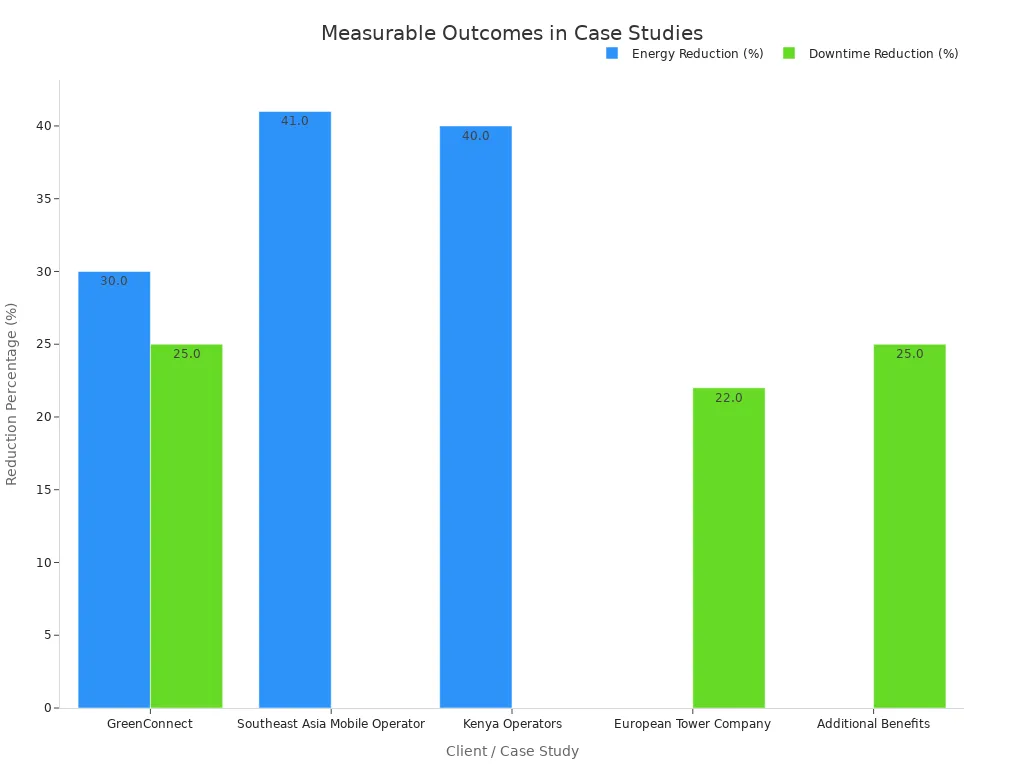
The lessons are practical. Real-time monitoring helps you spot inefficiencies quickly, and accurate data supports better capacity planning. Load balancing and environmental monitoring raise system reliability, and regular checks prevent overheating. A Smart PDU that feeds sensor data into one platform makes those gains repeatable across sites.
Future Trends in Environmental Sensing
Sensor hardware itself is changing. Researchers writing for PMC describe a self-powered moisture sensor built on a wood-based generator. It tracked finger motion, monitored breath through a mask, and quantified plant transpiration. A TENG-based urea BioMEMS sensor reaches a 4 μM detection limit for crop health assessment. These designs point toward sensors that harvest their own power and report without a wired supply.
Sensor Type | Mechanism | Application |
|---|---|---|
Wood-based moisture generator | Self-powered moisture sensing | Breath, motion, plant transpiration |
TENG urea BioMEMS | Dual-electrode enzyme reactions | Crop health, 4 μM detection limit |
Nonwoven fabric MEG | Moisture electricity generation | Sensing fluid types via voltage and current |
AI and edge intelligence
Edge AI moves analysis onto the device. Advantech describes a drone that changes its flight path in real time based on soil analysis. That tight loop from sensing to action enables responsive, autonomous systems. Urban infrastructure shows the same pattern. Edge cameras optimize signal timings, streetlights adjust to pedestrian presence, and waste systems optimize collection routes, according to arXiv. Scale Computing notes that ships process wave, weather, and vessel data locally to avoid collisions and run predictive maintenance without cloud connectivity.
Analytics sharpen the payoff. Heaven Green Energy reports machine learning predictive maintenance at 95% accuracy in fault prediction, with 6 to 7 days advance notice of inverter or transformer failures and a 30 to 45% reduction in unplanned downtime. LSTM networks forecast solar output at 94.2% accuracy.
Toward autonomous operations
The path runs in stages. arXiv describes early workflows as almost entirely manual, with engineers consulting documentation and relaying information by phone. Semi-automated platforms then standardized procedures and improved efficiency. Agentic workflows now let agents orchestrate tasks and collaborate based on network conditions. LLM-powered agents interpret natural language instructions, decompose them into tasks, and invoke tools without human orchestration. Digital twins support operation rehearsal, performance evaluation, and fault prediction. For your cabinets, connect sensor data to analytics now, so the platform learns your baseline before autonomy arrives.
Plug-and-play sensors on a Smart PDU link environmental sensing straight to O&M results. You gain real-time visibility into every rack and cabinet. You act on early warnings before failures strike. You control conditions remotely, without dispatching a crew.
Adoption will keep accelerating. Sensors will grow more capable, and analytics will grow sharper. Teams that start now will capture the gains first.
Take one practical step today. Audit your current monitoring gaps, then pilot a plug-and-play sensor deployment with a trusted partner like ESTEL. Measure the results against your baseline. Let the data make your case for wider rollout.
FAQ
What does "plug-and-play" actually mean for a sensor?
You plug the sensor into the PDU's sensor port. The controller identifies the device and starts reporting readings on its own. You skip address assignment and parameter entry. Setup that once took weeks now finishes in hours, and general IT staff can handle the work.
Can I add sensors to PDUs I already own?
Often yes, but match the sensor family to your PDU generation. Some vendors sell one sensor line for current rack PDUs and a separate module line for older units. Check compatibility before you order, then stage the rollout in phases to protect uptime.
Which metrics should I monitor first?
Start with temperature and humidity at the rack inlet, following ASHRAE guidance. Keep relative humidity between 40% and 60%. Add water leak sensors near cooling units and contact closures on doors. These four cover the most common failure modes in cabinets and computer rooms.
How do alerts reach a remote cabinet?
Relay output alarms close a dry contact on a threshold breach. That contact triggers a light, buzzer, or building system. For unmanned sites, add an out-of-band path such as cellular backup, so alarms still leave the cabinet when the primary link drops.
What should a pilot deployment look like?
Instrument one cabinet or room against a manual baseline. Use ESTEL's Environment Monitoring System, which supports RS485 and RS232 and carries ISO9001 and CE certification. Track readings for a set period, compare results to your baseline, then decide on wider rollout.
See Also
Enhancing Outdoor Cabinet Performance Through Integrated Power Cooling And Monitoring
Understanding ESTEL PDUs And Their Essential Function In Data Center Cabinets
Eco-Friendly And Intelligent Outdoor Communication Cabinets Designed For The Year 2025
A Guide To Installing And Maintaining Smoke Sensors In Communication Cabinets
Strategies For Achieving Optimal Monitoring Of Outdoor Telecom Cabinets
CALL US DIRECTLY
86-13752765943
3A-8, SHUIWAN 1979 SQUARE (PHASE II), NO.111, TAIZI ROAD,SHUIWAN COMMUNITY, ZHAOSHANG STREET, NANSHAN DISTRICT, SHENZHEN, GUANGDONG, CHINA
