Multi-Standard Output (AC/DC/48V) Telecom Power System for Multi-Service Convergence Scenarios

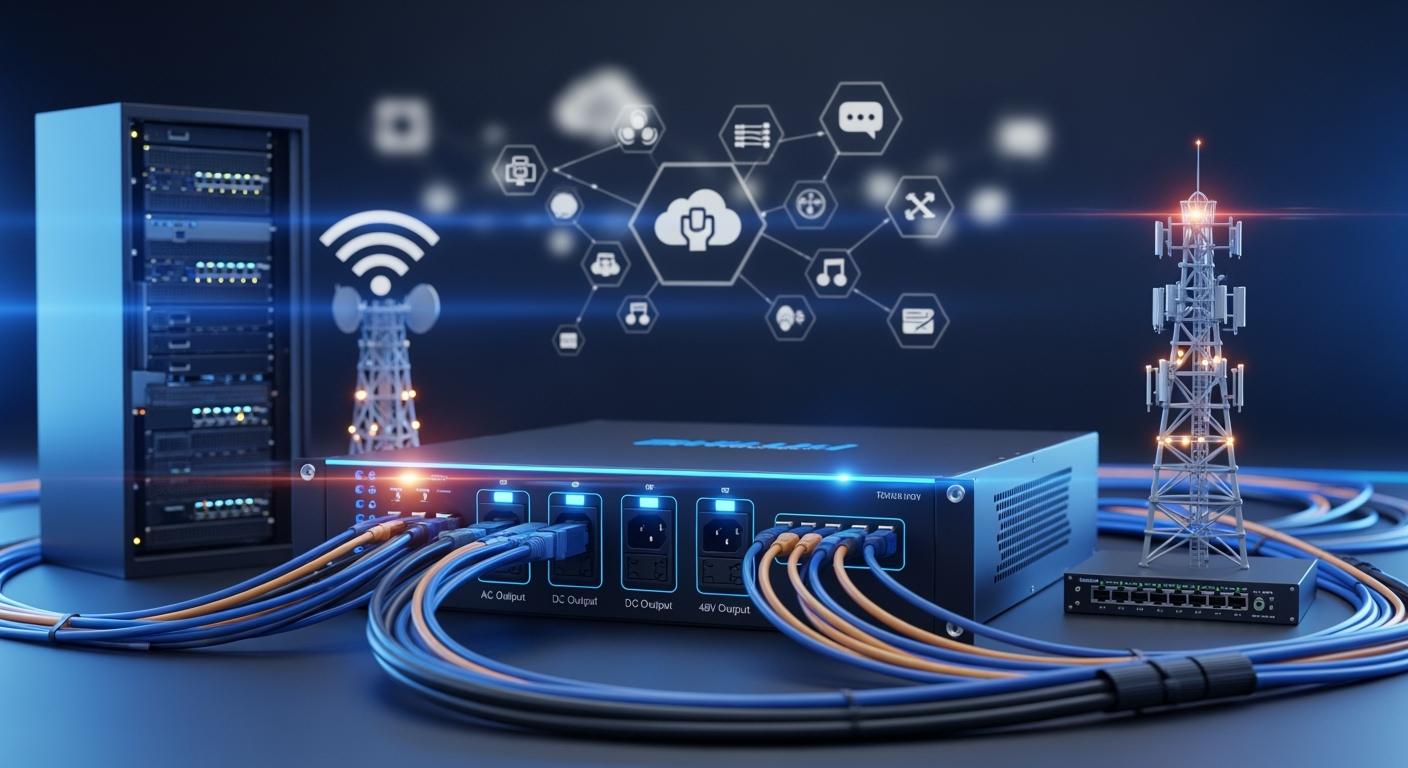
You face new challenges as telecom networks converge and demand grows for reliable, flexible power solutions. Multi-standard output systems with AC, DC, and 48V options help you support a wide range of equipment efficiently. High efficiency and strong reliability matter in your daily operations. ESTEL leads the way with innovative Telecom Power System designs that keep your infrastructure running smoothly and adapt to your evolving needs.
Key Takeaways
Multi-standard output systems provide AC, DC, and 48V power from one platform, supporting both old and new telecom devices.
Using a flexible power system reduces downtime and maintenance, allowing for seamless upgrades and efficient network management.
Natural cooling technology in ESTEL systems lowers operational costs and increases reliability by minimizing moving parts.
Modular designs enable easy expansion and maintenance, helping your network grow without major disruptions.
High efficiency ratings above 96% save energy and reduce costs, ensuring your telecom operations remain reliable and cost-effective.
Multi-Standard Output Overview
System Definition
You need a power solution that can handle different types of equipment in your network. A multi-standard output system gives you the ability to deliver AC, DC, and 48V power from a single platform. This approach helps you support both legacy and modern telecom devices. The Telecom Power System from ESTEL is designed to meet these needs. It provides a stable and efficient power supply for your critical infrastructure.
Key Components
A reliable Telecom Power System uses several essential components to support AC, DC, and 48V outputs. Each part plays a unique role in keeping your network running smoothly. The table below shows the main components and their functions:
Component | Role in Telecom Power Systems |
|---|---|
Convert AC power to -48 VDC for telecom equipment and trickle charge batteries. | |
Batteries | Provide backup -48 VDC power to telecom equipment when rectifiers fail or during power outages. |
Diesel Generator | Automatically provides AC power to the DC system when grid power is lost. |
Automatic Transfer Switch | Synchronizes voltages from different sources to ensure a stable power supply to equipment. |
Power Distribution System | Distributes power from various sources to the telecom equipment. |
Solar Panels | Serve as an alternative power source, contributing to the overall power supply system. |
Controllers and Chargers | Manage the charging of batteries and the overall power system operation. |
AC, DC, and 48V Outputs
You will find that each output type serves a specific purpose in your network:
AC power supplies work best for larger systems and complex setups.
DC power supplies, including 48V, offer higher efficiency and simpler operation for telecom applications.
The 48V DC output is especially important for communication systems. It provides safety and efficiency, and it is easier to handle than higher voltages.
Here are some key advantages of the 48V DC system:
48V DC reduces cable size and costs while keeping the system safe.
It is classified as Safety Extra Low Voltage (SELV), making it safer for you to handle.
The 48V system remains reliable in remote areas, supporting your network even when traditional infrastructure fails.
A Telecom Power System with multi-standard outputs ensures you can power all your equipment, maintain safety, and keep your network running in any situation.
Telecom Power System in Converged Networks
Powering Diverse Services
You see telecom networks changing quickly. Today, you must support mobile, broadband, and IoT services on the same infrastructure. Each service has different power needs. A flexible Telecom Power System helps you meet these demands. You can deliver AC, DC, and 48V outputs from one platform. This flexibility means you can power new 5G base stations, legacy switches, and IoT gateways without extra equipment.
Modern platforms, like OCUDU, show how adaptable power systems support diverse services. You can run core functions on stable servers and use GPU acceleration for heavy workloads. This approach lets you scale resources quickly and share them across applications. You see this in smart ports and rural networks, where power and performance must match local needs. With the right power system, you keep your network efficient and ready for any service.
Challenges and Solutions
You face many challenges when you deploy multi-standard output power systems in converged networks. You must manage different types of equipment, ensure reliable communication, and prepare for future upgrades. The table below shows common solutions and their benefits:
Solution | Benefit |
|---|---|
Simplified network architecture | Reduced ongoing maintenance efforts and variety of equipment management. |
Accelerated network design | Enabled streamlined and standardized LAN engineering across substations. |
Seamless integration | Ensured reliable communication across the digital substation ecosystem. |
Eliminated compatibility bottlenecks | Supported data flow and communication between devices and systems. |
Prepared to adapt | Allowed integration of new technologies and energy sources without disruption. |
You can see that a simplified network makes your job easier. You spend less time on maintenance and equipment management. When you accelerate network design, you set up new sites faster. Seamless integration means your devices always communicate well. By removing compatibility bottlenecks, you keep data flowing smoothly. If you prepare to adapt, you can add new technology or energy sources without stopping your network.
ESTEL Product Integration
You want a power system that fits your network and grows with your needs. ESTEL gives you this flexibility. You can use the Telecom Power System in many scenarios. It supports a wide AC input voltage range, so you can connect it to different power sources. Natural cooling keeps your system running without extra fans or air conditioners. You can install it on a standard 19-inch rack or inside a cabinet, which saves space and makes upgrades easy.
ESTEL’s Telecom Rectifier System adds more value. You get high efficiency, with rates over 96%. The modular design lets you scale up as your network grows. You can choose the right input voltage for your site, and always get a stable 48V DC output. This system works well in outdoor cabinets, remote sites, and busy urban centers. You can trust ESTEL to deliver reliable power, reduce downtime, and support all your telecom services.
Tip: When you choose a flexible power system like ESTEL’s, you prepare your network for the future. You can add new services, upgrade equipment, and meet customer needs without major changes.
Technical Features and Advantages
Flexible Output Options
You need a power system that adapts to different network demands. Modern telecom power systems, like those from ESTEL, offer flexible output options. These systems support AC, DC, and 48V outputs, so you can power a wide range of equipment. This flexibility helps you manage both legacy and new devices on the same platform.
You also benefit from advanced battery energy storage systems (BESS). These systems improve reliability and energy independence, especially in remote sites. You can optimize costs by storing energy during low-rate periods and using it during peak demand. Modular lithium battery systems require less maintenance and fit easily into high-density sites. The table below shows how flexible output options support your network:
Benefit | Description |
|---|---|
Reliability | BESS enhances reliability by providing power continuity in areas with unreliable grid access. |
Energy Independence | BESS supports energy independence, crucial for remote telecom sites without grid access. |
Cost Optimization | Enables peak shaving by storing energy during low-rate periods and discharging during peak demand. |
Minimal Maintenance | Modular lithium battery systems require less maintenance compared to traditional generator systems. |
Microgrid Capability | BESS can be integrated into microgrids, improving resilience during regional power disruptions. |
Space Efficiency | Compact, rack-mounted batteries fit within physical space constraints of high-density telecom sites. |
Support for Energy-Intensive Apps | BESS supports applications like edge AI and 5G networks, maintaining data throughput and avoiding overload. |
Tip: Flexible output options help you future-proof your network and reduce operational headaches.
Efficiency and Reliability
You want your network to run efficiently and reliably. ESTEL power systems achieve energy efficiency ratings above 95%. These systems use advanced technology to optimize energy use and reduce waste. You get features like outlet-level metering, which gives you more control over power distribution.
You experience consistent performance, even in demanding conditions.
You reduce downtime because the system is built for reliability.
You save on energy costs due to high efficiency.
When you use a Telecom Power System with these features, you keep your network running smoothly and avoid unexpected outages.
Natural Cooling and Rack Compatibility
You need a power system that is easy to install and maintain. ESTEL designs its systems with natural cooling. This means you do not need fans or extra air conditioners. Natural cooling lowers operational costs and reduces maintenance because there are no moving parts. The system runs silently and has fewer failure points, which increases reliability.
Benefit | Natural Cooling | Forced-Air Cooling |
|---|---|---|
Operational Costs | Lower due to no moving parts | Higher due to energy consumption |
Maintenance | Minimal, no mechanical components | Higher, due to moving parts |
Noise Level | Silent operation | Noisy due to fans |
Reliability | High, fewer failure points | Lower, more potential failure points |
Environmental Impact | Reduced energy use | Higher energy use |
You can install these systems on standard 19-inch racks or inside cabinets. This compatibility makes upgrades and expansions simple. You save space and can fit the system into almost any telecom site.
ESTEL Telecom Rectifier System
You need a system that grows with your network. The ESTEL Telecom Rectifier System uses a modular design. You can add or remove modules as your needs change. Each module operates independently, so you can upgrade or replace units without shutting down the whole system.
Feature | Description |
|---|---|
Modularity and Scalability | Easy expansion as network demands grow; independent operation of each module. |
Advanced Monitoring and Control Systems | Real-time tracking of performance metrics and remote management capabilities. |
High efficiency up to 96.5% reduces energy waste.
Compact design increases power density and saves space.
You can achieve up to 5% annual energy cost savings.
Intelligent monitoring features allow you to track performance and detect issues early.
Remote monitoring lets you manage the system without being on-site.
Predictive maintenance features help you fix problems before they cause downtime, reducing operational costs by up to 20%.
Note: Modular designs make upgrades and maintenance fast and easy. You can keep your network running while you add new technology.
You get a Telecom Power System that supports your network’s growth, improves efficiency, and keeps your operations reliable.
Real-World Applications
Telecom Networks
You see multi-standard output power systems play a key role in modern telecom networks. These systems support a mix of energy sources and provide reliable backup during outages. You can use hybrid setups that combine solar, battery, and diesel power to keep your network running. This approach reduces downtime and increases resilience. The table below shows common applications and their benefits:
Application | Benefit |
|---|---|
Multi-energy input systems | Higher reliability and reduced downtime |
Hybrid systems (solar, battery, diesel) | Cost savings and increased resilience |
Renewable energy integration | Environmental benefits and operational resilience |
Continuous backup power | Seamless communication during outages |
You can rely on ESTEL’s solutions to ensure your network stays online, even in remote or challenging environments.
Data Centers and Edge Sites
You need efficient power for data centers and edge sites. Multi-standard output systems help you increase power density and reduce costs. You can scale your setup as your needs grow. Maintenance becomes easier with modular designs and hot-swappable parts. The table below highlights the main benefits:
Benefit | Description |
|---|---|
Power density increase | Achieves higher processing capability with minimal power use |
CapEx and OpEx reduction | Lowers capital and operational expenses through efficiency |
Scalability | Modular solutions grow with your needs |
Simplified maintenance | Fewer components and hot-swappable parts make upkeep easier |
Grid interconnection supports on-site generation.
Solar installations can meet large energy needs.
Energy storage ensures continuous operation.
You can trust ESTEL’s power systems to keep your data flowing and your operations efficient.
ESTEL Case Studies
You benefit from real-world results when you choose ESTEL. The following table shows how ESTEL’s multi-standard output power systems have helped customers:
Client / Case Study | Performance Metrics and Cost Savings Reported |
|---|---|
Leading Telecom Provider | Energy efficiency up to 97.8%; early issue detection; seamless network expansion |
GreenConnect | 30% reduction in energy use; 25% less downtime; 40% lower CO₂ emissions |
Southeast Asia Mobile Operator | 38% fewer site visits; repair time cut from 12 to 4 hours; $500,000 saved yearly |
European Tower Company | 22% improved uptime; emergency maintenance trips cut by half |
You see measurable gains in energy savings, reliability, and reduced maintenance. ESTEL’s solutions help you achieve your goals, whether you manage a telecom network, a data center, or a remote site.
You see that multi-standard output power systems help you support multi-service convergence in telecom. ESTEL’s solutions give you efficiency, reliability, and adaptability for any network scenario.
You can power diverse equipment with one system.
You reduce downtime and save energy.
You prepare your network for future growth.
Consider ESTEL for your next infrastructure upgrade. You stay ahead as telecom networks evolve.
FAQ
What is a multi-standard output telecom power system?
You use a multi-standard output telecom power system to supply AC, DC, and 48V power from one platform. This system supports different telecom devices and helps you manage both old and new equipment easily.
How does ESTEL’s power system improve network reliability?
You benefit from ESTEL’s power system because it uses natural cooling and modular design. These features reduce downtime and make maintenance simple. You keep your network running smoothly in all conditions.
Can you install ESTEL’s power systems in standard racks?
Yes, you can install ESTEL’s power systems in standard 19-inch racks or inside cabinets. This compatibility lets you upgrade your setup quickly and fit the system into any telecom site.
What efficiency rates do ESTEL telecom rectifier systems offer?
ESTEL telecom rectifier systems deliver efficiency rates above 96%. You save energy and reduce operational costs. High efficiency means your network stays reliable and cost-effective.
See Also
Ensuring Consistent Power Supply For Telecom Equipment
Key International Guidelines For Communication Power Systems
Essential Insights Into Telecom Power Supply Characteristics
CALL US DIRECTLY
86-13752765943
3A-8, SHUIWAN 1979 SQUARE (PHASE II), NO.111, TAIZI ROAD,SHUIWAN COMMUNITY, ZHAOSHANG STREET, NANSHAN DISTRICT, SHENZHEN, GUANGDONG, CHINA
