How Telecom Power Systems Achieve Stable Wide Temperature Operation from -40°C to +75°C

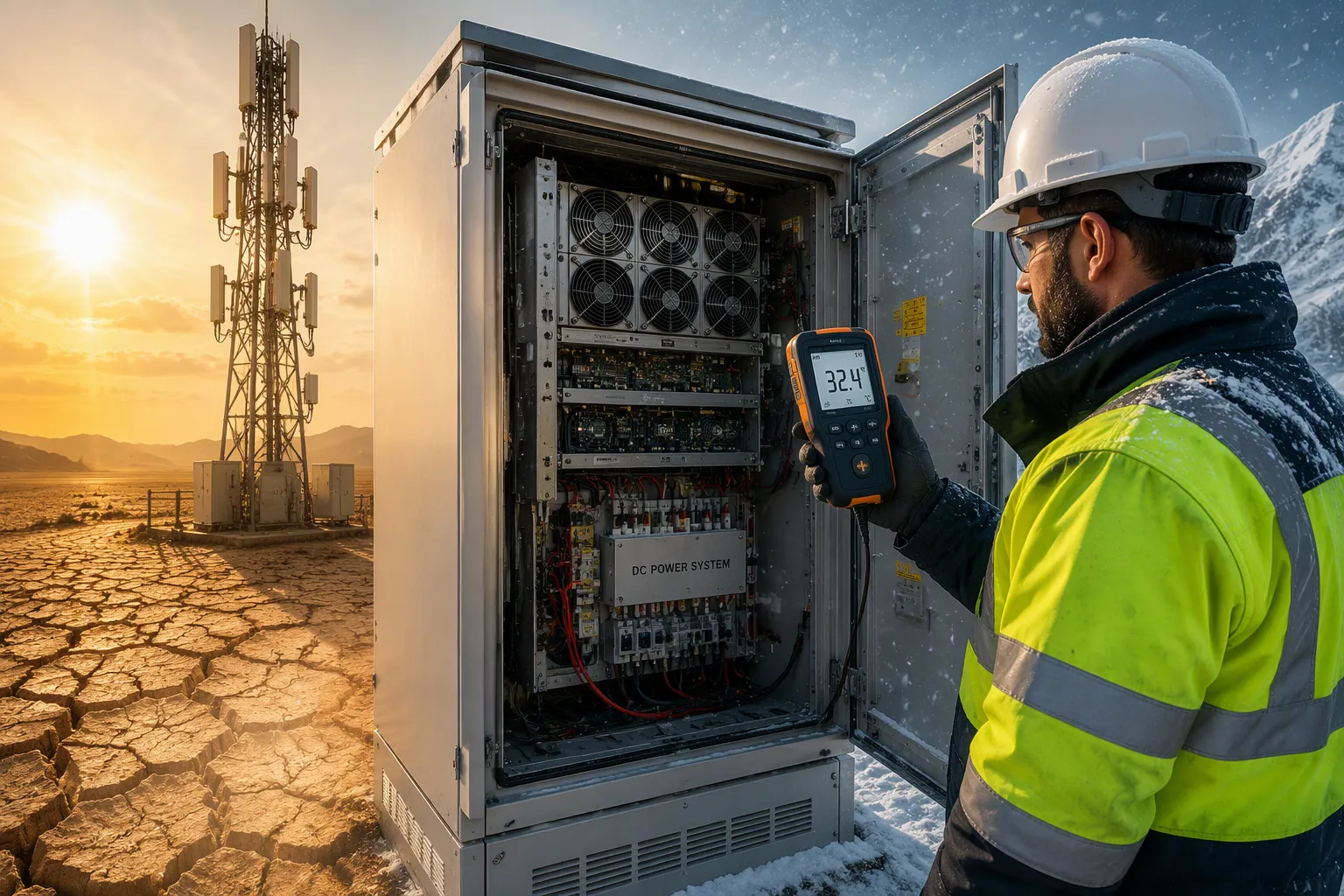
An outdoor telecom site faces a brutal range. Equipment must start at -40°C and keep running at +75°C. Ordinary power electronics derate in that heat and stall in that cold.
Telecom Power Systems stay stable through three combined strategies. First, wide-temperature component selection gives every part margin beyond the ambient extremes. Second, active thermal management adds heat when the site freezes and removes it when the cabinet bakes. Third, standards-based testing proves the design holds across the full span.
You will see how each strategy works at both ends of the range. You will also get an objective comparison of cooling approaches, so you can match the method to your site.
Key Takeaways
Choose components rated beyond the temperature range to ensure reliable operation at both -40°C and +75°C.
Use heaters to warm batteries in extreme cold and cooling systems to remove heat in high temperatures.
Test the full system in a thermal chamber to prove it works across the entire temperature span.
Select the right cooling method based on heat load and site conditions to save energy and cost.
Combine wide-temperature parts, smart thermal control, and robust enclosures for stable performance.
How Telecom Power Systems Handle Component Extremes
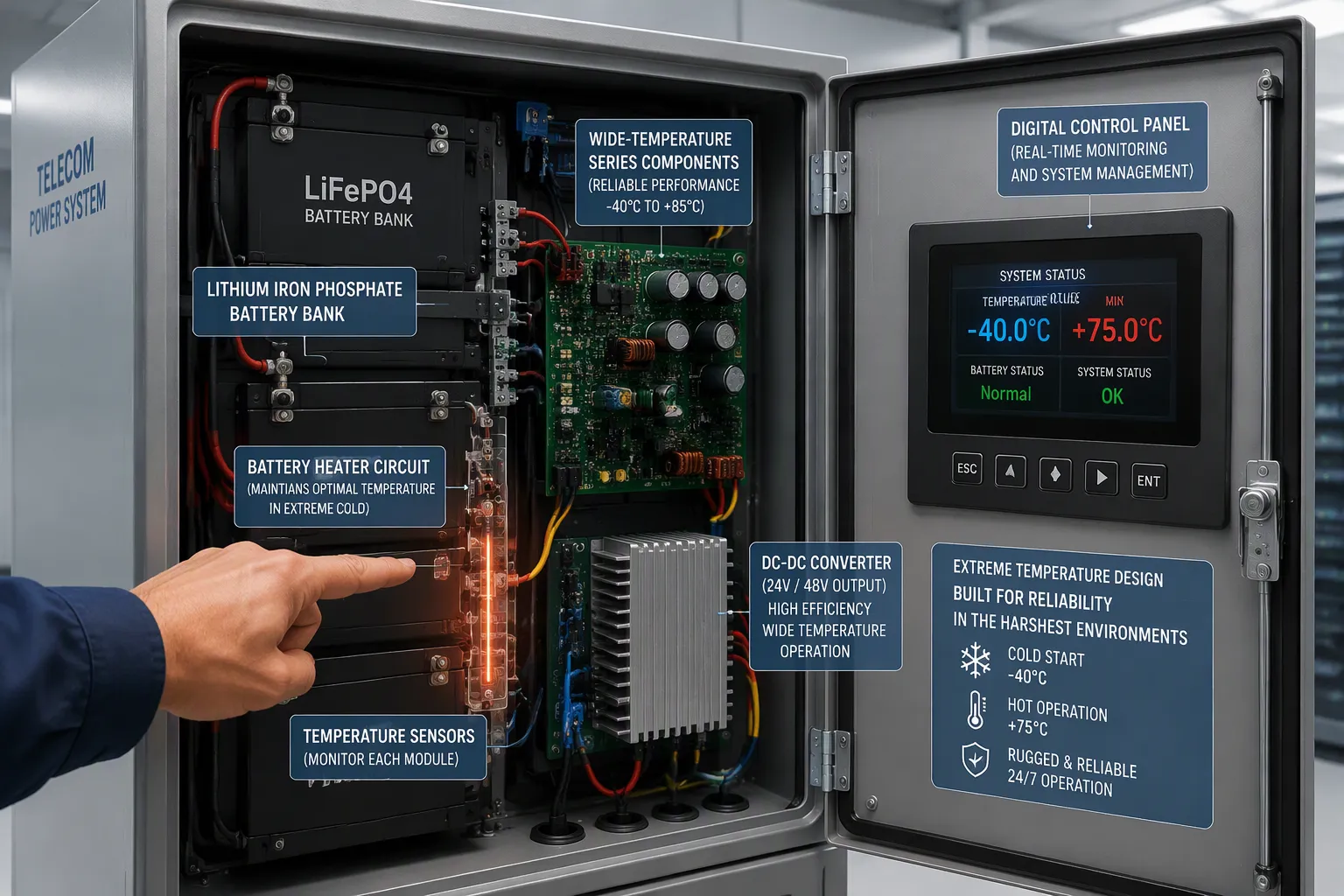
A cabinet rated for -40°C to +75°C ambient does not contain parts rated only for that window. Designers specify every critical component beyond the ambient range, so the part never runs at its limit. Regulators and DC-DC converters commonly carry a junction temperature rating of -40°C to +125°C. That headroom matters at the hot end. A converter dissipating power inside a +75°C cabinet runs hotter than the air around it, and the extra margin keeps the junction inside its safe band.
Batteries and Capacitors in Cold and Heat
Batteries feel the cold first. At -40°C, a lithium battery loses a large share of its usable capacity, and charging it at full current risks damage. Telecom Power Systems address this with lithium iron phosphate chemistry, which tolerates wide temperature swings better than many alternatives, paired with heater circuits. A heater warms the battery compartment before charging begins, and control logic blocks charge current until the cells reach a safe temperature. At the hot end, the same chemistry resists thermal runaway better than older designs, and the cabinet's thermal management keeps the bank below its upper limit.
Capacitors show the opposite pattern. Electrolytic capacitors see their equivalent series resistance rise sharply in cold, which reduces ripple handling and can upset startup. In heat, every capacitor has a rated life at a reference temperature, and life shortens as temperature climbs. Wide-temperature capacitor series and conservative voltage derating keep both effects in check. You get stable filtering at -40°C and predictable service life at +75°C.
Semiconductors and Wide Input Modules
Semiconductors follow the same margin logic. Silicon devices lose switching headroom as junction temperature rises, so designers calculate junction temperature from ambient plus power dissipation and confirm the result stays below the rated maximum at +75°C ambient. Wide input power modules add another layer of stability. A module with a 90–300 Vac input range holds a regulated output through deep voltage sag, generator fluctuation, and temperature swings alike. Some classes extend further, covering 18–264 Vac or 18–375 Vdc, which suits sites with unstable grids or DC plant feeds.
Safety spacing deserves equal attention across the range. Clearance and creepage distances between high-voltage and low-voltage circuits must hold at every operating temperature, because insulation materials and air gaps behave differently when hot or cold. Designers verify these distances against the full input range, not just nominal 220 Vac. The result is a power train that delivers steady output whether the site sits in desert heat or mountain cold.
Thermal Management: Heating Cold, Cooling Heat
Components with wide ratings only deliver their margin when the cabinet around them stays inside a workable band. Thermal management closes that gap at both ends. Heating and cooling are two halves of one control loop, not rival strategies. The system adds heat when the site freezes and removes it when the cabinet bakes.
Cold-Start Heating Below Freezing
At -40°C, the first job is to make startup possible at all. Heater elements mounted near the battery bank and the power compartment raise internal temperature before the system accepts load. Battery warmers wrap or sit beside the cells, because lithium iron phosphate chemistry still loses usable capacity in deep cold and resists charge current until the cells warm. Control logic ties the heaters to a set threshold. A sensor reads compartment temperature, and the controller energizes the heaters below that point and cuts them once the target is reached. The same logic blocks charging until the battery is ready, which protects cell life across repeated cold starts.
Heating also supports the hot-end design. Designers calculate junction temperature as ambient plus the rise from power dissipation. A converter running in a +75°C cabinet sits well above the air around it, so the thermal path from die to heatsink to outside air must carry that rise. A clean path at the hot end and a warm start at the cold end come from the same engineering discipline.
Heat Rejection Above +55°C
Above +55°C, the cabinet must shed heat faster than the electronics generate it. Heatsink design sets the first limit. Finned heatsinks on rectifier modules and power stages expose more surface to moving air, and airflow paths route cool intake air across those fins before it reaches the warmest parts. Natural cooling relies on convection alone. ESTEL's Telecom Power System uses natural cooling, installs on a standard 19-inch rack or inside a cabinet, and delivers up to 150A output. That approach removes fans and their failure points, which suits sites where maintenance visits are rare.
The two functions share one controller. A single thermal loop reads compartment and battery sensors, then decides whether to heat, cool, or hold. You get steady internal conditions instead of a fight between subsystems.
System-Level Design with ESTEL Cabinets
Insulation, Sealing, and IP55 Enclosures
The enclosure buffers the ambient extremes before they reach your electronics. ESTEL outdoor battery cabinets use double walls with heat insulation between the layers, and the outer plate measures 1.5mm against a 0.8mm inner plate. That air gap and foam slow heat transfer, so the inner wall stays cooler under strong sun and retains warmth in cold snaps. The cabinet also carries an anti-corrosion powder coating in white gray (PANTONE 428C) that complies with GB/T 3181-2008.
Sealing keeps the barrier intact. A robot applies a foam-in-place gasket that expands and cures along the door edge, forming a continuous seal against water, dust, and air. Cable glands close the entry points, multi-point locks press the door against the gasket, and precision welding creates airtight seams. These details hold the IP55 rating through temperature swings and pressure changes.
Smart Thermal Control and Monitoring
Sensors turn the cabinet into a managed environment. A remote terminal unit tracks internal temperature, humidity, smoke, water penetration, and door access, and it accepts analog, switch, RS232, and RS485 sensor inputs. Data travels over contact-point, RS485/232, or IP mode, so you can upload readings and receive remote commands.
Automation acts before a technician arrives. If site temperature passes a threshold, the controller triggers backup cooling on its own. Economizer modes use outdoor air when conditions allow, and part-load operation matches cooling to changing equipment loads. Centralized platforms give you one view across sites, support remote troubleshooting, and cut unnecessary field dispatches. These controls keep Telecom Power Systems within their thermal band without constant site visits.
Standards, Testing, and Cooling Comparison
Qualifying to Wide-Temperature Standards
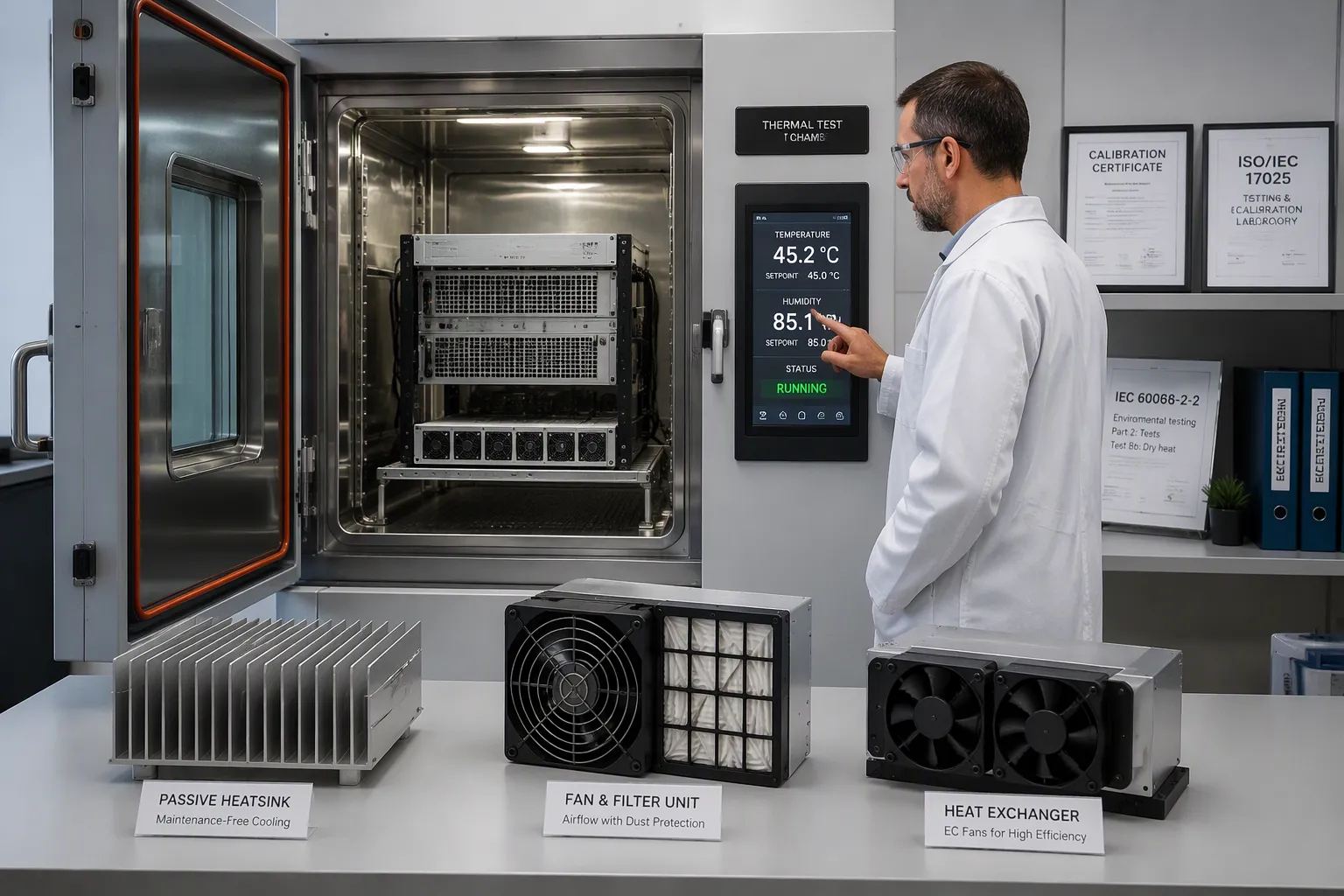
A wide rating means little without proof. Qualification testing places the full system in a thermal chamber and cycles it across the rated span. Cold-start tests confirm the unit wakes up at -40°C after a soak. High-temperature load tests run the system at +75°C ambient under full output and log junction temperatures. Humidity runs check performance at 95% non-condensing humidity, a reference point drawn from photovoltaic telecom systems rated -40°C to 60°C. ISO9001-backed quality control keeps production units matching the tested design.
Standards give you a shared language for these checks. ETSI EN 300 019-1-3 defines environmental classes for telecom equipment, so you can match thermal design to your actual site profile. IEC 60529 defines the IP code, and you should match enclosure and cooling hardware to real dust and water exposure. IP55, IP65, and IP66 are common reference points for outdoor fans. Dusty sites often call for IP65 or better, and desert or sand-storm sites often treat IP66 as a minimum. Coastal sites need more than an IP number, because salt fog demands coating quality and material compatibility too.
Convection vs. Fan vs. Air Conditioning
Each cooling method fits a different heat load. The table below compares them on capacity, power draw, and application fit.
Cooling method | Practical heat-load range | Efficiency / power draw | Application fit | Main limits |
|---|---|---|---|---|
Passive convection | Up to ~300–500 W | Zero energy draw, low complexity | Very low heat loads only | Very limited capacity for sealed 5G cabinets |
~500–1,200 W | Low cost, flexible airflow | Open-cabinet cooling where dust is manageable | Filter loading and dust-ingress risk | |
Heat exchanger with EC fans | ~800–1,500 W | Good balance of protection and efficiency | Sealed-enclosure sweet spot, moderate ambient | Less margin in high ambient and high solar load |
1,200 W+ or high delta-T demand | Higher power draw (compressor systems ~800–1,400 W vs controlled EC ~150–300 W) | High heat load, extreme ambient, large temperature drop | Higher power draw and service complexity |
Cost follows power draw over a five-year horizon. At 3,000 cabinets and USD 0.12/kWh, an EC fan system drawing about 200 W costs roughly USD 210 per cabinet per year, or about USD 3.15M over five years. A compressor AC drawing about 1,000 W costs roughly USD 1,051 per cabinet per year, or about USD 15.77M over the same period. Fan-based modules also cost less to buy, install, and service than packaged AC units.
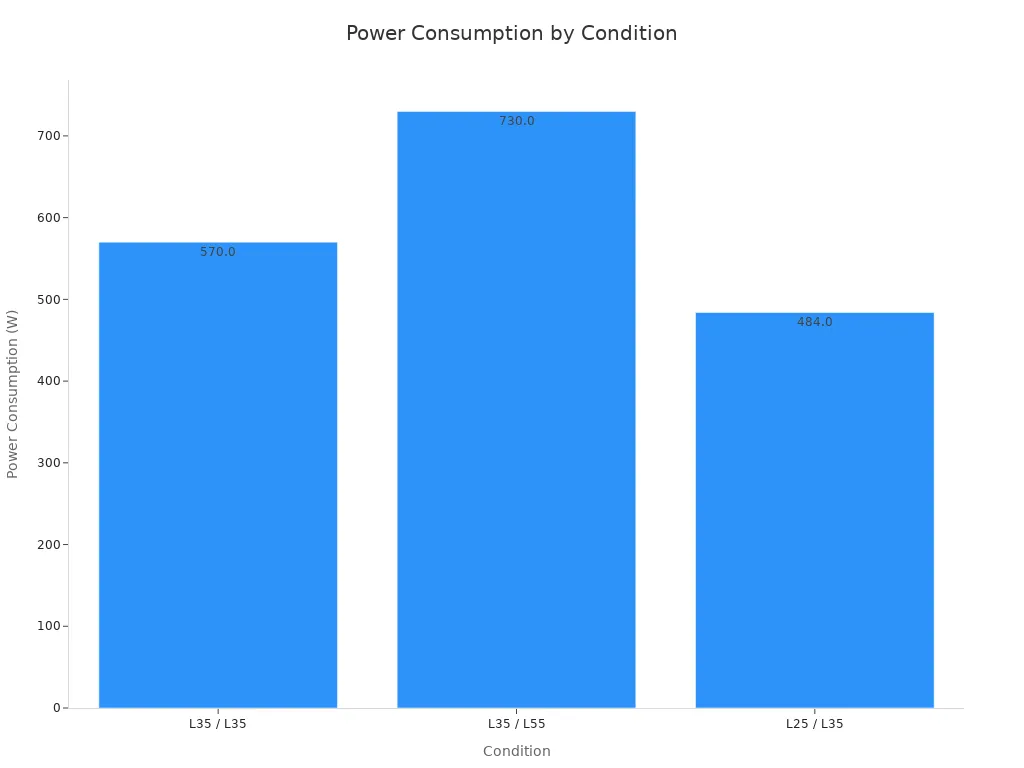
ESTEL's Telecom Power System uses natural cooling for low-load, low-maintenance sites. Its cabinet air conditioners cover the high-load end, with cooling capacity up to 2000 W at L35/L35 and 1350 W at L35/L55, across a working range of -15 to +55 °C.
Stable operation from -40°C to +75°C is an engineered outcome, not a lucky accident. Wide-temperature components carry margin at both ends. Coordinated heating and cooling hold the cabinet inside a workable band. Robust enclosures buffer the ambient extremes, and standards-based validation proves the design holds.
Each strategy earns its place. Components survive the cold start and the hot soak. Heaters protect batteries below freezing, and heat rejection carries the load above +55°C. Match your cooling method to site conditions, load, and cost. No single option wins everywhere.
ESTEL designs and tests Telecom Power Systems against these extremes, so you can specify equipment for harsh climates with confidence.
FAQ
What ambient range should I specify for an outdoor telecom site?
Match the rating to your site record, not to a generic number. A system proven from -40°C to +75°C covers most extreme deployments. Check the cold-start behavior and the full-load hot test separately, because a unit can survive a temperature without starting in it.
Why does a -40°C to +125°C junction rating matter at only +75°C ambient?
The junction runs hotter than the air around it. Power dissipation adds to ambient temperature inside each converter. The extra rating headroom keeps the junction inside its safe band at full load in a hot cabinet, so the module holds output instead of derating.
Do I need active cooling for a low-load remote site?
Not always. Natural cooling suits low-load sites where maintenance visits are rare, and it removes fan failure points. ESTEL's Telecom Power System follows this path with up to 150A output on a 19-inch rack. Higher heat loads call for fan, heat exchanger, or compressor cooling instead.
How do I compare cooling options on cost?
Follow the power draw over the service life. Fan-based modules draw far less energy than compressor units and cost less to buy and service. Compressor air conditioners earn their place at high heat loads and extreme ambient, where passive and fan methods run out of capacity.
Which standards prove a wide-temperature claim?
Ask for thermal chamber cycling, cold-start tests at the low limit, and full-load runs at the high limit. ETSI EN 300 019-1-3 defines environmental classes for telecom equipment, and IEC 60529 defines the IP code. ISO9001-backed quality control keeps production units matching the tested design.
See Also
Ways to Maintain Ideal Temperature Inside Outdoor Telecom Cabinets
Key Features You Should Know About Telecom Power Supplies
Temperature Compensation in Telecom Cabinet Power: It Is Not Really About Temperature
Analyzing Applications of Various Cooling Methods for Telecom Cabinets
Selecting the Optimal Cooling Method for ESTEL Telecom Cabinets
CALL US DIRECTLY
86-13752765943
3A-8, SHUIWAN 1979 SQUARE (PHASE II), NO.111, TAIZI ROAD,SHUIWAN COMMUNITY, ZHAOSHANG STREET, NANSHAN DISTRICT, SHENZHEN, GUANGDONG, CHINA
