What Makes a Telecom Rectifier System Compliant with IEC 60601 Medical Electrical Safety Standards?


A telecom rectifier system meets IEC 60601 rules when it covers three main areas: electrical safety under IEC 60601-1, electromagnetic compatibility under IEC 60601-1-2, and formal risk management with full paperwork. These rules go far beyond normal telecom power certifications.
Medical settings require stricter leakage current limits, reinforced isolation, and single-fault safety. A power failure near a patient can be deadly. Designers must therefore rethink every part of power conversion.
What changes when Telecom Rectifier Systems run near patients or medical equipment? The answer involves tighter component tolerances, extra protective barriers, and strict testing. Engineers cannot just reuse standard telecom hardware. They must check every safety margin against medical-grade limits.
Key Takeaways
To meet IEC 60601, you need three key parts: electrical safety, electromagnetic compatibility, and written risk management. Plan for all three early.
Medical power supplies must have stricter leakage limits than telecom rectifiers, plus stronger insulation to keep patients safe. Designers also have to plan for times when a single part fails.
Regular telecom rectifiers do not meet medical rules for leakage, isolation, and single-fault safety unless they are redesigned. Make every part stronger before it is used on patients.
IEC 60601-1-2 EMC sets strict limits on emissions and immunity based on risk analysis. Use shielding, filtering, and grounding to keep patients safe.
Complete paperwork under ISO 14971 and test reports are key for approval. Start early and use an approved test lab.
ESTEL Telecom Rectifier Systems for IEC 60601 Compliance
IEC 60601-1 is the main safety rule for medical electrical equipment. It sets tight limits on leakage current, requires reinforced isolation, and demands formal risk management. These rules are very different from normal telecom power certifications.
Leakage Current, Isolation, and Dielectric Strength
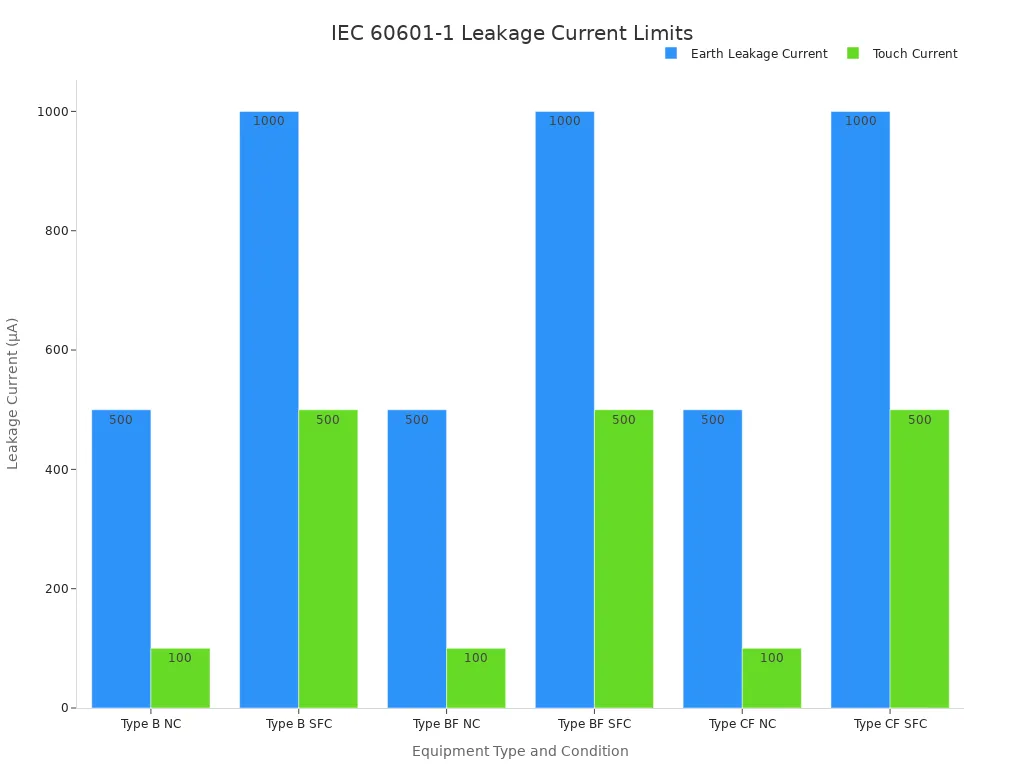
Leakage current limits are one of the biggest differences between telecom and medical power supplies. IEC 60601-1 limits earth leakage current to 500 µA and touch current to 100 µA under normal conditions for Type B, BF, and CF equipment. Under single fault conditions, those limits go up to 1 mA and 500 µA. Permanently installed equipment gets higher allowances of 5 mA in normal condition and 10 mA in single fault condition.
Isolation requirements push designs even further. Medical equipment needs 2 x MOPP (Means of Patient Protection) isolation, which means double or reinforced insulation. The dielectric strength test voltage shows this clearly:
Protection Type | Insulation Level | Dielectric Strength Test Voltage |
|---|---|---|
1 x MOOP | Basic Insulation | 1500VAC |
2 x MOPP | Double / Reinforced Insulation |
IEC 60601-1 requires a 4000VAC dielectric strength test for 2 x MOPP, which means double or reinforced insulation in medical power supplies. This higher test voltage keeps patients safe by stopping high-voltage breakdown and arcing, unlike industrial supplies that are usually tested at only 1500VAC.
ESTEL telecom rectifier systems give engineers a real hardware base they can adapt for medical-site use. The company also provides outdoor telecom cabinets, power distribution systems, and LiFePO4 batteries as supporting infrastructure. These parts work together to build a full power chain for healthcare facilities.
Essential Performance and Risk Management
IEC 60601-1 defines essential performance as "performance of a clinical function, other than that related to basic safety, where loss or degradation beyond the limits specified by the manufacturer results in an unacceptable risk." This definition makes designers figure out which functions must keep working when faults happen.
IEC 60601-1 defines essential performance as "performance of a clinical function, other than that related to basic safety, where loss or degradation beyond the limits specified by the manufacturer results in an unacceptable risk".
Essential performance usually applies to critical care equipment, but it can also apply to less critical equipment. Engineers must do a risk analysis and set performance limits between fully working and total loss in normal and single fault conditions. The risk management file must follow ISO 14971, the international standard for risk management in medical devices.
For telecom rectifier systems used in medical places, this means writing down what happens when a fan fails, when input voltage drops, or when a component shorts. The rectifier must either keep output within set limits or shut down safely without putting patients in danger. ESTEL works under ISO9001 and can provide documentation packages to help a manufacturer's compliance effort.
Medical-Grade Electrical Safety Features
Reinforced Insulation and Single-Fault Protection
IEC 60601-1 requires two separate Means of Patient Protection (MOPP) to prevent electric shock. This keeps patients safe even if one barrier breaks down. Designers can meet this by using double insulation, reinforced insulation, or a mix of insulation and protective earth grounding. For instance, a medical power adapter might use reinforced isolation in its transformer as one MOPP and a grounded metal enclosure as a second MOPP.
Creepage and clearance distances are very important here. Creepage is the distance between two conductive parts along a surface. Clearance is the direct distance through air. These distances depend on the material, working voltage, and air pollution degree. Engineers must plan for the worst case: high pollution and the highest universal AC mains voltage of 264 VAC. For 2 x MOPP, the minimum requirements are 8 mm creepage, 5 mm clearance, and 4000 VAC isolation between input and output terminals. When only operators touch the equipment, 2 x MOOP is enough. When patients could touch the equipment, even by accident, 2 x MOPP becomes required.
Single-fault condition testing goes beyond what normal telecom practice demands. Engineers must simulate any one component failure and check that leakage current stays within limits. This calls for tighter component tolerances and extra protective barriers across the whole power chain.
Component Selection and Y-Capacitor Limits
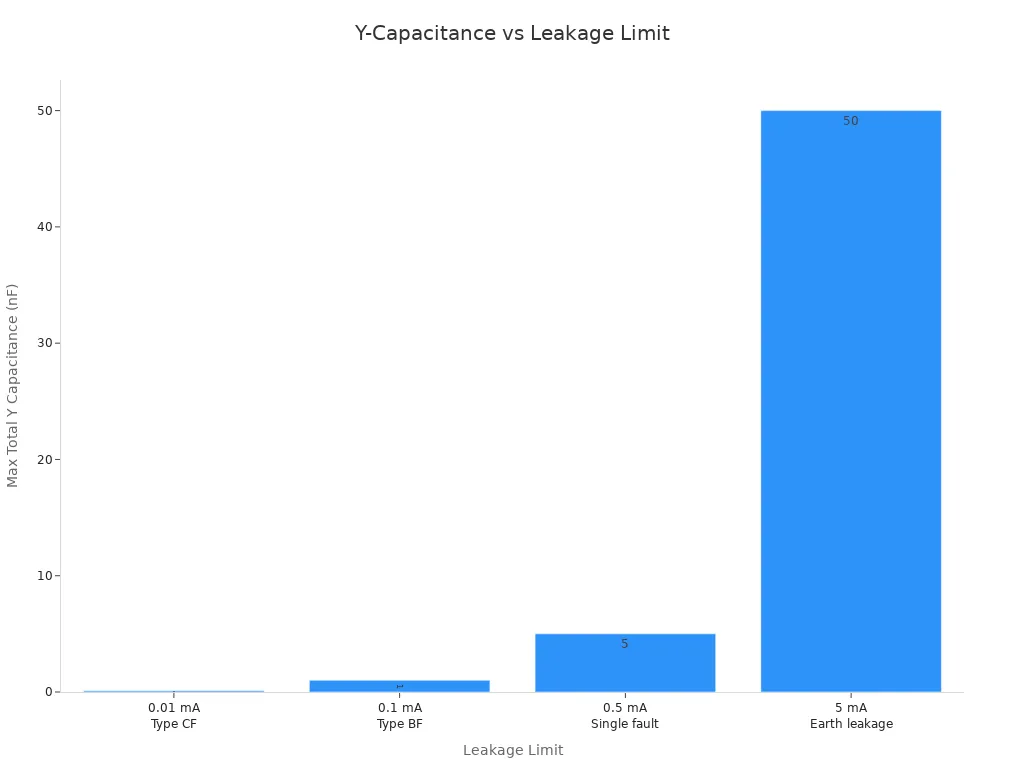
Y-capacitor selection directly controls leakage current. IEC 60601-1 sets strict limits on how much current can flow through a patient or operator. The maximum total Y capacitance depends on the leakage limit:
Leakage Limit | Max Total Y Capacitance | Typical Application |
|---|---|---|
0.1 mA | ~1 nF | Patient monitoring (Type BF) |
0.5 mA | ~5 nF | Single fault condition / general medical |
0.01 mA | ~100 pF | Type CF (direct cardiac contact) |
5 mA | ~50 nF | Earth leakage (permanently connected) |
These values are total system limits. Transformer interwinding capacitance and PCB parasitic capacitance must be subtracted from the budget before choosing discrete Y capacitor values. Engineers figure out the maximum Y capacitor using C = Imax / (2π × f × Vmax), where Imax is the maximum allowed leakage current in amperes, f is line frequency (use 60 Hz for worst case), and Vmax is maximum line voltage (use 264V). For a 0.5 mA limit, this gives about 5.02 nF.
ESTEL outdoor telecom cabinets often include IP55 protection, anti-corrosion powder coating, and thermal management options. These features help rectifiers run reliably in medical or outdoor healthcare sites. Telecom Rectifier Systems from ESTEL give engineers a solid starting point for medical-grade designs.
Electromagnetic Compatibility for Medical Environments
IEC 60601-1-2 is the EMC rule for medical electrical equipment. It sets limits for emissions and requirements for immunity. Group 1 medical devices that do not on purpose make RF energy must meet limits like CISPR 11 or CISPR 32. Professional healthcare places follow Class A limits, while home healthcare places follow stricter Class B limits. Conducted emissions are covered from 150 kHz to 30 MHz, with quasi-peak limits of 79 dB(uV) for Class A and 66 dB(uV) for Class B. Radiated emissions are covered from 30 MHz to 1 GHz, with limits of 30 dB(uV/m) at 10 m for both classes. These requirements are more than what normal telecom-only power expects.
Emission Limits and Shielding Strategies
Engineers use filtering, shielding, grounding, and careful PCB layout to control conducted and radiated emissions. Input filters with common-mode chokes and X-capacitors cut conducted noise on power lines. Metal enclosures and grounded partitions block radiated emissions from switching circuits. Proper grounding keeps noisy power grounds apart from sensitive signal grounds. PCB layout keeps high-frequency switching loops small and puts decoupling capacitors close to IC power pins.
ESTEL builds these EMC measures into Telecom Rectifier Systems and power distribution cabinets. This helps support compliance in sensitive medical settings where electromagnetic interference could disrupt patient monitoring or therapy equipment.
Immunity, ESD, and Transient Performance
IEC 60601-1-2 Edition 4 ties immunity test levels to documented risk analysis. Professional healthcare places need higher immunity levels than home environments. The standard sets electrostatic discharge testing at plus or minus 8 kV contact and plus or minus 2, 4, 8, and 15 kV air. Radiated RF immunity covers 3 to 10 V/m from 80 MHz to 2.7 GHz. Conducted RF immunity covers 3 to 10 V rms from 150 kHz to 80 MHz. These immunity requirements call for strong transient protection, good shielding, and careful grounding. Failure due to EMI in a medical device can be life-threatening, which makes these requirements stricter than those for consumer electronics.
Certification, Labeling, and Documentation Path
Marking, MOPP, and Essential Performance
A compliant medical rectifier has clear markings that show its protection level. Manufacturers must label the equipment with the applied part type, the means of patient protection classification, and the essential performance specifications. These markings tell clinicians and biomedical engineers what safety level the device provides. A rectifier rated for 2 x MOPP shows that designation directly on the nameplate. The label also states whether the device meets essential performance requirements under single fault conditions.
Regulatory bodies in different regions accept IEC 60601-1 through their own adoption paths. The FDA recognizes ANSI/AAMI ES60601-1, the US-adopted version of the international standard. The European Union uses EN 60601-1, which is identical to IEC 60601-1. A manufacturer can submit a declaration of conformity to these standards and eliminate the need to submit the bulk of test data.
"The agency has stated that conformance with recognized consensus standards like IEC 60601-1 can provide a reasonable assurance of safety... a submission can contain a declaration of conformity to that standard and eliminate the need to submit the bulk of test data..."
Country/Region
IEC 60601-1 Adopted As
United States
ANSI/AAMI ES60601-1
European Union
EN 60601-1 (identical to IEC 60601-1); in UK, BS EN 60601-1
Technical Documentation and Regulatory Evidence
A complete technical file includes a risk management file, test reports, and design documentation. The risk management file follows ISO 14971 and documents every hazard analysis, risk estimate, and control measure. Test reports from IEC 60601-1 and IEC 60601-1-2 evaluations provide the evidence that the design meets safety and EMC limits. Notified bodies under EU MDR 2017/745 review this documentation as part of the technical file or design dossier review.
Jurisdiction | Regulatory/Notified Body | Acceptance of IEC 60601-1 |
|---|---|---|
United States | FDA (Recognized Consensus Standards Program) | Recognizes ANSI/AAMI ES60601-1; declarations of conformity accepted in 510(k)/PMA submissions |
United States | FDA ASCA Program | Accepts test results from ASCA-qualified testing laboratories with greater confidence |
European Union | Notified Bodies (under EU MDR 2017/745) | Verify compliance with EN 60601-1, which provides presumption of conformity with Annex I essential requirements |
ESTEL operates under ISO9001 and can supply documentation packages to support a manufacturer's compliance effort. These packages help engineers assemble the evidence that Telecom Rectifier Systems meet medical-grade requirements.
A compliant design controls six things at the same time. These include low leakage current, reinforced isolation, single-fault protection, EMC control, risk management, and complete paperwork. Each one helps the others. If one area is weak, the whole approval can fail.
Engineers should bring IEC 60601 rules into the rectifier design process early. They should also work with an accredited test lab. This saves time and cuts down on rework. ESTEL gives design and paperwork support for Telecom Rectifier Systems made for medical places. The company's hardware supports 2×MOPP, BF-type rating, 4th edition IEC 60601-1-2 EMC, and Class I or Class II grounding choices. These features help engineers build safer power systems for patient care.
FAQ
What is the difference between MOOP and MOPP in IEC 60601-1?
MOOP means Means of Operator Protection. MOPP means Means of Patient Protection. Patients may not be able to resist shock, so they need stronger isolation. A 2 x MOPP design needs double or reinforced insulation and must pass a 4000 VAC dielectric strength test.
Why does IEC 60601-1 limit leakage current so strictly?
Patients may be unconscious or hooked up to internal electrodes. Even small currents can hurt them. IEC 60601-1 caps earth leakage at 500 µA and touch current at 100 µA in normal conditions for Type B, BF, and CF equipment. These limits are much tighter than what telecom standards permit.
How does IEC 60601-1-2 differ from standard telecom EMC requirements?
IEC 60601-1-2 links immunity test levels to a written risk analysis. It calls for higher immunity in professional healthcare places. The standard also sets exact ESD, radiated RF, and surge limits. Telecom EMC rules do not tie test levels to patient risk in this way.
What documents does a medical rectifier need for certification?
A full technical file has a risk management file, IEC 60601-1 and IEC 60601-1-2 test reports, and design documents. The risk management file follows ISO 14971. Notified bodies under EU MDR 2017/745 check these documents. ESTEL can give documentation packages to help with this work.
Can a standard telecom rectifier pass IEC 60601-1 without changes?
No. Standard telecom rectifiers do not meet medical leakage current limits, 2 x MOPP isolation, or single-fault protection rules. Engineers must tighten component tolerances, add protective barriers, and check every safety margin against medical-grade limits. ESTEL rectifier systems give engineers a hardware base they can adapt for medical sites.
See Also
Steps for Guaranteeing Steady Power Delivery in Telecom Cabinets
Learning About Worldwide Regulations for Communication Power Supply Units
Detailed ESTEL Manual for Evaluating Telecom Cabinet Battery Hazards
ESTEL Handbook on Specifications for Telecom Cabinets and Communication Devices
Methods ESTEL Uses to Maintain Correct Voltage in Telecom Cabinets
CALL US DIRECTLY
86-13752765943
3A-8, SHUIWAN 1979 SQUARE (PHASE II), NO.111, TAIZI ROAD,SHUIWAN COMMUNITY, ZHAOSHANG STREET, NANSHAN DISTRICT, SHENZHEN, GUANGDONG, CHINA
