How 48V Telecom Power Cuts TCO Through Energy Efficiency


You get a lower TCO when you run sites on 48v telecom power. Conversion losses shrink, distribution losses shrink, and cooling demand falls. Operational expenses drop every year as a result. That gap compounds over a ten-year horizon.
The physics is simple. Higher current means more heat. Heat costs money twice: once as wasted electricity, once as air conditioning. A 48v bus keeps current moderate for the same load.
ESTEL field data and deployments inform the figures in this article. A worked calculation later lets you apply the same logic to your own load profile.
Key Takeaways
48V power cuts energy waste and cooling costs, lowering your total cost over time.
Fewer conversion steps and lower current mean less heat and higher efficiency.
Measure your site's load profile to pick the right rectifiers and save more.
A 48V lithium-ion battery often costs less over 10 years than lead-acid.
Run a TCO worksheet to compare options and make a clear decision.
Defining Total Cost of Ownership for 48V Telecom Power
The Five Cost Buckets
You can break total cost of ownership into five buckets. Energy covers the electricity your rectifiers and loads draw. Cooling covers the power your air conditioners or heat exchangers consume to remove waste heat. Maintenance covers scheduled service, site visits, and spares. Replacement covers rectifier modules, fans, and batteries over the site life. Installation covers the upfront labor, cabling, and commissioning.
Bucket | What It Covers | When It Hits |
|---|---|---|
Energy | Rectifier and load electricity | Monthly |
Cooling | Air conditioning power | Monthly |
Maintenance | Service visits, spares | Recurring |
Replacement | Modules, batteries | Every few years |
Installation | Labor, cabling, commissioning | Once |
A 48v telecom power architecture touches every bucket. Fewer conversion steps lower the energy line. Lower heat lowers the cooling line. Both effects reduce stress on components, which softens maintenance and replacement costs.
Why Opex Dominates Over Time
Upfront capex feels large on the purchase order. The recurring lines usually outweigh it across a 5–10 year horizon. Energy and cooling run every hour of every day. A small efficiency gain compounds across thousands of operating hours.
Run a simple tco analysis and the pattern appears. Installation is a one-time event. Energy and cooling are continuous. A site that saves a modest amount per hour accumulates meaningful long-term savings over a decade. This is why the 48v bus matters for TCO. The efficiency gain lands in the buckets that never stop running.
You should treat the five buckets as a single system. A cheap rectifier with poor part-load efficiency can cost more in energy than a better unit costs upfront. The same logic applies to cooling. Waste heat from conversion losses becomes an air conditioning bill. Track all five buckets together, and the tco picture becomes clear.
Why 48V Architecture Is Inherently Efficient
Fewer Conversion Steps, Lower I²R Losses
Every conversion step wastes energy. A rectifier turns AC into DC. A DC-DC converter changes one DC level to another. Each stage loses a slice of the power you paid for. The 48v DC topology keeps those stages to a minimum. You convert once at the plant, then distribute DC straight to the load.
Distribution losses follow a simple rule. Loss rises with the square of the current for a fixed conductor resistance. Double the current, and you quadruple the loss. A 48v bus carries roughly one quarter the current of a 12v bus at the same power level. That difference matters across long cable runs and busy sites.
The -48V distribution scheme is the global telecom standard. It balances safety, efficiency, and standardization. The voltage sits low enough to be manageable for technicians. It sits high enough to keep currents moderate. Standard equipment, connectors, and batteries all follow this convention. You gain interoperability and predictable energy efficiency from day one.
The ESTEL Telecom Power System shows how this works in practice. It accepts a wide 90–300 Vac input, so it tolerates unstable grid conditions. Natural cooling removes the need for fans and their parasitic load. You can install it on a standard 19-inch rack or inside a cabinet. Multiple communication ports support remote monitoring and integration. All of these features support a lean, low-loss 48v telecom power path.
Part-Load Efficiency and Power Factor Correction
Sites rarely run at full load. A rectifier spends most of its life at part load, so the efficiency curve at 30 to 80 percent matters more than the peak figure. A well-matched 48v system holds higher efficiency across that band. You should size rectifiers to the real load profile, not to a nameplate maximum.
Power factor correction shapes the other half of the energy story. Modern telecom power systems with active PFC synchronize the current waveform with the voltage waveform. Active PFC using high-frequency switching converters, such as a boost topology, can achieve a power factor greater than 0.99. Total system power factor lands close to a near-perfect 0.99. A high power factor means less reactive current, smaller apparent power draw, and lower losses in upstream wiring.
Together, part-load efficiency and PFC decide how much of your metered electricity reaches the load. A 48v design that performs well on both fronts turns more input power into useful output. That is the core of telecom power energy efficiency. Fewer conversion steps, moderate currents, and a near-unity power factor compound into savings that show up on every bill.
Quantifying Energy Savings at Real Sites
Reading Rectifier Efficiency Curves
A rectifier efficiency curve plots output power against input power across the load range. You read it left to right, from light load to full load. The curve usually rises steeply at low load, flattens through the middle band, and dips slightly near 100 percent. The flat middle band is where you want your site to operate.
Match the curve to your site's actual load profile. A site that draws 40 percent of rated capacity most of the day should sit on the flat part of the curve. The table below shows an illustrative pattern you can expect from a well-matched 48v system.
Load (% of rated) | Efficiency (illustrative) |
|---|---|
30% | Lower, curve still rising |
50% | Near the flat band |
80% | Peak region |
100% | Slight dip |
Pull the real numbers from your rectifier datasheet. Compare two candidate units at your site's dominant load point, not at nameplate peak. That single comparison often decides the energy efficiency question.
Load Profiles and AI Optimization
Energy-efficient upgrades and AI-driven optimization deliver 10–30% emissions reductions per network. A North American operator used an energy-focused digital twin to cut annual energy costs by more than $100 million. The lesson is direct: measure the load profile, then optimize against it.
A digital twin models each site's draw hour by hour. You can test rectifier sizing, battery dispatch, and cooling setpoints before you touch hardware. The 48v bus makes this easier, because DC plant data is already granular and standardized. Run the model, find the savings, then fold them into your tco worksheet.
How Energy Savings Cut Cooling Costs
Heat Load and PUE Basics
Every watt a rectifier wastes becomes heat inside the cabinet or shelter. Your cooling equipment must then remove that heat, and it draws extra electricity to do so. This creates a double penalty: you pay for the wasted power and again for the cooling power. A 48v architecture shrinks both lines at once, because fewer conversion steps mean less waste heat released into the enclosure.
Power usage effectiveness, or PUE, measures this relationship. You calculate it as total facility power divided by the power delivered to the load. A lower PUE means less overhead spent on cooling and distribution. Efficient 48v conversion lowers the heat load, which pulls PUE down and improves the tco picture across the site's life. Track PUE before and after any upgrade to confirm the gain.
Estimating Cooling Savings per Site
Start with the waste heat figure. Subtract rectifier output power from input power at your dominant load point. That difference is the heat your cooling system must remove. Multiply it by your cooling system's coefficient of performance to estimate the extra electrical draw. Use the datasheet efficiency at your real load, not at nameplate peak.
Then apply your local electricity rate and annual operating hours. Compare the result against an alternative configuration with lower conversion efficiency. The gap between the two cooling estimates is your annual saving. Add it to the energy saving from the rectifier itself, and the combined figure feeds directly into your cost worksheet. Small per-site savings multiply quickly across a network, so sample a few representative sites first.
Maintenance, Reliability, and the 48V Lithium Ion Battery
Lower Heat, Longer Component Life
Heat is the quiet enemy of every power component. A rectifier that runs cooler lasts longer. Raising rectifier efficiency from 92% to 98% cuts wasted power, which directly lowers heat generation, reduces cooling demand, and extends equipment lifespan. You get the same benefit from modern semiconductor choices. GaN and low-RDS(on) MOSFETs lower switching and conduction losses, and they run 40–60°C cooler than silicon parts. That temperature gap translates into fewer failures and steadier performance.
A 48v lithium ion battery adds another layer of thermal relief. Telecom-grade Li-ion cells are 99.9% efficient, so they release far less heat during charge and discharge than older chemistries. This is one reason operators choose lithium-ion instead of lead-acid batteries. Lead-acid batteries generate more heat and demand more frequent replacement. A 48v lithium ion battery in modern telecom networks pairs higher energy density, longer lifespan, and greater efficiency with that cooler operation. Smart thermal management, including modular heat sinks and careful placement, keeps the whole cabinet within a safe range.
Fewer Truck Rolls and Spares
Lower heat means fewer site visits. Cooler rectifiers and cabinet components age more slowly, so you replace modules less often and carry fewer spares. Predictive maintenance and temperature monitoring catch thermal problems before they cause outages. This reduced maintenance burden shows up directly in your tco.
The 48v lithium ion battery technology behind modern battery backup systems reinforces the trend. A battery management system watches cell voltage and temperature continuously. Compact, modular 48v lithium designs simplify swaps and cut downtime. Efficient energy storage systems built on 48v lithium-ion systems deliver lower maintenance costs across the site life. You still see lead-acid batteries at many legacy sites, and they remain a workable option. Yet the 48v lithium ion battery now anchors most new battery backup systems. Each of these gains compounds, and the 48v lithium ion battery keeps proving its value.
Batteries vs Generators Over 10 Years
Fuel, Runtime, and Maintenance Trade-offs
A diesel genset burns fuel every hour it runs. A 48v lithium ion battery bank consumes no fuel at all. That single difference shapes the whole comparison. Fuel, delivery, and storage costs recur for a decade on a generator. A battery bank pays once at installation and then draws only the energy it stores.
Runtime tells the other half of the story. A generator runs as long as fuel lasts, which suits long outages. A 48v lithium ion battery covers short, frequent outages with instant response and no startup delay. Pair the two and you get a hybrid 48v lithium-ion battery system. The battery carries short events, and the genset starts only for extended ones. Li-ion efficiency enables reduced genset run time, which cuts fuel consumption and therefore costs in the tco analysis.
Maintenance separates the options further. Generators need oil changes, filter swaps, fuel polishing, and periodic load tests. A 48v lithium ion battery needs little beyond monitoring. Its battery management system tracks cell voltage and temperature continuously. That reduced maintenance lowers site visits across the decade.
Factor | 48V Li-ion bank | Diesel genset |
|---|---|---|
Fuel | None | Recurring |
Runtime | Short to medium events | Long outages |
Maintenance | Monitoring only | Scheduled service |
Replacement | Periodic cell aging | Overhaul cycles |
48V DC integration | Direct | Needs rectifier |
When Each Backup Option Fits Best
Match the option to the site. A 48v lithium ion battery suits urban and suburban sites with reliable grids and short outages. It integrates directly with 48v DC plants, so no extra conversion stage appears. Modern battery backup systems also fit remote sites where fuel delivery is costly or unreliable.
Generators still earn their place. Sites facing multi-day outages, extreme climates, or weak grids benefit from unlimited runtime. Many operators combine both. Battery backup systems handle the first hours, and the generator covers the rest. This pairing meets telecom backup power requirements at sites with mixed risk profiles.
Run a 10-year financial analysis before you decide. Compare fuel, service, replacement, and integration costs side by side. A 48v lithium ion battery often wins on total cost at short-runtime sites. A generator wins where runtime is the binding constraint. Older lead-acid batteries remain common at legacy sites, yet lead-acid batteries carry heavier maintenance and shorter life. Many operators now replace lead-acid batteries with 48v lithium-ion systems. The right answer depends on your outage profile, not on a single rule.
48V Telecom Power vs. Other Voltages
Technical Performance and Application Fit
Voltage choice shapes efficiency, component count, and line loss. The table below compares the main options on the factors that matter at a site.
Aspect | 48V DC | 24V DC | 60V DC |
|---|---|---|---|
Conversion efficiency | 92–96% | 85–88% | Acceptable, higher-rated parts |
Line loss (100W, 200m) | 7.3% | 29.4% | Lower than 48V |
Standardization | De facto telecom standard | Legacy option | Limited |
Safety | Below 60V SELV threshold | SELV-compliant | Near SELV boundary |
A 48v bus sits in an efficiency sweet spot across a 36–72V input window. Higher current at 24V drives the 29.4% line loss figure, roughly four times the 48V result. A 60V design needs higher-rated components, which adds cost. A 12V bus suits small enclosures with short runs and light loads. A 400V DC bus fits high-power, data-center-adjacent loads where minimal line loss offsets costly conversion hardware.
Compliance, Cost, and Best-Fit Scenarios
The -48V standard traces back to early telephone systems. Proven reliability made it the default, and existing infrastructure makes switching costly. The voltage stays below the 60V SELV threshold under IEC rules. Contact current stays under 48mA, far below the fatal 50mA level. Negative polarity also limits corrosion of metal parts, which extends equipment life.
Match each voltage to its job. Use 12V for small enclosures, 24V for legacy sites with existing plants, and 400V DC for high-power loads. For conventional telecom sites, 48v telecom power remains the best fit. It avoids AC-to-DC conversion losses, because equipment runs natively on DC. Batteries store DC, so backup integration stays simple. Factor these gains into your tco model, and the 48v case usually holds. Every telecom power decision should start with the load profile, then the voltage that serves it best.
A Step-by-Step TCO Calculation
Building the Input Assumptions
Start with the reference configuration. The ESTEL Telecom Power System accepts 90–300 Vac, uses natural cooling, and installs on a standard 19-inch rack. Natural cooling removes fan power from the load, so the input assumptions stay clean.
You need six inputs. First, site load in watts, measured hour by hour. Second, your electricity rate per kWh. Third, PUE, which you read from site records. Fourth, annual maintenance cost. Fifth, replacement cost and interval. Sixth, a 10-year discount rate, which converts future spending into today's money.
Treat PUE as a measured value, not a guess. A site with natural cooling and efficient conversion carries a lower PUE than a shelter with mechanical air conditioning. The discount rate reflects your cost of capital. A higher rate penalizes late spending, which favors options with low replacement frequency.
Write each input in a column. Keep the 48v case and the alternative side by side. Use the same load profile for both, or the comparison loses meaning. Document the source of every figure, because a reviewer will challenge the weak ones first.
Running the Numbers and Reading the Result
Now run the worksheet. Multiply site load by hours per year, then divide by rectifier efficiency at your dominant load point. Multiply that result by PUE. Multiply again by your electricity rate. That figure is annual energy cost. Repeat the step for the alternative voltage.
Add maintenance and replacement spending for each year. Discount each year back to present value. Sum the discounted lines. The difference between the two columns is your TCO delta.
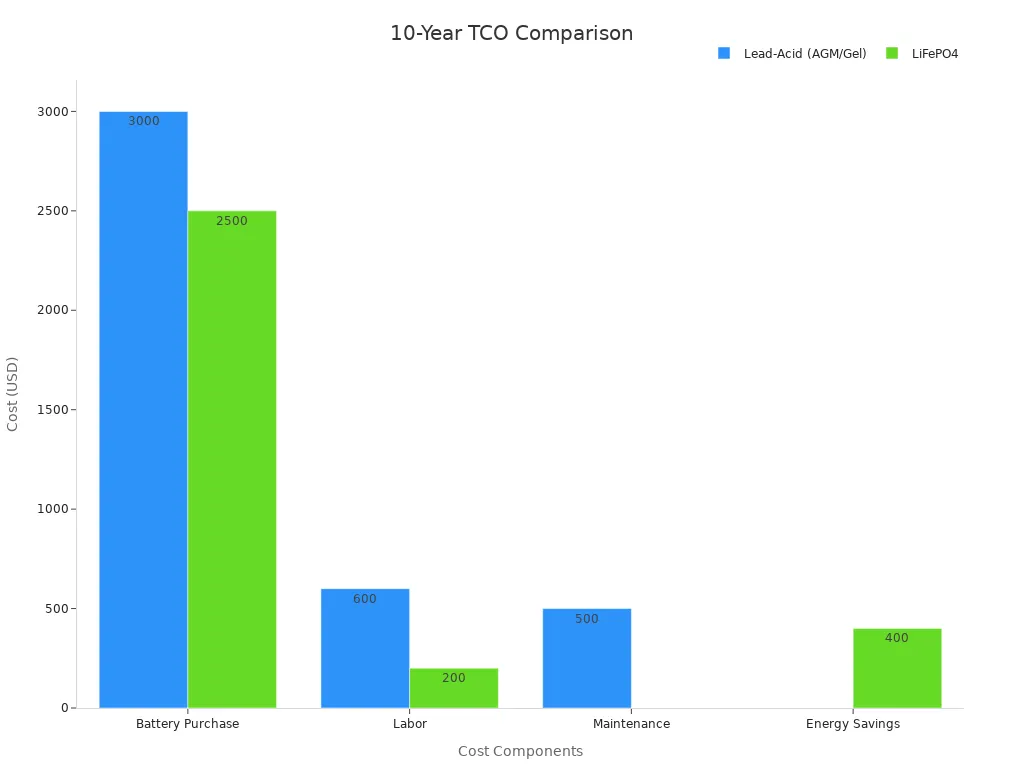
The battery line often dominates. A 10-year comparison of a 48V 100Ah bank shows the pattern. A lead-acid bank costs about $1,000 upfront, lasts 3–5 years, and needs two replacements. Total purchase reaches $3,000, labor adds $600, and maintenance adds $500. Estimated 10-year TCO lands near $4,100. A LiFePO4 bank costs about $2,500 upfront, lasts 10–15 years, and needs no replacement. Labor adds $200, maintenance adds nothing, and higher charging efficiency saves roughly $300–$500. Estimated 10-year TCO lands near $2,400–$2,700.
Read the result in two ways. Look at the absolute TCO for each option, then at the delta between them. A small delta means the decision rests on other factors, such as site constraints or legacy equipment. A large delta gives you a clear answer. Check the sensitivity too. Raise the electricity rate and the efficiency gap widens. Lower the discount rate and replacement costs weigh more heavily.
A comprehensive tco analysis applies the same framework to voltage choice. Substitute each system's unit prices, lifespans, labor events, and efficiency figures. Keep the 10-year horizon constant. This total tco view turns scattered line items into one number you can defend. Run the tco analysis once, and the 48v case usually delivers significant long-term savings. Those savings justify the 48v investment at most conventional telecom power sites. A disciplined worksheet also exposes weak assumptions before you commit capital.
Efficiency drives the whole story. A 48v bus trims conversion and distribution losses, and that gain lowers both energy and cooling spend. Those two lines move tco more than any upfront price difference.
Voltage choice still depends on your site. Load size, site type, and legacy infrastructure all shape the answer. For conventional telecom sites, 48v telecom power usually fits best. Other voltages serve different applications well.
Take one practical step next. Collect your site load profiles and rectifier efficiency data, then run the worksheet from the previous section. You can also contact ESTEL for site-specific evaluation support and reference deployments.
FAQ
Does a 48v plant really lower my electricity bill?
Yes. A 48v bus cuts conversion and distribution losses, so more metered power reaches your load. Lower waste heat also trims cooling draw. Both savings recur every hour, which is why they move TCO more than the upfront price.
How do I size rectifiers for best part-load efficiency?
Measure your site load hour by hour first. Then compare candidate rectifiers at your dominant load point, not at nameplate peak. A unit that holds efficiency through the 30–80% band usually beats one with a higher peak figure.
Is a 48v lithium ion battery worth the higher upfront price?
Often, yes. Telecom-grade Li-ion cells run at 99.9% efficiency and release less heat than lead-acid. A 10-year comparison in this article puts a LiFePO4 bank near $2,400–$2,700 against roughly $4,100 for lead-acid.
Can I keep my diesel generator alongside battery backup?
You can, and many operators do. The battery carries short, frequent outages with no fuel and no startup delay. The genset starts only for extended events. That hybrid approach cuts fuel consumption and genset run time.
Which voltage suits a small enclosure or a legacy site?
Match voltage to the job. Use 12V for small enclosures with short runs, 24V for legacy plants, and 400V DC for high-power loads. For conventional telecom sites, a 48v architecture usually fits best.
See Also
Calculating Telecom Cabinet Power Systems and Battery Methods
Essential Features of Telecom Power Supplies You Should Know
Photovoltaic Energy Storage Power Systems for Telecom Cabinets
Ensuring Reliable Power Supply for Telecom Cabinets
Grid-Connected Photovoltaic Inverter and Battery Systems for Telecom Cabinets
CALL US DIRECTLY
86-13752765943
3A-8, SHUIWAN 1979 SQUARE (PHASE II), NO.111, TAIZI ROAD,SHUIWAN COMMUNITY, ZHAOSHANG STREET, NANSHAN DISTRICT, SHENZHEN, GUANGDONG, CHINA
