How to Deploy Smart PDUs in a Hybrid Cloud Environment for Elastic Data Management Across Private and Public Clouds


You can deploy smart PDUs in a hybrid cloud environment through four phases: plan, deploy, achieve elasticity, and optimize. Metered power and environmental data from these units drive cross-cloud capacity decisions, so you can shift workloads where power headroom and conditions favor them.
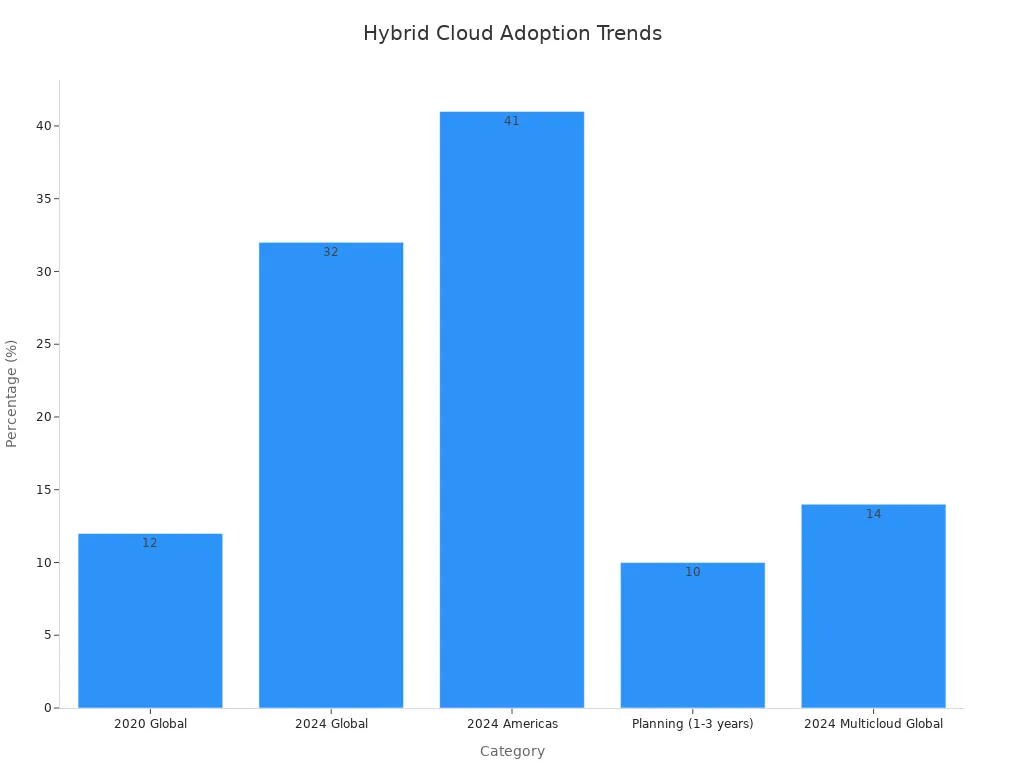
Hybrid cloud adoption reached 32% globally in 2024, up from 12% in 2020, per the Nutanix 2024 Enterprise Cloud Index. That growth raises the stakes for power visibility.
Metric | Value |
|---|---|
Hybrid cloud adoption, 2020 (global) | 12% |
Hybrid cloud adoption, 2024 (global) | 32% |
Hybrid cloud adoption, 2024 (Americas) | 41% |
This post gives you concrete steps, introduces ESTEL's Smart Power Distribution Unit, and covers performance, fit, compliance, and cost.
Key Takeaways
Follow a four-phase plan: assess power needs, deploy units, automate data flow, and optimize with best practices.
Measure actual power draw per device and add 20% headroom to avoid overloading your PDU.
Connect PDU data to your cloud management platform for real-time power and environmental monitoring.
Use policy rules to automatically move workloads based on power and humidity readings.
Start with a pilot rack to test your setup before scaling to more racks.
Plan the Smart PDU Deployment
Assess Power and Data Needs
Start with the rack. Measure the actual power draw of each device, not the nameplate rating, and record peak and average load per outlet group. Add the telemetry you need: per-outlet current, voltage, and environmental readings such as humidity. These numbers tell you how many outlets and what input capacity the rack requires.
Next, map where each workload runs. The table below shows how placement decisions shape your power and data plan.
Environment | Best-fit workloads | Decision signals | Tradeoffs |
|---|---|---|---|
Public cloud | Mobile-facing apps; resource-intensive processing and storage | Elastic demand, broad access, limited device compute | Data movement, transaction delays, WAN costs |
Private cloud | Sensitive data; strict privacy or regulatory workloads | Dedicated resources, stronger control, regulatory constraints | Less placement flexibility; integration still needs design |
On-premises | Workloads with local dependencies or proximity needs | Low-latency interaction, local systems, controlled data movement | Less flexible scaling than cloud |
Ask four questions for every workload: How sensitive is the data? How much latency can the app tolerate? Does demand change materially over time? How much data must move between the workload and its users, systems, and storage? Your answers determine which racks need smart metering and which can stay simple.
Select ESTEL Smart Power Distribution Unit
Match the hardware to the plan. ESTEL's Smart Power Distribution Unit fits racks that need metered, remotely managed power in a compact footprint. It accepts a maximum input current of 16A and provides 8 ways of output, so you can size it to the load you measured. The LCD display lets you verify readings on site during commissioning.
The unit includes surge protection and overload protection, which helps in humid or poorly conditioned rooms. Its plug is an AC input 16A/2P×1, and the 482×180×88 mm form factor suits standard rack depths. Review the full specification at https://www.outdoortelecomcabinet.com/supplier-151193-smart-power-distribution-unit before you finalize quantities. Smart PDUs at this tier suit edge closets and small-to-mid racks; larger facilities may pair them with higher-capacity units.
Deploy Smart PDUs Step by Step

Install and Configure Units
Mount each unit in the rack and plan the load before you connect anything. Calculate peak power consumption and choose a PDU with at least 20% headroom to avoid overloading. Use an N+1 redundancy model so a spare unit takes over immediately if one fails. Match outlet types and counts to current equipment, and leave spare capacity for future growth. Power each rack from two sides (A and B feeds) with dual-corded equipment. Plan for single-feed outage scenarios so one feed failure does not overload the other. Select intelligent units for real-time tracking of power consumption, load balancing, and environmental conditions such as temperature and humidity. A rack-level static transfer switch rated 16–63 A, single phase, with under 10 ms transfer, provides seamless failover between redundant AC sources.
Cable work rewards discipline. Label both ends of every cable with device names, ports, or functions. Use distinct colors for power and data, bundle runs with ties or Velcro straps, and keep power and data cables separated to minimize electromagnetic interference. Route cables away from high-traffic areas, install trays or raceways, and leave service loops so future adjustments do not require reinstallation. Use organizers, clips, and hooks to secure cables within the rack. Document every connection in diagrams and audit the rack periodically to remove obsolete cables. Keep a current cable map for troubleshooting.
For addressing, assign IP addresses via DHCP and run a script or management tool for mass configuration. This approach scales well, but it depends on working patch cables, provisioned switch ports, and routed PDU subnets. Many teams instead load a device list onto a USB drive. The unit verifies administrative privileges and applies static settings keyed by serial number, including a /24 subnet mask, gateway, NTP and DNS servers, and SNMP community strings. Keep a record of assigned addresses so you can reconcile the device list against the DHCP lease table. After power-up, verify readings on the LCD display before you trust remote data.
Integrate with Cloud Management
Connect PDU telemetry to your hybrid cloud management platform — VMware Tanzu, Red Hat OpenShift, Google Anthos, or Azure Arc. Each platform ingests power and environmental metrics through an agent or API, so per-outlet current and humidity readings appear beside workload health. Route this traffic over secure private connectivity, such as PrivateLink-style private endpoints, so power and environmental data never traverse the public internet. This keeps metering data inside your trust boundary and simplifies compliance reviews. Map each PDU to a workload tag so capacity reports align with application owners.
Where the primary network path is fragile, add redundant communications through out-of-band management devices such as serial consoles or KVM switches. Management access survives a network outage, and you keep visibility into rack conditions. Some deployments use a self-configuring mesh gateway that exposes all sensor data through a single IP address and encrypts the hardwired side with 128-bit encryption. Test failover before you rely on it, and confirm that Smart PDUs report correctly after a switchover. Document the failover procedure and review it after each network change.
Achieve Elastic Data Management

Elasticity means capacity follows demand without a ticket or a meeting. You write the rules once, and the system moves power and data on its own.
Automate Power and Data Flow
Set policy thresholds per rack and per workload. A per-outlet current reading above your ceiling can trigger a workload migration to a public cloud region with headroom. A humidity reading outside range can trigger a cooling adjustment or a data-tier move. Write these rules as policy-as-code so they behave identically on-premises and in the cloud.
Automation stalls when data lives in silos. The table below pairs common obstacles with practical fixes.
Challenge | Solution |
|---|---|
Data silos block a unified view | Unified observability platforms that aggregate monitoring, logging, and tracing |
Tool sprawl adds complexity | Consolidated platforms and open standards such as OpenTelemetry |
Manual monitoring slows response | Automated orchestration across cloud environments |
Anomalies hide in distributed flows | AI/ML models that detect anomalies in real time |
Inconsistent security and compliance | Unified security tools, encryption, access controls, automated compliance checks |
Inefficient provisioning | AI-driven automation of provisioning and deployment |
Protect the automated flow with encryption at rest and in transit, identity and access management with multi-factor authentication and role-based access control, and secure VPNs and firewalls between public and private components. Add continuous compliance monitoring with real-time deviation alerts. Feed logs into a SIEM solution that aggregates and analyzes data from multiple sources. Include disaster recovery planning and vendor management so third-party security aligns with your policy.
Build the governance layer in sequence. Inventory every system and data source, document the flows between them, and map compliance obligations to data types. Define governance objectives and KPIs aligned with business priorities. Stand up a centralized data catalog that auto-discovers and classifies data regardless of location. Apply unified policy management so you define policies once and enforce them everywhere. Add automated data quality monitoring with named data stewards who resolve issues where the data sits. Finish with end-to-end encryption, centralized key management, unified audit logs, and automated compliance checks. Review the whole policy set on a fixed schedule, because thresholds drift as workloads change.
Scale Smart PDUs Across Clouds
Telemetry turns expansion from guesswork into arithmetic. When a private-cloud cluster approaches its power ceiling, the trend line from your Smart PDUs shows how much headroom remains and how fast it is shrinking. You can then decide whether to add a rack locally or burst the workload to an IaaS site. The same data shows which public cloud region offers the coolest intake conditions for a given month.
Track three signals per site: sustained load as a share of rated capacity, thermal headroom, and the rate of change in both. A site with flat load and rising temperature needs cooling work, not more servers. A site with rising load and stable temperature is a candidate for elastic expansion. Keep the headroom margin you set during planning, and let measured demand — not forecast alone — drive cluster growth. Feed these signals into your capacity model so each new node lands where power and cooling already support it.
Best Practices and Considerations
Performance, Fit, and Compliance
Start with clear objectives. Define what each workload needs from power, latency, and data locality before you buy hardware. Then manage every site the same way. Consistent management means one policy set, one monitoring view, and one firmware baseline across private and public clouds. Security and compliance belong in that baseline from day one, not after the first audit. Data integration ties it together: telemetry, logs, and capacity records must flow into the same platform so you can compare sites fairly.
Fit decides placement. Public cloud suits elastic, mobile-facing workloads with broad access needs. Private cloud suits sensitive data and strict regulatory workloads. Neither option wins everywhere, so match each workload to the environment that serves it best.
Compliance verification at procurement prevents failed inspections and forced rework. The table below lists the standards that matter for smart PDUs.
Compliance Standard | Category | Relevance to Smart PDUs |
|---|---|---|
IEC 62368 | Electrical safety | Required safety certification for PDU equipment |
UL 2900-1 | Cybersecurity | Software and firmware cybersecurity certification |
IEC 62443-4-2 | Industrial cybersecurity | Component-level security requirements for control systems |
ISO 9001 | Quality management | Quality management system certification |
UL listing | Product safety | General product safety listing |
"In addition to being able to remote power on/off devices, smart PDUs provide the ability to gain insight into energy consumption allowing you to measure and manage it." — Cisco PENN 1 Hybrid Work case study
Cost Control and ESTEL Support
Estimate payback before you scale. A worked example shows a smart PDU at $1,200 plus $200 installation, or $1,400 upfront. Monthly energy savings of $100 and downtime savings of $50 give $150 in total monthly savings, so payback arrives in about 9.3 months. Treat that as a best case. Payback horizons for intelligent PDUs can exceed three years in price-sensitive regions, so model your own numbers.
ESTEL's ISO9001 focus supports consistent manufacturing quality across units. The company also states compliance with UL, CE, IEC, and ISO9001 standards. Its support team works closely with customers to resolve integration issues quickly and keep systems running. Use that support during your pilot, and confirm certification documents for your region before you commit to a full rollout.
You now have a four-phase roadmap: plan the deployment, deploy the units step by step, achieve elastic data management, and optimize with best practices. Follow the sequence and each phase builds on the last.
Four factors decide success. Assess your power and telemetry needs accurately. Integrate cleanly with your cloud management platform. Let policy-driven automation move power and data. Keep watching performance, compliance, and cost as workloads change.
Start small. Pilot one rack with an ESTEL Smart Power Distribution Unit, validate the telemetry against your LCD readings, and confirm the data reaches your management platform. Scale Smart PDUs only after that pilot proves your thresholds and policies work.
FAQ
How many outlets do you need for a rack?
Count every device plug, then add spare capacity for growth. ESTEL's Smart Power Distribution Unit provides 8 ways of output. Match the count to your measured load and leave room for future equipment.
Can you monitor and control the PDU remotely?
Yes. The unit supports remote management, so you can track power distribution and environmental readings from a distance. The LCD display lets you verify the same readings on site during commissioning and troubleshooting.
What does the dehumidifying function do?
It helps maintain suitable operating conditions inside the rack. This matters in humid rooms or poorly conditioned spaces. Pair it with your environmental monitoring so humidity trends appear beside power data in your management platform.
How much headroom should you plan for?
Choose a PDU with at least 20% headroom above peak power consumption. Use an N+1 redundancy model and dual A and B feeds. A rack-level static transfer switch rated 16–63 A with under 10 ms transfer supports seamless failover.
Should you pilot before scaling?
Yes. Pilot one rack, then compare the telemetry against your LCD readings. Confirm the data reaches your management platform and that your policy thresholds behave as expected. Scale only after the pilot proves the design works.
See Also
Understanding ESTEL PDUs And Their Function In Data Center Cabinets
ESTEL Smart Microgrid Integrated Energy Storage System For Telecom Cabinets
Solar Photovoltaic Energy Storage Power System For Telecom Cabinet Applications
Simple Cable Organization Methods For Data Center Cabinet Management
Optimizing Outdoor Cabinets Using Power Cooling And Monitoring Solutions
CALL US DIRECTLY
86-13752765943
3A-8, SHUIWAN 1979 SQUARE (PHASE II), NO.111, TAIZI ROAD,SHUIWAN COMMUNITY, ZHAOSHANG STREET, NANSHAN DISTRICT, SHENZHEN, GUANGDONG, CHINA
