How to Achieve Collaborative Heat Dissipation and Power Optimization with Smart PDU and AC Linkage


Smart PDU-AC linkage achieves collaborative heat dissipation and power optimization. It does this by dynamically matching cooling output to real-time power usage in high-density cabinets. You get three payoffs. First, energy savings grow as cooling tracks actual load. Second, thermal performance improves. Third, reliability rises. This matters because cooling equipment accounts for roughly 38% of an average data center's total energy consumption. A Smart PDU makes that link possible at the rack level. One practical question remains. How does the linkage work in practice, and how can you deploy it in your own facility? The answer starts with understanding the connection itself.
Key Takeaways
Smart PDU-AC linkage saves energy by matching cooling to actual power use.
It keeps rack temperatures stable and reduces hot spots.
Early warnings from monitoring prevent downtime and protect equipment.
Start with a pilot cabinet to test and tune the system before scaling.
Choose compatible hardware and open protocols for a smooth setup.
Smart PDU-AC Linkage Explained
What the Linkage Is
Smart PDU-AC linkage is a real-time communication and control connection between intelligent power distribution units and air conditioning systems. The PDU measures power draw at the rack. The AC unit receives that data and adjusts its cooling output to match. Think of it as a feedback loop: power usage rises, cooling responds, and the two stay in step.
This connection replaces fixed cooling settings with dynamic ones. A traditional setup cools a cabinet according to a preset temperature target. A linked setup cools according to what the equipment actually draws. That difference matters because cooling accounts for roughly 38% of an average data center's total energy consumption. HVAC optimization is therefore one of the largest efficiency levers you have.
Why High-Density Cabinets Need It
Rack densities keep climbing. Industry surveys show average rack density rising from 7 kW per rack in 2021 to 16 kW per rack by 2025, with growth concentrated in the 10–30 kW range. AI workloads push far beyond that. A fully loaded rack of NVIDIA H200 servers draws roughly 40–50 kW, a B200 rack about 130 kW, and next-generation racks may reach 240 kW.
Static cooling setpoints cannot keep pace with loads like these. A fixed setpoint sized for peak draw wastes energy during lighter periods. It also risks hot spots when power spikes faster than cooling reacts. Linkage solves both problems. The Smart PDU reports actual draw, and the AC unit scales its output accordingly. You get cooling that follows the load instead of guessing at it.
How Smart PDU-AC Linkage Works
Real-Time Power Monitoring
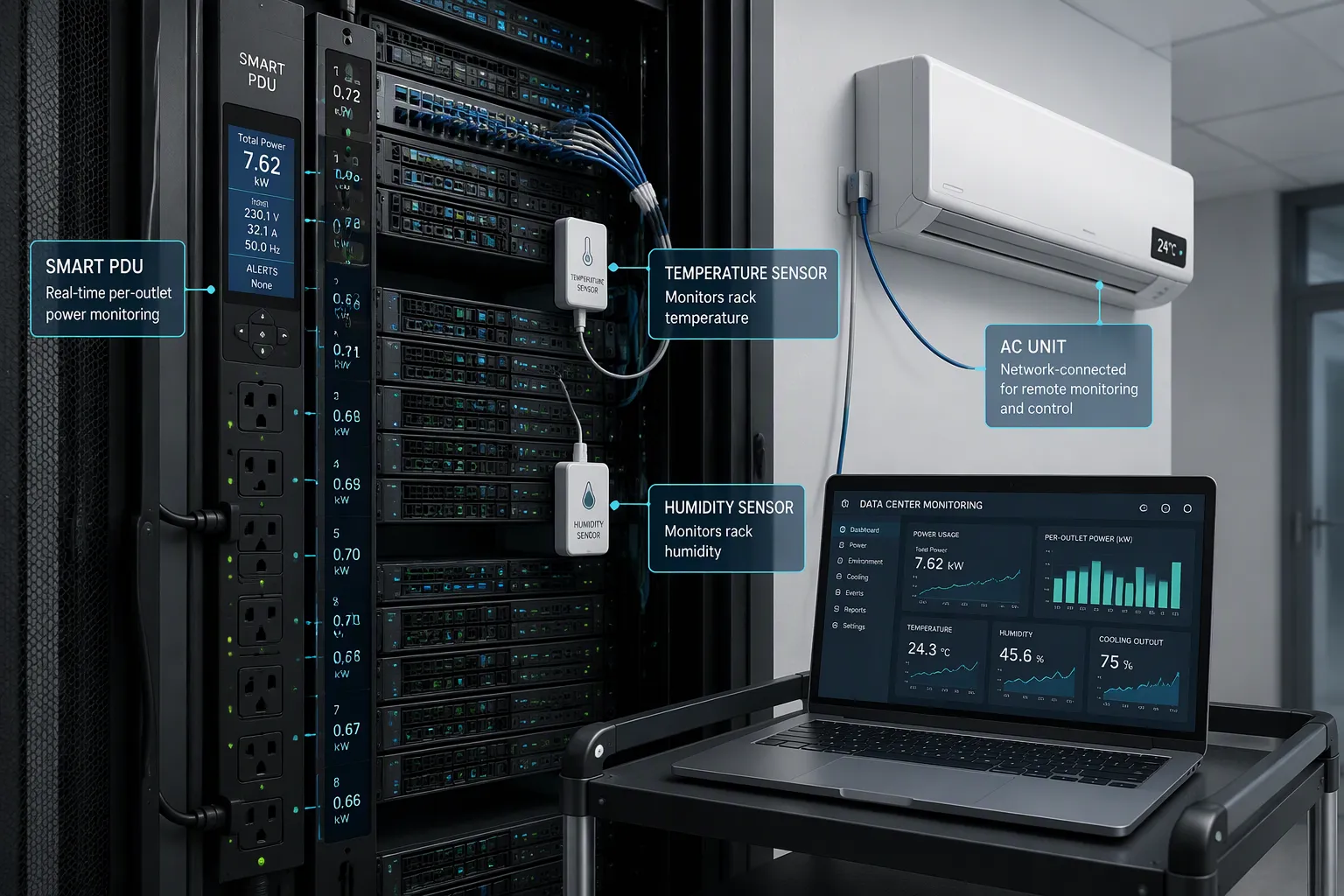
The linkage starts with measurement, and measurement starts at the outlet. A Smart PDU watches power at the rack level, and capable units go further than a single strip total. Metered input PDUs display power locally and over a secure network. That helps you avoid circuit overload and calculate PUE. Metered-by-outlet PDUs go deeper. They meter watts and accumulated energy per outlet, so you can see which server consumes what, plan rack capacity, and allocate cost fairly across teams. Per-outlet data also exposes idle servers that still draw power, a common source of waste in dense racks. Switched PDUs add remote on/off control of specific outlets, power sequencing delays to limit inrush currents, and reduced unauthorized access. Switched PDUs with outlet metering combine input metering, per-outlet metering, and per-outlet switching, the most robust intelligent PDU type.
PDU Type | Metering Scope | Remote Switching |
|---|---|---|
Basic | None | None |
Metered | Aggregate (whole strip) | None |
Metered-by-outlet | Per outlet | None |
Switched & metered | Per outlet | Per outlet |
Environmental data completes the picture. Intelligent rack PDUs collect temperature and humidity readings through attached sensors, and you can view them in a web browser or command line interface. Sensors can also report pressure and airflow. This matters when a counterintuitive temperature change appears after you rearrange a data center. You see the cause instead of guessing. One integrated unit can monitor heat and moisture inside the rack without a separate monitoring solution. Set thresholds on these readings, and the PDU warns you before condensation or heat buildup becomes a problem.
Data-Driven Cooling Control
The Smart PDU then shares that data with the AC unit through open protocols such as SNMP. Cooling output follows actual power draw rather than a fixed setpoint. The loop is simple. Power rises, the PDU reports it, and the AC unit increases output. Power falls, and cooling backs off. The AC unit does not need to know why the load changed. It only needs the number. Open protocols keep your options open. You are not locked to one vendor's AC line, and you can add sensors or meters later without rebuilding the control layer. SNMP traps and alerting feed your existing monitoring platform, and thresholds trigger email or SMS warnings before a circuit hits its limit.
AI-driven predictive control can push efficiency further than traditional rule-based approaches. Rule-based control reacts to a threshold. Predictive control anticipates the next load change and pre-adjusts cooling, which smooths temperature swings. Simulation evaluations show significantly reduced cooling energy consumption and improved PUE while maintaining SLA compliance. Learned policies adapt in real time to changing workloads and thermal conditions. Multi-agent designs outperform single-agent ones. The result is a more balanced thermal profile, fewer hotspots, and less hardware stress. AI-enhanced monitoring also predicts and prevents temperature excursions before they affect uptime, and early detection of system degradation enables timely corrective action.
ESTEL's Smart Power Distribution Unit fits this architecture well. It offers remote management, LCD monitoring, surge protection, and a dehumidifying function. Pair it with compatible AC units, and the rack becomes a node in a responsive cooling network. You can review the specifications at https://www.outdoortelecomcabinet.com/supplier-151193-smart-power-distribution-unit.
Benefits of Collaborative Optimization
Energy and Thermal Gains
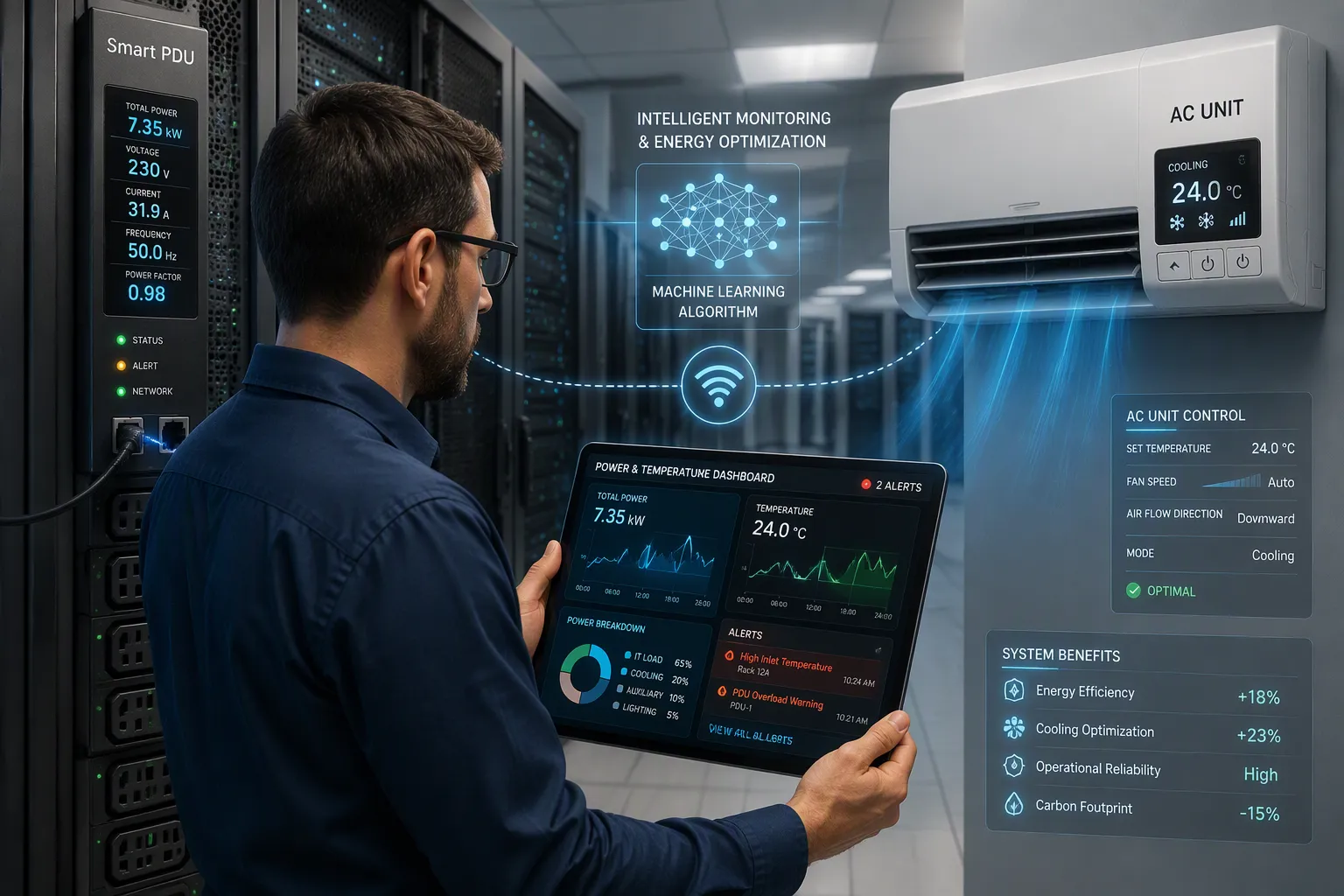
Matching cooling to actual load cuts energy waste at its source. A Smart PDU reports real power draw, and the AC unit scales output to that number. You stop cooling for a peak that is not there. You also stop overcooling a rack that draws half its rated load. Data-driven insights enable precise cooling control, preventing overcooling and minimizing wasted energy. The savings compound across a dense row of cabinets.
Thermal performance improves in parallel. Cooling that tracks load keeps rack temperatures stable instead of swinging between hot and cold. Stable temperatures reduce stress on servers and on the cooling equipment itself. You get a flatter thermal profile and fewer hot spots. The result is a calmer operating environment for every device in the rack.
Reliability and Visibility
Intelligent monitoring turns power and environmental data into early warning. Energy use cannot be separated from environmental conditions. Temperature, humidity, airflow, differential pressure, and cooling-system operating data reveal inefficient cooling strategies, airflow problems, hot spots, or overly conservative settings. A good monitoring system surfaces the conditions that need attention. It flags thresholds, rate-of-change alarms, equipment faults, temperature excursions, demand peaks, and abnormal energy consumption. Your staff do not need to watch dashboards all day.
Machine learning pushes detection further than fixed thresholds. Traditional cooling monitoring relies on threshold-based alerting. That approach produces high false positive rates from normal operational variance. It also delays detection when degradation unfolds gradually within nominal ranges. Building management and DCIM platforms mainly provide reactive monitoring rather than predictive analytics. ML-driven monitoring identifies precursor patterns instead.
Monitoring Aspect | Detail |
|---|---|
ML architecture | LSTM forecasting for gradual degradation; Random Forest for immediate detection |
Feature importance | Humidity 51%, pressure 27%, flow 17%, temperature 5% |
Early warning | |
Detection performance | Random Forest recall 97%; 96.5% F1-score; 98.4% coverage |
Anomaly signatures | Pressure drops over 15%, humidity spikes over 10%, flow reductions over 20%, gradual temperature shifts |
Those two hours of warning matter. You can migrate workloads, isolate a rack, and prepare your team before coolant loss becomes an outage. Industrial gateways collect data from temperature, vibration, and flow sensors. That gives near real-time visibility into fans, pumps, and chillers. Early detection of mechanical anomalies supports predictive maintenance, reduces unplanned downtime, and extends equipment lifespan.
A monitoring system should surface conditions requiring attention — thresholds, rate-of-change alarms, equipment faults, temperature excursions, demand peaks, and abnormal energy consumption — rather than requiring staff to watch dashboards continuously.
Combine power, environmental, facility, and network data, and you get a fuller picture of infrastructure health. Anomalies in energy use often signal equipment deterioration or changing operating conditions. Catching them early protects uptime and stretches the life of your hardware.
Implementing ESTEL Smart PDU Linkage
Choosing Compatible Hardware
Start with the rack itself. Measure expected power load, then confirm your electrical configuration. Check input and output voltage, single- or three-phase supply, and current rating. Verify the input connector, outlet type, and outlet count against your equipment. Decide whether you need A/B power redundancy, and choose vertical 0U or horizontal 1U/2U mounting to fit your cabinet. An intelligent PDU adds visibility, but it does not replace adequate upstream electrical capacity. Evaluate distribution together with UPS capacity, rack design, power density, and cooling infrastructure.
Consideration | What to verify |
|---|---|
Power load | Expected rack load and required capacity |
Electrical config | Voltage, single- or three-phase, current rating |
Connectivity | Input connector, outlet type, outlet count |
Redundancy | A/B power redundancy needs |
Mounting | Vertical 0U or horizontal 1U/2U |
Monitoring | Power monitoring and remote control needs |
Integration | DCIM or network integration |
For high-density racks, prioritize higher current capacity, three-phase configurations, and outlet-level monitoring. ESTEL's Smart Power Distribution Unit gives you a concrete reference point. It offers a 16A maximum input current, 8 to 19 outlets, a 230VAC 32A rated voltage current, an IEC60309-compliant plug, and a 600×450×185mm frame. ESTEL also supplies telecom cabinets and air conditioners for telecom cabinets, so you can source the enclosure and cooling side from the same portfolio.
Configuring Protocols and Control Logic
Set up communication next. Connect the PDU to the AC unit over an open protocol such as SNMP, then define thresholds and alerting rules. Tune the control algorithm last, and tune it carefully. An embedded adaptive fuzzy PID algorithm decouples dual-temperature regulation by modulating three actuators in real time: compressor speed, electronic expansion valve aperture, and liquid cooling pump speed. Compared with conventional PID control, this approach cut fuel temperature settling time by 55 seconds and improved transient response by 11.85%. It also reduced skin temperature stabilization duration by 83 seconds and improved dynamic performance by 23.38%. Peak pump speed fell by 400 r/min, maximum compressor speed fell by 700 r/min, and valve aperture overshoot dropped by 15.1%.
Do not scale immediately. Start with a pilot cabinet. Instrument one rack, run the linkage for a few weeks, and compare energy use and temperature stability against your baseline. Fix tuning issues at that scale, then expand row by row.
Smart PDU-AC linkage matches cooling output to actual power draw. You gain energy savings, stable rack temperatures, and stronger reliability. The result is a cooling system that follows the load instead of guessing at it.
Implementation depends on three things. You need compatible hardware, open communication protocols, and well-tuned control algorithms. Get these right, and the feedback loop runs smoothly.
Start with a pilot cabinet. Instrument one rack, measure the results, and tune before you scale. ESTEL's Smart Power Distribution Unit offers a practical starting point. Review its specifications at https://www.outdoortelecomcabinet.com/supplier-151193-smart-power-distribution-unit.
FAQ
What data does the Smart PDU send to the AC unit?
The PDU reports real-time power draw at the rack level, plus temperature and humidity readings from attached sensors. It shares this data over an open protocol such as SNMP. The AC unit uses those numbers to scale its cooling output up or down.
Can I link the PDU to my existing AC units?
Often you can, provided your AC units support an open protocol like SNMP. Check the protocol support before you buy. Vendor-specific protocols may limit your options. Open protocols let you add sensors or meters later without rebuilding the control layer.
What should I check before choosing a PDU for a dense rack?
Verify expected power load, voltage, single- or three-phase supply, and current rating. Confirm the input connector, outlet type, and outlet count. Decide on A/B redundancy and mounting style. For dense racks, prioritize higher current capacity, three-phase input, and outlet-level monitoring.
How do I start a linkage project without disrupting operations?
Begin with a pilot cabinet. Instrument one rack, run the linkage for a few weeks, and compare energy use and temperature stability against your baseline. Fix tuning issues at that small scale, then expand row by row.
What does the dehumidifying function add?
The dehumidifying function helps maintain optimal operating conditions inside the rack. It works alongside surge protection and LCD monitoring. Together they protect connected equipment and keep the environment within safe limits.
See Also
Improving Outdoor Cabinet Performance Through Power, Cooling, and Monitoring
Selecting the Optimal Cooling Approach for ESTEL Telecom Cabinet Systems
Examining and Applying Various Cooling Techniques in Telecom Cabinet Deployments
Understanding ESTEL PDUs and Their Function Within Data Center Cabinets
Guaranteeing Consistent Power Delivery for Telecom Cabinet Operations
CALL US DIRECTLY
86-13752765943
3A-8, SHUIWAN 1979 SQUARE (PHASE II), NO.111, TAIZI ROAD,SHUIWAN COMMUNITY, ZHAOSHANG STREET, NANSHAN DISTRICT, SHENZHEN, GUANGDONG, CHINA
