Smart PDU Auto-Recognition Makes Rack Security Simple


A smart PDU with auto-recognition detects and identifies door and environmental sensors the moment you connect them. You get instant, accurate rack-level security monitoring without manual setup. The mechanism is simple: universal I/O ports read each sensor's identity, so the PDU recognizes it automatically. This plug-and-play approach delivers faster, more reliable coverage across your racks. These PDUs also track temperature and humidity through real-time monitoring dashboards at the rack level. You spend less time mapping ports and more time acting on alerts. Auto-recognition turns sensor deployment into a quick, repeatable task for any rack, and your team gains confidence in every reading.
Key Takeaways
Smart PDUs automatically detect sensors, so you avoid manual setup and errors.
Door sensors alert you to open doors or tampering, keeping your racks secure.
Temperature and humidity sensors send alerts when conditions go out of range.
Auto-recognition saves time and reduces costs by cutting manual work and site visits.
Smart PDUs log events for easy audits and help you meet compliance standards.
What Is Smart PDU Auto-Recognition?
Auto-recognition means the PDU identifies each connected sensor on its own. You plug a sensor into a universal I/O port, and the unit reads its identity without any manual mapping. No one assigns addresses by hand. No one edits a configuration file. The rack mounted pdu simply knows what is attached and starts reporting.
How Auto-Recognition Works
The process follows a short, predictable sequence. According to ESTEL's technical blog, the unit checks the physical connection for new devices, reads the sensor's communication protocol, and matches it against an internal database. The system then assigns the correct address and begins data exchange. You see the sensor's status and readings on the LCD display or through remote monitoring software.
This sequence runs in seconds. You do not configure settings or install extra drivers. A smart PDU handles the identification work, so your team spends its time on alerts instead of port maps.
Why It Matters for Rack Security
Intelligent PDUs auto-detect a wide range of digital sensors. Sunbird's glossary groups them into two families. Environmental sensors cover temperature, humidity, pressure, and airflow. Security management covers contact closure and powered dry contact door locks for cabinets and containment areas. Synaccess adds motion detectors and water sensors to the list.
That breadth matters because rack protection depends on more than one reading. A door sensor confirms physical access control. A temperature probe confirms thermal conditions. One device watches both. You gain environmental monitoring and access tracking from the same unit, and every reading arrives in real time. Rack mounted pdus with this capability turn scattered sensors into one managed view. The result is simpler security with fewer gaps.
Door Security with Contact Closure Sensors
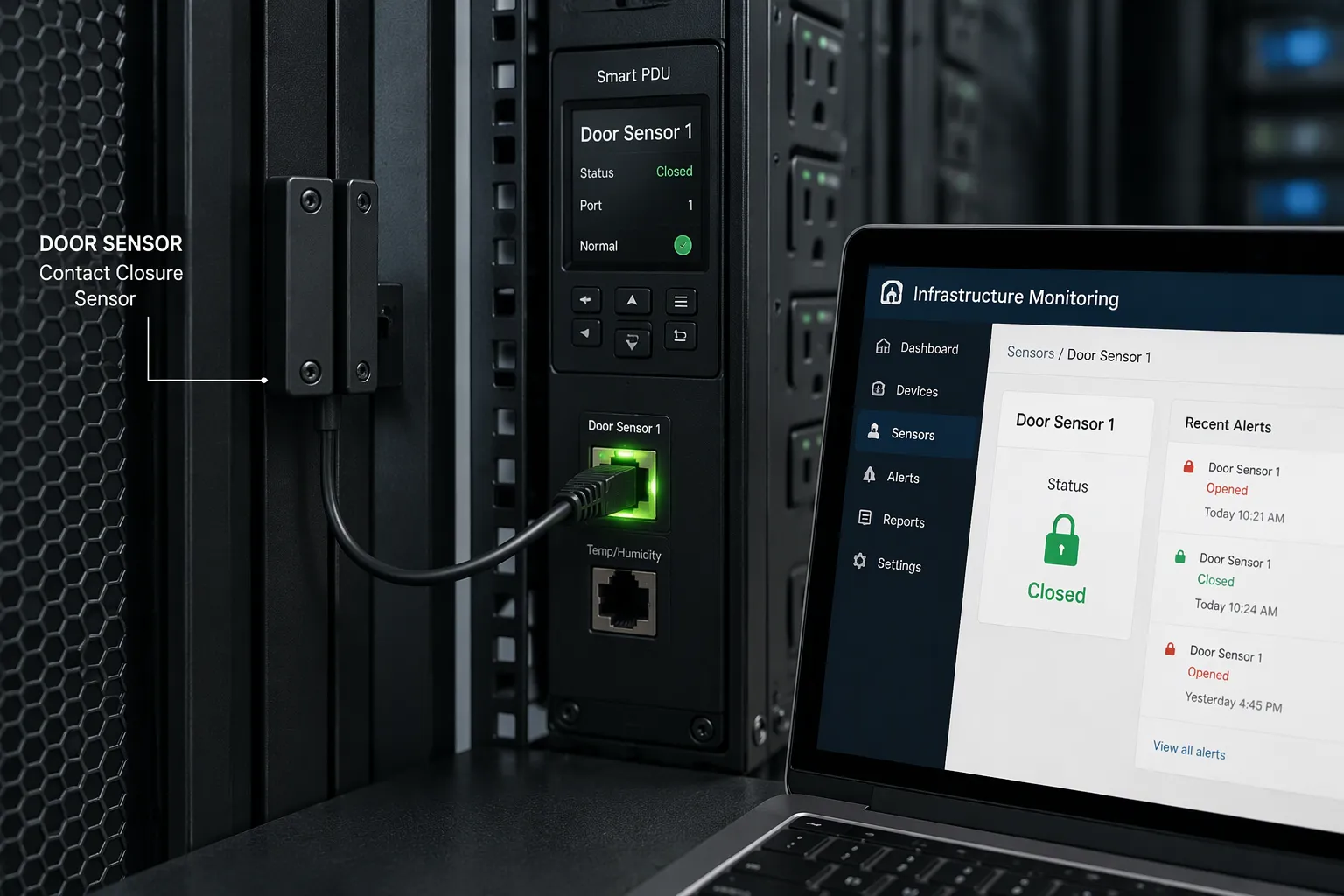
Data center contact closure sensors plug directly into the universal I/O ports on a smart PDU. The unit reads each sensor's identity and begins reporting in seconds. You gain door status without manual mapping.
Automatic Sensor ID
A contact closure sensor reports one simple state: the circuit is open or closed. The PDU reads that state and labels the port on its own. You see the sensor appear in your dashboard with a clear name and location. No one edits a configuration file. No one assigns an address by hand. The label survives a reboot, so your records stay accurate over time.
Automatic identification matters at scale. A rack mounted PDU can watch several cabinet door points at once. Each sensor keeps its own identity, so an alert points to the exact rack. Your team responds to the right location on the first try. You can rename a port later, and the system keeps the link between name and sensor. Many rack mounted PDUs also log every state change. Rack mounted PDUs that log events give you a clean audit trail.
Tamper Detection and Alerts
The PDU turns a door event into an alert. You configure the rule once, and the system handles the rest. Birtech notes that time-based alarm rules let you customize alerts by day, night, or season. A sensor might send a warning during working hours and a critical alarm after hours. That logic cuts noise and keeps attention on real events. A short delay before an alert fires filters brief contact bounce.
Alert delivery follows the same principle. Raritan ties an event to an action: the event is the condition met, and the action is the response. Common channels include:
Alert Mechanism | Configuration |
|---|---|
SNMP | Enable SNMP notifications in device settings |
SMTP (email) | Set the SMTP server and a dedicated sender account |
Identec recommends a risk-based alarm philosophy that maps each alarm to a priority, action, and escalation path. Standards such as ISA-18.2 and IEC-62682 support this life-cycle approach. High-priority alarms then escalate automatically when no one responds. PDUs that escalate alerts protect uptime. Identec also suggests a documented response target for each priority level, with a primary and backup owner. Test each channel before go-live. Send a test alert by email and by SNMP trap, then confirm both arrive.
Access logging completes the picture. Networked electronic locks can link to DCIM or BMS software for access logs and audit trails, according to ESTEL's blog. Raritan's SmartLock system adds automated audit-trail logging of access events. You can review who opened which rack and when. Audit trails matter for compliance reviews, and they help you trace an incident after the fact. Review logs on a regular schedule, not only after an event. Real-time monitoring of doors, temperature, and humidity sits in one view. A second real-time monitoring feed covers open doors and unauthorized access attempts. That combination strengthens physical security across the site.
ESTEL's Smart Power Distribution Unit is one example of a PDU with universal I/O sensor support. It pairs door access monitoring with environmental sensing in one unit. These PDUs support alarm and security monitoring through email and SNMP traps. A temperature reading above your set point raises its own alert. PDUs with this design simplify deployment. PDUs that combine sensing and power cut hardware count. PDUs like these fit modern racks well.
Temperature and Humidity Monitoring
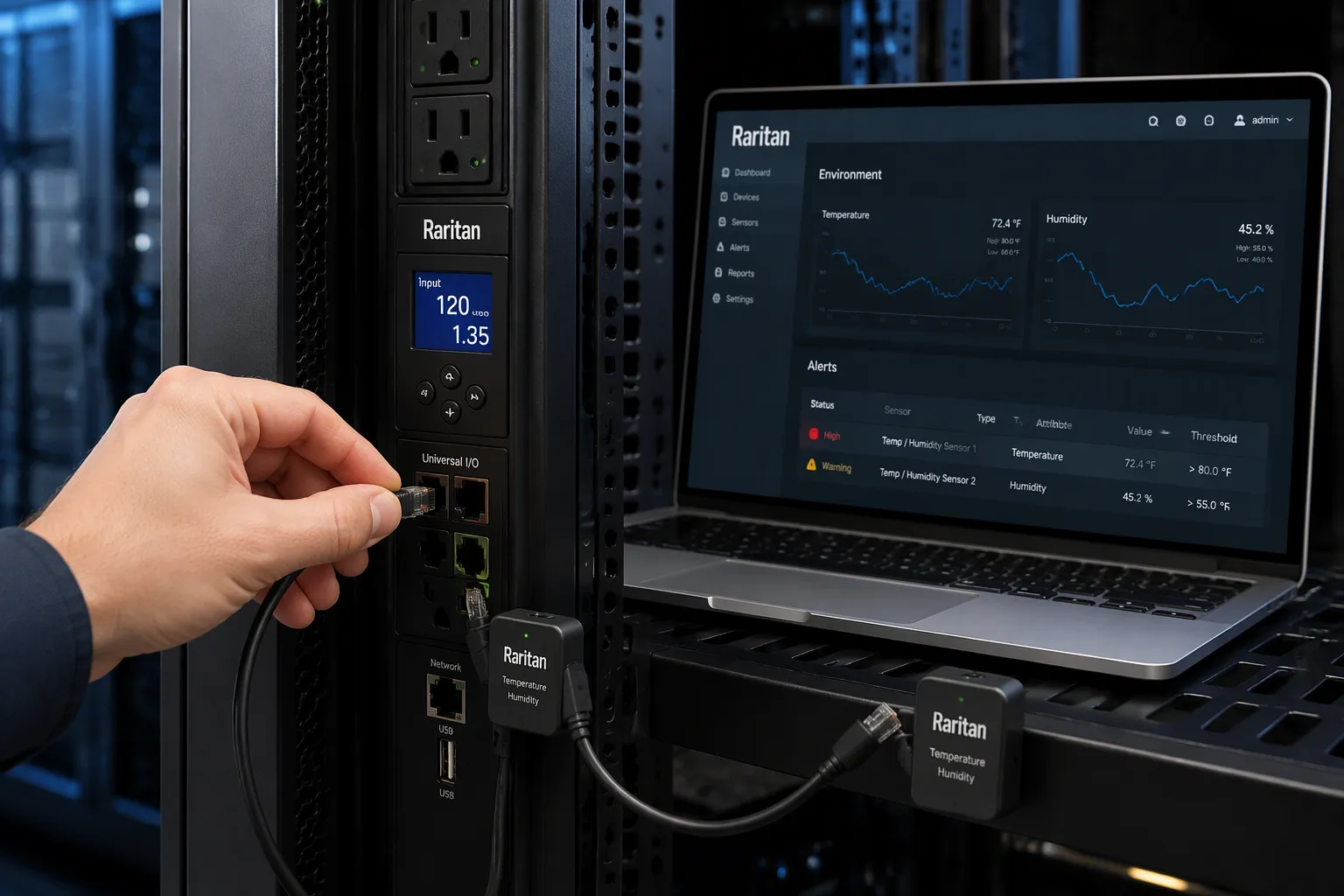
Plug-and-Play Data Center Temperature Sensors
Data center environmental sensors follow the same recognition logic as door contacts. You connect a probe to a universal I/O port, and the smart PDU reads its identity and starts reporting. Legrand describes its SmartSensors as plug-and-play ready with Raritan and Server Technology Xerus-enabled power management devices, so you install them without disrupting operations. Raritan adds that these sensors can also deploy through rack controllers, inline meters, and branch circuit monitors. That flexibility lets you reuse the network layer your PDUs already provide.
Attribute | Description |
|---|---|
Dual RJ45 Connectors | Eases installation and servicing without rewiring the rack or daisy chain |
Easy to Deploy | Plug-and-play ready with Xerus-enabled power management devices |
Supports Customization | Cascades different sensor types in a single bus/string architecture |
Data center temperature sensors and data center humidity sensors share that bus. You cascade them with Cat5/6 cables through one sensor port, per Raritan. A single string can instrument an entire row. Removable sensor heads help you maintain accuracy over time. This design keeps integration with environmental sensors simple, and it scales as your footprint grows.
Threshold Alerts and Data Accuracy
Accurate readings only matter when they trigger action. Paessler notes that thresholds are per-sensor, not global, so you can set different limits for a high-density compute rack versus a storage rack. That per-rack control lets managers tune set points to each workload. ASHRAE's 2021 Fifth Edition guidance, cited by DataSpan, recommends a temperature range of 64.4 to 80.6 degrees Fahrenheit and humidity between 20% and 80%, with a target near 50%. DataSpan also suggests staged warnings: early humidity alerts around 40% and 60%, critical ones around 30% and 70%.
Alert delivery stays flexible. Paessler lists email, SMS, push, syslog, and HTTP actions, and each alert carries a historical graph for context. Raritan notes that most SmartSensors include a status LED with pre-programmed blink patterns when a reading crosses a threshold. Remote triggers work with or without DCIM software. You gain real-time insights and alerts through email or text whenever conditions drift.
ESTEL's Smart Power Distribution Unit supports this workflow with LCD real-time monitoring and a dehumidifying function. The display shows readings at the rack, and the dehumidifying function helps hold conditions steady. These rack mounted PDUs deliver real-time monitoring of temperature and humidity alongside power data. Rack mounted PDUs with per-sensor thresholds turn raw readings into timely action. PDUs that combine sensing and switching keep your environmental monitoring in one place. Smart PDUs like these reduce tool sprawl across the site.
Implementation and Compatibility
Performance and Application Fit
Sensor port types and protocol support decide where a PDU fits. Universal I/O ports accept digital environmental sensors and contact closure devices on the same bus. The unit reads each sensor's identity and reports over SNMP, HTTP, or a web interface. You gain remote monitoring & control without extra gateways. A rack mounted pdu with this design covers a single cabinet, and larger rack mounted pdus scale to a full row.
Application fit follows the same logic. Jama-net notes that edge sites — remote offices, branch sites, retail environments, and industrial facilities — benefit most from smart rack capabilities. A monitored unit cuts on-site visits while keeping full visibility into equipment health. Server racks in a data center need per-outlet metering and environmental monitoring. Network closets with stable, low-risk loads can run a basic or metered model, per ServerRackPriceInBD. Match the tier to the site, and you avoid paying for features you never use.
Compliance and Cost
Regulatory compliance shapes both design and budget. In the U.S., UL 62368-1 compliance is mandatory for commercial installations, per Alibaba's buying guide. In the EU, CE marking under the Low Voltage Directive (2014/35/EU) and EMC Directive (2014/30/EU) applies. Newsunn adds FCC Part 15 Class A, TUVus, and UKCA to the list. RoHS and REACH limit hazardous materials, and ISO9001 confirms quality management. ESTEL's Smart Power Distribution Unit ships with a cable plug system compliant with IEC60309 standards.
Standard | Scope |
|---|---|
UL 62368-1 | U.S. commercial safety |
CE (LVD 2014/35/EU, EMC 2014/30/EU) | EU safety and emissions |
IEC60309 | Plug and connector compatibility |
RoHS / REACH | Hazardous material limits |
Cost needs a total-ownership view. DEI Power warns that basic units carry hidden costs through manual intervention and limited visibility. A smart PDU costs more upfront, yet remote troubleshooting and efficiency gains offset that premium over time. Pair the unit with data center management software to track energy use and capacity. Check that your data center environmental sensors match the port type before you buy. Confirm the temperature range your environmental sensors support, and verify the temperature thresholds you plan to set. Review temperature logs monthly, and compare temperature trends across racks. A rack mounted PDU with clear compliance records simplifies audits and protects your budget.
Smart PDU vs. Manual and Non-Smart PDUs
Performance and Fit Compared
Technical performance separates these options most clearly. A manual PDU distributes power and nothing more. A non-smart metered unit adds a local display, yet it still needs a person on site to read it. A smart PDU identifies sensors on its own and reports over SNMP or HTTP. That difference decides where each unit belongs.
Fit follows function. Manual and non-smart PDUs suit simple, static setups: a small network closet with fixed loads, a lab bench, or a cabinet nobody opens. A rack mounted pdu with auto-recognition suits dynamic racks where conditions shift and access needs tracking. Smart rack mounted pdus earn their place in colocation cages and edge sites with no staff on hand. Real-time monitoring of door state and temperature pays off wherever a site runs unattended. Choose the tier that matches how often the rack changes.
Compliance and Cost Compared
Regulatory compliance applies to every tier. UL 62368-1, CE marking, RoHS, and REACH cover manual, non-smart, and smart units alike. The difference sits in documentation depth. A smart PDU logs sensor events and temperature history, and those records support audits. ESTEL's Smart Power Distribution Unit adds an IEC60309-compliant plug system, so connector compatibility is settled before installation.
Cost needs a total-ownership view. Manual PDUs cost least upfront and suit budgets with no monitoring scope. Non-smart PDUs sit in the middle. Smart PDUs carry a higher purchase price, yet remote troubleshooting and fewer site visits offset that premium over time. Real-time monitoring cuts truck rolls at remote sites. Match the spend to the risk: a static closet needs little, and a monitored rack needs the full feature set. Many suppliers, ESTEL included, offer every tier, so you can size each rack on its own merits.
Auto-recognition strengthens rack security in two ways. Door sensors report opens and tamper events the moment they connect. Temperature and humidity probes deliver accurate readings with threshold alerts, so you catch drift early.
Deployment stays simple. A smart PDU identifies each sensor on its own, and that removes manual mapping errors. You gain real-time monitoring you can trust across every rack.
Evaluate ESTEL Smart Power Distribution Unit solutions for your racks. These PDUs pair universal I/O sensor support with LCD monitoring and a dehumidifying function. PDUs from ESTEL cover door access and environmental sensing in one unit. A rack mounted PDU with auto-recognition keeps temperature visible, temperature trends clear, and temperature alarms timely. Choose PDUs that identify sensors automatically. PDUs like these reduce setup time. PDUs that log temperature events simplify audits. Smart PDUs protect uptime. Rack mounted PDUs fit modern sites. Compare PDUs against your temperature goals today.
FAQ
What happens when I plug in a new sensor?
The PDU reads the sensor's identity and starts reporting in seconds. No manual mapping is needed. The PDU matches the device against an internal database and assigns the correct address. Several PDUs can share one dashboard. Each of those PDUs sends its readings to a single view.
Which sensors work with the universal I/O ports?
You can connect door contacts, temperature probes, and humidity sensors. A PDU reads temperature alongside door status. Many PDUs accept both sensor types on one bus. Those PDUs label each device automatically. A temperature spike and an open door then raise separate alerts.
How do threshold alerts work?
You set thresholds per sensor, not globally. A compute rack and a storage rack can carry different temperature limits. The PDU sends an alert by email or SNMP trap when a temperature reading crosses your set point. Many PDUs blink a status LED. Those PDUs log each temperature event.
Do I need extra software to see sensor data?
No. The PDU reports over SNMP, HTTP, or its web interface. You gain real-time monitoring without extra gateways. The LCD shows temperature and humidity at the rack. A dehumidifying function helps hold conditions steady. PDUs with this design cut tool sprawl. PDUs like these keep temperature data in one place.
Where does this setup fit best?
A rack mounted PDU suits colocation cages and edge sites with no staff on hand. A smart unit identifies sensors on its own. The PDU logs temperature history for audits. PDUs in these roles watch door state and temperature together. Choose PDUs that match how often the rack changes.
See Also
Effective Strategies for Enhancing Anti-Theft Features in Communication Cabinets
Explaining Supervision System Integration Within ESTEL Outdoor Cabinets
Understanding ESTEL PDUs and Their Function in Data Center Cabinets
Expert Advice on Securing Communication Cabinets in High-Risk Locations
Ensuring Optimal Monitoring for Outdoor Telecommunications Cabinets
CALL US DIRECTLY
86-13752765943
3A-8, SHUIWAN 1979 SQUARE (PHASE II), NO.111, TAIZI ROAD,SHUIWAN COMMUNITY, ZHAOSHANG STREET, NANSHAN DISTRICT, SHENZHEN, GUANGDONG, CHINA
