How Smart PDU End-Point Sensing Enables Dynamic Environmental Monitoring in Data Centers

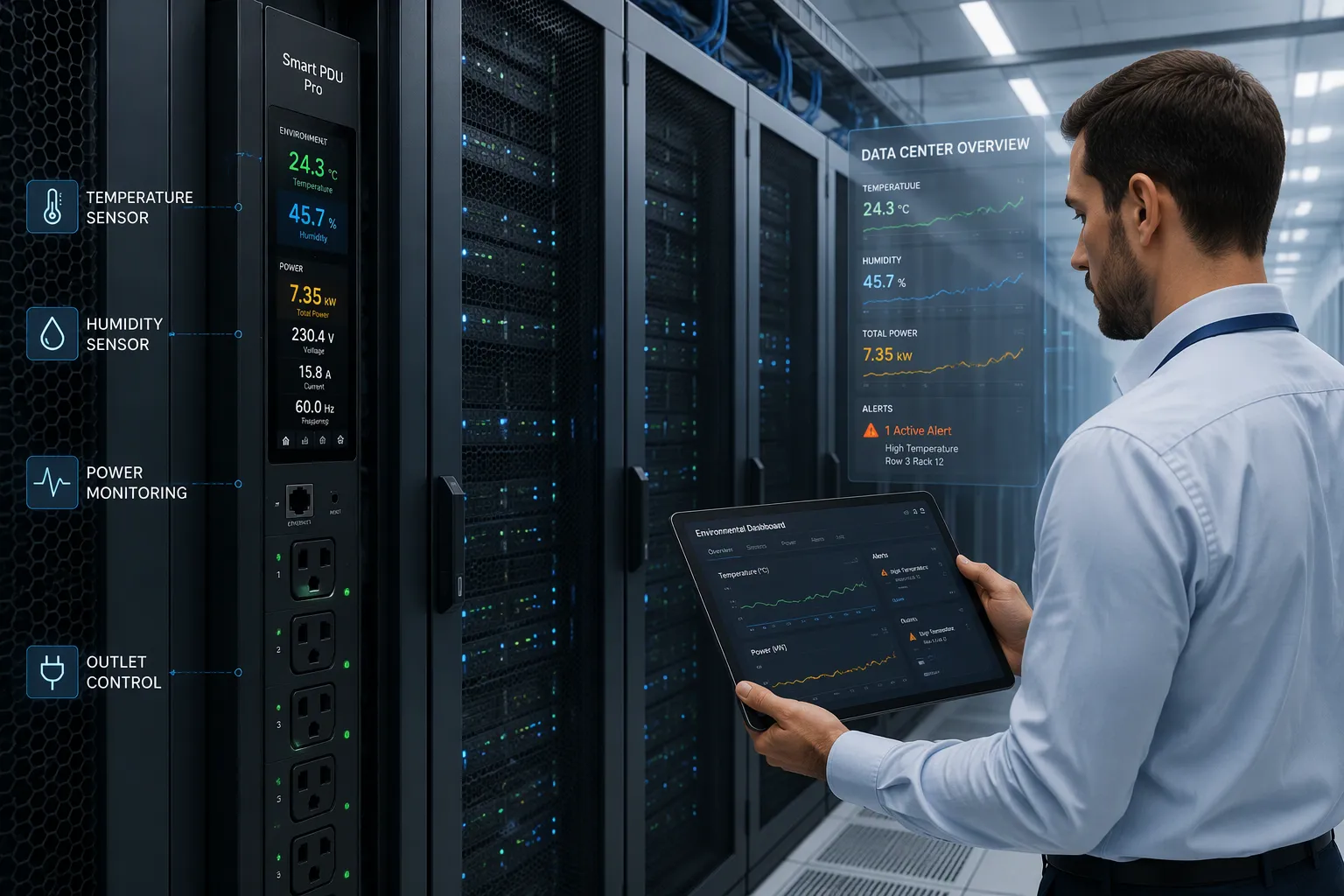
You spot a hot spot forming near rack 14, or watch a sudden energy spike on your dashboard. Smart PDU end-point sensing delivers real-time environment data at the rack level, enabling dynamic data center environmental monitoring. This real-time data center power monitoring gives you better cooling control, lower energy costs, and higher uptime. You gain real-time power visibility through power monitoring that extends beyond electricity. This post covers how the technology works, its benefits, deployment best practices, selection criteria, and DCIM integration. ESTEL's Smart Power Distribution Unit supports this approach with remote management and surge protection. Effective data center monitoring starts with the right partner.
Key Takeaways
Smart PDU end-point sensing gives real-time data on power and environment at the rack level.
This technology helps prevent overcooling and undercooling, saving energy and reducing costs.
Deploy sensors at rack inlets and set thresholds to catch problems early and avoid downtime.
Integrate smart PDU data with DCIM software for a complete view and proactive management.
Start with a pilot on high-density racks and scale gradually with a trusted partner.
How Smart PDUs Enable End-Point Sensing
From Power Distribution to Environmental Intelligence
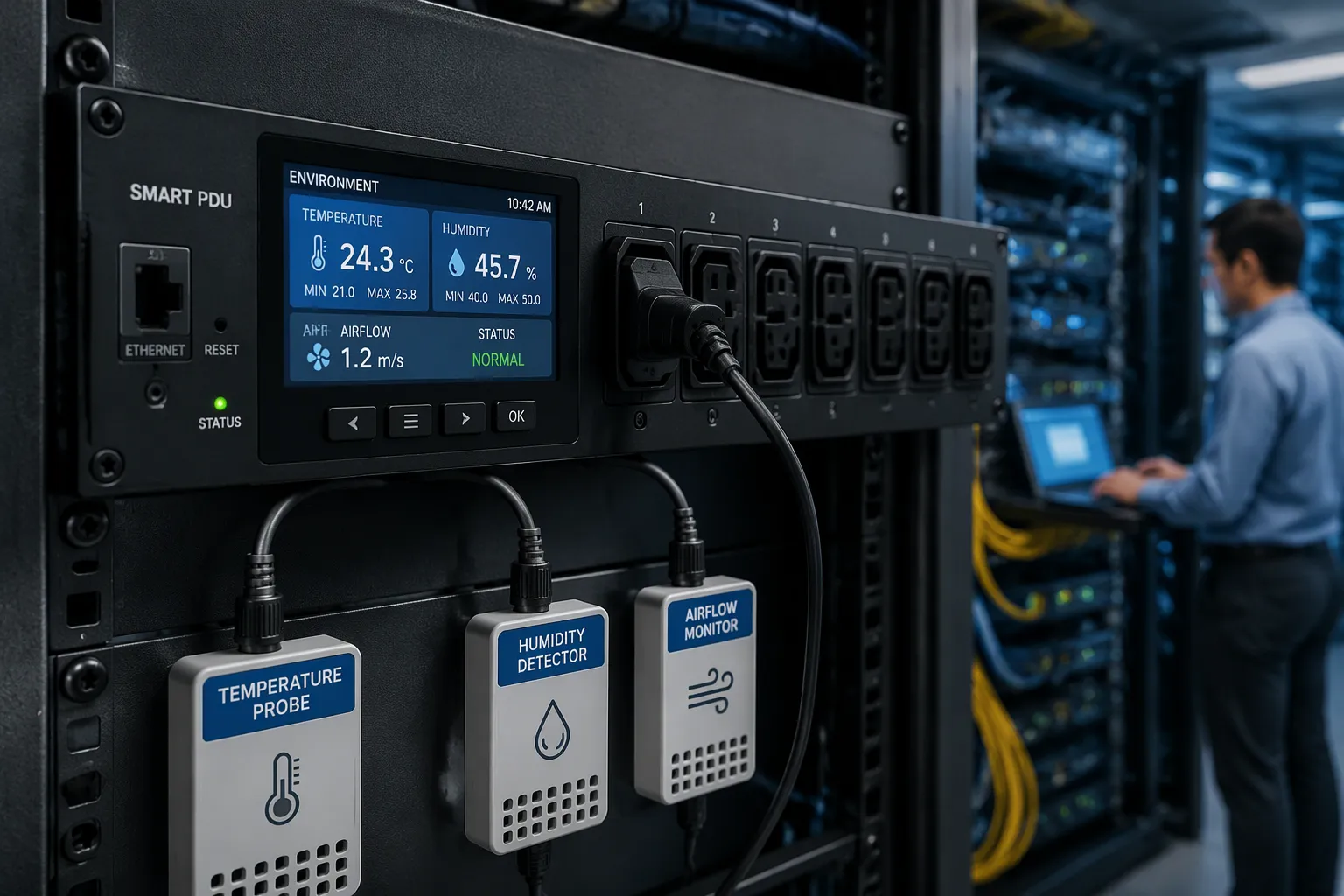
A traditional PDU simply distributes electricity. A smart pdu does much more. It transforms into a data collection hub for your data center environment. The ESTEL Smart Power Distribution Unit exemplifies this evolution. It combines remote management capabilities with an LCD display for real-time monitoring. You also get a dehumidifying function and surge protection built into the same unit.
The shift from passive distribution to active intelligence happens through intelligent protocols. These protocols let your smart pdu communicate with external sensors. You can connect temperature probes, humidity detectors, and airflow monitors directly to the unit. The ESTEL unit supports this through its onboard sensor ports. For larger deployments, you can expand beyond those ports using external sensor expansion boxes. This scalability meets even the most complex environmental monitoring needs.
Network connectivity makes the difference between local awareness and centralized control. Your smart pdu supports robust protocols like SSHv2 and MQTT. These protocols enable secure IoT integration and secondary development. You can also use SNMP interfaces to integrate the unit into your existing supervision systems. According to UltraEdge, centralized management works from any network entry point with sufficient access. This flexibility means you monitor your environment from anywhere.
Intelligent rack pdus combine power and environmental information. This combination provides additional context for rack operations. High-density environments benefit most from this integrated view. You see not just how much power a rack draws, but also the conditions affecting that equipment. Smart or metered pdus offer this dual visibility as a standard feature.
Rack, Aisle, and Facility Visibility
Your monitoring strategy operates at three distinct levels. Each level serves a different purpose in your overall environmental management plan.
Rack-level monitoring focuses on the immediate environment around your servers. Temperature sensors at rack inlets give you precise data about intake air. You can place thermistors here for their sensitivity and quick response. These sensors excel at monitoring localized temperatures. Humidity sensors at this level prevent condensation from high moisture levels. They also prevent static electricity caused by dry conditions. This granular monitoring protects your most sensitive equipment.
Aisle-level visibility extends your view to the space between racks. You monitor hot aisles and cold aisles separately. Differential pressure sensors detect airflow blockages by measuring pressure differences. This data ensures consistent cooling throughout the aisle. Indoor air quality sensors measure pollutants like CO2 and volatile organic compounds. These measurements protect both equipment and personnel.
Facility-level metering gives you the complete picture. You track conditions across the entire data center floor. Temperature sensors at CRAC return paths show how effectively your cooling system performs. Underfloor leak detection sensors identify water problems early. Fire suppression sensors detect smoke and trigger protection systems. Dew point sensors monitor moisture in liquid cooling systems. Carbon monoxide sensors ensure a safe environment for your team.
The ESTEL smart pdu supports all three levels through its intelligent environmental sensors. You connect different sensor types to match your monitoring needs. The unit's LCD display shows real-time data at the rack. Remote management brings that same data to your central dashboard. This pdu monitoring approach gives you complete visibility without separate infrastructure.
Intelligent rack pdus with environmental sensing create a unified view. You see power consumption alongside temperature and humidity data. This integration helps you spot correlations between energy use and environmental conditions. You make better decisions about cooling and capacity planning. The result is a more efficient, more reliable data center operation.
Benefits of Real-Time Data Center Power Monitoring
Preventing Overcooling and Undercooling
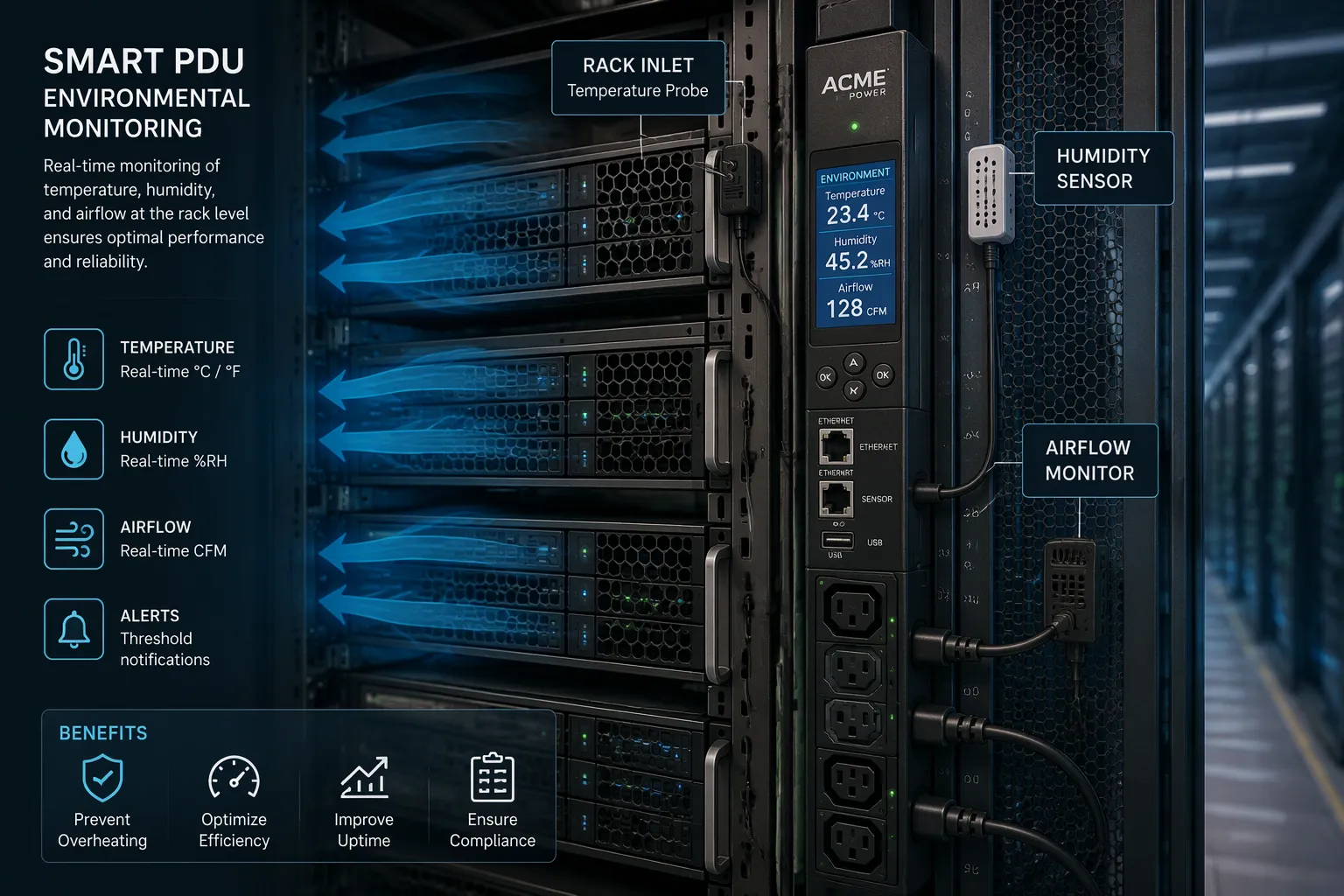
Overcooling and undercooling both cost you money. Overly aggressive cooling systems consume unnecessary power to maintain excessively low temperatures. Undercooling raises the risk of thermal excursions, performance throttling, and unplanned shutdowns. Real-time data center power monitoring helps you avoid both extremes.
The challenge starts with incomplete data. Poor sensor placement results in inaccurate temperature readings. This leads to inefficient climate control and potential equipment failures. Uneven temperature distribution creates persistent hot spots that accelerate component wear and shorten equipment life. You need granular data at the rack level to see these patterns clearly.
Smart PDU end-point sensing delivers that granularity. Temperature sensors at rack inlets show you intake air conditions precisely. Humidity sensors prevent condensation from high moisture levels. They also prevent static electricity caused by dry conditions. When you pair these sensors with DCIM software, you record, analyze, and respond to environmental factors in real time.
Raritan reports that data center managers can save up to four percent in energy costs if they avoid undercooling or overcooling each room. The same source notes you can save four percent for every degree of upward change in the set point. More sensors throughout your data center provide granular and accurate data to achieve the ideal temperature for maximum energy savings.
Your smart PDU supports this approach through intelligent environmental sensors. The unit connects temperature probes, humidity detectors, and airflow monitors directly. The LCD display shows real-time data at the rack. Remote management brings that same data to your central dashboard. This power monitoring approach gives you complete visibility without separate infrastructure.
Lower Costs, Higher Uptime
Real-time power monitoring directly impacts your bottom line. Sunbird DCIM highlights several key benefits. You save money by knowing when to raise temperatures to prevent overcooling. You maintain confidence that you are not overheating sensitive equipment. Monitoring airflow allows you to reduce airflow to only what your data center requires.
Uptime improves through early detection. Data centers need environmental monitoring to help prevent undercooling, electrostatic discharge, corrosion, short circuits, and other threats to valuable IT devices. Nlyte explains that monitoring environmental factors and setting up alerts enables you to take immediate action when conditions hit certain thresholds. An increase in temperature could indicate a failing air conditioning unit. You can then service or replace faulty equipment before it leads to an outage.
IFM notes that improved sensor data quality enables more accurate digital twins to predict and prevent unexpected outages. Real-time data and early-warning systems shorten your reaction time and reduce potential damage. This helps extend equipment lifespan. Accurate and reliable measurements maintain optimal thermal conditions for mixed-density server racks.
Your environmental monitoring and alert system should cover multiple threat types. Temperature sensors catch thermal events before they damage equipment. Humidity sensors protect against condensation and static discharge. Water leak sensors identify cooling system failures early. Smoke sensors trigger fire suppression. Door contact sensors alert you to open cabinet doors that disrupt airflow.
Sunbird DCIM emphasizes that you can set environmental thresholds on collected data from sensors. You receive real-time alerts for critical and warning conditions. This data from temperature, humidity, contact closure, leak detection, smoke, air pressure, air flow, and other environmental sensors can be analyzed in real-time with zero-configuration dashboards and reports.
Real-time power monitoring also reveals load imbalances across your racks. You see which circuits carry heavy loads and which remain underutilized. This data helps you balance power consumption more evenly. You avoid overloading individual circuits while maximizing the use of available capacity. Energy consumption drops when you optimize both cooling and power distribution.
The ESTEL Smart Power Distribution Unit supports this comprehensive approach. Its remote management capabilities let you monitor conditions from anywhere. Surge protection safeguards connected equipment. The dehumidifying function maintains optimal operating conditions automatically. This real-time data center power monitoring turns raw sensor data into actionable intelligence for your facility.
Deployment Best Practices for Branch Circuit Monitoring
Branch circuit monitoring complements environmental sensing at the rack level. Environmental sensors tell you about temperature and humidity conditions. Branch circuit monitoring tells you how much electrical load each circuit carries. Together, they give you a complete operational picture. You can correlate a thermal event with a specific circuit's power draw. You can spot load imbalances before they trip a breaker. This combined view transforms raw data into actionable intelligence for your facility.
Sensor Placement and Coverage
Start your deployment incrementally. Focus first on the highest-risk circuits and highest-density racks. DEI Power recommends beginning with main switchgear and distribution boards. You should also prioritize circuits feeding critical compute, such as AI or GPU clusters. Target racks drawing more than 20 kW first. These areas carry the greatest risk of failure and the highest potential for savings.
Configure warning and critical thresholds before you go live. Set circuit load thresholds at 70-80% of rated capacity, aligned with NEC's 80% continuous load rule. Watch for phase imbalance beyond 3% voltage unbalance or 10% current unbalance. Set voltage deviation alerts beyond ±5% of nominal. These thresholds give you early warning before problems escalate.
Ensure alerts route to the right personnel through multiple channels. Use email, SMS, and your DCIM dashboard simultaneously. Integrate alerts with existing ticketing systems. Centralize raw meter data in your DCIM software. This transforms individual readings into an operational picture. Look for platforms that provide trend analysis, capacity reports, and PUE dashboards. These tools help you catch gradual degradation before it becomes a failure.
Choosing Sensor Types
Your sensor selection should match your monitoring goals. Temperature sensors remain essential for detecting thermal events at server inlets. Humidity sensors prevent condensation from high moisture levels and static electricity from dry conditions. Water leak sensors identify cooling system failures early. Smoke sensors trigger fire suppression systems. Door contact sensors alert you to open cabinet doors that disrupt airflow.
Consider the evaluation criteria from DPS Telecom when choosing a system. Look for SNMP support with v1, v2c, and v3 and downloadable MIBs. Ensure alerting channels include SNMP traps, email, SMS, voice calls, and relay outputs simultaneously. Check protocol support for older equipment, including Modbus, TL1, and DNP3. Verify scalability from single-site to multi-site without replacing edge hardware.
Avoid common pitfalls. One sensor on the ceiling tells you almost nothing about conditions at the server inlet. ASHRAE recommends no fewer than six temperature sensors per rack. Do not choose on upfront price alone. Total cost of ownership includes licensing, support contracts, and expansion. Plan for outage-time alerting with cellular backup paths. Avoid vendor lock-in by selecting systems that accept industry-standard 0-5VDC or 4-20mA analog inputs from third-party sensors. This flexibility keeps your options open as technology evolves.
Selection Criteria and DCIM Integration
Scalability, Accuracy, and Installation
Your selection process should start with installation factors. You need to decide between vertical 0U PDUs mounted along the rack side or horizontal 1U or 2U units installed within the rack's mounting space. Vertical units save rack space and accommodate more outlets for high-density environments. Horizontal units align with the rack's width, improving airflow and reducing overheating risks. You must also verify voltage compatibility, current rating, and single-phase versus three-phase configurations. Outlet types matter too. C13 and C19 outlets serve different equipment classes. Count your current IT equipment, planned additions, dual-power configurations, spare capacity, and future rack expansion when determining outlet quantity.
Accuracy factors deserve equal attention. Real-time power monitoring at the outlet level gives you granular energy consumption data. Threshold alerts notify you when conditions exceed safe limits. Environmental sensors track temperature and humidity alongside electrical load. DCIM integration and API access enable automated responses. Attom.tech recommends accounting for at least 20 percent headroom above your expected load. This buffer prevents circuit overloads during peak demand or equipment upgrades.
Scalability determines whether your investment lasts. Modular and scalable designs allow incremental upgrades without full replacement. Hot-swappable components let you replace or upgrade parts without shutting down the entire system. TechTarget notes that average rack power density has increased from 15-20 kW per rack in traditional data centers to 36-132 kW for AI-centric racks. Your PDU selection must support this trajectory. Compact PDUs with wider temperature ranges suit edge deployments in non-traditional environments.
ESTEL Smart PDU and DCIM Insights
The ESTEL Smart Power Distribution Unit offers configurations from 8 to 19 outlets with a maximum input current of 16A and an IEC60309 plug system. This range accommodates diverse rack densities. The unit's LCD display shows real-time data at the rack. Remote management capabilities bring that same data to your central dashboard. Surge protection safeguards connected equipment. The dehumidifying function maintains optimal operating conditions automatically.
Data center power monitoring flows into DCIM through a structured process. The first layer collects information from physical infrastructure, including power meters, PDUs, and IT equipment. Protocols such as SNMP and Modbus integrate equipment from different manufacturers. The DCIM platform then consolidates this information. Visualization tools convert raw data into operational views, including rack-level dashboards, power monitoring screens, and historical trends. Analysis functions identify power utilization trends, equipment loading, available capacity, and abnormal conditions.
ESTEL's Smart PDU supports this integration through intelligent protocols. The unit enables advanced monitoring of power usage and environmental conditions. Automated load shedding initiates shutdown of non-critical outlets during peak times. Predictive maintenance analyzes data trends to detect irregularities and predict failures. Dynamic load balancing minimizes unplanned downtime. Alarm thresholds prevent circuit overloads with alerts for violations.
This pdu monitoring approach delivers actionable intelligence. You see energy consumption patterns alongside environmental conditions. You correlate thermal events with specific circuit loads. You forecast capacity expiration dates before you hit limits. Real-time power monitoring combined with DCIM analytics transforms raw sensor data into strategic decisions. Branch circuit monitoring adds another layer of visibility, showing you exactly which circuits carry heavy loads. This comprehensive view enables proactive management rather than reactive troubleshooting.
Smart PDU end-point sensing turns raw environmental data into actionable intelligence. You gain real-time visibility at the rack level. This data center monitoring approach prevents overcooling, lowers energy costs, and improves uptime.
Your deployment checklist starts with sensor placement. Position temperature probes at rack inlets. Configure warning thresholds before going live. Choose sensor types matching your specific risks. Select a scalable pdu with remote management. Integrate data into your DCIM platform for trend analysis.
Start with a pilot deployment. Focus on your highest-density racks first. Scale gradually with a trusted partner like ESTEL. Their Smart Power Distribution Unit supports this journey with intelligent protocols and robust construction.
Real-time power monitoring evolves continuously. Power monitoring becomes proactive rather than reactive. Data center power monitoring transforms your facility into an adaptive system. Environmental monitoring becomes your competitive advantage. Smarter operations await you.
FAQ
How Many Environmental Sensors Can One Smart PDU Support?
The ESTEL Smart PDU connects temperature probes, humidity detectors, and airflow monitors directly through onboard sensor ports. For larger deployments, you expand capacity using external sensor expansion boxes. This scalability accommodates complex environments without requiring additional infrastructure. Your monitoring coverage grows with your facility's needs.
What Environmental Threats Can Smart PDU Sensors Detect?
Your smart PDU monitors temperature, humidity, water leaks, smoke, and door contact status. Temperature sensors catch thermal events before equipment damage occurs. Humidity sensors prevent condensation and static discharge. Water leak sensors identify cooling failures early. Smoke sensors trigger fire suppression systems. Door sensors alert you to airflow disruptions.
How Does Smart PDU Sensing Integrate With Existing DCIM Software?
The ESTEL Smart PDU supports SNMP, SSHv2, and MQTT protocols for seamless integration. Your DCIM platform collects data from the PDU alongside other infrastructure equipment. Visualization tools convert this raw data into operational dashboards. You analyze trends, identify capacity issues, and receive threshold alerts through your existing monitoring system.
Do I Need Separate Environmental Monitoring Infrastructure?
No. Smart PDU end-point sensing eliminates the need for separate sensor networks. The PDU combines power distribution with environmental intelligence in one unit. You gain rack, aisle, and facility visibility through a single deployment. This approach reduces installation complexity and lowers total cost while maintaining comprehensive monitoring coverage.
What Maintenance Does Smart PDU Environmental Sensing Require?
Smart PDU sensors require minimal routine maintenance. You periodically verify sensor accuracy against known reference points. Replace faulty sensors when alerts indicate failure. The ESTEL unit includes a dehumidifying function that maintains optimal operating conditions automatically. Remote management lets you check sensor status without physical inspection, reducing maintenance visits.
See Also
Understanding ESTEL Power Distribution Units In Data Center Racks
Ensuring Effective Supervision Of Outdoor Telecommunications Enclosures
Enhancing Outdoor Enclosures Through Power Cooling And Oversight
Integrating Monitoring Systems Into ESTEL Outdoor Enclosures Clearly
ESTEL Telecom Cabinet With Smart Microgrid Energy Storage Integration
CALL US DIRECTLY
86-13752765943
3A-8, SHUIWAN 1979 SQUARE (PHASE II), NO.111, TAIZI ROAD,SHUIWAN COMMUNITY, ZHAOSHANG STREET, NANSHAN DISTRICT, SHENZHEN, GUANGDONG, CHINA
