Outlet-Level Metering of Smart PDUs in Telecom Cabinets: Precise Energy Consumption Monitoring Per Device

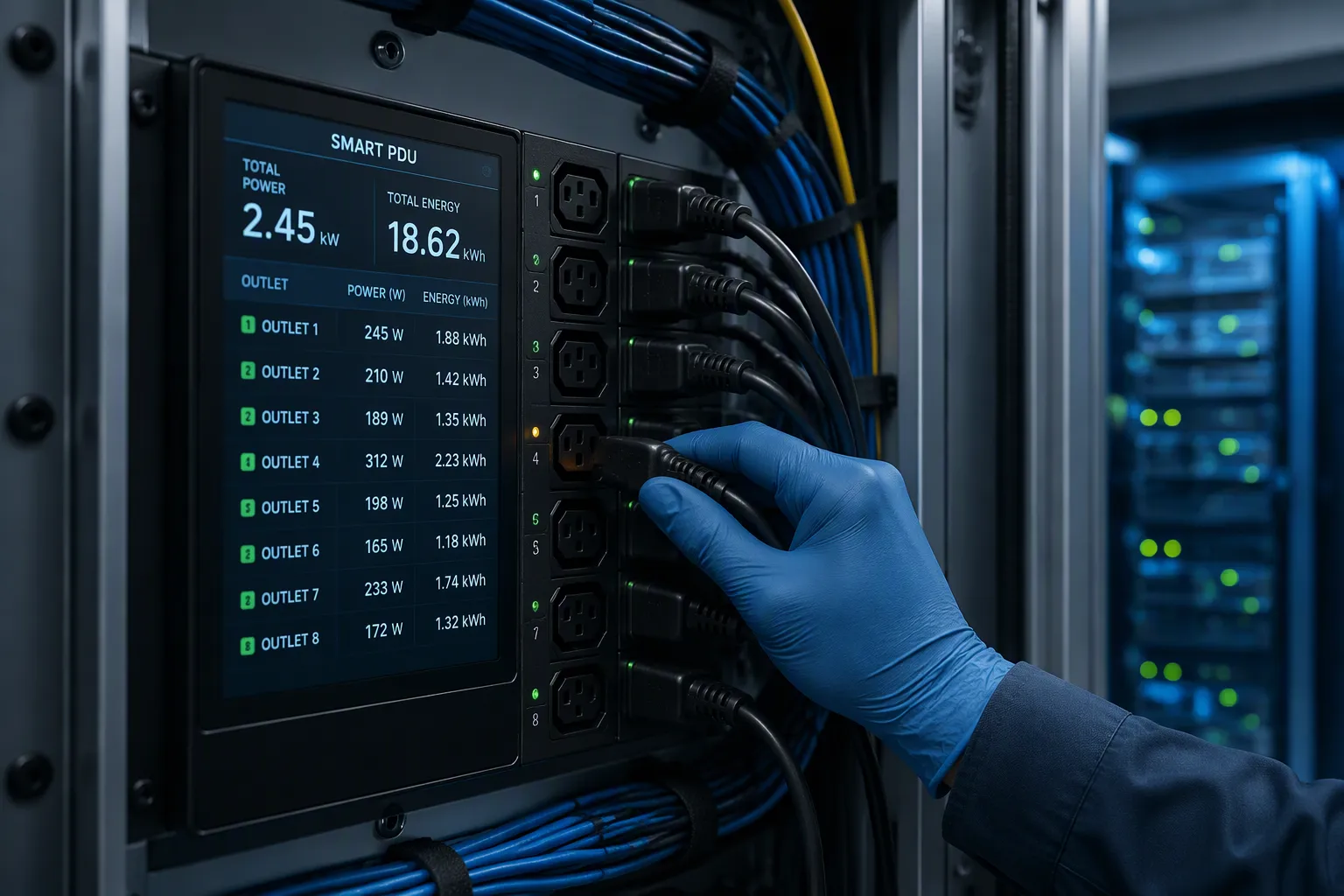
Outlet-level metering means a smart PDU senses power at each outlet. This feature ties energy use to each connected device, not to the whole rack. This matters in telecom cabinets, where mixed equipment loads make whole-rack totals too rough for per-device accountability. One cabinet may hold rectifiers, routers, and transmission gear that draw power very differently. Total readings cannot show each device's share. Outlet-level data fills that gap. The smart power distribution unit reports each outlet on its own, so operators see which device drives load and which sits idle. That visibility helps with cost allocation, capacity planning, and fault detection. This fine detail marks the high end of power distribution monitoring, and it suits cabinets where per-device accountability drives decisions.
Key Takeaways
Outlet-level metering tracks power for each device, not the whole rack.
This detail helps with sharing costs, planning capacity, and finding faults.
Outlet-level metering works well for telecom cabinets that have different types of equipment loads.
Pick outlet-level metering when you need to track energy use for each device most.
Smart PDUs with outlet-level metering let you monitor power from afar and get alerts.
How Smart PDU Outlet Metering Works
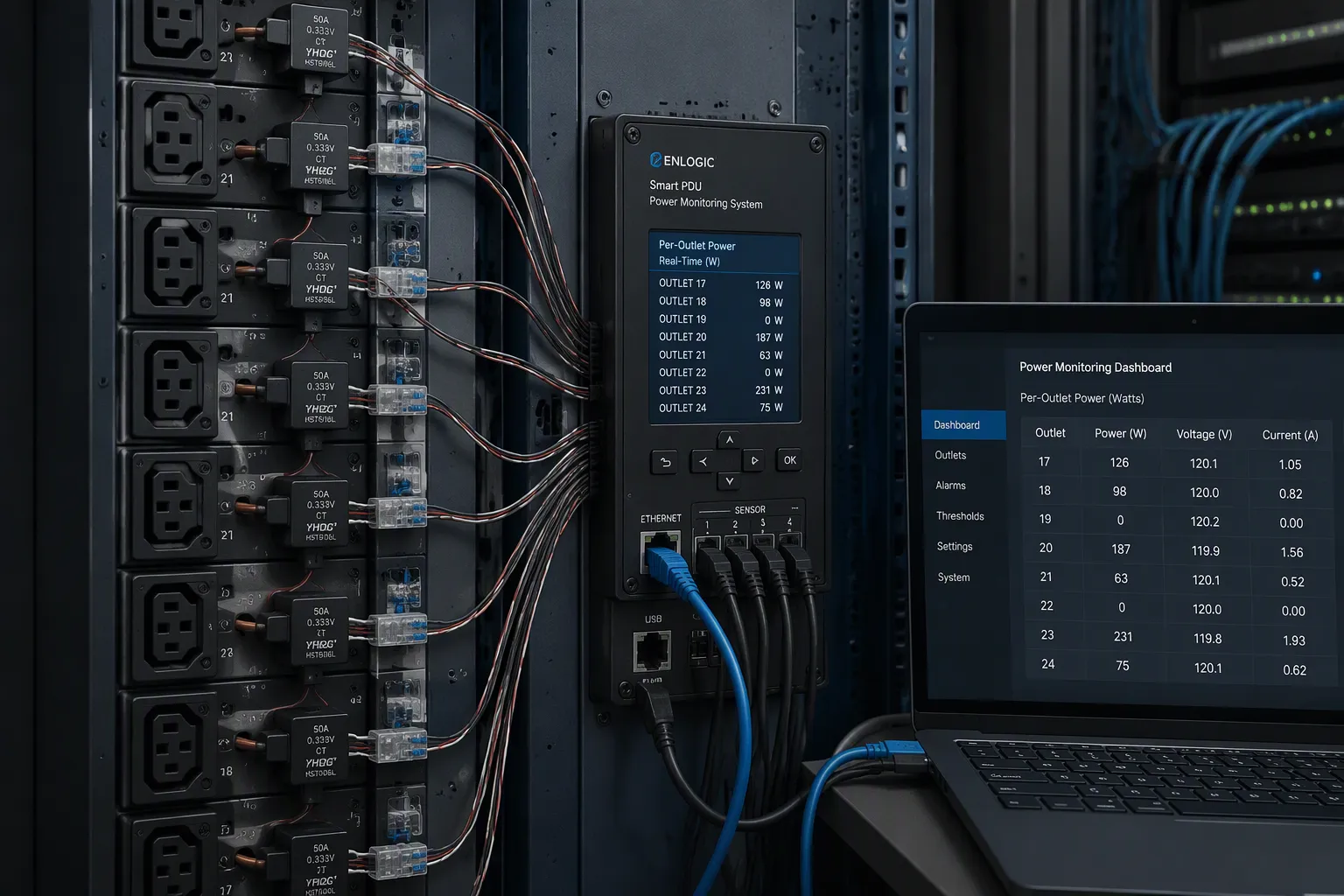
A smart PDU turns raw electrical flow into device-level insight in two stages. First, sensing hardware captures current and voltage at each outlet. Second, the controller packages those readings and sends them to a monitoring platform. Both stages depend on solid power distribution design.
Sensing at Each Outlet
Every outlet on a metered rack PDU has its own current and voltage sensor. A current transformer clamps around the live conductor, and a voltage tap reads line potential. The pair gives true power, so the platform records watts, not just volt-amps. This precision sets a smart power distribution unit apart from a basic power strip. The sensing hardware also captures power quality. A falling power factor can signal a power-supply problem inside a device. Crest factor, the ratio of peak to average current, shows harmonic distortion when it rises above 1.41. Engineers can group several power outlets under one device label. That grouping shows which devices do useful work and which sit idle. The same sensing layer supports outlet-level remote monitoring across a full cabinet. Each sensor feeds the controller with a steady stream of readings. The PDU timestamps every sample, so the platform can line up outlet data with events elsewhere in the network. The design keeps each channel independent, so one noisy load does not distort a neighbor's reading.
Data Collection and Reporting
The data path runs from outlet sensor to the PDU controller, then over the network to the monitoring platform. Each PDU polls its sensors and builds a record for every outlet. Smart PDUs report these per-outlet figures alongside aggregate PDU totals, so managers see the whole and the parts. Smart PDUs also sample branch circuits, and smart PDUs flag a feed that runs hot. Outlets report independently, so a single failure does not blind the whole cabinet. The PDU network link carries the data to a central platform. Common protocols include SNMP v2/v3 with consistent MIBs, the Redfish RESTful API, JSON-RPC, and Modbus/TCP. These protocols feed real-time power data into DCIM platforms and building management systems. Integration with DCIM lets PDU data flow into infrastructure dashboards for trend analysis and capacity planning. Real-time monitoring then becomes practical at scale. Operators can set thresholds and get alerts through SMS, SNMP traps, or e-mail when a reading drifts. Alerts can trigger on a single outlet or on a group, which suits mixed cabinets. This chain gives telecom teams continuous visibility. The smart power distribution unit delivers instant readings and a stored history. That history supports carbon-footprint calculations and regulatory reporting. Real-time monitoring of each outlet closes the loop between measurement and action. Real-time monitoring needs short polling intervals, and smart PDUs feed a rolling archive. A smart PDU that loses its link keeps local records on the PDU. Teams can compare outlets and export these records. Real-time monitoring at the outlet level turns a passive power distribution unit into an active management tool. A smart power distribution unit that reports every channel gives planners what they need, and real-time monitoring keeps that data current. A metered rack PDU supports power distribution planning, and that view helps teams size new loads.
Why It Matters in Telecom Cabinets
Telecom cabinets hold different kinds of equipment, and that mix makes it hard to track power for each device. Outlet-level metering answers the question of which device uses how much power. The data changes how teams plan power usage, bill, and troubleshoot power consumption.
Granular Data and Capacity Planning
Per-outlet measurement ties each reading to a specific device. That link makes charge-back and cost allocation across equipment possible. Teams can spot high-draw devices and compare energy consumption between units. A metered rack PDU records current, power, and often energy at each outlet or outlet group. The smart power distribution unit then reports those figures alongside cabinet totals. For telecom cabinets in remote sites or network POPs, this detail helps with cooling load management and early issue flagging. Smart PDUs add branch-level context, so the outlet level and the circuit view stay aligned.
Telecom cabinets rarely hold identical gear. Per-outlet data shows power usage per device and the headroom left at the rack. Planners can set up new networking devices without guessing. A rack may look safe at the circuit level while one device nears its own limit. Outlet telemetry exposes that hidden imbalance. Smart PDUs that report every channel give planners a clear picture of power usage across the cabinet. A second rack PDU compares on the same basis.
Fault Detection and Remote Visibility
Precise per-outlet data supports proactive troubleshooting. A drifting reading can signal a failing power supply before downtime. Real-time monitoring delivers instant power consumption and environmental data to the platform. Operators can set thresholds on the PDU and receive alerts on a single outlet. Smart PDUs also support remote power cycling, so staff can restart frozen equipment without a site visit. This capability matters at unmanned edge sites and remote telecom cabinets.
Outlet-level remote monitoring extends visibility to each connected device. Integrated Web UI, SNMP, SSH, Modbus, and REST APIs feed DCIM and BMS platforms. Real-time monitoring then covers the whole cabinet, not just the inlet. The PDU becomes an active management tool. Detailed insight also reveals energy waste and inefficient devices. The smart power distribution unit closes the loop between measurement and action. Real-time monitoring of power consumption at each PDU turns raw data into daily decisions. For telecom cabinets, that loop matters every day.
Comparing Metering Options
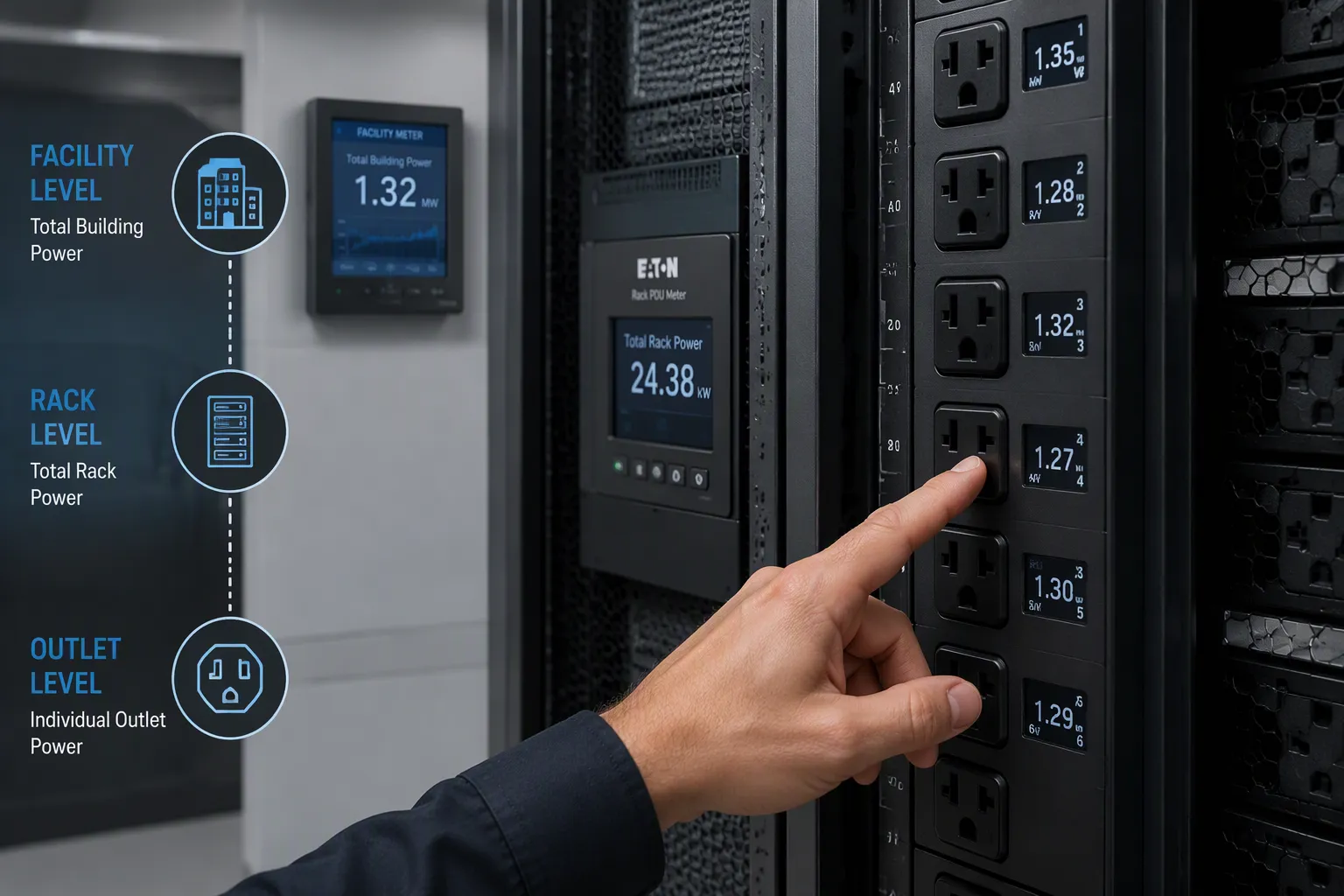
Outlet-Level vs. Rack-Level vs. Facility-Level
Three metering levels do different jobs, and each one answers a different question. Facility-level meters sit at the building service entrance. They capture total power usage for the whole site. Rack-level meters sit at the cabinet inlet. They report the total for one cabinet. Per-outlet meters sit inside a metered PDU and report each receptacle. Granularity rises from facility to rack to outlet. Accuracy follows the same path. A facility meter may drift by a few percent across a large load. A metered PDU at the outlet typically holds about ±1%. Cost rises with granularity too. Facility meters cost the least per point measured. Rack-based PDUs cost more. A fully metered rack PDU with per-outlet sensing costs the most. A facility meter reads one large number, and small loads vanish inside it.
Level | Granularity | Typical Accuracy | Best Fit |
|---|---|---|---|
Facility | Whole site | Coarse | Aggregate billing |
Rack | One cabinet | Moderate | Cabinet totals, cost allocation by cabinet |
Outlet | Each device | About ±1% | Per-device accountability |
The table shows the trade-off in plain terms. Finer data costs more, and it buys sharper answers. A facility meter cannot name the device behind a load spike. A rack PDU narrows the search to one cabinet. A per-outlet meter narrows it to one receptacle. That progression defines the value of each level. Power usage data at the outlet level carries the most detail, and it carries the highest price. Each level suits a different reporting need, and no single level covers every need.
Fit by Application, Compliance, and Cost
Facility-level metering fits aggregate billing and utility reporting. It answers how much power the site draws. It cannot split that total by device. Rack-level metering fits cabinet totals and cost allocation by cabinet. A rack power distribution unit gives planners a clean cabinet figure. Outlet-level metering fits per-device accountability. It shows which device drives power consumption inside a cabinet. The choice follows the reporting unit the operator tracks.
Compliance needs shape the choice. Many operators report site-level energy figures for sustainability programs. Facility meters cover that need. Some telecom cabinets need device-level records for internal charge-back. Per-outlet data covers that need. Real-time monitoring adds value at every level. Smart PDUs feed the finest data into that monitoring stream. A smart power distribution unit also supports remote alerts, so teams act on data without a site visit. Regulators and internal auditors often ask for records at a specific level, and the meter must match that level.
Cost matters. A monitored PDU carries the highest price per cabinet. Rack-level units cost less. Facility meters cost least. Teams should match the level to the goal. A site that only needs a monthly total does not need per-outlet sensing. A site that bills departments per device does. Smart PDUs give the per-outlet option a practical home in telecom cabinets. The right choice depends on the question the operator needs to answer. Real-time monitoring closes the gap between a cabinet total and a device record. A smart power distribution unit that reports every channel makes that gap disappear. Telecom cabinets with mixed loads benefit most from that detail. Budget limits also steer the decision, and a phased rollout can start at the cabinet level.
Implementing a Smart Power Distribution Unit
Installation and Integration
A good rollout starts before the unit arrives. Teams check voltage, frequency, plug type, and breaker capacity when they order. They compare plug shape, outlet spacing, and cable clearance with the cabinet layout. Even a small mismatch can block airflow or stop installation. The ESTEL Smart Power Distribution Unit fits this planning well. It offers 16A maximum input, 8–19 outlet configurations, an IEC60309-compliant plug, and a 600×450×185mm chassis. Its LCD display supports real-time monitoring on site. Surge protection and a dehumidifying function protect equipment in humid cabinets.
Physical installation follows a fixed sequence:
Check that the mounting location is structurally sound; the floor must bear at least 10,000 N/m².
Prepare foundation channel steels and fixed bolts to fix and level the unit.
Keep minimum clearance: 1200 mm from the front panel to any obstruction, 500 mm from the left and right walls, and 250 mm from the top to the ceiling.
Inspect incoming and outgoing wires and confirm secure connections at the top of the panel, with special attention to PE cables.
Integration then connects per-outlet data to the monitoring platform. Engineers set alarm thresholds below breaker limits, not at them. They test a sample unit with the actual rack load and leave headroom for startup surges. Network security, user permissions, event logs, and firmware controls deserve review before deployment.
Data Management and Alerts
Smart PDUs provide per-phase and per-outlet visibility with configurable current thresholds. Teams validate alarms under realistic loads before they rely on them. A threshold that trips on a normal startup surge creates noise, not insight. Stored per-outlet records support reporting, charge-back, and trend analysis across telecom cabinets. Real-time monitoring turns those records into daily decisions. Outlet-level remote monitoring and remote power control let staff act without a site visit. This outlet-level control suits unmanned sites. The smart power distribution unit closes the loop between measurement and action, and the rack PDU becomes an active management tool.
Outlet-level metering shows energy use for each device, which coarser metering cannot do. This detail fits telecom cabinets best. Per-device accountability, capacity planning, and fault detection matter most in telecom cabinets, and outlet level data serves all three. The metering level should match operational goals and budget, and outlet-level sensing remains the high-granularity option. A smart power distribution unit brings that detail into the cabinet. Looking ahead, energy management in telecom facilities is moving toward digitalization, AI-driven analytics, and greener power sources. These trends raise the value of fine-grained data from each PDU. Teams that capture per-outlet readings today will act on them more easily as platforms grow smarter. A PDU with per-outlet sensing positions each cabinet for that future.
FAQ
How accurate are the readings from each outlet?
A smart PDU checks current and voltage at every outlet, and it is accurate to about ±1%. This precision lets teams trust per-device numbers for charge-back and capacity planning. Readings follow real consumption closely, so a drifting value can warn of a failing power supply before downtime.
How many outlets does a metered unit offer?
Configurations range from 8 to 19 outlets, so one chassis can serve small and dense cabinets alike. The unit takes a maximum input current of 16A and uses an IEC60309-compliant plug. Teams match the outlet count to the equipment mix inside each cabinet.
Can operators monitor each outlet remotely?
Yes. The PDU sends per-outlet data over the network to a monitoring platform through protocols such as SNMP and Modbus/TCP. Operators set thresholds and get alerts on a single outlet. Remote power cycling lets staff restart frozen equipment without a site visit.
When does outlet-level metering make sense over rack-level?
Outlet-level metering fits cabinets where per-device accountability drives decisions. Rack-level units suit cabinet totals and cost allocation by cabinet. Facility meters cover aggregate billing. The right level follows the reporting unit the operator tracks and the budget available.
See Also
Understanding ESTEL PDUs And Their Role In Data Center Cabinets
Photovoltaic Energy Storage Power System For Telecom Cabinet Applications
Ensuring Reliable Power Supply For Telecom Cabinets Effectively
Ensuring Optimal Monitoring For Outdoor Telecom Cabinets Efficiently
ESTEL Smart Microgrid Integrated Telecom Cabinet Energy Storage System
CALL US DIRECTLY
86-13752765943
3A-8, SHUIWAN 1979 SQUARE (PHASE II), NO.111, TAIZI ROAD,SHUIWAN COMMUNITY, ZHAOSHANG STREET, NANSHAN DISTRICT, SHENZHEN, GUANGDONG, CHINA
