How Smart PDUs Restrict Inrush Current to Protect Upstream Breakers in Telecom Cabinets

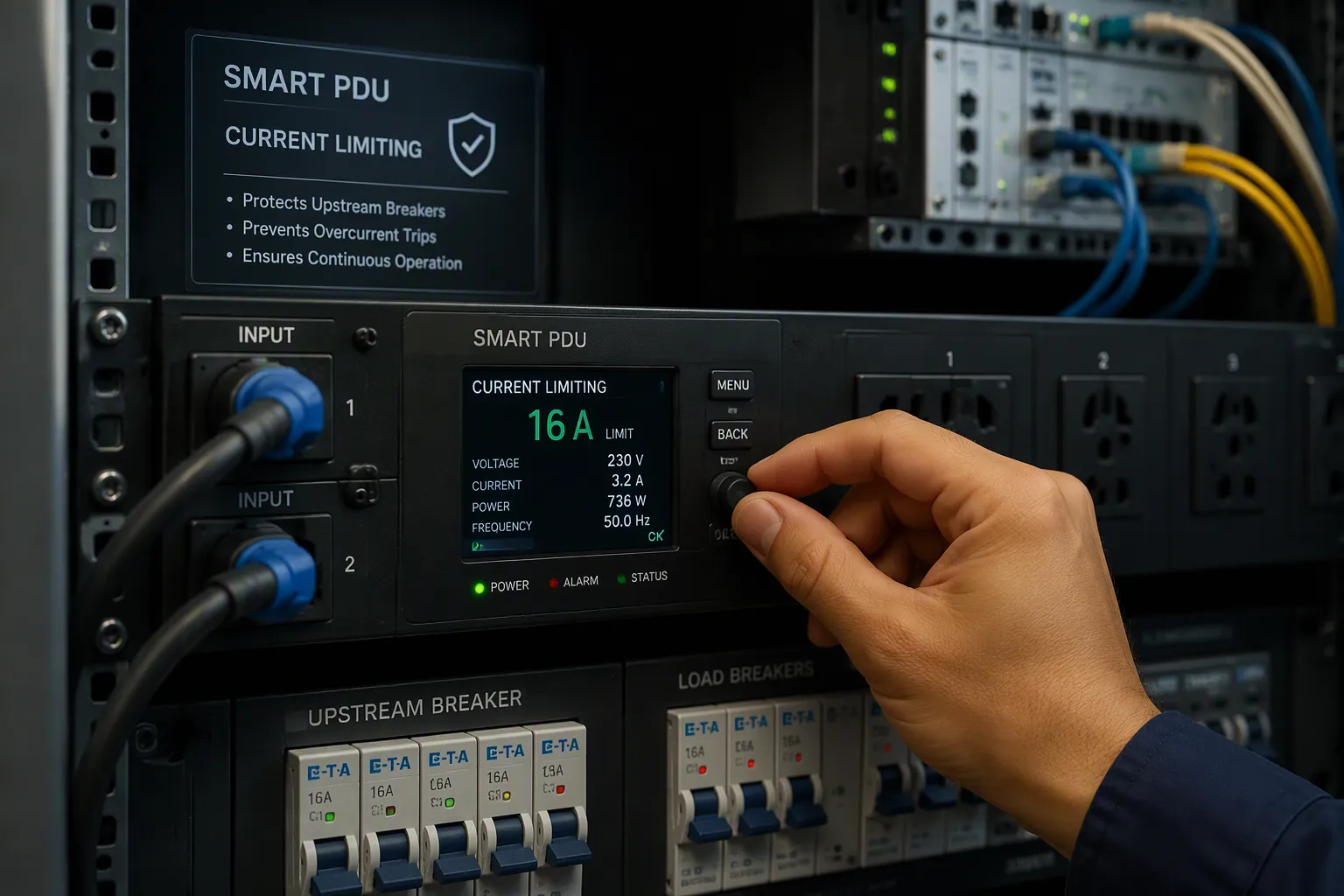
A smart PDU restricts inrush current through active current limiting and outlet sequencing. This keeps the startup surge below the trip threshold of upstream breakers and prevents nuisance trips. In telecom cabinets, dense equipment shares a single upstream feed. One trip takes the site down and triggers a truck roll. You need coordination between the rack PDU and the circuit breaker feeding it. The trip curve of that breaker, the surge profile of each load, and the order you power loads up all interact. This post explains the limiting mechanism, the breaker protection and coordination logic, and where smart PDUs fit among the alternatives.
Key Takeaways
Inrush current is a brief surge of electricity when equipment turns on. It can trip upstream breakers in telecom cabinets.
Smart PDUs use active limiting and outlet sequencing to reduce inrush current. This keeps the startup surge below the breaker's trip threshold.
Proper coordination between the PDU and upstream breakers prevents nuisance trips. A coordination study checks breaker settings and trip curves.
Smart PDUs improve uptime and reduce truck rolls by preventing breaker trips. They also provide visibility and control over power usage.
Smart PDUs fit best in cabinets with many small loads on one feed. Other options like soft starters suit large single loads.
Inrush Current And Circuit Breaker Risk
What Inrush Current Is
Inrush current is the sudden surge of electrical current that flows into a device at the moment it is switched on. This current is significantly higher than the normal operating current and typically lasts for a very short duration, from milliseconds to a few seconds.
That short window matters. A circuit breaker responds to sustained overloads and short-circuit current, not to a brief spike. The surge often falls outside the breaker's trip curve, so a surge well above the rated load can pass through the breaker without a trip.
Why Breakers Trip In Cabinets
Telecom cabinets pack high-density equipment onto shared upstream breakers. One feed may carry many loads, and each load adds its own startup surge. Transformer energization makes this worse, because the physics can draw 8 to 15 times rated load and trip the main breaker on the upstream feed.
Energization — results from re-energization of a transformer; the residual flux in this case can be zero or depend on energization timing.
Recovery — flows when transformer voltage is restored after having been reduced by a system disturbance.
Sympathetic — flows when multiple transformers are connected on the same line and one of them is energized.
These transient inrush currents stack. A cabinet full of rectifiers and fans can push a shared feed past its limit at cold start. You then face a choice: oversize the feed, or add coordination so the downstream breaker clears before the main one does.
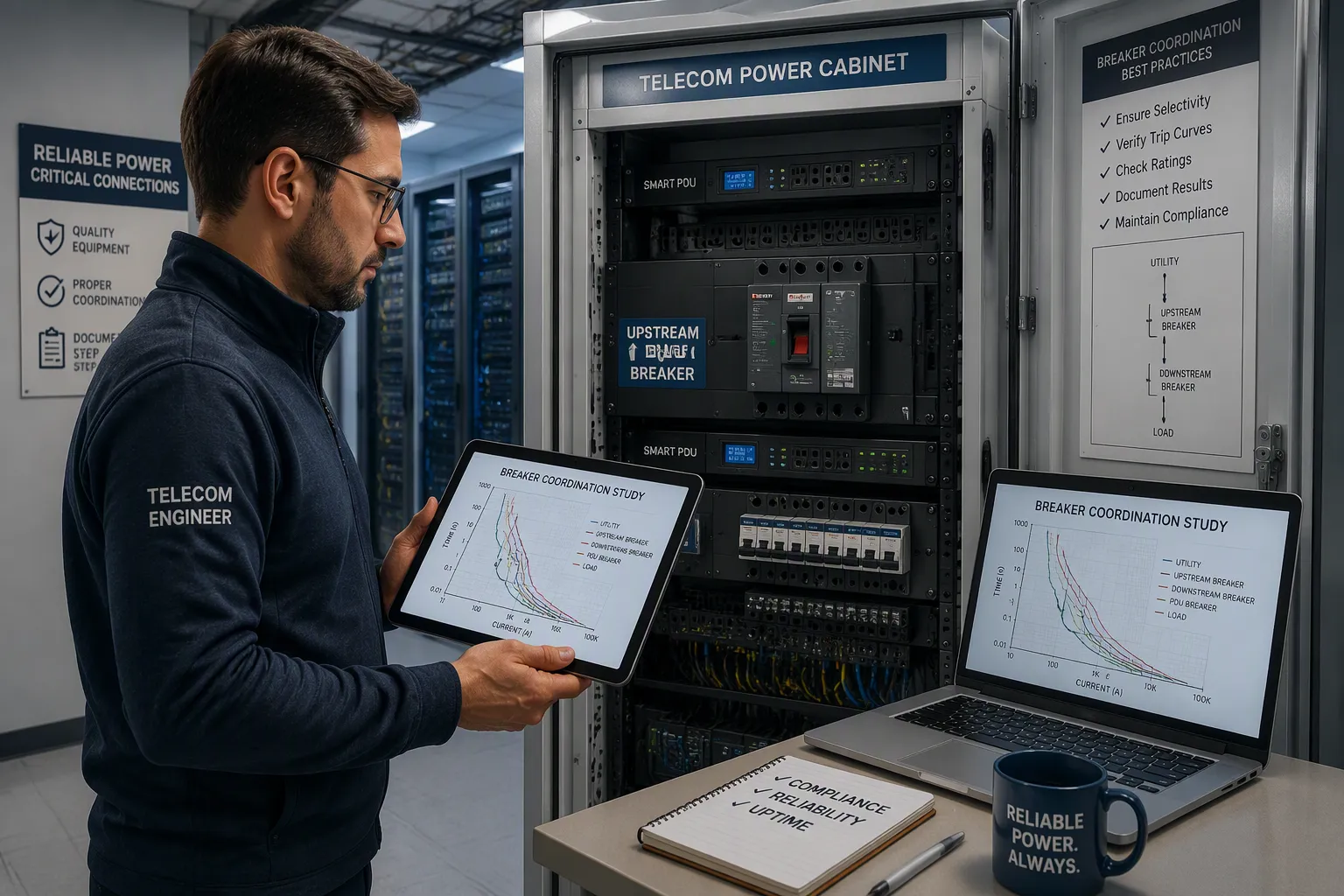
Selective coordination solves this by design. You compare trip curves, set the downstream breaker to open first, and keep the upstream device closed. Selective coordination sets that order: branch breakers trip first, main breakers stay closed, and the site keeps running. A coordination study protects the electrical system from overcurrent conditions across the whole chain. Overcurrent protection settings, PDU behavior, and circuit breakers for data centers all belong in the same review. A PDU with active limiting changes the picture, because it lowers the surge each branch presents to the breaker.
How Smart PDUs Restrict Inrush Current
Active Limiting Methods
A smart PDU can hold the startup surge below the trip threshold of the upstream breaker. It does this with active current limiting at the outlet or branch level. An NTC thermistor is one common method. Its resistance is high when cold, so it chokes the first rush of current into a load. The resistance falls as the part warms, and normal operation resumes. Solid-state control is the other main approach. A controller ramps the voltage applied to the load instead of switching it on instantly. The load capacitance charges gradually, so the peak current stays low. Both methods act on the shape of the startup curve, not on the load itself. You get a gentler ramp without changing the equipment.
Outlet Sequencing And Delays
Outlet sequencing spreads startup across time. A rack PDU with this feature powers devices in a logical order rather than all at once. The sequence below shows how a typical group scheme works:
On system power-up, Group A outlets energize immediately.
When the remote Power On signal is asserted, Group B outlets energize.
After a fixed internal delay of approximately 2 seconds, Group C outlets energize.
The staggered delay reduces inrush and helps prevent breaker trips. You can also set user-configurable, outlet-level delays. Put rectifiers first, then fans, then monitoring gear. Slowing the voltage rise on load capacitance lowers the surge further. The table below shows where this approach fits:
Method | Best suited to | Main limitation |
|---|---|---|
Sequential energization | Multiple loads starting together | Adds control complexity; does not reduce each load's individual inrush |
Sequencing and active limiting work well as a pair. Sequencing lowers the total surge a cabinet presents. Active limiting lowers each load's own contribution. Together they keep the startup profile under the coordination settings you chose for the feed.
Breaker Coordination And Compliance
Coordinating With Upstream Breakers
Coordination is the ability of a protective device to clear a fault at its own location without cutting power to healthy parts of the system. You want downstream breakers trip before upstream breakers, so a branch fault never takes the whole cabinet offline.
When a branch short circuit causes the main breaker to trip first, the problem is not necessarily that the breaker is too small or too large. A more common cause is poor selectivity and coordination between upstream and downstream protection devices.
A breaker trips anywhere within a tolerance band around its nominal setting. A unit set for a 2500 A long-time trip with ±10% tolerance may actually trip anywhere from 2250 A to 2750 A. In a coordinated system, the tolerance bands of upstream and downstream breakers must not overlap. You plot sufficient margin between their curves, so the downstream device clears the fault before the upstream device operates. The setting must also ride through normal inrush, motor-starting, and temporary surge currents. An over-sensitive setting causes nuisance trips.
A coordination study for PDU transformers follows a clear sequence. First, calculate total PDU transformer inrush by summing the inrush currents of all PDU transformers, using worst-case simultaneous energization. Second, set the bypass circuit breaker instantaneous setting to withstand total inrush with margin, so it rides through the 0.1–0.5 s inrush event while still clearing downstream faults. Third, configure internal UPS breakers with adjustable trip settings to withstand inrush and coordinate with upstream breakers. Fourth, handle the rectifier input breaker as a special case, set per the UPS manufacturer's specification.
Parameter | Recommended Value | Rationale |
|---|---|---|
Bypass CB instantaneous | 8–15× FLA | Must exceed calculated PDU inrush peak |
Internal static switch CB | ≥ PDU inrush × 1.25 | Prevent nuisance trip; still clear faults in <100 ms |
Long-time delay (all CBs) | 0.5–2.0 s | Allow inrush to subside before clearing |
Selectivity ratio | ≥1.5:1 (upstream:downstream) | Ensures proper fault discrimination |
Common mistakes include assuming all transformers energize simultaneously, setting instantaneous too low, and ignoring harmonic content. Always verify with field testing during commissioning.
Meeting Electrical Standards
Coordinated inrush limiting supports code-compliant telecom cabinet deployments. A well-designed DC distribution system isolates a fault as close to its location as possible. A short circuit on one branch should trip the branch protection while keeping the DC bus and other healthy loads in operation. Without selective coordination, a fault limited to one branch may cause the entire DC panel or telecom power system to lose power.
Good DC distribution protection is not simply about ensuring that a breaker trips whenever a fault occurs. It should ensure the fault is isolated as close to its location as possible while healthy loads continue operating. This matters for substation DC systems, telecom power systems, data center auxiliary power, and industrial control power. A PDU with selective coordination capability protects the electrical system from overcurrent conditions across the whole chain. Overcurrent protection settings, PDU behavior, and circuit breakers for data centers all belong in the same review. That review covers conductor ampacity, allowable temperature rise, load startup characteristics, expected short-circuit current, and protection operating characteristics. It also confirms DC rated voltage, pole configuration, and DC breaking capacity suit actual DC conditions. Cable size, length, and terminal conditions account for reduced fault current and localized heating. Data center electrical protection depends on this discipline, and an upstream PDU with active limiting changes the picture by lowering the surge each branch presents.
Benefits And Telecom Cabinet Applications

Reliability And Nuisance-Trip Reduction
Fewer nuisance trips is the first gain you notice. Active limiting holds each load's startup surge down, so the upstream breaker sees a gentler ramp. That lowers stress on the breaker mechanism itself. A breaker that trips repeatedly wears faster and drifts from its published curve. Stable boot-up order matters just as much in a dense cabinet. You bring loads up in a fixed sequence, so every restart follows the same path.
User-configurable, outlet-level delays allow data center managers to power sequence devices to reduce inrush currents and to establish logical boot-up sequences.
The payoff shows up in the field. Fewer trips also mean fewer truck rolls to remote sites. A rack pdu that sequences outlets gives you that order without manual intervention. You set the delays once, and every cold start repeats them.
Where ESTEL Smart PDUs Fit
A smart pdu earns its place where you need active control and visibility, not just power distribution. ESTEL Smart PDUs are designed to integrate seamlessly with ESTEL Outdoor Telecom Cabinets, fitting standard 19-inch racks and meeting international safety and quality standards (UL Listed, CE Mark, FCC Class A, IEC 62368-1). That makes them suitable for harsh outdoor telecom cabinet environments.
One European telecom operator managed outdoor cabinets across Germany, France, and Spain, where local teams spoke different languages. ESTEL Smart PDUs went into all of these cabinets, and the multilingual interface let each team work in its native language. That reduced errors and improved emergency response times. The same deployment pattern suits cross-border operations:
Consistent power distribution to critical equipment, which prevents disruptions
Power usage monitoring that reveals underutilized equipment and optimizes energy consumption
Fault tolerance and scalability for telecom-specific challenges such as heat generation
A rack pdu with outlet sequencing fits best where several loads share one feed. You get selective coordination between the pdu and the breaker feeding it, and the current stays under the trip threshold at every start.
Comparing Inrush Mitigation Options
Performance And Application Fit
Each option attacks the surge at a different point. A soft starter ramps voltage to a motor or a large load, so it suits a single big load with a known startup profile. Point-on-wave switching closes a circuit breaker at a chosen moment in the AC cycle, which reduces transformer inrush without adding series impedance. Harmonic restraint works inside the breaker's protection logic. It lets the breaker ignore the harmonic-rich signature of inrush and respond only to a real fault. Pre-magnetizing energizes the transformer core in a controlled way before the main circuit breaker closes.
A smart PDU takes a different route. It limits current at each outlet and sequences outlets in time, so it fits a cabinet with many small loads on one feed. You get active control and visibility across the whole branch. Soft starters and pre-magnetizing fit large individual loads. Point-on-wave switching and harmonic restraint fit where the transformer itself drives the surge. A rack PDU fits where dozens of rectifiers and fans share a feed.
Compliance And Cost
Compliance depends on the device you protect. Harmonic restraint lives inside the breaker, so it follows the breaker's listing. Point-on-wave switching needs a controlled switching device with its own type tests. Soft starters and pre-magnetizing hardware carry their own standards and add components to the chain. A smart PDU with active limiting supports selective coordination across the cabinet, and that coordination supports code-compliant deployments.
Cost tracks complexity. Soft starters and pre-magnetizing units add hardware per load. Point-on-wave switching adds cost at the switching device. Harmonic restraint adds cost inside the breaker. A smart PDU spreads its cost across many outlets, so the per-load figure stays low. Selective coordination studies, overcurrent protection settings, and circuit breakers for data centers all belong in the same review. Smart circuit breakers and a PDU with limiting both help you keep the electrical system from overcurrent conditions during startup. Match the option to the load, and check the downstream breaker and upstream breaker curves together.
Smart PDUs limit inrush current and sequence outlets. The startup surge stays under the trip threshold of the upstream breaker. You protect breakers and improve reliability in cabinets.
A pdu holds each load's surge down. Coordination with upstream breakers ties the pdu to the trip curve. Selective coordination keeps branch breakers ahead of main breakers. A coordination study checks feed breakers, bypass breakers, rectifier breakers, and panel breakers. Breakers coordinate with breakers, and each breaker protects the breaker downstream. Breaker curves, breaker settings, breaker trip points, and breaker margins must ride through inrush.
Smart PDUs are one option among several. They fit best where you value active control and visibility.
FAQ
How does a smart PDU keep startup current under the trip threshold?
It limits current at each outlet and staggers outlet power-up in time. The upstream breaker then sees a gentler ramp instead of one combined surge. Active limiting and sequencing work together, so the startup profile stays below the coordination settings you chose for the feed.
Why do shared feeds trip when a cabinet restarts?
Many loads start at once, and each adds its own surge. Transformer energization can draw 8 to 15 times rated load. Those surges stack on one feed. The main breaker then trips before the branch breakers clear. Proper coordination between breakers prevents that outcome.
What does a coordination study check for a PDU transformer?
It sums the inrush of all transformers using worst-case simultaneous energization. It then sets the bypass breaker instantaneous trip to ride through the 0.1–0.5 s event with margin. It also confirms a selectivity ratio of at least 1.5:1 between upstream and downstream breakers.
Can outlet sequencing replace active current limiting?
No. Sequencing lowers the total surge a cabinet presents. It does not reduce each load's individual inrush. Pair a rack pdu with sequencing and active limiting, and each breaker sees both a lower total and a gentler per-load ramp.
Where does a smart PDU fit among the alternatives?
Soft starters and pre-magnetizing suit large single loads. Point-on-wave switching and harmonic restraint suit transformer-driven surges. A pdu fits a cabinet with many small loads on one feed. Match the option to the load, and check both breaker curves together.
See Also
Ensuring Reliable Power Supply Within Telecom Cabinets For Optimal Performance
Understanding ESTEL PDUs And Their Crucial Role In Data Center Cabinets
Protecting Equipment Effectively Using Outdoor Telecom Cabinets For Durability
Exploring The Various Uses And Applications Of Telecom Cabinets
Reasons Telecom Cabinets Use -48VDC Voltage And Ground The Positive Terminal
CALL US DIRECTLY
86-13752765943
3A-8, SHUIWAN 1979 SQUARE (PHASE II), NO.111, TAIZI ROAD,SHUIWAN COMMUNITY, ZHAOSHANG STREET, NANSHAN DISTRICT, SHENZHEN, GUANGDONG, CHINA
