How Smart PDUs and Environmental Sensors Drive Green Data Centers

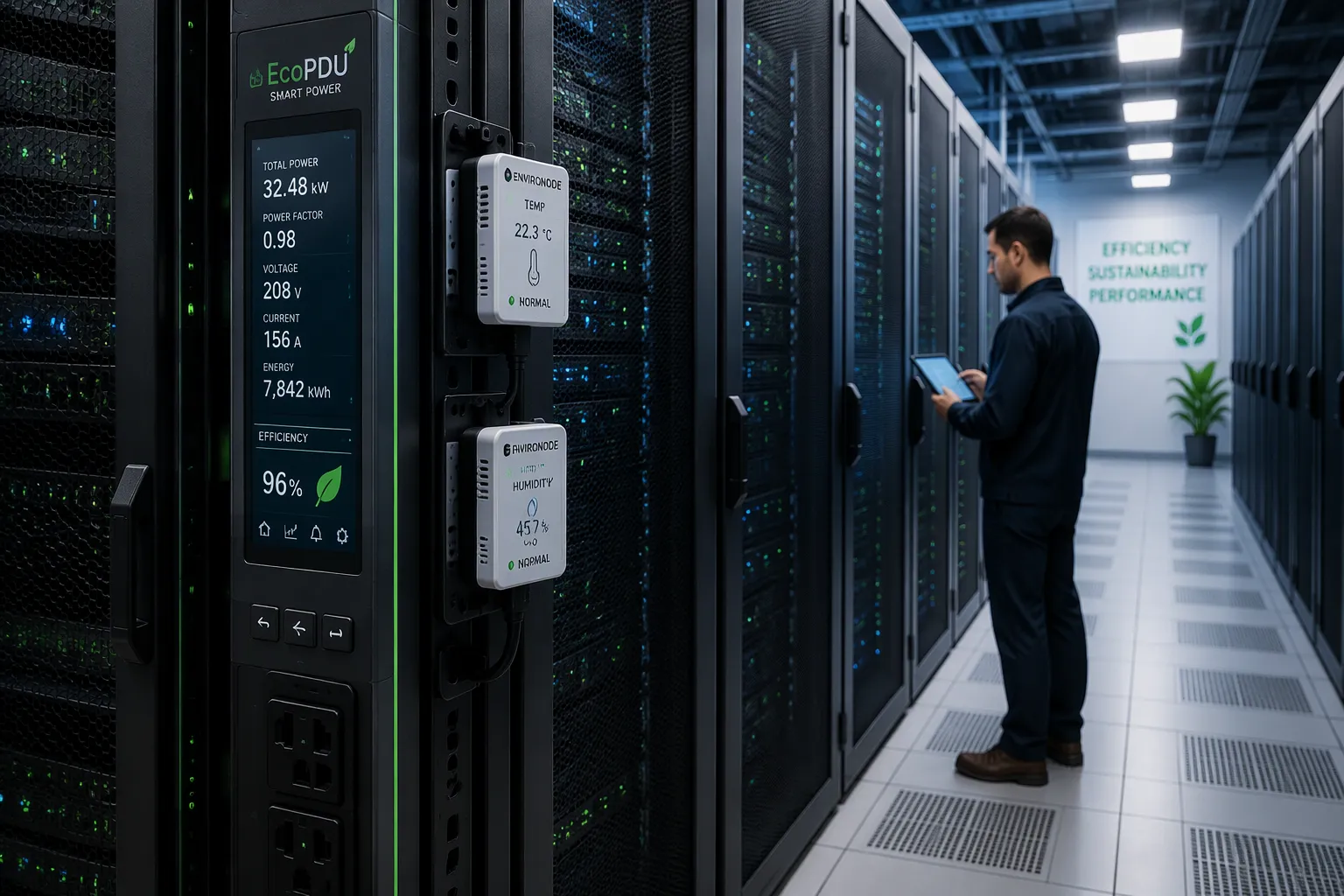
Smart PDUs and environmental sensors drive green data centers through three mechanisms: real-time energy monitoring, granular control, and optimized cooling. Each mechanism cuts energy waste and lowers operating costs.
A smart pdu measures power at the outlet level. That data reveals exactly where electricity goes. Environmental sensors track temperature, humidity, and airflow around your racks. Together, these tools turn invisible waste into numbers you can act on.
Granular control follows measurement. You can switch outlets remotely, balance loads, and adjust cooling to match actual demand. This combination of real-time monitoring, control, and optimization replaces guesswork with evidence.
The sections below explain what each technology does, how a pdu and sensors work as one system, and the practical benefits and implementation steps. You will also see where each pdus configuration fits best.
Key Takeaways
Smart PDUs measure power at each outlet. This shows you exactly where electricity goes.
Environmental sensors track temperature and humidity. They help you find hotspots and adjust cooling.
Remote control lets you switch outlets and balance loads. This saves energy and reduces downtime.
Integrated data from PDUs and sensors supports predictive maintenance. You can fix problems before they cause failures.
These technologies cut energy costs and support sustainability. They help data centers grow efficiently.
Smart PDU Power Visibility
A smart PDU distributes power like a basic unit, yet it adds measurement, network access, and control at the rack. ESTEL's Smart Power Distribution Unit shows this shift in practice. It offers remote management, an LCD for real-time monitoring, surge protection, a dehumidifying function, 8 to 19 outlet configurations, and a 16A maximum input current. The table below, drawn from nbyosun.com, summarizes the gap between the two designs.
Feature | Smart PDUs | Basic PDUs |
|---|---|---|
Metering | Yes | No |
Remote access | Yes, via web or SNMP | No |
Outlet level monitoring | Yes | No |
Alerts and alarms | Yes | No |
Environmental monitoring | Yes | No |
Basic units still fit small offices and budget setups where simple distribution is enough. Smart power distribution units suit racks that need data and remote reach.
Real-Time Monitoring and Remote Control
Live data changes how you manage power usage at the rack level. You see which device draws too much or too little, and you act before waste compounds. According to nbyosun.com, organizations report energy savings of up to 20% after deploying these devices, and intelligent PDUs cut downtime by 25% or more through real-time alerts and load management.
Remote control removes truck rolls. You reboot a frozen server or shut an idle outlet from a browser or phone. Unit-level and outlet-level remote monitoring also let you monitor power consumption continuously as demand shifts. A switched PDU adds remote on/off per outlet, so load shedding at peak hours becomes a policy, not a site visit.
Load Balancing and Smart Power Distribution Units
Balanced loads keep circuits cool and stable. Smart PDUs track power consumption per outlet, and you redistribute devices to spread the draw. AscentOptics reports that load balancing cuts unintentional outages by an average of 15%, and intelligent outlet PDUs raise power efficiency by 20%.
Granular control turns insight into action. Switched PDUs enable remote rebooting, peak-demand load shedding, and outlet-level efficiency gains. Monitored PDUs give visibility without switching, which fits racks where uptime rules out remote toggling. Either way, efficient power distribution starts with knowing where every watt goes.
Environmental Sensors and Cooling
Temperature, Humidity, and Airflow
Environmental sensors turn the invisible climate around your racks into readable data. They track temperature, humidity, airflow, air pressure, and leaks. According to ifm, rack-inlet temperature should sit between 18°C and 27°C (64.4°F to 80.6°F), and differential pressure between hot and cold aisles should stay between 10 Pa and 30 Pa. Humidity sensors prevent condensation at high humidity and static electricity at low humidity, as Amphenol explains. Differential pressure sensors confirm that cold air actually reaches the racks. Underfloor leak detection catches moisture before it reaches equipment.
Smart PDUs can carry these sensors directly. ESTEL's Smart Power Distribution Unit includes a dehumidifying function, so in-rack humidity control starts at the power strip itself. This builds on the power visibility covered earlier: the same PDU that meters power consumption can also report the conditions around it.
Hotspot Detection and Efficiency
Hotspots are local temperature variations inside a data center, and they appear most often at the top of server racks because hot air rises, according to Nlyte. You detect them by placing temperature detectors at the upper, central, and lower sections on both the front and rear of racks, as Encor Advisors recommends. This layout captures stratification and blocked pathways before servers throttle.
Cooling accounts for as much as 30 to 60% of a data center's utility bill, Nlyte notes. Sensor data lets you raise setpoints and adjust airflow to match real demand, which trims energy consumption without risking hardware. Environmental monitoring matters at edge sites too, where small rooms and variable loads make local conditions harder to predict. A monitored PDU with integrated sensors gives you that visibility without a full building management system.
Intelligent PDUs and Sensor Integration
Integrated Data and DCIM Insights
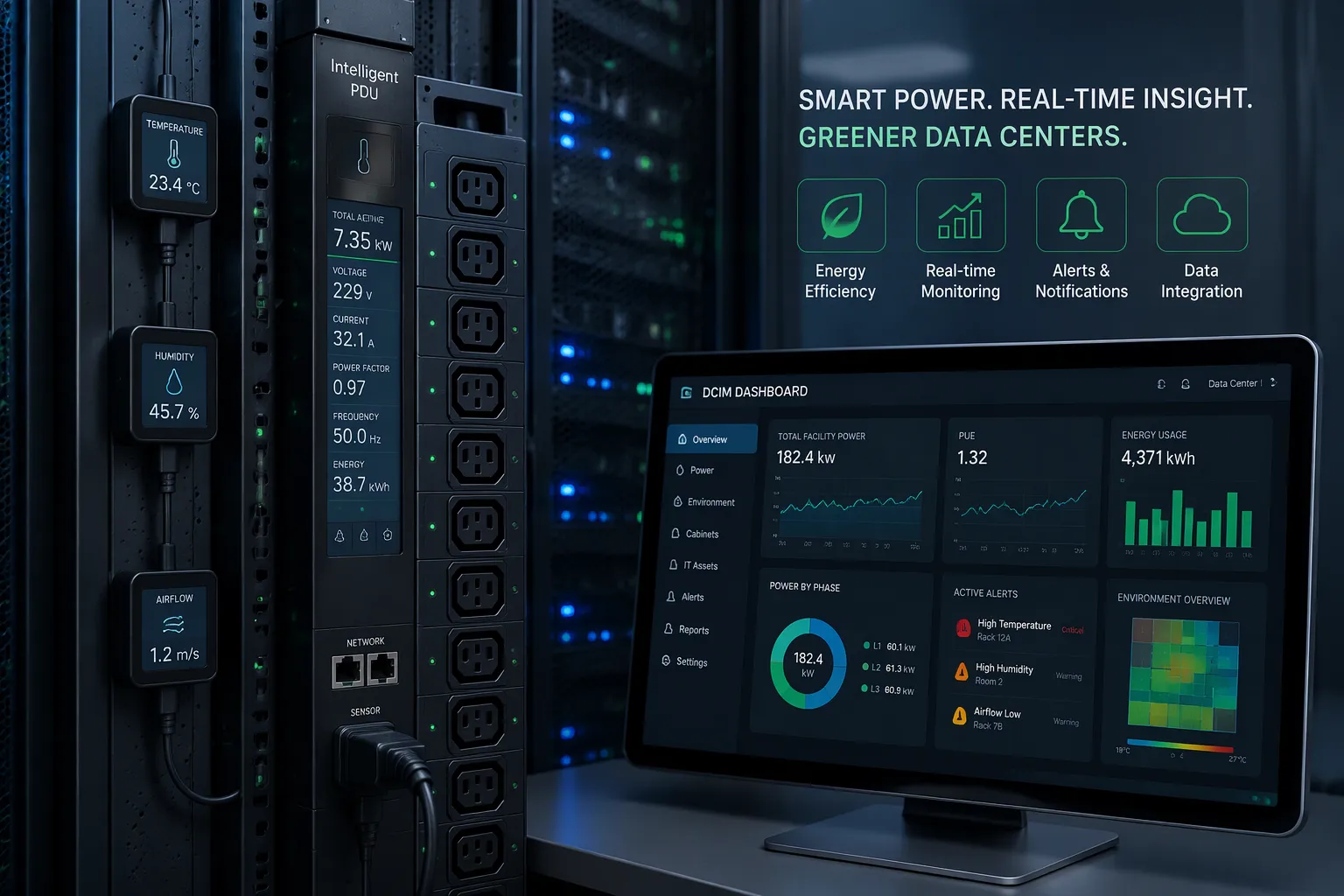
An intelligent PDU does more than meter power. It acts as a data hub for the rack. Intelligent PDUs collect several data types, and each type supports a different decision. The table below, drawn from ESTEL's blog, shows how these streams work together.
Data Type | Importance |
|---|---|
Load Cycle Data | Essential for modeling remaining useful life (RUL) by tracking charge-discharge cycles and stress on components. |
Voltage and Current | Critical for assessing health of power systems; fluctuations can indicate potential failures and inefficiencies. |
Temperature Data | Vital for predicting RUL; high temperatures can accelerate degradation and risk of failure. |
Environmental sensors add context to that electrical picture. They report temperature, humidity, airflow, smoke, water leaks, security events, and energy usage and carbon emissions, according to ESTEL's blog. NBYOSUN notes that its 42U monitored PDU integrates environmental sensors to watch temperature, humidity, and airflow, which keeps IT equipment within optimal conditions. A monitored PDU therefore delivers real-time power and environmental data from one device.
DCIM integration turns these streams into facility-wide insight. Vertiv explains that DCIM solutions provide a single access point to view real-time power and environmental data, plus trend reports that show the whole facility. You gain visibility for capacity planning, and you spot stranded capacity before it becomes a budget problem. Intelligent PDUs support standard protocols such as SNMP and HTTP, so most management systems accept their data without custom work.
Automated Responses and Predictive Maintenance
Data becomes valuable when it triggers action. Intelligent PDUs and their sensors can fire alerts and run responses automatically. Sunbird DCIM notes that intelligent PDUs send SNMP trap notifications when temperature or load crosses a threshold. Raritan describes plug-and-play sensors that flag cooling inefficiencies, hot spots, or airflow recirculation. Common automated actions include:
Power control (on, off, reboot) per outlet
Email notifications and SNMP traps
Webhook or HTTP requests to tools such as Slack or PagerDuty
Chained actions that run several steps in sequence
Synaccess shows how these triggers combine. A ping timeout can start a reboot cycle and send an email. A humidity spike can power down non-essential equipment to cut load. Scheduled triggers automate off-hours power sequences. Switched PDUs make these responses possible, while intelligent power monitoring and control keeps every action logged.
Predictive maintenance builds on the same data. NBYOSUN reports that cooling costs drop by 10–15% when environmental data guides adjustments. AI can combine parameters with historical trends to spot degradation patterns, such as battery temperature rising while charging behavior changes, as one LinkedIn analysis describes. Alarm correlation then separates the primary event from its side effects. You fix the cooling fault instead of chasing the temperature alarm. This approach supports energy management that anticipates problems rather than reacting to them.
Green Data Center Benefits
Energy Savings and Compliance
Efficiency pays back on two fronts: the utility bill and the rulebook. Device42 lists the core gains of green data centers: cost savings from lower energy consumption, regulatory compliance, environmental sustainability, scalability, resource conservation, and uptime. Each benefit reinforces the others. Lower power draw trims utility costs. Tighter cooling improves reliability. Better reliability protects uptime.
Compliance now carries direct financial weight. Hanwha Data Centers notes that jurisdictions with carbon taxes or cap-and-trade systems create penalties for inefficiency. The same source observes that energy is typically the second-largest operating expense after staffing. Cutting energy consumption by 30% while holding computational output transforms unit economics. You also avoid rushed retrofits later. Data center sustainability therefore becomes a planning discipline, not a slogan.
Scalability and Cost Reduction
Scalable efficiency lets you grow without proportionally growing the bill. The table below, drawn from the Pit Journal, shows strategies that pair scalability with cost reduction.
Strategy | Evidence of scalability and cost reduction |
|---|---|
Dynamic resource allocation | Public cloud services are estimated to be 3.8 times more energy-efficient than conventional enterprise data centers. |
Migrating applications to cloud | Lawrence Berkeley National Laboratory found migrating core applications can save up to 87% of energy. |
Serverless computing | Lowers energy consumption by up to 45% compared to traditional server-based models. |
Energy-efficient processors | AWS Graviton processors enable PUE ratings as low as 1.08 versus the industry average of 1.57. |
AI-powered cooling | Google Cloud reduced cooling energy consumption by 30%. |
IBM adds virtualization, efficient cooling, waste heat reuse, and DCIM to the list of cost-saving practices. Intelligent PDUs feed the DCIM layer with rack-level data. Switched PDUs let you shed idle loads remotely. Together, PDUs and sensors support sustainable data centers that scale on evidence rather than guesswork. Lower operating costs improve margins, and providers can pass savings to service prices for a competitive edge.
Implementation with ESTEL
Assessment and Selection Criteria
Start with an assessment of the whole facility. Chint Global recommends that you examine total power needs and add a margin for expansion. A data center with 80 kW of equipment, for example, may call for a PDU rated at least 100 kW to leave room for growth. Check the maximum rated current of outgoing MCBs to confirm load capacity. Then map where sensors will go, because temperature and humidity data keep equipment in its best operating range.
Selection follows the assessment. Work through these criteria in order:
Define the rack power requirement, including expected load and future expansion.
Confirm voltage and phase against the upstream electrical system.
Choose a form factor: vertical 0U or horizontal 1U/2U.
Pick the monitoring level, from basic through metered, monitored, switched, and intelligent.
Verify outlet type, quantity, and connectors, such as C13 and C19.
Plan redundancy with A/B power paths for critical equipment.
Design for future density, especially AI workloads.
Confirm DCIM or BMS integration.
Build quality matters too. PDUs sit in the hottest part of the cabinet, behind high-density equipment, so the unit must withstand high temperatures. ESTEL's Smart Power Distribution Unit meets this demand with surge protection, a dehumidifying function, and 8 to 19 outlet configurations. For sensor accuracy, Legrand's SmartSensors deliver ±0.2°C for temperature and ±5% for relative humidity, according to ServerTech.
Deployment Best Practices
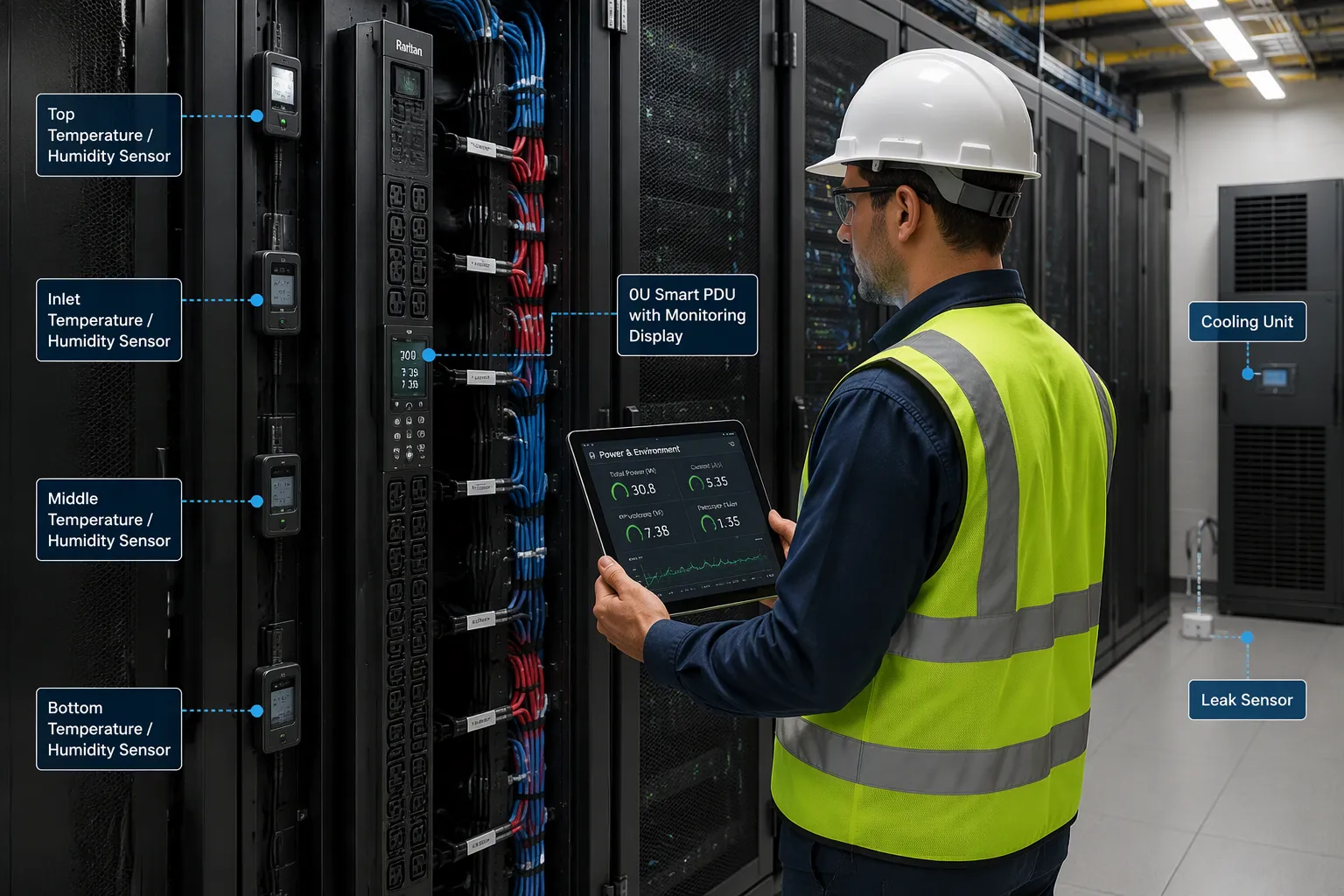
Deploy vertical 0U units to save horizontal space, and keep every PDU clear of exhaust vents. Lianjer advises 20–30% headroom on capacity, so an undersized unit never trips a circuit at peak. Label and color-code cables to prevent tangles and hot spots. Mount temperature sensors at the rack inlet, top, middle, and bottom, per ASHRAE guidance cited by ServerTech. Place leak sensors around cooling units and outside walls.
Maintenance keeps the system honest. Schedule visual inspections for heat marks and cable stress, update firmware, and test dual-feed failover. Raritan notes that data center managers can save 4% in energy costs for every degree of upward setpoint change. Intelligent PDUs with integrated sensors deliver that visibility, and intelligent PDUs also feed DCIM tools for trend reporting. Pair monitored PDUs with sensors where you need data only, and choose switched PDUs where remote outlet control matters. As a trusted supplier of outdoor telecom cabinets and power systems, ESTEL supports deployments in modern data centers and network environments.
Smart PDUs give you power visibility and control at the rack. Environmental sensors optimize cooling around it. Together they enable integrated, automated, and predictive energy management. Strategic Market Research describes how intelligent pdus track outlet-level usage and anticipate failures before they occur.
These technologies drive green data centers through real-time monitoring, granular control, and cooling optimization. That combination reduces waste and cost. UltraEdge notes that pdus with switching capabilities automate shutdown of non-critical equipment. A single pdu can also report rack conditions directly.
Switched pdus and monitored pdus fit different needs. As your facility grows, intelligent pdus scale with it. Partner with a trusted provider like ESTEL to plan that path.
FAQ
What does a smart PDU add to a standard rack?
A smart PDU adds metering, network access, and remote control at the outlet level. You see which device draws power and you switch outlets from a browser. ESTEL's unit also includes surge protection, a dehumidifying function, and 8 to 19 outlet configurations.
How do environmental sensors lower cooling costs?
Sensors track temperature, humidity, and airflow around your racks. You detect hotspots early and adjust cooling to match real demand. Evidence cited earlier shows cooling costs drop by 10–15% when environmental data guides those adjustments.
Do smart PDUs suit small or edge sites?
Yes. Edge rooms have variable loads and few staff on site. A monitored PDU with integrated sensors reports power and climate data remotely. You gain visibility without a full building management system.
How do I begin a deployment?
Assess total power needs and add headroom for growth. Choose the monitoring level your racks require, then plan sensor placement at rack inlets and tops. Pair monitored pdus with sensors for data only, and switched pdus where remote outlet control matters.
See Also
Understanding ESTEL PDUs And Their Function In Data Center Cabinets
Improving Outdoor Cabinets Through Power Cooling And Monitoring Optimization
Simplifying Cable Organization Inside Data Center Cabinets
ESTEL Smart Microgrid Integrated Telecom Cabinet Energy Storage Solution
Smart And Sustainable Outdoor Communication Cabinets For The Year 2025
CALL US DIRECTLY
86-13752765943
3A-8, SHUIWAN 1979 SQUARE (PHASE II), NO.111, TAIZI ROAD,SHUIWAN COMMUNITY, ZHAOSHANG STREET, NANSHAN DISTRICT, SHENZHEN, GUANGDONG, CHINA
