Smart PDU Recognition and Dynamic Environmental Monitoring for End-Point Sensing in Data Centers


Smart PDU recognition lets a power distribution unit identify each connected device and its power profile at the outlet. Dynamic environmental monitoring captures live temperature and humidity readings at that same endpoint. Together, these technologies deliver end-point sensing at the rack and outlet level.
You gain real visibility into every load, and that visibility protects uptime, efficiency, and reliability. Facilities with intelligent PDUs report a 50% reduction in unplanned outages, according to nbyosun. Strong data center infrastructure management depends on this granular data, and data center infrastructure management tools turn it into action.
How can you understand, evaluate, and implement these technologies effectively in your own environment?
Key Takeaways
Smart PDU recognition identifies each connected device and its power use at the outlet.
Dynamic environmental monitoring tracks live temperature and humidity at the rack.
Combining both technologies gives you real-time visibility to protect uptime and efficiency.
Intelligent PDUs can reduce unplanned outages by 50% and improve energy efficiency.
Choose a PDU based on performance, fit, compliance, and cost to meet your needs.
Smart PDU Recognition and End-Point Sensing Basics
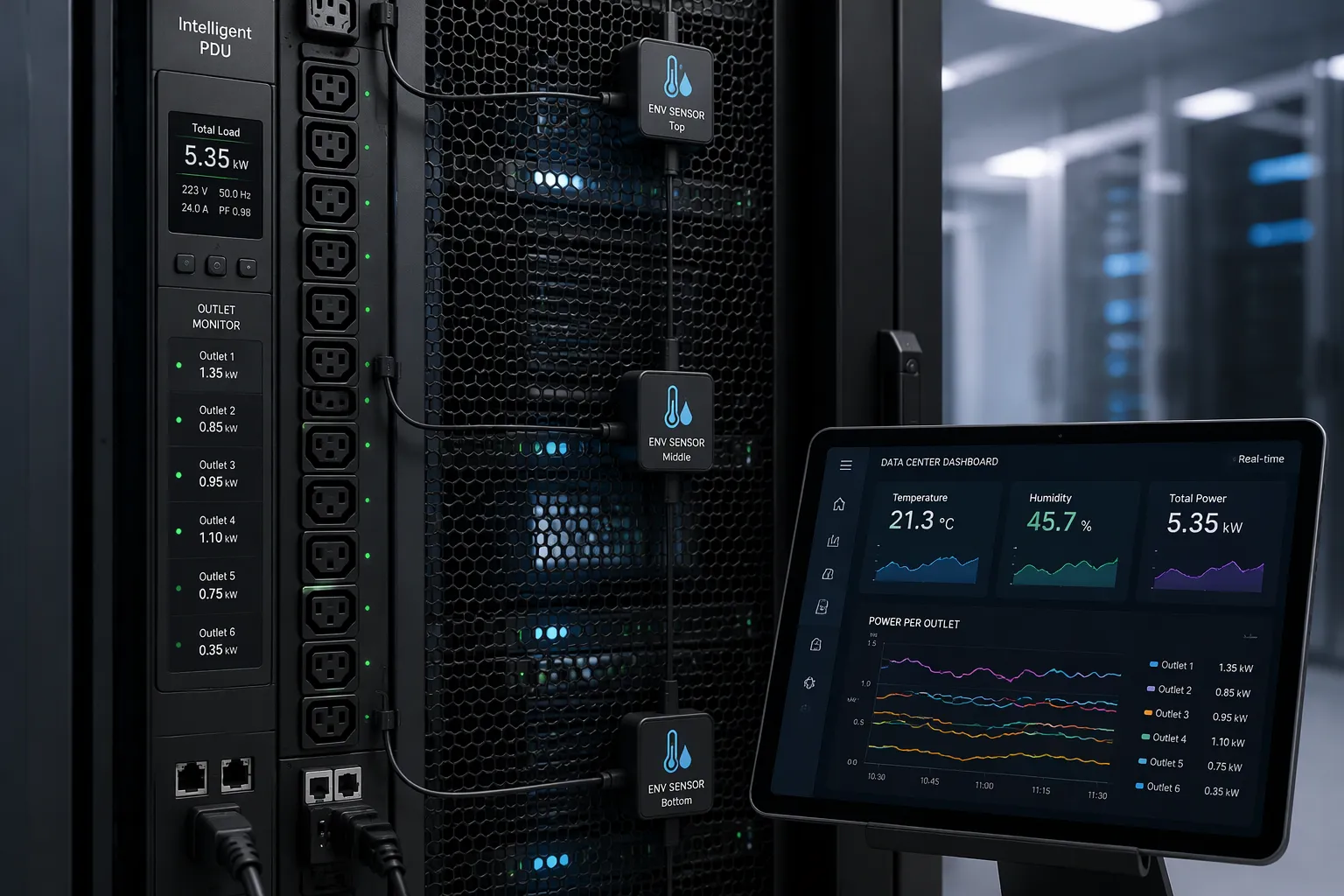
Defining Smart PDU Recognition
Smart PDU recognition is the ability of a power distribution unit to identify what is plugged into each outlet and to read the electrical behavior of that device. The unit detects a connected load, records its power draw, and reports that identity and profile to a management platform. You no longer guess which circuit feeds which server.
Dynamic environmental monitoring is the continuous capture of conditions around the equipment itself. Sensors measure temperature, humidity, and related variables at the rack, and the system updates those readings as conditions change. The data reflects the moment, not a monthly walkthrough.
Combining Recognition with Environmental Monitoring
Recognition and monitoring answer different questions, and their combination is what makes end-point sensing useful. Recognition tells you what device sits at the outlet and how much power it consumes. Environmental monitoring tells you what conditions that same device experiences. Pair the two and every outlet becomes a data point with both an identity and a context.
This pairing supports per-outlet pdu monitoring at a granularity that rack-level averages cannot match. A single intelligent pdu can flag a server drawing unusual current while the sensor beside it reports a rising inlet temperature. You see the electrical event and the thermal cause together.
Sensor coverage varies by platform. Some intelligent PDUs accept external environmental sensors, and common measurements include temperature, humidity, and other rack-level conditions, according to attom.tech. Legrand describes SmartSensors that monitor temperature, humidity, airflow, differential air pressure, water and leaks, dust and particles, contact closures, proximity and motion, and vibration. Raritan's DX2-T3H1 strings together three sensor heads, which makes it easy to mount them at the bottom, middle, and top of the cool air inlet side as per ASHRAE guidelines.
The result is real-time power and environmental data flowing from the same endpoint. That stream feeds data center infrastructure management workflows, where teams compare load against thermal headroom. Two pdus in the same rack can report different conditions, and that difference often reveals an airflow problem before it becomes an outage.
End-point sensing also changes how you plan capacity. Power monitoring shows the true load per outlet, and environmental readings show whether the rack can support more equipment. Together they turn a rack from a black box into a measured asset. Your dcim software can then model growth against actual conditions rather than nameplate ratings.
The concept is simple to state and powerful in practice. Recognition supplies identity and electrical truth. Monitoring supplies context. End-point sensing is the union of both, delivered continuously at the point where your equipment actually operates.
Intelligent PDU Capabilities and Types
Key Recognition and Monitoring Features
An intelligent PDU packs several capabilities into one device. Real-time electrical metering tracks power metrics so you can optimize energy use. Remote management lets you control individual outlets without a site visit. User-defined alarm thresholds warn you about overloads or equipment failures before they escalate. Environmental sensors add temperature and humidity data to the same stream. Power sequencing with time delays prevents overloads at startup, and cascading supports up to 10 units in large facilities, according to nbyosun. One leading telecommunications provider improved energy efficiency by 30% after deploying intelligent PDUs with real-time monitoring and automation.
The ESTEL Smart Power Distribution Unit brings these strengths to your rack. You get remote management, an LCD display for real-time monitoring, a dehumidifying function, and surge protection. The unit offers 8 to 19 outlet configurations, a 16A maximum input current, and an IEC60309-compliant plug system. Intelligent PDUs also speak LAN or SNMP protocols, so they report power consumption, voltage, current, frequency, temperature, and humidity to your management platform, as hyperviewhq notes.
Metered, Switched, and Monitored PDUs
Each type fits a different need. A metered PDU shows local load data through a built-in current meter and suits sites that need real-time readings without network access. A monitored PDU adds built-in networking for remote voltage, power, frequency, and load tracking, plus historical trends and alarm notifications. A switched PDU adds remote on/off control of each outlet, which helps with load shedding and rebooting unresponsive equipment at remote sites.
PDU Type | Best Fit |
|---|---|
Metered | Local load visibility, no remote access needed |
Monitored | Trend analysis and remote alerts across many racks |
Switched | Critical loads needing remote reboot and load shedding |
Environmental Monitoring Features for Dynamic Data
Real-Time Temperature and Humidity Sensing
An intelligent pdu incorporates environmental sensors directly into the rack, so you monitor conditions where your equipment actually runs. These sensors capture temperature and humidity continuously and feed the readings into your management platform. You see the rack climate change in real time instead of waiting for a quarterly inspection.
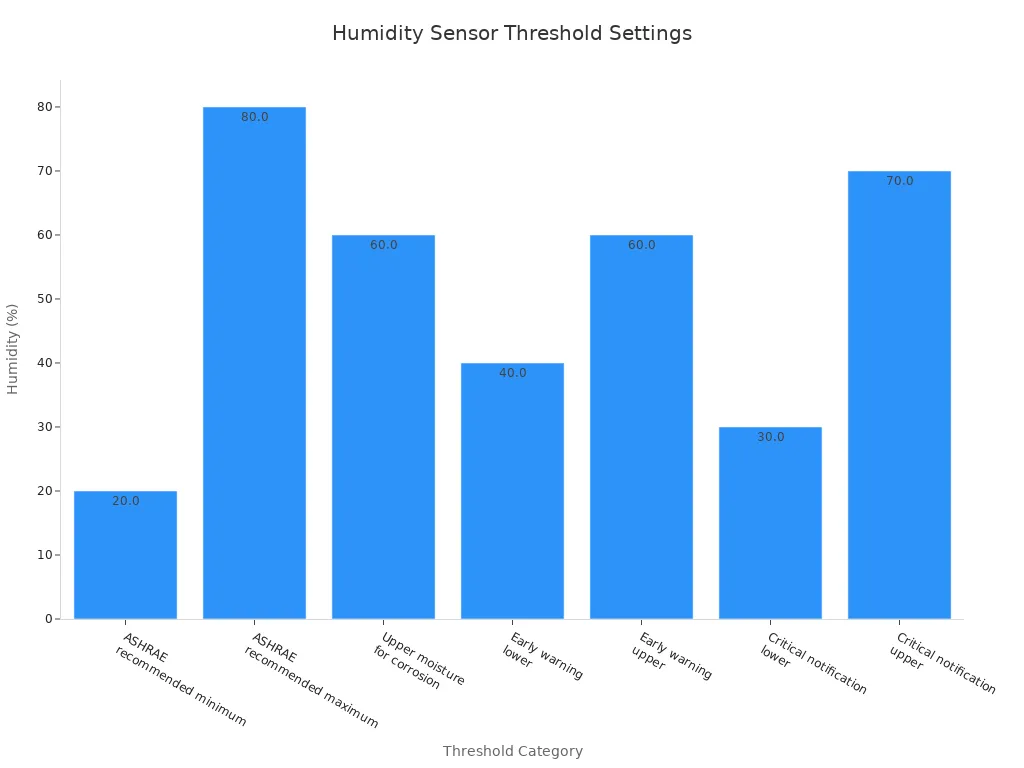
Humidity control deserves special attention. An environment monitoring system with humidity sensors can notify staff when humidity falls below 40% or rises above 60%. Dataspan notes that ASHRAE recommends a range of 20% to 80%, with a target as close to 50% as possible. Early warning thresholds typically sit around 40% and 60%, and critical notifications trigger near 30% and 70%. Dataspan also publishes a bar chart that compares these typical humidity threshold settings.
From Sensor Data to Actionable Insight
Raw readings only help when you act on them. Pair your pdus with dcim software to store, analyze, and display the collected environmental data. The software sets threshold alarms and shows real-time readings on a floor map or rack elevation. Sunbird DCIM notes that its platform works out of the box with environment sensors connected to intelligent rack PDUs.
Good dcim software turns sensor data into environmental alerts that reach the right person. Set temperature thresholds and humidity limits, then review alarms regularly. This workflow supports data center infrastructure management by connecting real-time thermal data to capacity decisions. Your data center infrastructure management team gains power monitoring context alongside climate readings, and environmental alerting closes the loop between detection and response.
Benefits and Data Center Infrastructure Management Fit
Efficiency, Reliability, and Capacity Gains
Real-time data changes how you run the floor. Ifm reports that industrial sensors improve measurement accuracy and give continuous insight into cooling equipment health. You can optimize maintenance schedules and spot inefficiencies early. The same source notes that the industry benchmarks energy efficiency with Power Usage Effectiveness, and the global average PUE was around 1.54 in 2025. Granular power monitoring shows you where that overhead sits.
Benefit Area | What You Gain |
|---|---|
Efficiency | Continuous cooling insight, optimized maintenance, lower pump workload |
Reliability | Streamlined maintenance, fewer outages, longer equipment life |
Capacity planning | Better cooling capacity planning, fewer thermal throttling threats |
Raritan adds that sensors help prevent overcooling, undercooling, electrostatic discharge, corrosion, and short circuits. Sensor data also feeds AI and machine learning initiatives. eBay cut power costs in half, doubled compute performance, and gained operational agility after deploying smart sensors and rack PDUs, according to Raritan. Your data center infrastructure management workflow gains the same foundation when performance and environmental data flow from every rack.
Practical Deployment Scenarios
Different sites need different emphasis. A server room benefits from outlet-level remote monitoring and threshold alarms on a small number of racks. White space deployments gain the most from power and cooling monitoring across many rows, where trend data guides airflow fixes. Edge sites often run unattended, so environmental alerting on temperature and humidity protects equipment between visits.
Outdoor telecom sites add weather and enclosure stress. Here an intelligent pdu with surge protection and a dehumidifying function supports reliable operation. A smart pdu in these locations reports back to your dcim software, and monitored pdus extend that visibility across a distributed estate. You can compare sites in one dcim software view and plan capacity against real conditions. Your data center infrastructure management team then acts on evidence, not guesswork, and your data center infrastructure management process scales as the estate grows.
Selecting and Implementing a PDU Solution

Performance, Fit, and Compliance
Start with the electrical facts of your rack. Attom's PDU buying guide lists the core checks: rack power requirements, voltage and phase configuration, current and power capacity, outlet type and quantity, form factor, monitoring needs, redundancy architecture, and future power density. Work through these in order before you compare models.
Outlet density follows circuit capacity. Heather Technologies publishes a comparison that shows how rated ampacity shapes usable load and outlet count.
Rated Circuit Ampacity | 20A | 30A | 30A (per phase) |
|---|---|---|---|
NEC 80% Usable Amps | 16A | 24A | 24A per phase |
Usable Continuous kW | ~1.92 kW | ~4.99 kW | ~8.6 kW |
Typical Outlet Count (0U PDU) | 8–12 outlets | 20–30 outlets | 30–42 outlets |
Typical Application | Light networking, edge/branch | Mid-density servers, storage | HPC, GPU clusters |

Metering accuracy deserves a close look. Voltz notes that IEC 61557-12 defines performance requirements for power metering devices, and that a percentage of reading behaves differently from a percentage of full scale at low loads. Ask how the vendor states accuracy across current, voltage, power factor, and temperature. An Electrical Systems Architect quoted by Heather Technologies puts the bar plainly:
"Outlet-level current metering is no longer optional in modern data center PDU specifications. Per-outlet monitoring to ±1% accuracy allows operations teams to enforce NEC 80% thresholds in real time and capacity-plan at the circuit level rather than discovering overloads after a tripping event."
Compliance decides whether a unit can ship to your site. Anen Power advises buyers to confirm that certification covers the exact model quoted, not just a component. IEC 60309 governs the input plug, UL 62368-1 applies in North America, and CE marking with RoHS compliance covers European deployments. Newsunn adds that high-density sites often require short-circuit current rating testing to 10,000 amps. Custom outlet layouts trigger re-certification, so build that time into the schedule.
Cost, Integration, and Partnering with ESTEL
Weigh upfront spend against lifetime savings. Yosun PDU notes that smart units carry higher initial cost, and that efficiency ratings and energy metrics drive operational expense over time. Integration complexity and IoT security also demand evaluation before you commit. A large US financial services firm tracked real-time usage after deploying smart PDUs, cut energy consumption, and lowered total cost of ownership, according to Strategic Market Research.
Your data center infrastructure management platform ties these threads together. Choose a pdu that speaks your protocols, and confirm the dcim software can ingest outlet-level data. ESTEL builds integrated outdoor telecom cabinets and power systems, and the company's Smart Power Distribution Unit supports Modbus/TCP, SNMPv3, and MQTT with open APIs. ESTEL reports that its deployments cut O&M cost by up to 35% and raise system uptime by 25%. Visit https://www.outdoortelecomcabinet.com to review the full range. Pair monitored pdus with your dcim software, and your data center infrastructure management workflow gains power monitoring and environmental data from every rack. Two pdus per rack give you redundancy, and an intelligent pdu with the right certifications keeps that data center infrastructure management picture complete.
Smart PDU recognition and dynamic environmental monitoring work as one system. Recognition identifies each load at the outlet, and monitoring captures the conditions around it. Together they deliver end-point sensing that turns every rack into a measured asset. It protects uptime, sharpens capacity planning, and strengthens your data center infrastructure management decisions.
Selection comes down to four priorities: performance, application fit, compliance, and cost. Weigh metering accuracy against rack load. Confirm certifications cover the exact model you order.
ESTEL's Smart Power Distribution Unit and integrated outdoor telecom cabinets support scalable, intelligent data centers. Evaluate your environment, then choose a pdu that grows with it. A well-matched pdu completes your data center infrastructure management picture.
FAQ
What does smart PDU recognition actually identify at each outlet?
Recognition detects the connected load and reads its electrical profile. The unit reports device identity and power draw to your management platform. You learn which circuit feeds which server, and you see the load in real time. This visibility feeds your data center infrastructure management records with outlet-level facts.
How many outlets does the ESTEL Smart Power Distribution Unit offer?
The unit comes in configurations from 8 to 19 outlets. Maximum input current is 16A, and the plug system complies with IEC60309. You match outlet count to your circuit capacity. A 600×450×185mm chassis fits standard rack space.
Which humidity thresholds should trigger an alert?
Set early warnings near 40% and 60%. ASHRAE recommends a range of 20% to 80%, with a target close to 50%. Critical notifications typically sit near 30% and 70%. Your dcim software turns these limits into automated alerts.
Can I monitor an unattended edge or outdoor site remotely?
Yes. A monitored or switched PDU reports power and environmental data over the network. Surge protection and a dehumidifying function support harsh locations. Remote outlet control lets you reboot unresponsive equipment without a site visit. Your data center infrastructure management team keeps visibility across distributed estates.
How accurate should outlet-level metering be?
Look for per-outlet monitoring to ±1% accuracy. That precision lets you enforce NEC 80% thresholds in real time and plan capacity at the circuit level. Ask vendors how they state accuracy at low loads, where a percentage of reading differs from a percentage of full scale.
See Also
Understanding ESTEL PDUs and Their Function in Data Center Cabinets
How to Optimize Outdoor Cabinets Using Power Cooling and Monitoring
Ensuring Best Monitoring Practices for Outdoor Telecom Cabinet Systems
Explaining Supervision System Integration Within ESTEL Outdoor Cabinet Solutions
ESTEL Smart Microgrid Integrated Telecom Cabinet Energy Storage Solution
CALL US DIRECTLY
86-13752765943
3A-8, SHUIWAN 1979 SQUARE (PHASE II), NO.111, TAIZI ROAD,SHUIWAN COMMUNITY, ZHAOSHANG STREET, NANSHAN DISTRICT, SHENZHEN, GUANGDONG, CHINA
