How Smart Standby Sleep Mode and Low Power Loss Power Supply Reduce Site Energy Consumption Under Light-Load Conditions

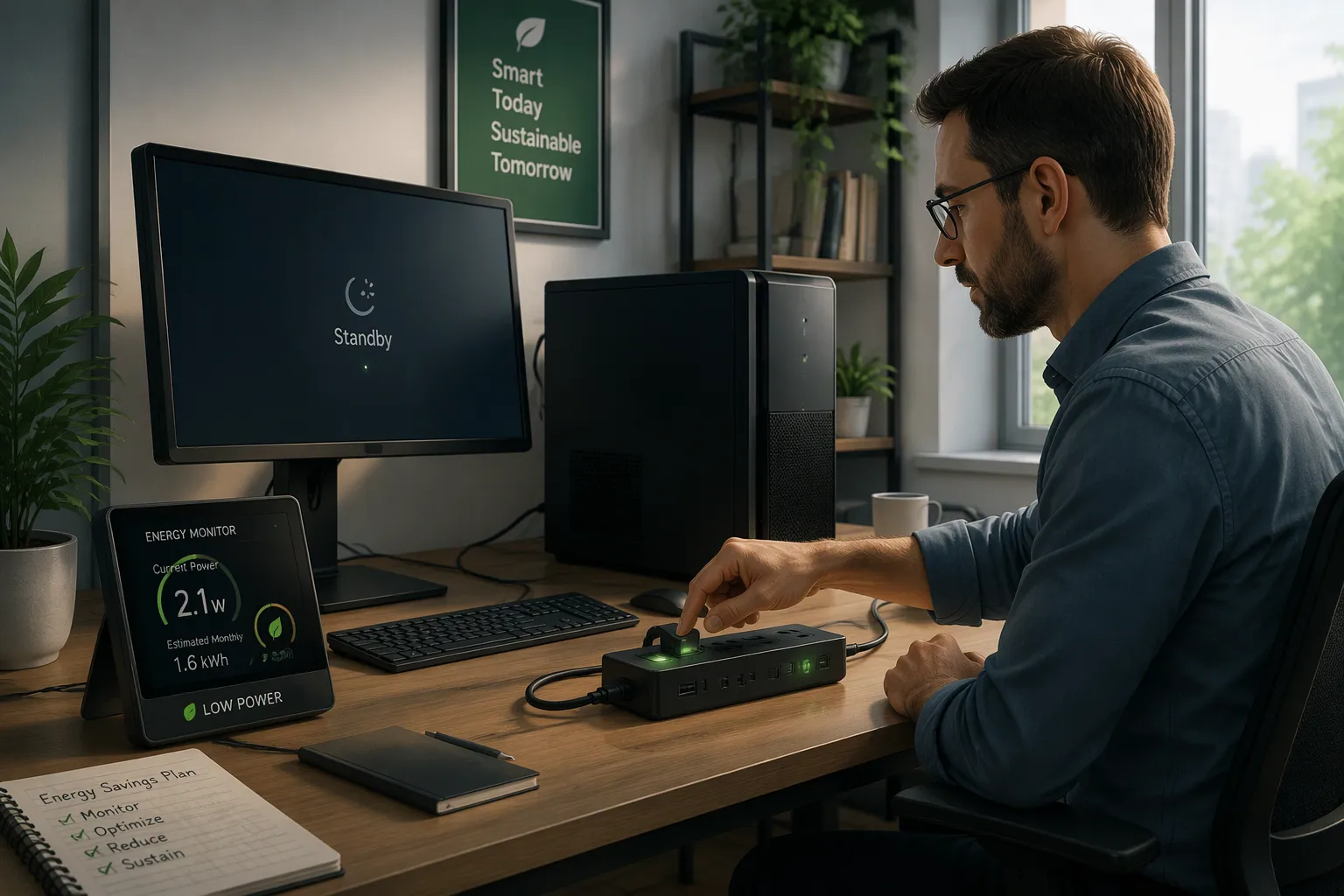
Under light load, fixed overhead drains most of your site's energy. Idle draw and power-supply inefficiency cause this waste, and two mechanisms target both losses. Smart standby sleep mode watches demand and powers down idle circuits. A low power loss power supply converts power at high efficiency with almost no no-load loss. You get lower idle watts, less heat, and measurable savings. Sites run lightly loaded most of the time, so small per-hour gains compound across a fleet. Each watt of standby power consumption raises your energy consumption, and trimming standby power pays back daily. That math holds across every site you operate.
Key Takeaways
Standby power waste adds up quickly: one watt always on uses 9 kWh per year.
Smart standby sleep mode cuts idle power by over 90% and wakes up fast.
Low power loss power supplies keep efficiency high even at light loads.
Together, these two solutions lower energy bills, reduce heat, and extend equipment life.
Check energy regulations and measure your site's standby power to find savings.
The Light-Load Energy Problem
Standby Power Consumption Waste
Always-on equipment draws a fixed overhead even when it does nothing useful. The U.S. Department of Energy reports that standby power accounts for 5% to 10% of residential energy use, according to EnergySage. That share is not trivial. It means a steady slice of every bill pays for devices that sit idle. The same pattern appears in telecom sites, where always-on customer premises equipment keeps drawing current through quiet hours.
The math compounds quickly. The Lawrence Berkeley National Laboratory notes that a device drawing 1 watt constantly for a year uses 9 kWh/yr.
if a device draws 1 watt constantly for a year, then its energy consumption is 9 kWh/yr.
Multiply that across dozens of always-on CPE units at one site, then across a multi-site fleet, and standby energy loss becomes a visible line item. Each added watt of standby power consumption raises standby energy consumption for the whole year. You can treat this as an opportunity. Trimming standby power consumption at each unit lowers energy consumption everywhere the fleet operates.
Conversion Losses at Low Load
A power supply rarely runs near its rated output. Most sites sit at light load conditions for long stretches, and some sit at extremely low load conditions overnight. Efficiency curves fall off sharply below roughly 10% of rated load. At that point the power supply itself becomes the dominant loss, not the equipment it feeds.
This is where standby power consumption hides a second cost. The converter burns energy just staying ready, and that overhead grows as a share of total draw when the load shrinks. You see the result as heat inside the cabinet and as watts on the meter. The fix is not to run equipment harder. The fix is to shrink the fixed overhead and to keep efficiency flat as the load drops. Both levers cut power consumption without touching the service you deliver.
How Smart Standby Sleep Mode Works
Detecting Light Load
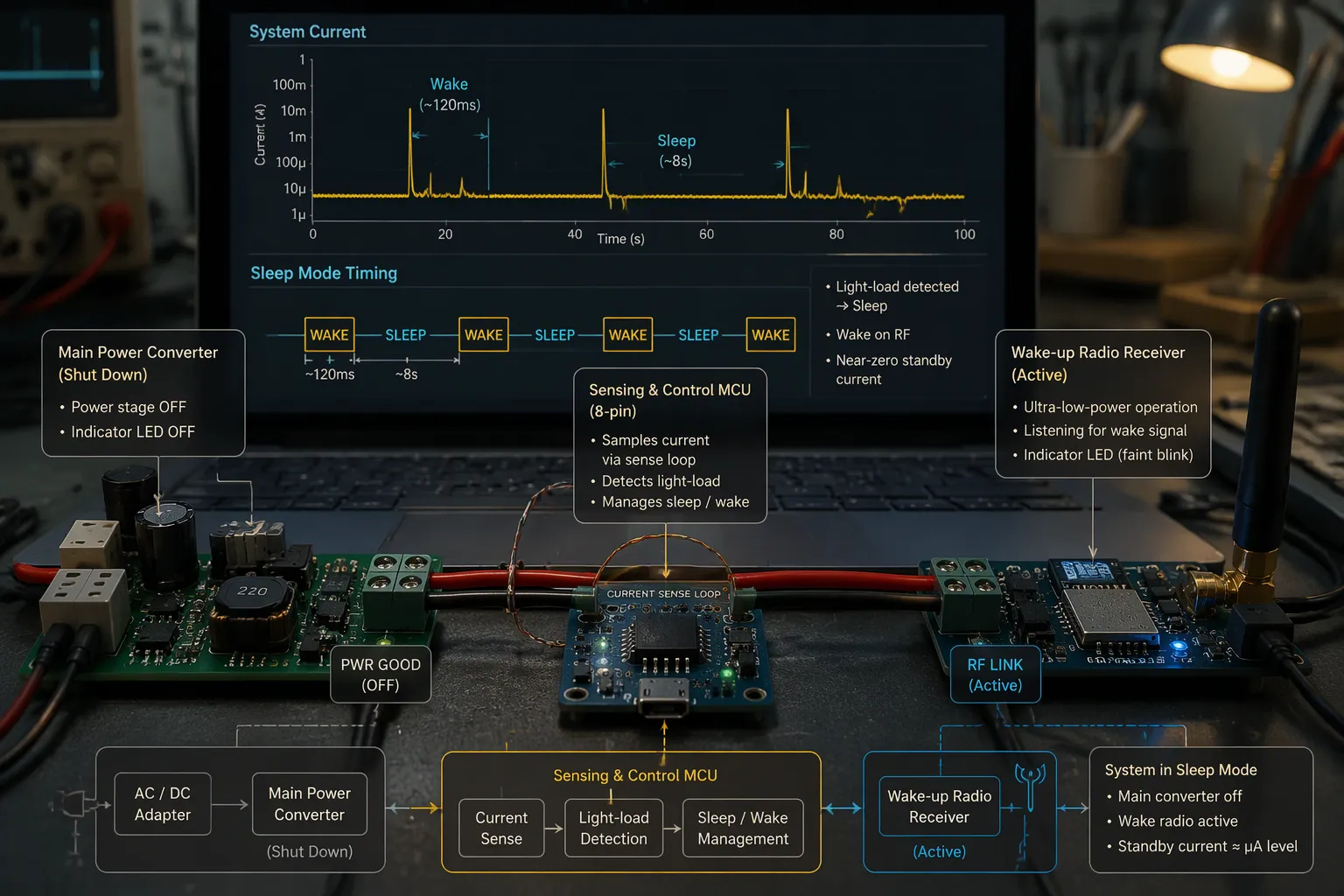
A small controller sits at the heart of every smart standby design. An 8-pin microcontroller with a good low-power mode can watch current draw and activity continuously. It samples the current, checks for traffic, and decides whether the site is truly busy or just idling. The controller runs this check in the background, so normal service continues untouched. This sensing layer costs very little to run. It also gives you intelligent power management without adding complex hardware.
The detection logic matters more than raw sensing. You want the controller to distinguish a genuine light load from a brief lull. A short delay before sleeping prevents needless cycling and protects connected devices. The controller can also weigh traffic patterns, time of day, and recent activity history. Once it confirms a sustained low-activity window, it triggers sleep mode. That decision point is where standby energy loss starts to fall.
Fast Wake-Up and Near-Zero Standby
In the sleep state, the main converter and non-essential circuits shut down. An ultra-low-power receiver stays awake and watches for the wake-up signal. That receiver draws remarkably little. Published research in PMC shows wake-up radio designs consuming 236 nW and 104 nW at sensitivities of −56.5 dBm and −39 dBm. Another design in the same review draws about 2.3 µW at a 200 kbps data rate. A separate receiver design achieves −72 dBm sensitivity at 2 GHz while drawing just 52 µW from a 0.5 V supply.
Design / Scheme | Sensitivity | Power Consumption |
|---|---|---|
Wake-up radio | −56.5 dBm and −39 dBm | 236 nW and 104 nW |
Design with 200 kbps rate | — | ~2.3 µW |
Uncertain-IF receiver | −72 dBm at 2 GHz | 52 µW |
Sleep mode also relies on duty cycling to stretch that budget further. Sean Blanchfield describes an ESP32 receiver that sleeps for 800ms at about 4µA, wakes for 10ms at 7mA to check for a signal, then repeats. The average power consumption lands at only 100µA. These ultra-low-power sleep states keep the watch circuit alive at a cost you can barely measure on a meter.
The payoff is large. Silicon Labs reports that a CPE using sleep mode drops from 10–15 watts at night to less than 1 watt, a cut of over 90%. That is cpe sleep mode doing real work. PUSR reports deep sleep power consumption as low as 0.1W, which keeps only the RTC clock and wake-up circuit alive. An always-on cpe without these features keeps burning standby power around the clock, and that standby power consumption shows up on every bill.
Wake-up speed protects service quality. The receiver must respond fast enough that users never notice the transition. A wake-up on trigger design restores full power in milliseconds, so voice and data traffic resume without interruption. You get near-zero standby power without sacrificing availability. That balance is the whole point of standby or deep sleep modes in modern equipment. A well-tuned standby mode also protects efficiency at the system level, because the supply never idles at a wasteful operating point. Good standby modes keep the converter out of its weakest operating region. Cut standby power consumption here, and total energy consumption falls with it.
Low Power Loss Power Supply Design
Efficiency Curves and No-Load Loss
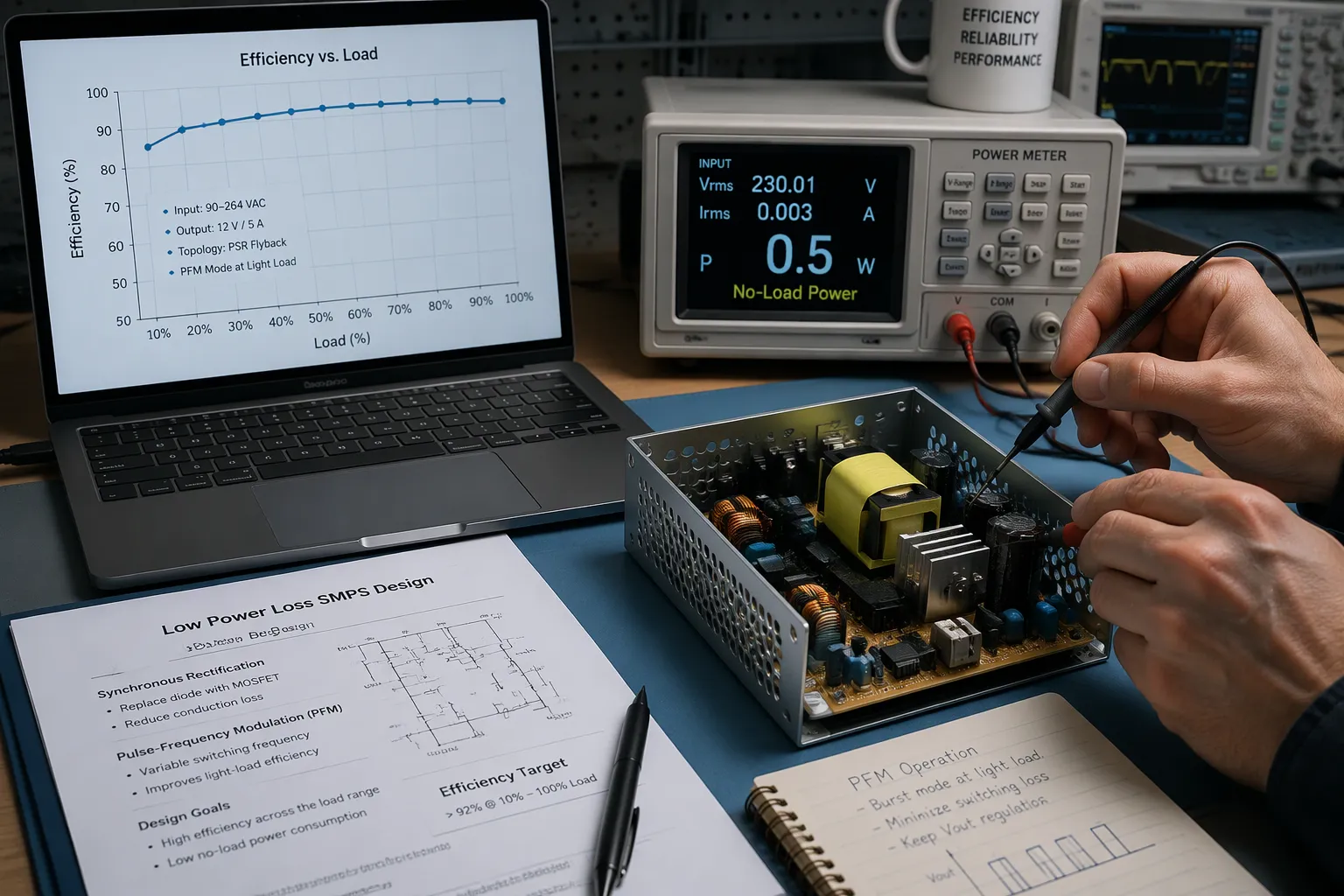
A low power loss power supply is engineered for flat efficiency across the load range. It does not chase peak efficiency only at full load. Current switching power supplies present efficiency ratios of between 85% and 95% across a varied load range, according to the published source. That ratio stays almost constant from 10% to 100% of rated power. An SMPS stays efficient down to roughly 10% load. This flat curve matters because your site rarely runs near full output.
No-load loss is the other half of the design target. No-load power consumption for a switching power supply sits at 0.5–5 W standby, per the same source. That figure sets the floor for standby energy loss at every site. You want that floor as low as possible. The losses come mainly from semiconductor switching losses and core losses in the ferrite transformer. Designers attack both to keep no-load power consumption down.
Several design choices deliver this behavior:
Synchronous rectification replaces lossy diode drops with actively driven MOSFETs.
Integrated MOSFETs with low on-resistance cut conduction losses.
Very low quiescent current keeps the control circuit from eating the standby budget.
Pulse-frequency modulation, or pulse-skipping control, trims switching activity at light loads.
Vendors tune these techniques further. TI's implementation includes proprietary smart drive technology that adjusts gate drive strength based on load conditions, reducing switching losses during light loads while maintaining low conduction losses during heavy loads. ON's technology implements adaptive turn-off delay that adjusts based on load conditions, ensuring efficient operation across varying power levels. Their SR controllers feature proprietary minimum on-time control that prevents excessive switching during light load conditions. Adaptive switching frequency control and dynamic dead-time adjustment round out the toolkit. Each choice lowers standby power without hurting full-load performance.
Cutting Light-Load Harmonic Losses
Small additional circuits can restrict peak current at light loads. That restriction reduces harmonic power and minimizes losses. The benefit shows up as lower consumption during quiet hours. You get cleaner input current and less heat inside the cabinet. These circuits add little cost and no complexity to daily operation.
Treat this design as complementary to sleep mode, not a competing option. Sleep mode removes unnecessary active draw. The low power loss power supply shrinks the losses that remain. Both fit different parts of the loss picture. Together they cut standby power and total energy consumption at the same time. A site that pairs them sees lower standby power consumption and better energy efficiency across the whole day. That combination is how you turn a light-load profile into real savings.
Combined Savings and Gateway Energy Consumption
Sleep mode removes unnecessary active draw. The low loss power supply shrinks the losses that remain. Together they attack the dominant waste under light load, and neither works as well alone.
Real-World Use Cases with ESTEL
Take a gateway as a representative example. A gateway that sleeps below 1 W and runs on a high-efficiency supply cuts site energy consumption dramatically during nights and weekends. Those quiet hours make up most of the week, so the savings accumulate fast. Gateway energy consumption drops because the device stops burning watts it does not need. Better gateway energy efficiency also means less heat inside the cabinet and longer equipment life.
ESTEL's Telecom Power System fits this role well. The unit accepts a wide AC input and delivers substantial output, which suits telecom sites that need efficient light-load behavior.
Specification | Value |
|---|---|
Input voltage range | AC input from 90 to 300Vac |
Cooling method | Natural cooling (eliminates fans and filters) |
Installation options | Standard 19-inch rack or inside a cabinet |
Output current | Up to 150A at 20-36VDC |
Natural cooling removes fan power draw from the equation. Rack or in-cabinet mounting keeps deployment simple. ESTEL builds this system for sites that run lightly loaded most of the day.
Meeting Energy Regulations
Regulators now scrutinize off-mode and standby power consumption limits. The EU Ecodesign Regulation 2023/826 sets rules for off-mode and standby power consumption limits, and similar codes of conduct appear in other markets. These rules target exactly the losses described above. A supply with poor light-load efficiency can push standby power consumption two to three times higher than expected, according to CDTech, and that gap causes test failures.
Granular power gating helps you comply. MOSFETs or load switches disconnect non-essential peripherals during low-power states. Pair that intelligent power management with a supply that holds efficiency across the load range, and your site clears the bar. Lower standby energy consumption follows naturally. You also gain margin for future tightening of energy efficiency rules.
Sleep mode removes the draw your equipment does not need. A low power loss supply shrinks the losses that remain. Together they target the dominant waste under light load. You get lower bills, less heat, longer equipment life, and easier compliance. Savings scale with fleet size, so every site adds to the total.
Standards will keep tightening, and load-aware control will keep getting smarter. Start by auditing your own light-load profile. Measure standby power at night and on weekends. That baseline reveals where standby power consumption hides and where energy consumption climbs. ESTEL builds combined low-loss power and demand-aware control solutions for sites that want lower energy consumption.
FAQ
How much does one watt of standby draw cost over a year?
A device that draws 1 watt continuously uses about 9 kWh per year. Multiply that figure by every always-on unit at a site, then by every site in your fleet. The total explains why idle draw deserves attention even when each device looks harmless.
Does sleep mode risk dropping live traffic?
No. A well-designed receiver restores full power in milliseconds after it detects a wake-up signal. Users never notice the transition. The controller also waits for a sustained quiet window before it sleeps, so brief lulls do not trigger needless cycling.
Why does a power supply waste more at light load?
Efficiency curves fall off sharply below roughly 10% of rated load. The converter then burns a larger share of its input just staying ready. No-load loss for a switching supply typically sits at 0.5–5 W. A flat efficiency curve keeps that overhead small.
Do sleep mode and an efficient supply overlap?
They address different parts of the loss picture. Sleep mode removes active draw the equipment does not need. A low loss supply shrinks the losses that remain during conversion. Pair them and site energy consumption falls further than either delivers alone.
Which standards cover standby and no-load loss?
The EU Ecodesign Regulation 2023/826 sets limits for off-mode and standby power. Similar codes of conduct exist in other markets. A supply with poor light-load efficiency can push standby draw well above the limit, so check both the converter and the sleep control.
See Also
Enhancing Outdoor Cabinets Through Power Cooling And Monitoring Solutions
Estel Smart Microgrid Integrated Telecom Cabinet Energy Storage System Overview
Ensuring Reliable Power Supply For Telecom Cabinets Effectively
Comprehending International Standards Governing Communication Power Supply Systems
Calculation Methods For Telecom Cabinet Power Systems And Batteries
CALL US DIRECTLY
86-13752765943
3A-8, SHUIWAN 1979 SQUARE (PHASE II), NO.111, TAIZI ROAD,SHUIWAN COMMUNITY, ZHAOSHANG STREET, NANSHAN DISTRICT, SHENZHEN, GUANGDONG, CHINA
