How Smart PDU Auto-Access Enables Rack Door Status and Environmental Tracking

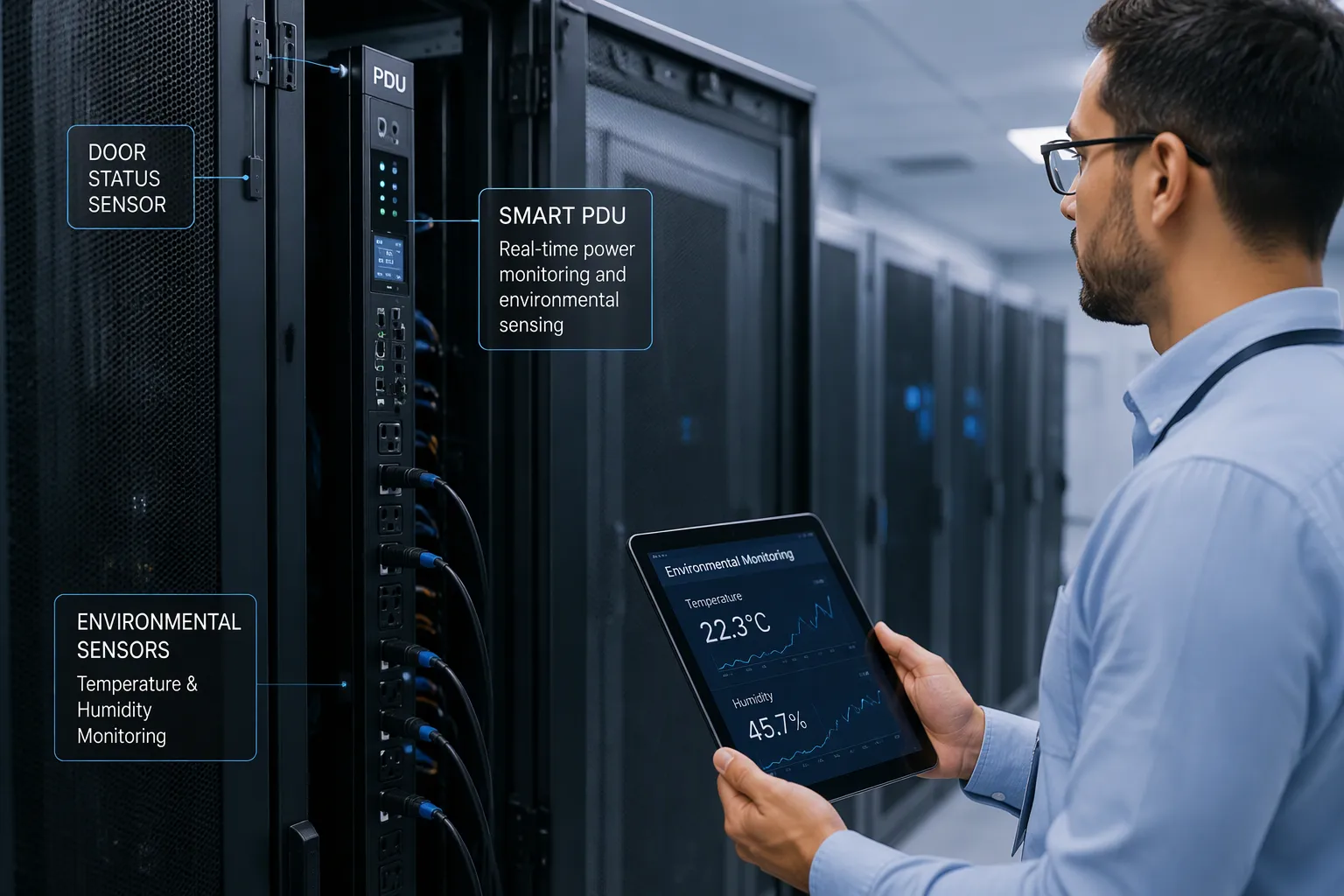
A smart PDU auto-access function links every rack door open or close event to live sensor readings. You get one record that shows who entered the cabinet and what the conditions were at that moment. Most teams face a different reality. Cabinets open many times each day, yet door status and environmental readings sit in separate logs, or nobody logs them at all. That gap leaves your data center with blind spots. PDUs with built-in intelligence close it. This post defines auto-access, then shows how these PDUs track door status and environmental conditions, and how you integrate the data.
Key Takeaways
Smart PDU auto-access automatically logs who opens a rack door and the conditions at that moment.
Door sensors connect to the PDU and create a timestamped record of every entry for security and compliance.
External sensors track temperature and humidity, and the PDU sends alerts when conditions exceed limits.
Smart PDUs integrate with DCIM and BMS platforms to give you one view of power and environmental data.
Follow a staged rollout: inventory racks, check compatibility, set thresholds, and test with a pilot rack.
Smart PDU Auto-Access Basics
Auto-Access Defined
Auto-access is the ability of a PDU to grant, manage, and log rack-level access automatically, with no manual intervention. You set the rules once. The PDU then records each entry and pairs it with live readings. A networked smart PDU does more than deliver power. It enables real-time remote access to power and environmental conditions through a built-in network card. Packet Power reports that monitored PDUs let you track voltage, power, frequency, and load, review trends, and receive alarms. Switched PDUs add remote on/off control per outlet.
That intelligence separates an intelligent PDU from a basic strip. Sunbird DCIM lists metering, network controllers, remote management, sensors, firmware updates, SNMP traps, and door-lock security as core features. Outlet-level power monitoring is the payoff. You see consumption per device. Outlet level monitoring also supports capacity planning across the data center. Basic PDUs cannot do this. Smart PDUs can, and that gap defines the category. A metered PDU adds monitoring at the inlet. A switched PDU adds control. Continuous monitoring turns those readings into trends.
Power Distribution Unit Role
The power distribution unit anchors the rack. It feeds every device and hosts the door contacts and probes that report conditions. ESTEL's Smart Power Distribution Unit is a solid reference. It takes a maximum input current of 16A, comes in 8 to 19 outlet configurations, and includes an LCD display, surge protection, a dehumidifying function, an IEC60309-compliant plug, and a 600×450×185mm housing.
PDU-integrated sensing and standalone sensors are complementary. Built-in ports on rack PDUs suit door contacts and a few probes. Standalone systems fit large halls with dense grids. Many teams deploy both. The rpdu covers power and local sensing. A second rpdu or a separate platform covers the wider floor. Power distribution units from ESTEL give you a starting point. Metered PDUs and switched PDUs both fit this model. Rack PDUs with remote access simplify the rollout, and outlet-level power monitoring on each PDU keeps the data center visible. Most PDUs in a modern hall are networked. Legacy PDUs often lack this.
Tracking Rack Door Status
Door Sensors and Events
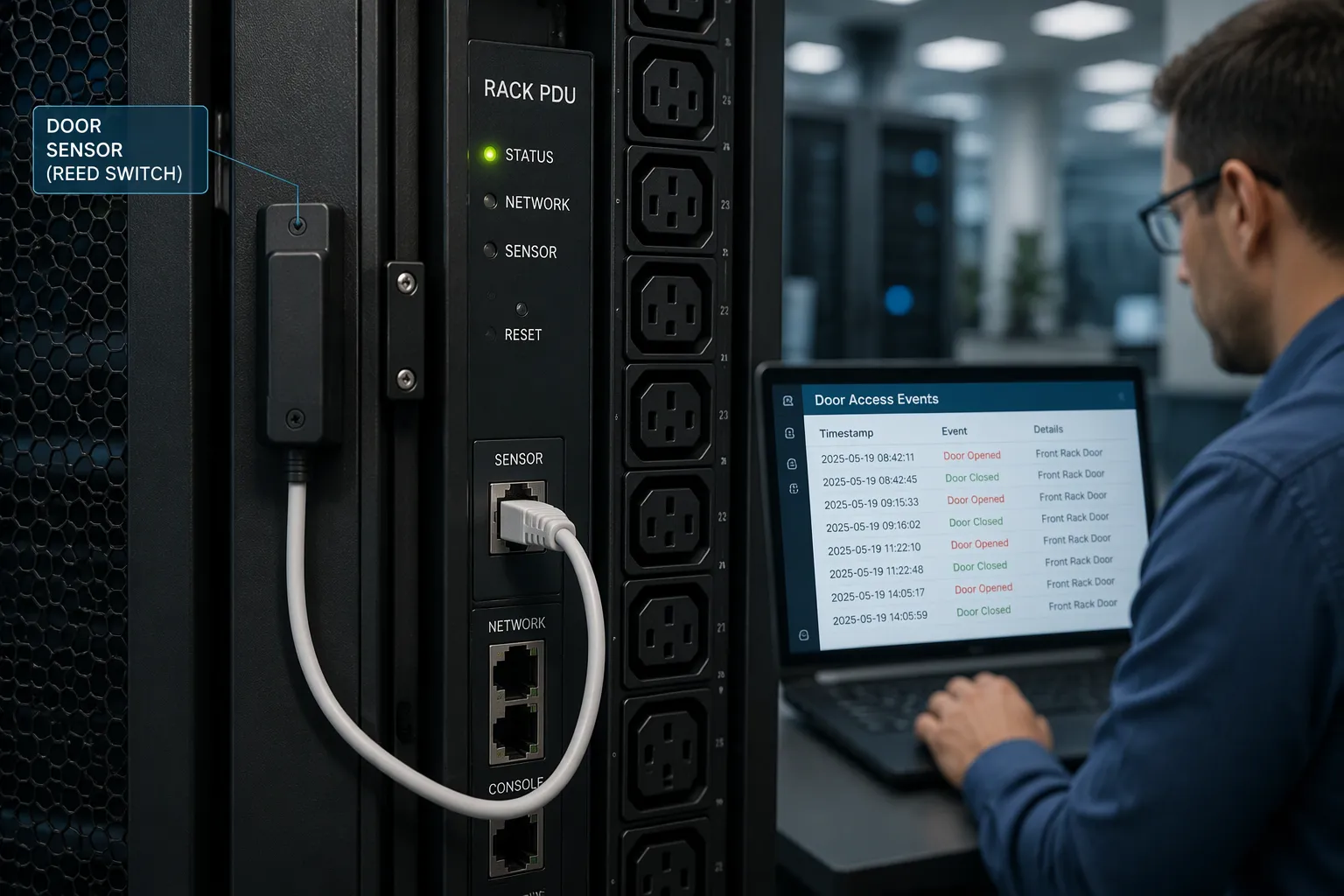
Door sensors on enclosed racks connect to the PDU through dedicated ports or contact closure inputs. Each open or close generates a timestamped event. Raritan's Smart Rack Controller (SRC-0102) carries SmartLock 2 local door lock controller ports onboard and supports control and detection of a cabinet's door status. The DX2-CC2 contact closure sensor detects the open-and-close and on/off status of connected third-party door position and door lock detectors. The Legrand SML SmartLock System works with PRO4X and PRO3X Intelligent Rack PDUs only. Its intelligent door sensor connects, powers, operates, and manages electronic handles from cabinet hardware manufacturers like DIRAK, EMKA, and Southco. Raritan's controller also maintains cabinet and enclosure security with USB peripherals and contact closure sensors.
Sensor choice depends on your cabinet hardware. A simple reed switch suits a standard cabinet front. An electronic handle needs a controller that speaks its protocol. Either way, the PDU becomes the collection point. You wire the sensor once, then let the PDU report every event. Most PDUs ship with these ports already. Networked PDUs push those events over SNMP. Basic PDUs cannot. A rack-level PDU with remote access lets you check status from anywhere. Intelligent PDUs and switched PDUs both support this workflow. Confirm the port map before you order hardware.
Event Logging
Event logging turns raw signals into an auditable trail. Each record captures who opened the cabinet, when, and for how long. Raritan embeds its Xerus technology into the SmartLock system. Xerus enables smart sensing, tracking, and alerting of proactive, real-time information with automated audit-trail logging of access events. The Elcore Group describes comprehensive logging as a full audit trail of all access operations, including user identification, exact timestamps, and duration. That detail matters during a compliance review. You can answer a simple question fast: who entered this cabinet last Tuesday, and how long did the visit last? Auditors ask for proof, not memory. A timestamped log gives them that proof in seconds.
Forced or unauthorized openings trigger alerts through the same management interface. You set the rule once. The PDU then flags any event that breaks it. That single interface covers power, environment, and access, so your team reads one dashboard instead of three. Switched PDUs can also cut power to an outlet after a flagged event. Metered PDUs record the event without that control. Every PDU feeds the same log, and that log supports monitoring across the data center. Set the alert rule to match your policy. A maintenance window may allow entry. A weekend entry may not. Export the log on a schedule and store it outside the PDU.
Environmental Monitoring via Auto-Access
Environmental Monitoring Sensors
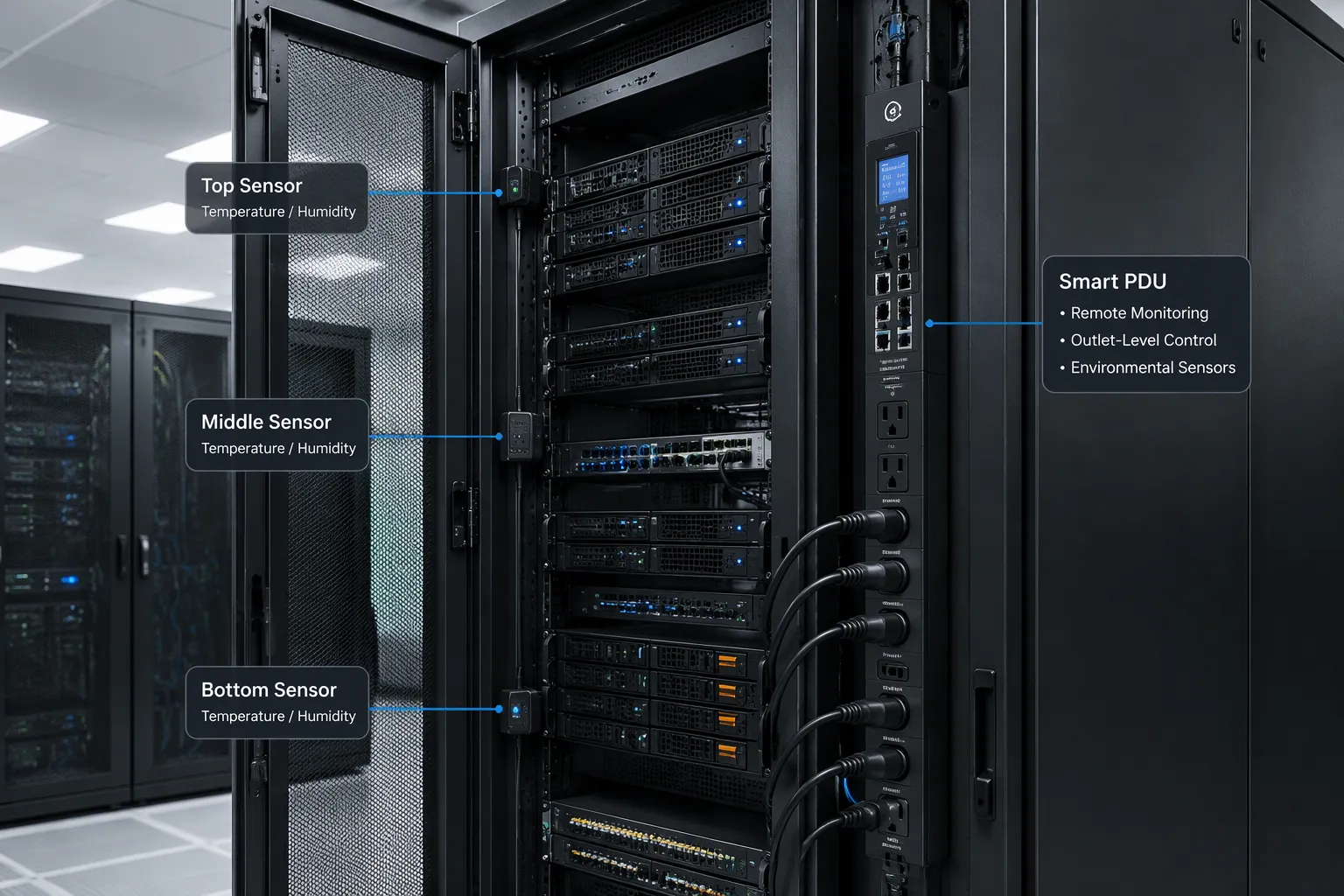
External sensors connected to the PDU turn auto-access into environmental monitoring. Temperature and humidity are the most common measurements. Sunbird DCIM catalogs the options: AKCP's single-port temperature humidity sensor frees an extra intelligent port, APC offers a NetShelter Rack PDU Advanced Temperature Sensor and a universal Temperature & Humidity Sensor with an RJ-45 connector and 3.9m cord, and Aten's EA1240 lets administrators set environment thresholds and act before a system failure occurs. Raritan's DX2-T1 and DS2-T1H1 SmartSensors monitor and record temperature and humidity data. Vertiv's Geist sensor ships with dual inputs and 3ft and 6ft probes for the top, middle, and bottom of a rack.
Vendor | Sensor | Note |
|---|---|---|
AKCP | Single Port Temperature Humidity Sensor | Frees an extra intelligent sensor port |
APC | NetShelter Rack PDU Advanced Temperature Sensor | Built for intelligent rack PDUs |
Aten | EA1240 Temperature & Humidity Sensor | Supports environment thresholds |
Raritan | DS2-T1H1 SmartSensor | Monitors and records both values |
Vertiv | Geist Temperature x3, Humidity, Dew Point | Dual inputs, 3ft and 6ft probes |
Placement decides data quality. Dataspan recommends in-rack sensors at the top, bottom, and center of each rack, because the top gives a worst-case reading and the center sits closer to the room average. Keep probes away from direct airflow entering and leaving equipment, since that zone fluctuates most and can trigger false alarms. AKCP adds a practical rule: monitor the front, top, middle, and bottom of racks, preferably no less than every third rack in a row, and watch exhaust air too. In-room sensors belong away from sunlight and frequently used doors. Combine in-rack and in-room sensors where the facility allows it.
Alerts and Data Flow
Readings follow a clear path. Embedded components in the PDU collect electrical and sensor data, then a network interface carries it outward through a local display, web interface, SNMP, APIs, or a DCIM platform, per Attom Tech. The PDU checks each value against thresholds and issues user-defined alert notifications by SMS, SNMP trap, or email, as Vertiv describes. That flow gives you power and environmental information in one place, and it supports liquid detection where leak risk exists.
ESTEL's Smart Power Distribution Unit shows sensing and correction working together. Its dehumidifying function removes excess moisture at the rack level, preventing condensation, corrosion, and electrical faults without overcooling the whole room. When temperature or humidity crosses a limit, the unit alarms and can act without waiting for a technician. That pairing of temperature and humidity probes with active correction keeps conditions stable near your critical assets.
Data Center Integration and Rollout
DCIM and BMS Integration
Smart PDUs connect to DCIM and BMS platforms through standard protocols. Deipower lists SNMP v2/v3 with identical MIBs across product families, Redfish RESTful API, JSON-RPC, and Modbus/TCP for industrial and BMS integration. This integration aggregates power and environmental data into one management interface for trend analysis, capacity planning, and regulatory reporting. Granular data lets you identify energy-intensive or underutilized equipment, optimize load distribution across circuits, reduce stranded power capacity, and improve Power Usage Effectiveness. NBYOSUN reports that modern power monitoring solutions, including smart PDUs, help lower data center energy usage by 20% to 40%.
Remote monitoring through a centralized interface lets IT teams catch issues early. Level.io describes how continuous monitoring shifts operations toward a proactive model, giving earlier visibility into service degradation, infrastructure failures, and hardware issues. Early alerts let technicians respond faster and prevent prolonged outages. Raritan notes that monitoring at inlet, outlet, and circuit breaker levels enables early detection of heavy loads before breakers trip. Real-time visibility and remote outlet control help teams address power quality issues quickly.
Rollout Steps
A staged rollout keeps risk low. Follow these steps:
Inventory racks and confirm which cabinets need door and environmental sensors.
Confirm PDU and sensor compatibility. Match protocol versions, use compatible hardware, and standardize addressing so devices communicate reliably.
Map door sensors to their ports. Supported types include contact closure, vibration, and proximity.
Set alert thresholds for temperature and humidity to avoid alert fatigue.
Connect to DCIM or BMS through RESTful APIs, TFTP, SSH, or web interfaces.
Validate with a pilot rack before scaling to the full hall.
ESTEL's Smart Power Distribution Unit is a practical deployment option for this work. Its auto-recognition feature detects each connected sensor, reads its protocol, assigns the correct address, and begins data exchange without extra software. Contact ESTEL for configuration guidance on your own racks.
Auto-access turns the PDU into the rack's access-and-environment hub. Every door event now pairs with live sensor data in one record. Three pillars carry this design. Door status tracking builds an auditable trail of each entry. Environmental monitoring keeps temperature and humidity visible near your critical assets. DCIM and BMS integration pushes both streams into one interface. Unified rack-level visibility then supports capacity planning and compliance audits. Smart PDUs make that visibility practical, and networked PDUs keep it continuous. Review ESTEL's Smart Power Distribution Unit for your own racks, and contact ESTEL for configuration guidance.
FAQ
What does auto-access mean on a smart PDU?
Auto-access means the PDU grants, manages, and logs rack-level access on its own. You set the rules once. The unit then records each entry and pairs it with live sensor readings. No manual step is needed.
How do door sensors connect to a PDU?
Door sensors connect through dedicated ports or contact closure inputs on the unit. Each open or close creates a timestamped event. You wire the sensor once, and the PDU reports every event to your management interface.
Can a PDU track temperature and humidity?
Yes. External sensors plug into the unit and report readings to a central interface. The PDU checks each value against your thresholds and sends alerts. ESTEL's Smart Power Distribution Unit also includes a dehumidifying function to correct excess moisture.
Do these PDUs integrate with DCIM and BMS platforms?
Yes. Networked PDUs support standard protocols such as SNMP and RESTful APIs. Both PDUs and PDUs with switched outlets push power and sensor data into one interface. That link gives your data center team early warning and a single view of rack conditions.
See Also
Understanding ESTEL PDUs and Their Function in Data Center Cabinets
Explaining Supervision System Integration Within ESTEL Outdoor Cabinets
Essential Strategies for Enhancing Anti-Theft Functions in Communication Cabinets
Ensuring Optimal Monitoring for Outdoor Telecom Cabinets Effectively
Smart and Sustainable Outdoor Communication Cabinets for the Year 2025
CALL US DIRECTLY
86-13752765943
3A-8, SHUIWAN 1979 SQUARE (PHASE II), NO.111, TAIZI ROAD,SHUIWAN COMMUNITY, ZHAOSHANG STREET, NANSHAN DISTRICT, SHENZHEN, GUANGDONG, CHINA
