Smart PDU Auto-Access Makes Rack Door Tracking Easy

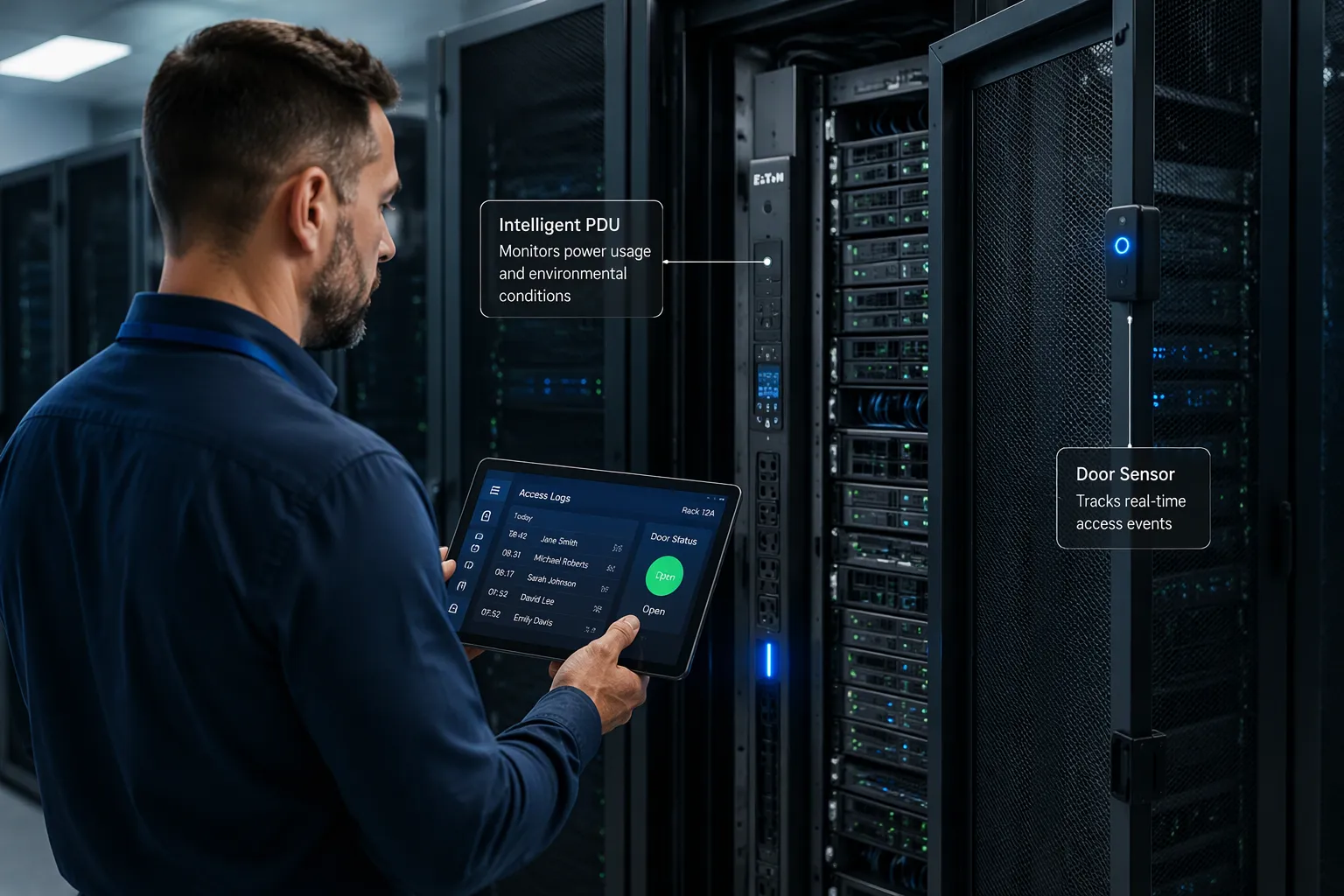
A smart pdu with auto-access turns each rack into a self-reporting node. Sensor options include door position, temperature, and humidity, bgasales notes. They also track power and environmental conditions. Network connectivity pushes that data to standard management interfaces. Manual door checks leave blind spots in your view. Sensor gaps let heat build unnoticed. Incident response turns reactive. Auto-access replaces guesswork with continuous monitoring. ESTEL builds pdus that support this model. These pdus fit standard racks and report over the network. Each pdu handles door status and sensor data without extra hardware. A pdu like this gives you real-time visibility across your data center.
Key Takeaways
Smart PDUs automatically track rack door status and send real-time alerts for unauthorized access.
Built-in sensors monitor temperature and humidity to prevent overheating and moisture damage.
Smart PDUs connect to your management software for a complete view of power and environment.
You can set custom thresholds to get alerts before problems become emergencies.
Start with a few racks and easily scale to full data center coverage as needed.
How Smart PDU Auto-Access Works
Sensors And Edge Intelligence
Sensors connect directly into the rack PDU. This single connection turns the unit into a networked monitoring point for both power and the surrounding environment. You no longer need a separate monitoring appliance in every cabinet. A door contact, a temperature probe, and a humidity probe all land on the same device that already feeds your servers.
The sensor market offers real choice here. Tripp Lite by Eaton's EnviroSense Rack Environment Sensor tracks temperature, humidity, and contact-closure inputs, and it works with SNMP cards or intelligent PDUs. Vertiv's Geist sensors cover temperature, humidity, dew point, and airflow, with dual inputs for probes placed at the top, middle, and bottom of a rack. Packet Power's E306 tracks up to six temperature points and adds differential pressure monitoring. You match the sensor set to the risk you want to see.
Edge intelligence separates a smart unit from a dumb strip. The PDU processes readings locally. It pushes real-time alerts and continuous monitoring data to a centralized management interface. Local processing means an alert fires even when the upstream link is slow. Your team sees the event, not a delayed batch report.
ESTEL Smart PDU In Practice
ESTEL's Smart Power Distribution Unit shows how these pieces fit together. Remote control and intelligent protocols let you switch outlets and manage distribution from a distance. The LCD display gives real-time status at the rack. A dehumidifying function protects equipment in damp rooms. Surge protection shields connected gear from spikes.
The hardware suits real deployments. You choose from 8 to 19 outlet configurations. Maximum input current is 16A. Outlet-level power monitoring and outlet level monitoring both come standard, so you see consumption per device rather than a single cabinet total. That detail supports capacity planning and chargeback.
Rack Door Status Tracking
Real-Time Open And Close Events
Door sensors wired into the smart PDU auto-access report open and close events automatically. Each event carries a timestamp. You stop walking the aisle with a clipboard. The PDU logs the exact moment a door swings open and the moment it closes again. RF Code describes physical door state monitoring that continually reports the open or closed state of cabinet doors and containment portals. That continuous stream replaces the periodic snapshot of a manual check.
The same logic covers door position across a row of enclosed racks. One rpdu can serve several cabinets, and each sensor input maps to a known location. You see which door moved, not just that some door moved. Smart pdus feed this data into the management layer without extra gateways. Rack pdus with sensor ports handle the job at the cabinet level. A plain strip cannot do it. The distinction matters when you scale from a few racks to a full hall.
Alerts, Logs, And Access Correlation
Real-time alerts fire the moment a door opens without authorization. RF Code notes that unauthorized access alerting instantly flags open cabinet doors to preserve hot and cold aisle containment. You get the warning while the event is happening, not the next morning. Remote access to the alert stream means your team responds from anywhere.
Event logs then tie door activity to power and environmental conditions. RF Code also describes door and environmental correlation, which links door state telemetry to ambient cooling profiles. A door left open shows up beside a rising inlet temperature. You see cause and effect in one view. DCIM software aggregates data from all monitoring layers into dashboards, alerting systems, and historical reports, according to DEIPower. That unified record supports audits and speeds troubleshooting. The accuracy of the whole chain depends on the quality and calibration of the underlying hardware sensors, DEIPower adds. Choose pdus with reliable sensor inputs and the audit trail holds up.
Environmental Monitoring At The Rack
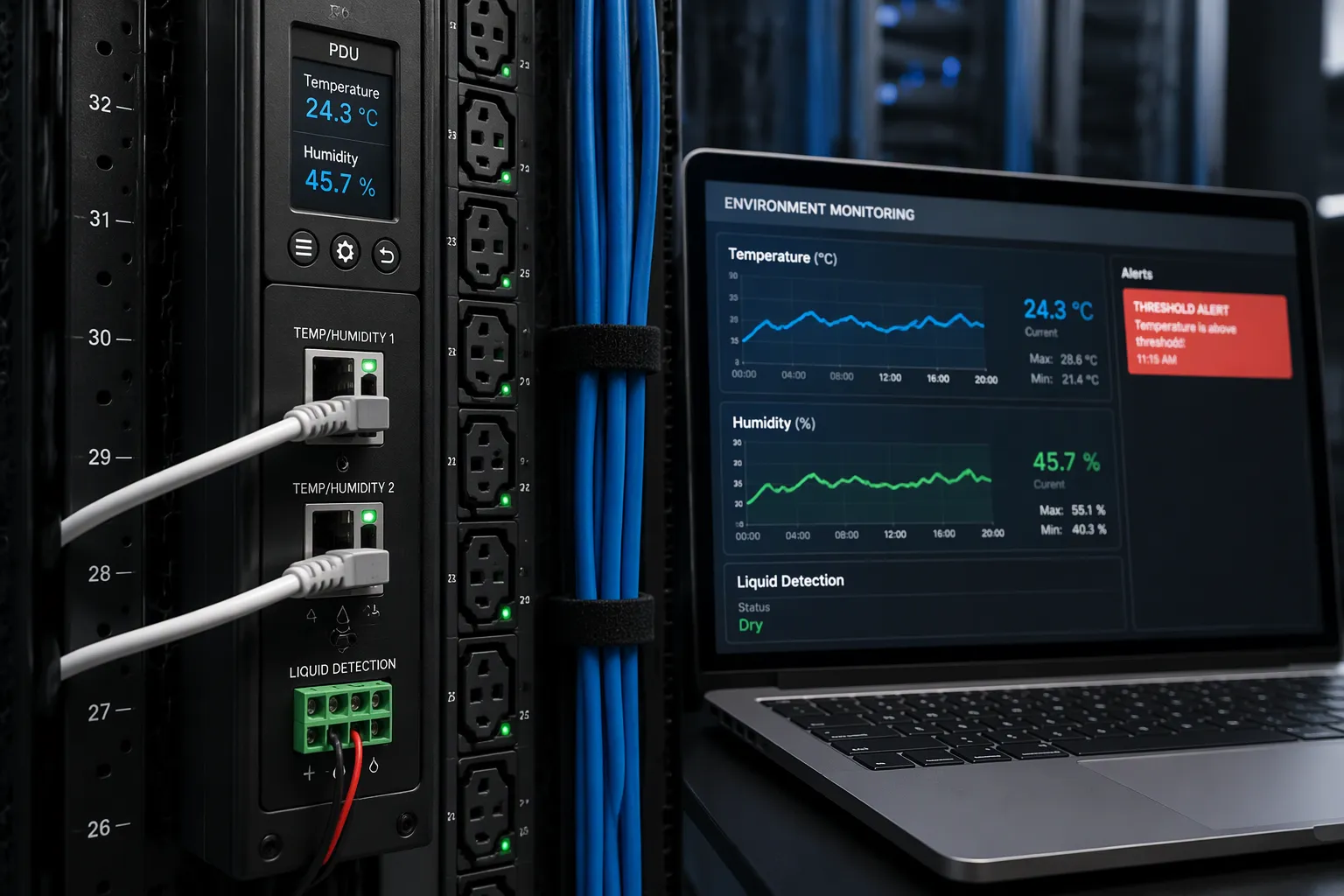
Smart PDU Environmental Monitoring
Temperature and humidity probes plug straight into the unit. So do contact-closure devices. One rack-level device now watches the air around your servers, not just the power flowing through them. Server Rack Online lists a typical sensor layout for this class of hardware:
Port / Input | Supported Sensors |
|---|---|
Integrated sensor | 1 integrated temperature/humidity combination sensor |
RJ45 Sensor Ports | Two RJ45 modular jacks for connecting temperature sensors or combined temperature/humidity sensors |
Dry Contact Closures | Two screw terminal pairs for connecting dry contact devices and the liquid detection sensor |
These sensors are hot pluggable, so you add coverage without powering down the rack. Note what the table shows: temperature and humidity inputs, plus a dry contact pair for liquid detection. Airflow sensing is not part of this particular sensor set. Check the sensor options on any rpdu before you assume airflow coverage.
Color-coded sensor graphs turn those readings into a quick visual. A glance shows which rack runs warm and which one sits in a damp corner. Operators spot the outlier without reading a single number.
Thresholds And Proactive Alerts
Continuous monitoring beats a periodic walk-through. Monitored smart PDUs track outlet levels, the device's environment, event logs and data logs, and they send alerts based on user-defined thresholds, according to TechTarget. You set the limit once. The pdu watches it around the clock.
Threshold-based alerts ensure operators respond to environmental anomalies before they escalate into equipment failures or compliance violations, Sisgain notes. Multi-parameter threshold monitoring covers temperature, humidity, airflow, water, and smoke with escalation workflows. Synaccess describes the same pattern in practice: environmental sensors detect rising temperatures, trigger an email alert, and can turn off non-essential equipment to reduce load. NBYOSUN adds that monitoring PDUs also watch temperature and humidity, and the system sends alerts quickly when anomalies occur. Those user-defined alert notifications reach your team before a hot spot becomes an outage.
ESTEL's Smart Power Distribution Unit adds a dehumidifying function as a complementary safeguard. The unit draws moist air across a cold surface, condenses the water, and drains it away before it settles on terminals or busbars. A temperature and humidity sensor feeds the control logic. When humidity crosses your set threshold, the pdu starts dehumidifying automatically. Local moisture control replaces room-wide overcooling, which lowers energy use and keeps conditions inside the recommended band. Surge protection and an LCD display for real-time monitoring round out the package. Pair that with outlet-level power monitoring and you see both the electrical and the environmental picture at each cabinet.
Data Center Integration And Value

Power Distribution Unit And DCIM Integration
Your power distribution unit becomes far more useful once it speaks to the software you already run. ESTEL's Smart Power Distribution Unit exposes door and sensor data through several standard paths:
SNMP v2/v3, Redfish RESTful API, JSON-RPC, and Modbus/TCP connect each unit to DCIM or BMS platforms.
Real-time energy metering samples voltage, current, power, and temperature, then pushes that data over Ethernet through SNMP polling. No agents or proprietary protocols are needed.
IP aggregation of 2–50 PDUs lets one address represent a group of units.
Remote power control reboots an unresponsive device through SNMP, HTTP, or Telnet sessions.
RESTful APIs and management protocols such as TFTP, SSH, and web interfaces round out the options. A switched rpdu adds outlet-level control, so authorized staff can cycle equipment from a web interface. Monitored rack pdus deliver the same visibility without switching. Either way, your DCIM platform receives one continuous stream of power and environmental information, including outlet-level power monitoring data. These power distribution units fit new builds and retrofits alike.
Security, Efficiency, And Compliance Gains
Access tracking tightens security across the data center. Every door event lands in a log with a timestamp, and unauthorized openings trigger alerts in real time. Grand View Research notes that cybersecurity hardening, including encrypted communication and role-based permissions, is an increasing requirement as rack-level hardware becomes network-exposed. Remote access to alerts and logs keeps your team informed from anywhere. A second remote access path through the web interface covers staff on the move.
Efficiency follows from visibility. Credence Research reports that intelligent PDUs help reduce energy waste and improve operational visibility. Grand View Research adds that high-resolution data supports optimization of power provisioning and identification of inefficiencies. Outlet-level power monitoring and outlet level monitoring show which device draws what, so you can act on the numbers. The same records simplify compliance reporting. Grand View Research notes that reducing PUE and carbon footprint is both an economic and regulatory imperative, and monitoring plays a strategic role in meeting energy efficiency benchmarks. Your smart pdu turns rack-level blind spots into documented, actionable data. Across a growing data center, these pdus scale from one rack to full rows, and each pdu reports power and environmental conditions on its own. Your data center team gains one consistent view.
Sensors, network connectivity, and automatic reporting give you continuous visibility into every door and every environmental condition at the rack. That combination delivers stronger security, better energy efficiency, and simpler compliance. Rack-level blind spots become actionable data.
Scale this pdu model across the data center. Start with a few racks and add pdus as coverage grows. Monitored pdus and switched pdus both fit this role. ESTEL's smart pdu family offers a practical starting point, and each rpdu reports door and sensor data on its own. Add outlet-level power monitoring and remote access, and your pdus become the monitoring backbone of the data center. Evaluate smart pdu auto-access for your own equipment.
FAQ
Do I need extra hardware to track rack doors?
No. Door contacts and environmental probes plug into the pdu itself. Each unit reports over the network, so you avoid a separate appliance in every cabinet. A smart pdu handles door status and sensor data on its own, and these pdus fit standard racks.
Which interfaces carry door and sensor data to my software?
Look for SNMP v2/v3, Redfish, JSON-RPC, and Modbus/TCP support. These paths push door and sensor data to DCIM or BMS platforms. ESTEL's smart pdu exposes data this way, and pdus with IP aggregation let one address represent a group of pdus.
Can I set my own alert thresholds?
Yes. You define the limits once, and the pdu watches them around the clock. Threshold-based alerts cover temperature, humidity, and door events. Each pdu sends alerts quickly when anomalies appear. Continuous monitoring on these pdus flags problems before they escalate, and the dehumidifying function adds local moisture control.
How do I scale door tracking from one rack to a full hall?
Start with a few racks and add pdus as coverage grows. Each pdu reports on its own, so a data center expands without new gateways. Monitored and switched pdus both fit this role, and outlet-level data supports capacity planning.
What specifications should I check before buying?
Check outlet count, input current, and plug type. ESTEL's smart pdu offers 8 to 19 outlets and 16A maximum input current. Confirm the pdus you shortlist fit your rack depth and your data center power plan. A pdu with reliable sensor inputs keeps the audit trail intact.
See Also
Effective Methods for Enhancing Anti-Theft Features in Communication Cabinets
Guide to Integrating Supervision Systems Within ESTEL Outdoor Cabinets
Improving Outdoor Cabinets Through Power, Cooling, and Monitoring Solutions
Best Practices for Achieving Optimal Monitoring of Outdoor Telecom Cabinets
Understanding ESTEL PDUs and Their Function in Data Center Cabinets
CALL US DIRECTLY
86-13752765943
3A-8, SHUIWAN 1979 SQUARE (PHASE II), NO.111, TAIZI ROAD,SHUIWAN COMMUNITY, ZHAOSHANG STREET, NANSHAN DISTRICT, SHENZHEN, GUANGDONG, CHINA
