How Remote Circuit Breaker Auto-Reclosing in Smart PDUs Enables Automatic Recovery After Faults in Unattended Telecom Cabinets

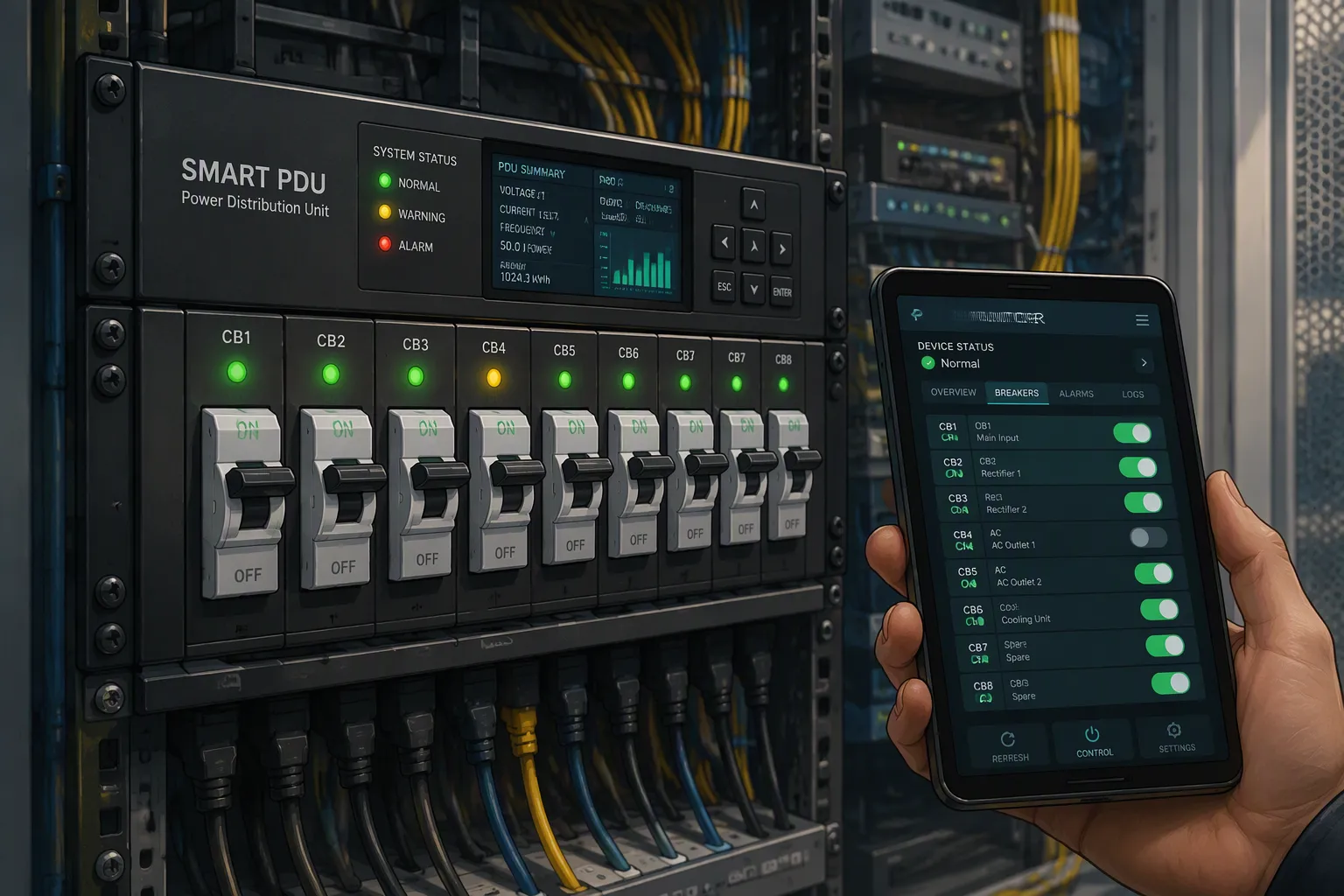
Remote circuit breaker auto-reclosing in a smart pdu lets unattended telecom cabinets recover from transient faults automatically. This capability cuts downtime and eliminates most site visits. A tripped breaker at a remote cabinet can mean hours of outage and a costly truck roll for a fix that may take seconds. You face this risk at every site without staff on hand.
Reclosing logic changes that equation. The device detects a fault, trips, waits briefly, and re-closes. Power returns when the fault has cleared. Your team gains visibility into each event, and uptime improves without a dispatch.
This article explains the mechanism, the smart pdus features that enable it, how the approach compares with standard solutions, and where it fits in practice across telecom networks.
Key Takeaways
Smart PDUs automatically recover power after temporary faults, so most outages fix themselves without a site visit.
Remote monitoring and restart let you manage cabinets from anywhere, cutting downtime from hours to minutes.
Auto-reclosing saves money by avoiding costly truck rolls and reducing repeat visits.
Lockout safety isolates permanent faults until a technician arrives, preventing unsafe operation.
Remote and solar-powered sites benefit most because they are hard to reach and faults often clear on their own.
How Auto-Reclosing Works
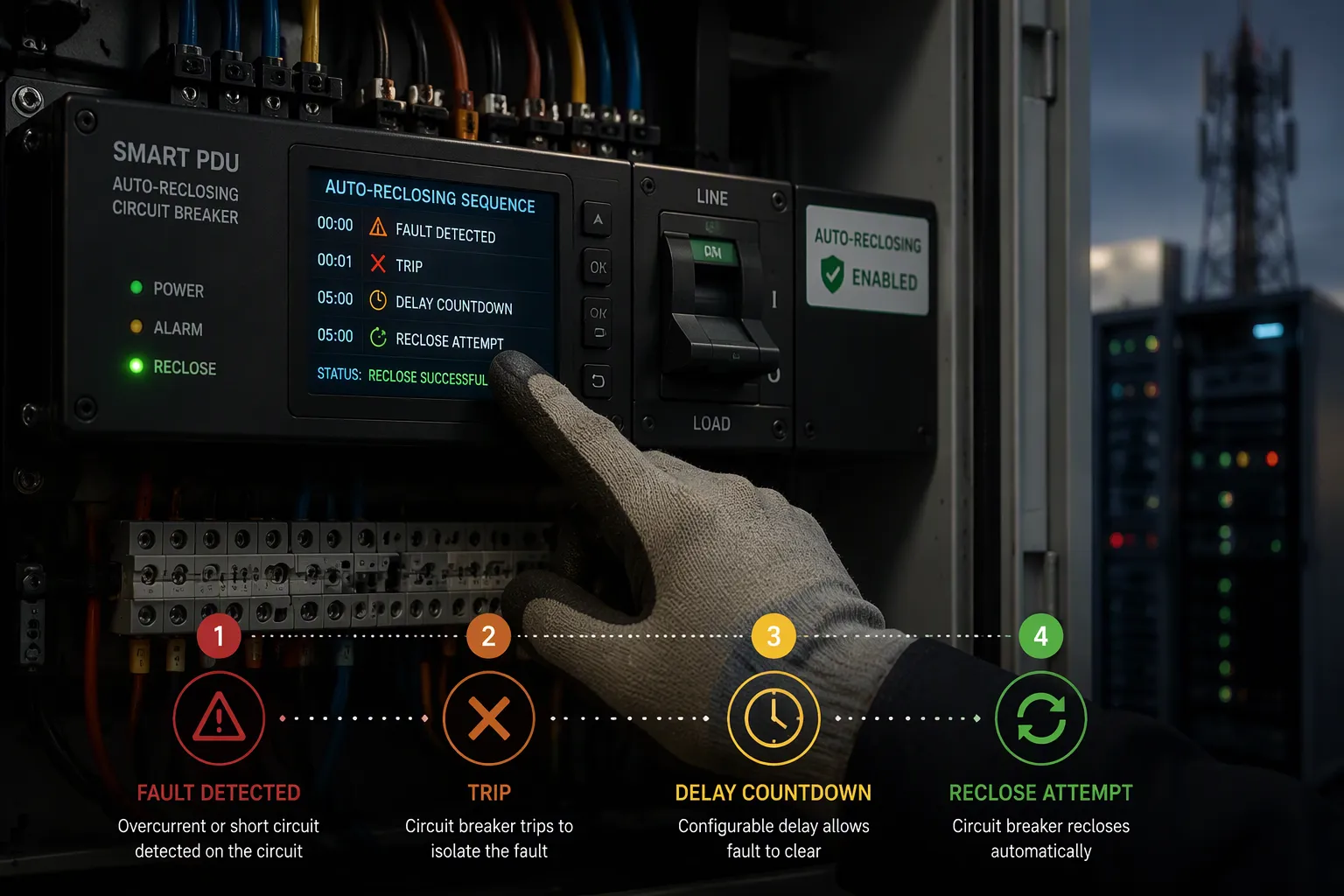
Auto-reclosing follows a fixed sequence. The device detects a fault, trips to protect the system, waits a brief moment, and re-closes automatically. Power returns when the fault has cleared. If the fault persists, the device locks out and waits for maintenance. You can trace this cycle in four steps:
Fault detection — sensors register overcurrent above the pickup threshold.
Trip — the recloser opens the circuit almost instantly on a fast-clearing curve.
Timed delay — the device waits a preset dead time, typically 0.3 to 2 seconds, so the fault arc can deionize and insulation can recover.
Reclose attempt — the contacts close again, and the device checks whether the fault has cleared.
Fault Detection And Delay
The working principle of intelligent auto-reclosing residual current circuit breaker starts with measurement. The unit records fault time, fault type, and electrical parameters before it trips. It then enters a user-set reclosing delay, adjustable from seconds to minutes, reserved for temporary faults to self-eliminate. A control motor drives the operating mechanism to close the contacts when the delay ends.
Intelligent auto-reclosing residual current circuit breaker designs also separate ground fault protection from phase protection. Ground pickup typically sits at 50 to 70 percent of the phase pickup current. This sensitivity catches high-impedance events, such as a downed conductor on dry ground, that produce currents below 100 A. Adaptive delay reclosing lets the device stretch or shorten the dead time to match the fault pattern.
Reclose Attempt And Lockout
A successful reclose restores power, and the sequence counter resets after a reclaim time. That reset confirms a temporary fault. A failed reclose means the fault persists. The device trips again and repeats the attempt on slower curves, which coordinates with downstream fuses. After the programmed attempts run out, typically two to four, the recloser locks out and isolates the section until manual repair.
Delay settings shape this behavior. A first reclose interval of about one-third of a second, or 20 cycles, lets ionized air from lightning dissipate. A second interval near 15 seconds handles slower-clearing events such as wildlife contact. A third interval near 45 seconds serves as the final attempt before lockout. Automatic reclosing control also blocks reclosing when the breaker sits in an abnormal state, such as low gas or oil pressure, and forces lockout to prevent unsafe operation.
Temporary faults make up 70 to 90 percent of overhead faults, so most events clear on the first attempt. The device uploads fault data after each event, which supports follow-up analysis and faster recovery planning. For telecom cabinets, this reclosing logic removes the need for a site visit after a transient event and limits downtime to the dead time itself.
Smart PDU Integration And Remote Restart
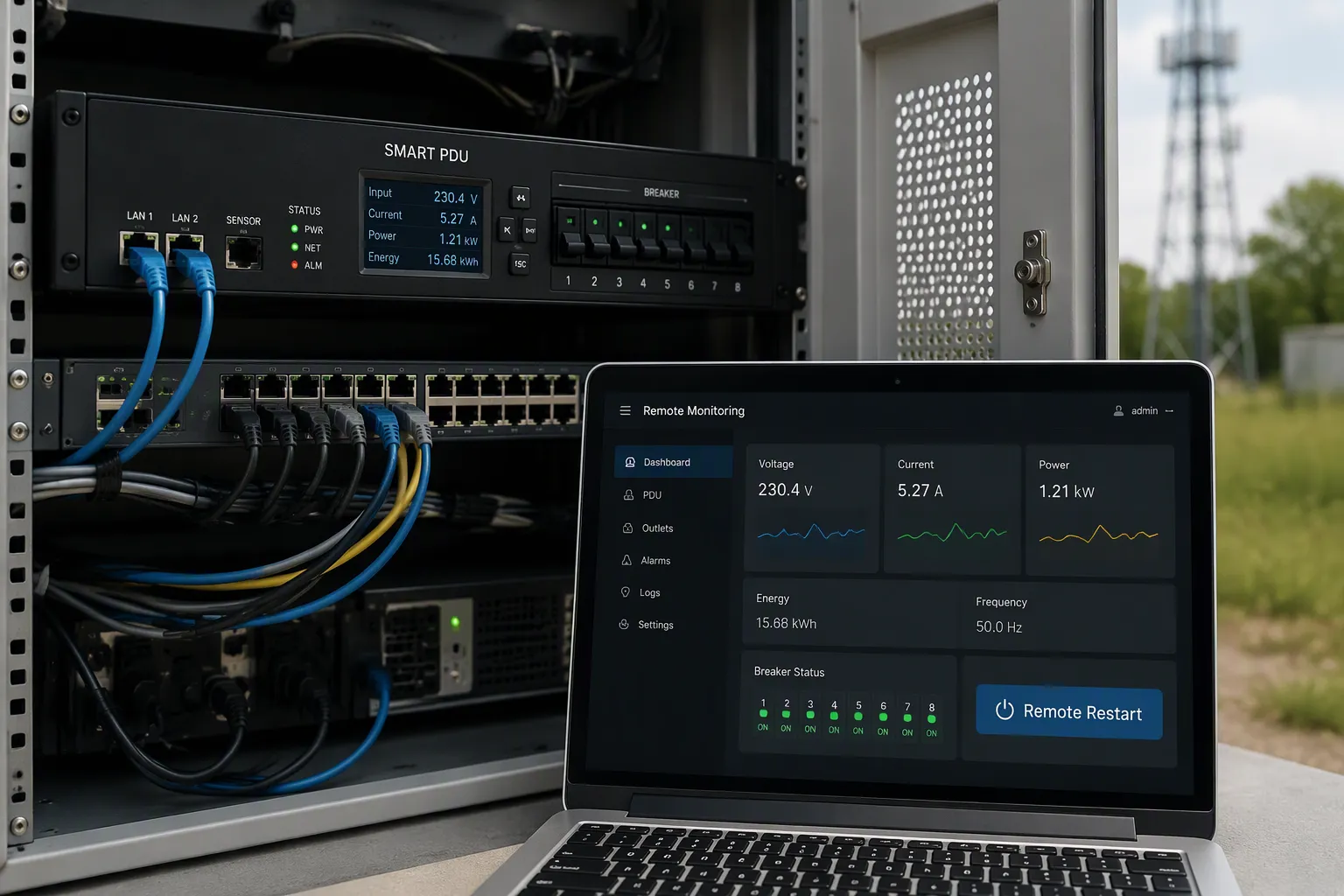
A smart PDU merges auto-reclosing with remote monitoring and communication. This combination lets you manage unattended cabinets without site visits. The unit handles the fast reclosing cycle on its own. Your network operations center then receives the event data and decides the next step. You gain both automatic action and human oversight in one device.
Remote Monitoring And Communication
Network connectivity gives you remote access and integration with infrastructure management systems. Depending on the implementation, communication may rely on protocols or interfaces such as SNMP, web interfaces, APIs, or vendor-specific management platforms. These channels make rack-level power data available to your operators and management systems.
A communications interface in the PDU transmits multiple measurements through digital controllers. Sensors connect to a local controller, and remote stations with their own controllers receive pre-defined messages using standardized protocols such as RS-232, Modbus, HTTP, or SNMP. This design offers flexible remote monitoring, though it may demand more engineering effort.
For connecting rack devices with management systems, smart PDUs support protocols such as SNMPv3, HTTPS, SSH, and REST APIs to improve integration. Test compatibility with your existing monitoring and ticketing software before deployment. Product documentation may appear clearer than actual deployment.
Network Protocols | Purpose |
|---|---|
SNMPv3, HTTPS, SSH, Syslog, NTP, email alerts | Integration with monitoring, logging, time synchronization, and secure administration |
SNMPv1/v2c (legacy) | Retained only for legacy monitoring systems |
Verification should cover supported protocol versions, authentication methods, encryption, MIB availability, event severity levels, and alert delivery options. Request the MIB file or API documentation and confirm exposure of current, voltage, power, energy, breaker, outlet, and sensor data.
Remote Control And Environmental Sensing
Smart PDUs in telecom cabinets support remote restart capabilities that can reduce device recovery time from hours to minutes. This minimizes downtime and service disruption. One Southeast Asia mobile operator cut mean time to repair from 12 hours to 4 hours, a reduction of about 67 percent, and reduced site visits by 38 percent.
Typical remote control capabilities include remote switching of outlets, outlet-level power cycling to power-cycle individual devices, remote monitoring of real-time power consumption, remote firmware upgrades, IoT platform integration, programmable breakers, and role-based access control. Environmental monitoring of heat and humidity is also accessible remotely.
Environmental sensing strengthens this picture. Real-time environmental monitoring of temperature and humidity delivers immediate data on cabinet conditions. Instant alerts for temperature, humidity, or power anomalies let your teams respond faster. Automated fault identification pinpoints faulty sockets or components remotely. Predictive analytics on combined data forecasts failures and schedules maintenance at the right time. Field teams are dispatched only when truly needed.
ESTEL's Smart Power Distribution Unit illustrates these smart power distribution unit features in practice. It offers remote control, surge protection, a dehumidifying function, an LCD display, 8–19 outlet configurations, a 16A maximum input current, and an IEC60309-compliant plug. You can adapt smart PDUs for solar power and remote monitoring and control, so unattended telecom cabinets run without on-site staff. The intelligent auto-reclosing residual current circuit breaker inside handles reclosing, while remote restarts handle the rest. This delivers reliable power management and rapid recovery with remote restart for critical devices.
Smart Power Distribution Unit Vs. Standard Solutions
Performance, Fit, And Compliance
A smart power distribution unit adds metering, network connectivity, and remote outlet switching. A standard PDU distributes power and little else. The table below shows the gap in technical capability.
Technical Capability | Smart PDU | Standard PDU |
|---|---|---|
Power metering | Voltage, current, power, energy, power factor at input and outlet level | Basic electrical data at most |
Remote outlet switching | Yes, with power-sequencing delays | None |
Network connectivity | Web interface, SNMP, SSH, RESTful APIs | Not network-connected |
Alerts | Real-time alerts on overloads and abnormalities | None |
Environmental monitoring | Temperature and humidity sensors supported | Not supported |
Standard PDUs still fit simple, staffed sites with stable loads. Smart pdus fit remote or unmanned sites where visibility matters. Compliance also differs. Smart pdus typically carry FCC Part 15 Class A, UL/cUL, IEC 62368, CE, and UKCA marks. ISO9001 covers production quality, and IEC60309 governs the industrial plug system. Confirm local language rules for labels and manuals per country before you order.
Cost And Minimizing Downtime In Telecom Cabinets
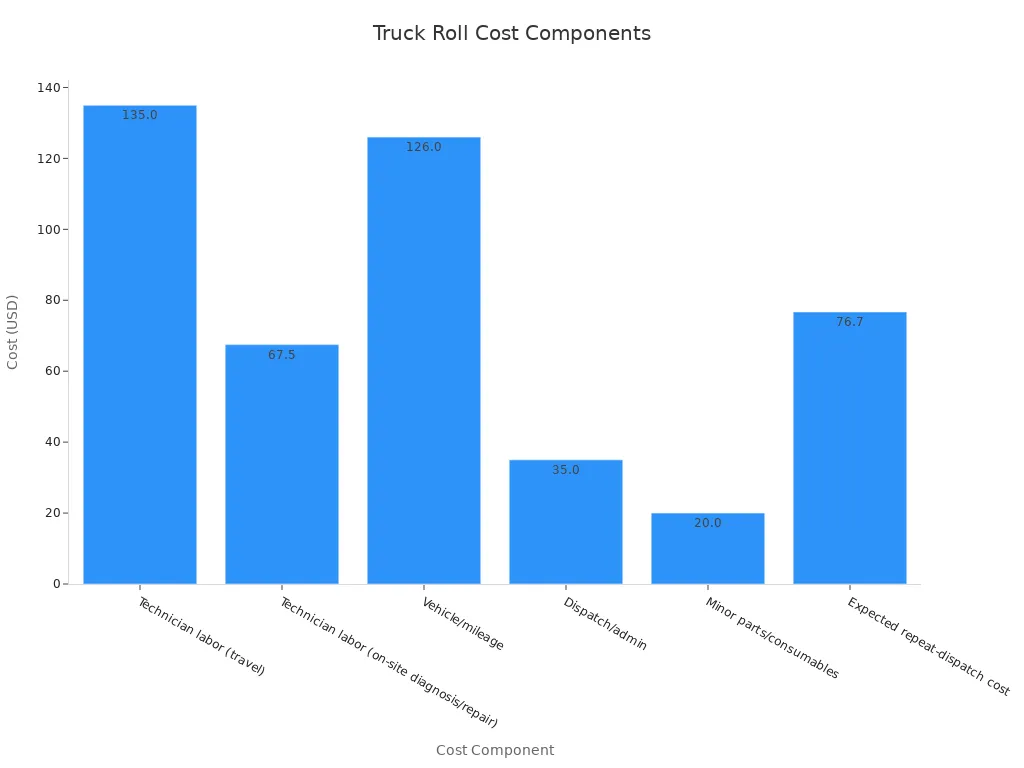
Manual recovery carries a hidden price. One illustrative dispatch totals $383.50, and a 20 percent chance of a repeat visit pushes the expected field-service cost per incident to $460.20.
Cost Component | Example Amount |
|---|---|
Travel labor (3.0h × $45/h) | $135 |
On-site labor (1.5h × $45/h) | $67.50 |
Vehicle/mileage (180 mi × $0.70/mi) | $126 |
Dispatch/admin | $35 |
Parts/consumables | $20 |
Expected repeat dispatch | $76.70 |
Expected cost per incident | $460.20 |
Auto-reclosing removes most of that cost at transient events. Reclosing restores power in seconds, so recovery needs no truck roll. Reclosing also protects system uptime during lightning or wildlife contact. Persistent faults still trigger lockout, and that is where remote restart and real-time monitoring earn their place. Fewer dispatches mean lower operating cost and better uptime across your telecom sites. Smart pdus therefore pay back through avoided visits, not through hardware markup. Deployments report measurable gains: one ESTEL telecom cabinet deployment cut energy use 15 percent and lifted equipment uptime 20 percent through outlet-level monitoring. That combination supports reliable power management and reduces critical device downtime, service downtime, and overall downtime at unmanned cabinets.
Application Scenarios And Case Examples
Typical Deployment Scenarios
Remote roads, mountain tops, and solar-powered sites share one trait: help is far away. A tower site on a mountain may sit behind roughly two miles of dirt road with no neighbors and no foot traffic. Equipment there runs around the clock and gets attention only at install or failure. Drive time between territory edges can reach two hours. Cabinets bake under a hot sun, and batteries get swapped on a blind five-year cycle.
Smart pdus turn each of these sites into a data point. Remote status checks replace physical inspection, and screen-based visibility replaces truck rolls. You can confirm whether a breaker tripped or the grid dropped, then act before the site fails. Solar adaptation adds another layer. Outlet-level switching, scheduled reboots, and intelligent energy management keep a solar-backed cabinet alive through faults, while real-time monitoring samples voltage, current, power, and temperature over SNMP or Modbus.
How smart PDUs address it | |
|---|---|
Cabinets reach about 170°F under hot sun | Remote status monitoring replaces physical inspection |
Drive time between territory edges hits 2 hours | Screen-based visibility replaces truck rolls |
Batteries replaced every 5 years blindly | Fleet PDUs become data points for proactive maintenance |
Cannot distinguish tripped breaker from grid outage | Remote monitoring reveals the actual cause |
Case Example With ESTEL Smart PDUs
Consider a mountain cabinet fitted with an ESTEL smart power distribution unit. A transient fault strikes during a storm. The intelligent auto-reclosing residual current circuit breaker detects the overcurrent, trips, waits its dead time, and re-closes. The fault has cleared, so power returns within seconds. No one drives the dirt road.
Weeks later, a permanent fault occurs. The device attempts reclosing on its programmed schedule, fails each time, and locks out. It uploads the fault data for follow-up. Your operators see the event through remote monitoring, confirm the cause, and dispatch a technician with the right parts. Remote restart brings the loads back once the repair is done. That sequence protects uptime, shortens recovery, and keeps downtime and cost low across your telecom cabinets.
Remote auto-reclosing in smart pdus solves the manual-recovery problem at unattended cabinets. You gain fast recovery from transient faults, lockout safety for permanent faults, and remote visibility into every event. Reclosing restores power in seconds, so most faults never trigger a site visit. That cuts downtime and lowers operational cost across your telecom sites.
The mechanism drives the benefit. Reclosing handles temporary events automatically. Lockout isolates persistent faults until repair. Remote restart and monitoring keep your team informed without a drive to the cabinet. Together they protect uptime at remote telecom cabinets.
Contact ESTEL for customized smart PDU solutions matched to your cabinet and network requirements. Their team can tailor outlet configurations, monitoring protocols, and reclosing settings for your telecom deployment.
FAQ
How does reclosing differ from a standard breaker trip?
A standard breaker trips once and stays open until someone resets it by hand. Reclosing adds a timed retry. The device waits a short dead time, then closes again. Most transient faults clear on that first attempt, so power returns without a site visit.
What happens when the fault does not clear?
The device retries on its programmed schedule. Each failed attempt confirms a persistent fault. After the final attempt, it locks out and isolates the circuit. Your operators see the event through remote monitoring and dispatch a technician with the right parts.
Can you restart equipment remotely after a lockout clears?
Yes. Smart pdus support outlet-level power cycling, so you can reboot individual devices from your network operations center. This shortens recovery from hours to minutes. You avoid a drive to the cabinet and keep service disruption low.
Which sites benefit most from this setup?
Remote roads, mountain tops, and solar-powered sites gain the most. Drive times there run long, and faults often clear on their own. Reclosing handles those events in seconds. Persistent faults still trigger lockout, and remote visibility tells you when to send a crew.
How do you match a unit to your site?
Check your load profile, outlet count, and input current first. ESTEL's Smart Power Distribution Unit offers 8–19 outlets, a 16A maximum input current, and an IEC60309-compliant plug. Confirm protocol support for your monitoring platform before you order. ESTEL can tailor configurations for your telecom cabinets and network needs.
See Also
Ensuring Consistent Power Delivery for Telecom Cabinet Operations
Solar Energy Storage Power Systems for Telecom Cabinet Applications
Protecting Telecom Equipment Using Outdoor Cabinet Solutions
Understanding ESTEL PDUs and Their Function in Data Center Cabinets
Achieving Effective Monitoring for Outdoor Telecom Cabinet Systems
CALL US DIRECTLY
86-13752765943
3A-8, SHUIWAN 1979 SQUARE (PHASE II), NO.111, TAIZI ROAD,SHUIWAN COMMUNITY, ZHAOSHANG STREET, NANSHAN DISTRICT, SHENZHEN, GUANGDONG, CHINA
